100% agree. The key issue is that users think they are getting results from a specific model configuration and they are clearly not, which is fraudulent.
If OpenRouter wants to succeed as a business, they need to be auditing the providers they connect to (i.e. benchmarking) and removing fraudulent ones from their service.
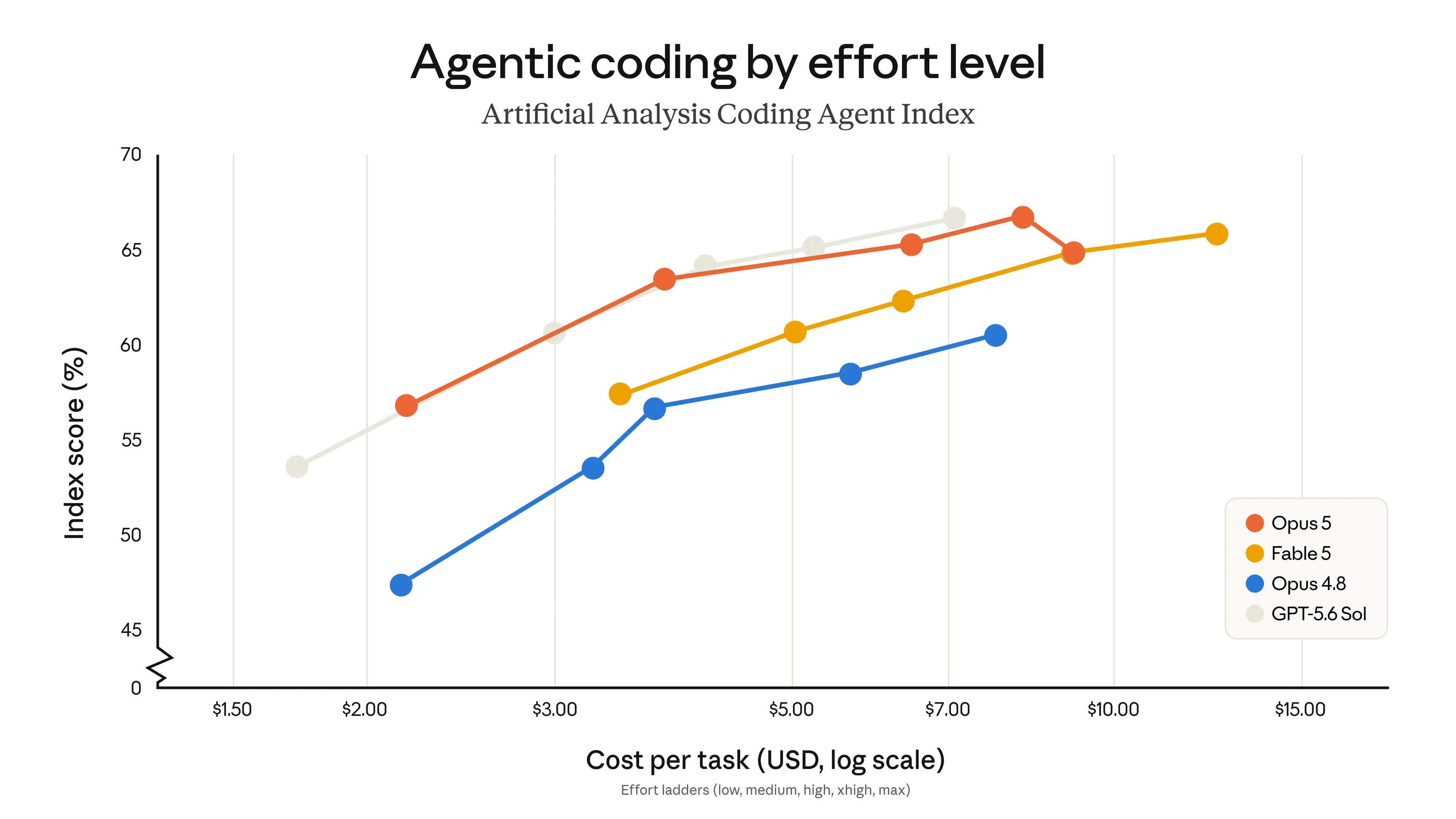
I think you're being overly cynical here. First, I don't see any claim that is the world's best model for agentic coding. Second, it is absolutely the best model in terms of coding performance vs. dollar, and it's raw performance seems very close to the frontier.
How are you supporting the claim that GPT 5.6 is "far more token efficient" than Opus 5? Tokens equal, output is cheaper for Opus 5 ($25/1M) than GPT-5.6-Sol ($30/1M), and it seems to outperform slightly on agentic coding benchmarks.
It would still be the best model per dollar if the score was 2% lower instead of 0.1% lower. Would it be ok to still give it the highlight color then?
How big of a lie is too big? Especially when no lie needed to be told at all: many including myself would have noticed the tiny 0.1% deficit and been suitably impressed by the Opus 5 result.
I’ll admit this is a small deception by today’s standards. I’m one of those who believes in truth for truth’s sake.
It's interesting that it cares about formatting choices like bullet points.
On the one hand, it makes the system more brittle and arguably overfit, since it's not making a decision on the content of the writing itself. Most people would say that AI writing is still AI writing even if bullet points are removed, and vice versa.
On the other hand, we know that AI writing does has a very specific formatting signature (e.g. em-dashes, bullet points) so it seems unwise to completely ignore it.
> It's interesting that it cares about formatting choices like bullet points.
Since AI I have noticed a lot of sudden bulleted lists appearing in pretty benign forum posts. That along with "You are right" "You are correct" "you're right" as the response.
You would be surprised how much of a difference the model makes for certain niche tasks.
For my use case, `gemini-3.1-flash-lite` is ~20% higher accuracy than the next best model of comparable cost (considering both proprietary and open-weight alternatives)
Well it is a bit surprising that 3.1 flash-lite could be better than deepseek-v4-pro (cheaper output and way cheaper cache so might cost less for quite a few use cases).
They are not anywhere close according to pretty much every benchmark (even v4-flash is considerably ahead and its way cheaper than flash-lite). Maybe tuning prompts/tools/etc. might be useful?
A lot of people in this thread think they're being clever by pointing out that a bookstore can't sell "banned" books. But it's common for bookstores and libraries to feature titles that have been banned in some jurisdictions. It's a small way to push back against censorship and promote freedom of information and critical thinking.
And there are always people who think they are clever by saying that a library deciding to not have a book on their shelves means the book is BANNED. OK, it's banned in that library, so what? This is not the government sending you to prison if they find you with this book in your pocket, it's a library deciding to use the shelf space for something else and thinking the book is not appropriate for their target audience.
Seeing this makes me wonder if Grok uses Claude conversations for training.
It's otherwise kind of surprising that they both converge on very similar phrases (e.g. "API integration is kicking my ass") that aren't anywhere in the prompt.
Automatic coding systems have way too much economic value to be considered a "fad". I don't think you need to be Nostradamus to predict that we're never going back to manual coding. Sure, the systems will evolve and improve, but they're certainly not going anywhere.
You're describing "modularity" or "loose coupling" in code. But it rarely implies you can just delete files or directory. It usually just means that a change in one component requires minimal changes to other components -- i.e. the diff is kept small.


If OpenRouter wants to succeed as a business, they need to be auditing the providers they connect to (i.e. benchmarking) and removing fraudulent ones from their service.
reply