I've never got the reason for home automation over setting the heating to come on half hour before I get out of bed in the winter. I'm quite happy manually turning on lights, etc; and keeping things simple and off line. I also turn most stuff off, fridge/heating system excluded, before leaving the house or going to bed. I definitely don't see the point in smart lights and things like that.
Nothing on there is really crazy or complex. Just things like running the Roomba when I leave, or turning on lights at sunset.
I’ve found it to be very nice because I can automate common things around temperature, motion, waking up/falling asleep, and leaving/coming home. It also all integrates with HomeKit so I can control everything with Siri.
It’s definitely more in the hobby territory than something truly essential, but I would say that it is definitely useful and better than managing a bunch of random apps to automate lights or whatever.
I definitely like the idea, and I do think it's cool. But I just can bothered with the complexity and the fact it needs to be maintained and networked, etc. Also yaml...
On the side of writing YAML, this was actually all generated by the UI and then exported to YAML when I decided I wanted to version control it. It's really nice because Copilot works pretty well for creating/editing automations.
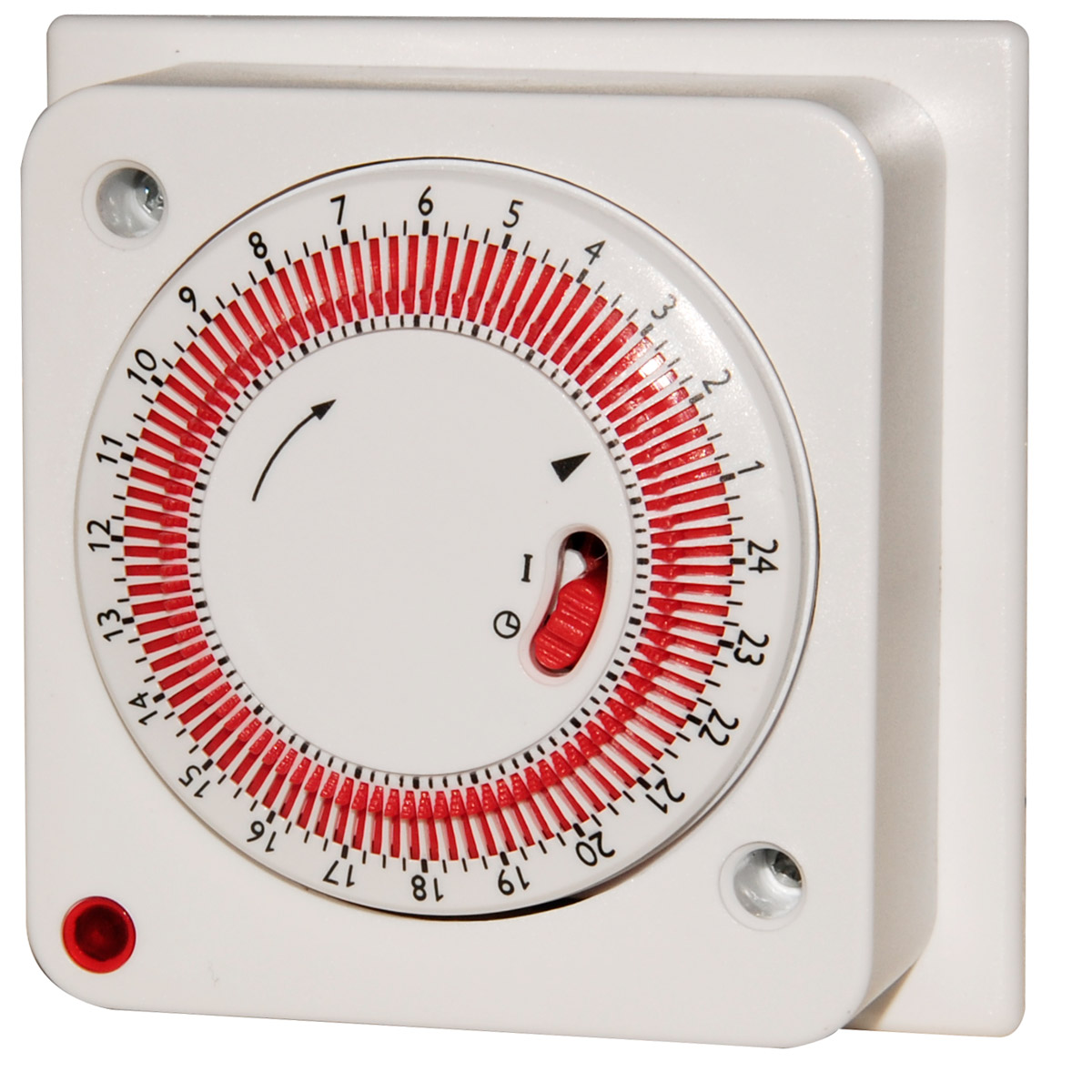
I can assure you there's nothing smart about my 15 year old boiler and it's thermostat supports that functionality externally, though the name escapes me it looks like this [0]. No need for any fancy nonsense, networking, "smart" anything. Simple and easy to use.
it's literally smart home automation, just analog. you like the functionality of automation, you just have a fashionable allergy to it in its digital form
Timers are "smart" now? I just though they were timers. Does the timer on my cooker, so I don't need to set an external timer, make my cooker smart too? Is my outside light over my bins "smart" because it's connected to a light and motion sensor and come on automatically at night?
I've definitely no "fashionable allergy" to digital forms of automation. I simply don't want the massive complexity that comes with it.
I'm also not advocating against it, I just don't see the point it in.
Setting schedules and automatically doing things in reaction to events is home automation. You've set it up to do something automatically when needed so you don't have to interact with it. I wouldn't include a timer you have to set manually every time though.
Your thermostat? Yes, based on the image above. The cooker? I'd say not. The lights? Definite yes.
I agree it's an automation, I don't agree with it being "smart".
What I like about my thermostat timer is that it's simple, local, and requires nothing else. No networking, no app, no maintenance over changing the timer for if I'm away, etc.
I think(?) you're thinking of "Adaptive Recovery" which has a few manufacturer-specific aliases.
The behavior is broadly as follows: Consider a thermostat heating schedule that is programmed for 64F overnight, increasing to 70F at 7:00am. A regular thermostat would begin heating at 7am, and take e.g. 40 minutes before reaching 70F. So between 7:00 and 7:40 the temperature is "less than 70F."
With adaptive recovery, the thermostat figures out (or is hand-tuned to know) that it will take 40 minutes to raise eight degrees, so begins the schedule at 6:20 so that it hits 70F right at 7am.
If that's not what you were saying then, uh, ignore me.
The overhead and maintenance involved in setting up these home automations have always seemed to spend more time than it saves. I'm not convinced that automatic lighting is better than just flipping a light switch.
Beyond the "cool" factor I'm with you. I don't know what the benefits would be but I can definitely see it being a pain to maintain and the extra cost in both time and money for running these automation do not seem worth it. I would definitely like to be proven wrong, but I have not seen anything to date.
Well. I'm not living in a big house, but believe me the simplest and less fancy automations make life way better. My favourites :
- Lights on when the first person living here arrive after sunset
- Shutdown every lights when the last person living here leave
- Main switch to shut every lights at night
- 30min light sequence from red to white every morning, everywhere, before playing the "birds" playlist on sonos : waking up like this and not having to deal with switches and darkness while my head is up my ass changed my life.
- Ungrouping every sonos devices each night a 5am and setting volume to each so I don't wake up to full volume and I can have birds in the bedroom, music everywhere else. Screw you Sonos for not making it in your app.
- Gently tone down lights when something is played after 8pm on Apple TV
- Gently lights up when something is paused or stopped on Apple TV
- Setting "night mode" on automatically on sound bar every night at 11pm
- Setting it off automatically every morning at 7am
- Using dirt cheap Ikea remotes for eveything connected, without limitation or Ikea Bridge.
Everything is possible thanks to Home Assistant and some efforts. Because manufacturers either don't care, don't want to be compatible with other brands, or want to keep new exciting features for the future.
Motion activated lights switch is also very useful for corridors and definitely not for lazy people as I often read.
For all of that, thank you HA and its beloved and passionate community !
I would like further detail about this also. I suspect that SQLite wasn't choking and it was something else. I cannot imagine a single home being able to overwhelm SQLite [0]. Unless the OP has a couple thousand devices all looking to write to it at the same time and they cannot queue and take turns.
I am not a developer by trade but being technically capable I inherited a system once that I kept running beyond its real lifespan. Eventually it was to be replaced and an outside company was contracted to develop a new system. Despite multiple meetings in which I demonstrated the shortcomings of the current system and the workflow on which it was based, all this company did was replicated the old system in their chosen software stack (which also didn't really work because to old version was relational and theirs was no-sql). I got the impression that they already had an idea of what they were going to create and didn't listen at all. I've since moved on, but I hear the new system is worse than the old system.
TL;DR, I have direct experience of: “I don’t really care until we can start coding.”
I never buy new laptops, and I always put linux on the ones I do buy. My only issues have been running the more resource intensive applications I needed to run as a student, and the fact that the university expects you to be running windows. But as an everyday machine a used/refurbished laptop is the way to go.
No the laptops met my needs perfectly. They were cheap, and they ran fully up to date operating systems and the latest software. The issues with the university are issues with the university.
I love SQL. I'm not a full-time developer but always use SQL over other abstractions, which I find extremely confusing and way more complicated that plain SQL.
I'm now firmly into management but the one skill I use very regularly is SQL. By far the best investment I made in my entire career was a little bit of relational algebra, some casual study of DBMS internals and a lot of hands-on SQL. The quasi-standards have also made it the easiest transfer across specific DBs and their flavours over the years.
PSA: Hi kids, here's a dinosaur with yet more free advice: put the tiniest bit of effort into SQL early on and watch the compound interest add up.
Some ORMs have weird design issues. Eloquent for example allows you to pull relationships lazily on single objects, so if you're in a loop that'll create a lot of queries. So much for laziness!
I'm OK with this ability, but the API shouldn't encourage it by making it trivial.
I wonder how long it will be before other theories of Graham Hancock are found to be plausible or true instead of him being dismissed as a crackpot fringe conspiracy person?
Which of Graham Hancock's claims do you think this supports? It certainly isn't the one about a global seafaring proto-British empire from the last ice age, considering how far inland it is, the technology is off, and it vastly predates his hypothesis for the global apocalypse.
The Santa Elena Rock shelter people have been making this argument for years now. Between the questionable lithics, dating, and excavation methodologies they don't have sufficient evidence to support the claims they're making and they've offered no convincing explanations for why the standard of evidence should be lowered given the massive chronological issues their dates would suggest (<5000 years after Yana 10k miles away!).
I wonder how long it will be before theories, beliefs, superstitions, hunches, are no longer combined with grievance and pride and packaged up as somehow empirically relevant.
I have no clue about maths beyond extremely basic stuff, but am fascinated by this sort of thing, and I need pictures to understand stuff like this. What an excellent video. During it, when they introduced how you can map the 2D to 3 dimensions, my initial thought was "I wonder if this is how you could map 3D into the 4th dimension?". Then later they mentioned 4 dimensions. This is something I cannot visualise or really understand.
> I have no clue about maths beyond extremely basic stuff, but am fascinated by this sort of thing, and I need pictures to understand stuff like this.
Fascination is all you need. I find many people have a lot of self-limiting beliefs around math. There’s many reasons for them to develop, but I firmly believe that many people are legitimately interested in mathematics and have the capability despite their beliefs.
One of the problems with math, like a lot of things, is that even though you may find it deeply interesting and fascinating and you may even see great utility in it, becoming an expert is very difficult and is fraught with a lot of failure which many people can't, or won't, stomach.
I guess that's true for most things. Say, learning to play an instrument can be similarly difficult at first.
Motivation is vaning, you need discipline to actually stick to something and get better at it. But even getting better day-by-day by only a tiny percentage will result in huge gains over long periods.
I believe the most important aspect for learning math is being comfortable with not understanding and being able to smack your head into the wall repeatedly. It takes some stubborn determination to push past
I gave up on trying to visualize 4 dimensions. I don't know if it's possible. Instead I just try to think of 4D as more of ideas and less geometry: rules, consequences, capabilities, etc. We can do the same thing in 3 dimensions by saying things like "two objects can't exist at the same place and at the same time" or "parallel lines meet at infinity" or "parallel lines never meet" or something. We usually don't do that for 3 dimensions because we have visualizations and intuitions which we can use instead of breaking everything down formally all the time.
I've always wanted to make a 4d space in VR. That way it's only one dimension higher, technically. Could help to visualize it in a way that hasn't been done yet
There's a 4D mini golf VR game you might be interested in checking out. It's called, uh, 4D Golf. Creative! I've not played it myself, but it's on my list. I hear it's pretty cool!
There’s a video from the same channel on visualizing quaternions as a projection into 3d that was really fun for this. Only a restricted section of a 4d space, but i feel like the principle generalizes a little because of the idea of, like, imagining one 3d space thats finite as equivalent to an infinite 3d space, just stretched
Time is nature's forth dimension, so I think considering the various stages of a slice moving through a four dimensional object at once counts as a visualization.
Time is not a dimension of the same kind as spatial dimensions. It has a different metric and you can’t move freely back and forth on it. When you rotate on the XT plane, it doesn’t mean the same thing as rotating on the XY plane. It is not a good candidate for the sort of fourth dimension we’re interested in.
My understanding is that time can be a 4th dimension, but n-dimensional spaces themselves are simply a very basic mathematical structure, where a point can be described by n numbers (you can actually be abstract even in that, no need to stick to rational numbers, I believe).
As long as you can map time to a number line, it's a valid representation. We just happen to have hardware acceleration for 3-dimensions, and the 4th is just completely unintuitive to us.
If we're only talking about simple vector spaces, your understanding is accurate, but when we're talking about visualizing shapes in 4 dimensions, we typically want something more. We are doing geometry then, and so we want a metric space that defines a concept of distance (which vector space don't have).
When it comes to geometry and not just vector spaces, time dimensions have a different definition of distance than do space dimensions. There's a minus in the formula where you would usually have a plus. And this means that shapes in this space behave very differently than what we're after when imagining a hypercube or hypersphere, for example.
We want to think of a 4 dimensional space where all the dimensions are indistinguishable, but the minus sign in the metric distinctly identifies the time dimension. For this reason, physicists typically call this kind of space a 3+1 dimensional space rather than a 4 dimensional one.