As the other commenter said: violent games are popular all over the world, but it's only the US with the gun problem. So I think they can be safely crossed off the list.
Also there's numerous studies that have come out over the past 20 years showing there's little to no connection between virtual violence and real violence. If anything, they help as an outlet. Google is your friend here.
Finally, Jack Thompson is a good cautionary tale of what happens when you let your tyrannical crusade overwhelm you to the point of destroying your career. Don't be a Jack Thompson. Violent games are very far down on the list of things to address regarding the US gun problem.
Have there been any studies specifically on the effects of violent video games on the mentally ill?
afaik the studies are all investigating whether video games make the average person violent or if they increase population-level violence and obviously they don't because until very recently violent crime has been at all-time lows.
> but it's only the US with the gun problem
Because we have guns. We all know this. But we've always had guns, and only recently have had mass shootings. So something else is at work here.
It's bizarre to me that so many tech people think we need to regulate speech, and news, and social media because it makes people do things they otherwise would not, but then they have this special carve-out for what are essentially mass shooting simulators, which they believe have absolutely no effect on anyone.
Disclaimer: I'm not advocating for any policy here.
it was meant to facilitate another American revolution (against our own government should it turn tyrannical).
"Was" is the key word now. People have become so indoctrinated and addicted to 24/7 news cycle that they'll more readily use them against their own neighbor than the real source of the problem (government/corporation collusion).
Guns are a tool, a very deadly tool, but a tool none the less.
Really tired of seeing this argument. They're made for killing, period. Fertilizer, box cutter, automobiles all have other uses. Killing is not one of them. For guns, it's in the top 3. And I say this as a gun owner.
Doesn't track for many places in the US. Chicago has some of the strictest gun control in the country, yet also has a mass shooting every other week in the summer.
Sure, in no small part because of the different policies between states and between cities. Chicago, in particular, has strict laws that are almost worthless because of lax gun laws in Indiana. Gary, Indiana might as well be included in part of the Chicago metro area - in other words, you barely need to leave the city to get to easy gun access. It is very much similar to Canada having issues with guns because despite laws, it is fairly easy to smuggle legally bought guns from the US into Canada.
In other words, it should be obvious that regulations in one city do not hamper interstate trade - or heck, they likely don't hamper intrastate trade either, but I don't have any examples in my head about that specifically.
While that possibly makes it harder to acquire a gun in the city, an individual purchaser or black market dealer could simply drive a couple of hours to get their hands on one, no?
Also while impossible to prove, I think the numbers would be even higher in the city without the control in place.
..an individual purchaser or black market dealer could simply drive a couple of hours to get their hands on one, no?
Gary, Indiana shares a fence with Chicago: The fence sits on the Indiana/Illinois state line. Indiana has fairly lax gun laws. Also of note: There are not border checks on that line, nor on the border of Chicago.
It's been shocking the amount of "emergency" funding for Ukraine that has been passed in the past 2 months. If it were for anything else other than the military, Republicans would have a gargantuan hissy fit over it and probably filibuster it to death.
Reading about the Mead Reservoir the other day and now this, I'm thoroughly convinced the US needs some sort of large scale disaster for something to really change in this country.
There's obviously various pockets in the country that suffer from shitty public infrastructure (e.g. Flint, Michigan), but for most of the country, it's been OK; they're still able to to go to Wal-Mart to get their feed and be content. There's always talk about potential future disasters, but it never seems to come. We've had an inept federal government for multiple decades that doesn't work for the people anymore. We need an episode of millions of people to get mad enough for something to happen.
Yep. My fear at this point is that even with large scale disaster, we won’t respond with sufficient scale to avoid large scale suffering. We’re not responding for climate change. We’re not responding for student debt. We’re quick to respond with $40B for war, but what can we do for the every day people? I’m just not seeing much.
I think the difference between your examples is timescale.
People are generally good at responding to acute, existential threats. We don't seem nearly as good at managing abstract ones that occur over long timescales. I just don't think we're wired to think about risk accurately in that way and, let's face it, most decision are made at an emotional, visceral level.
I would also say that defense contractors are some of the largest donors to the political class (not sure how they rank in media spending) and politicians have an incentive to solve near term crises and ignore long term crises. I would not say this is purely down to human “wiring” but the real world political structures we have today (which in theory can be changed).
I should also note that, regardless of how one feels about him, two things about Bernie Sanders are that he didn’t accept any SuperPAC donations and he was very willing to put effort in to eliminating student debt and alleviating climate change. So such platforms are not unheard of.
I think this is part of the issue, but we may disagree about the magnitude. As a counterpoint, "Retirees" are the second largest political donors behind the financial system and yet the retirement system is perpetually in peril.
My comment about our "wiring" is about how we are bad at estimating risks. We likely evolved to think causally rather than statistically and, when coupled with highly emotional risks, it tends to skew the accuracy of risk assessments. Climate change is not as emotionally charged as, say, terrorist attacks so it will tend to get lower priority in an individual's mind.
You didn't see much response to COVID? We spent more on COVID relief and response than we spent on WWII. $40B is a rounding error in what we spent on COVID.
I think you’ve misread what I said. I said “My fear is… we won’t respond with sufficient scale to avoid large scale suffering.”
With a million dead and millions more financially ruined, I think it’s fair to say we didn’t prevent large scale suffering. And to be clear my issue isn’t just with direct spending - a few more stimulus checks would have been nice but wouldn’t solve the larger problem - I think we needed better consistency from the government on risk profiles and the importance of masks, as well as more mask mandates and travel restrictions, and finally better testing infrastructure. Some of that is direct spending but much isn’t.
Under a different US administration, it would have been completely different. What we just had was the worst possible administration in place, and they dealt with the disaster in the worst possible way.
Imagine the chaos if millions of Californians started getting saltwater in their faucets, in a matter of hours. Saltwater dehydrates the body. There would be pandemonium. Every store that sells water bottles would be cleaned in less than an hour. Hoarders would buy everything they can by the truckload. Online marketplaces would be flooded by desperate people looking for water. The price of a water bottle would quickly reach $40+. There would be a run on portable desalination machines. The governor would call the National Guard to restore order. FEMA and the Department of Homeland Security would be mobilized. California being the breadbasket of the country, the President would declare a national emergency. Congress would pass emergency spending bills to build desalination plants and nuclear power plants in California. It would be WWII/Manhattan project levels of government mobilization.
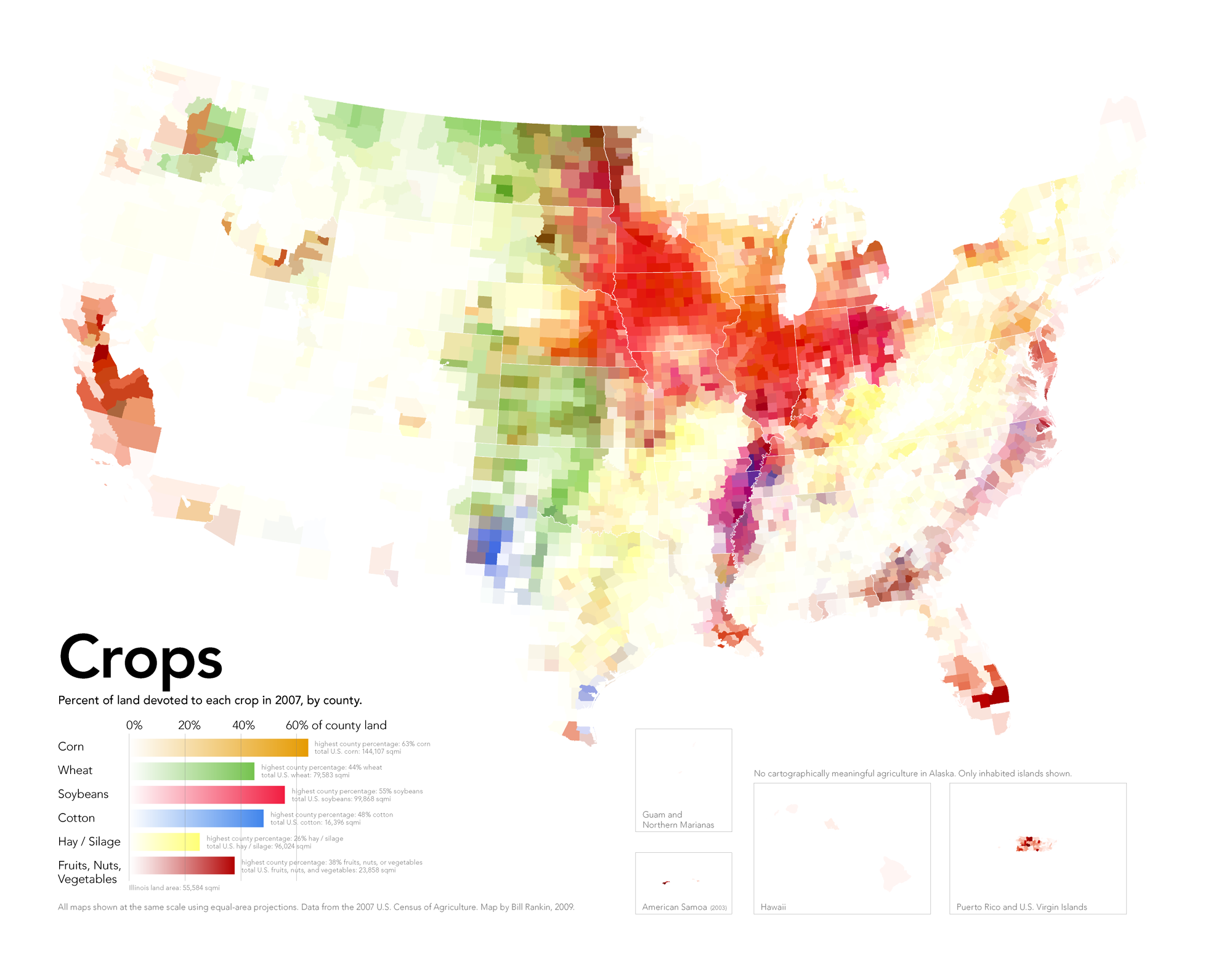
Much of the Midwest is corn and soybeans, both garbage since a good portion of them are synthesized into corn/soybean oils. We should make better use of the farmland but Big Agro would rather torch their fields than stop their government handouts.
https://cdn2.vox-cdn.com/assets/4565275/crop_value.png is likely a better approach that looks at the value per acre in food and the percent of animal products vs vegetable product. You can see Wisconsin dairy there, but there is a significant amount of green from North Dakota through Illinois and then down the Mississippi river valley.
The products can be seen at https://cdn1.vox-cdn.com/assets/4565283/crops_by_county.png showing that the Missippi and the Central Valley are fruits and nuts while Iowa is certainly Soybean and Wisconsin is corn... and wheat shows up too.
As to government handouts... that's an interesting thing to bring up.
> In fact, in setting up the prevailing system of dairy price supports and marketing orders in the late 1930s and 1940s, the U.S. Agriculture Department decided that the most efficient place in America for milk production was Eau Claire, Wis.
> Government officials then measured the distance dairy farmers in states such as Connecticut or Florida were from Eau Claire and, using a complicated formula, calculated their premiums and subsidies.
The further away you are from Eau Claire, the more the government helps the dairy industry.
So that California cheese? That's about as far away from Eau Claire, WI as you can get.
This changed a bit in recent times - https://www.minneapolisfed.org/article/2004/got-milc - but if you want to campaign against government subsidies and big ag, get rid of California cheese (and its associated water use).
> It would be WWII/Manhattan project levels of government mobilization.
It should be, but it would be too little, too late. Before anyone has even compiled the list of construction materials needed for a single nuclear power plant (tons of water needed, BTW), everyone will have died. So people will flee to areas where there is water. And since the abandoned area is too big to control, it'll turn into a ghost country where warlords run unchecked before the National Guard can take it.
So that's a pretty negative prediction, but I'm sure yours is too positive. It'll be a pretty big disaster with major social and economic impact.
You're right. It will be a disaster. There will be millions of overnight refugees in parts of the state and in other states. The traffic jams will be tens of miles long on every highway.
How can anyone help anyone out when an entire zip code loses water? And I don't think people understand just how much clean water our society uses, especially in the food supply chain.
Sure if there's a mix of homes with and without salt water. However i think you're wishful if everyone is surviving on bottles. You can only help your neighbor if you went to the store and bought water. And that supply would go quickly.