People make it sound as if Munich flip-flopped on Linux. The then ruling social-democrats and the greens started the LiMux project in 2003! The social-democrats and the conservative christians ruling in 2020 switched back to MS Windows. The current administration is mandating open source but not specifically Linux.
I use Linux since the year 2000 and it has been ruff in the early days, no doubt. The desktop competition were MS Windows 2000 and XP, often lauded as peak MS Windows. Apple had all but disappeared. But 2020 I'd wager that average KDE desktop vs. average MS Windows 10 desktop would be a draw. Today it would be a KDE desktop win, but that's more due to MS Windows 11 suckiness than the leaps and bounds Linux made.
I can’t count the number of demos I’ve seen that were “small team, multiple sprints” to produce something that could have been done in a lazy afternoon in excel by a single person.
It’s a common pattern in enterprise IT to take a useful spreadsheet and turn it into an application. Without fail, they turn into a forever chase of excel features re-implemented (and poorly) on some front end. Entire teams dedicated to features that would be two clicks away in excel ootb.
Yes, I have already three such projects on my CV, failed attempts to replace Excel.
The root cause for failure is always the same, not understanding all use cases for 100% of the department users instead of only the representative group present during UI/UX sessions, coupled with the human natural resistance to change.
Oral exams don't scale at the beginning with hundreds of students per course, agreed. So make them in-person written exams, German universities managed that just fine a few decades ago. Oral exams were reserved to advance from Grundstudium (basic) to Hauptstudium (main).
In my very limited experience (I have German major degrees in Informatik and Philosophy, I was a TA for Logic in Philosophy) the more advanced the topic the thinner the attendance anyway.
Maybe the Germans were right? One in-person test, preferably an interview, at the end of the semester should be enough to motivate the smarter part of the bunch to make sure they understand the issues at hand. The rest is chaff anyway. Don't optimize for chaff.
As was sort of offhandedly mentioned in the article, all pre-LLM research into what results in students actually learning the material (as a distinct thing from passing the class) has landed pretty solidly on the side of frequent, low-stakes exams having better outcomes than rare high-stakes exams. The best students learn the material regardless of how you evaluate them; some weaker students will benefit from more frequent nudges to keep up rather than trying to cram at the end, some students simply won't realize they're falling behind without regular feedback, and some students successfully cram at the end and pass the class without retaining much of the material. The final group often expresses a preference for the one-exam-at-the-end model despite being disserved by it if the goal is to learn and not merely pass.
Yeah and look at where this soft approach landed us. We have entitled crybabies voting for Hitler 2.0 because they can't stomach the uncomfortable feeling of seeing a diverse person in their pure white neighbourhoods. Children and young adults need to be hit with the big hard fist of reality repeatedly until they become good people. If some should fall through the cracks, they would not have made for good members of society anyway, so best they fall early and not drag the rest of us with them.
I had that a variation of that experience. This was mostly in the pre-AI days.
Homework assignments were mandatory but only counted towards exam admission not the final grade.
Much better for motivation.
When I was a student, nobody cared if you did your home work. The teacher would go through the home work in the next class, and if you didn't do it, you would just lose the opportunity.
Then there was the written exam at the end of each course, which constituted 100% of the grade. The only reason that got abolished was because it made too many students fail, and the board hates that. So that became a race to the bottom, and apparently, we can still go lower.
It's reaching levels where most uni diplomas don't matter any longer. The only thing that will then matter is your network. That's the end of social mobility.
"Don't optimize for chaff." is being chaff a permanent state of a child or person?
I think I understand what you mean though, and I kind of agree. I just don't like the use of the word chaff, like something you would discard permanently.
I'm pretty sure I was "chaff" at some point (maybe multiple) in my life growing up.
Funny to see this comment, that's exactly how studying math in Cologne was. On the very first day one of our profs said:
"This is math, you can find all solutions to the course problems in old material since I've been teaching here for 20 years, but know this you're cheating yourself and at the end of the semester you're taking a three hour test on pen and paper so good luck"
I see zero reason why AI should impact teaching. You can grade exercises as information to the students as to how well they're doing, but simply have an exam at the end of the course. Needlessly to say like 60-70% flunked through Analysis I and Linear Algebra. But they're adults and they're there voluntarily, so why is this an issue
Nuclear power is not a renewable power source in the technical correct meaning of the word. Fission material is "only" abundant, in that we can win nuclear fission material from many sources, including recycling spent nuclear material, but it is not available and spent without human intervention (otherwise we could argue fossil fuels are renewables, too).
As an aside, nuclear fission power differs from renewable power in many other ways, too. It is not clean, it is not easy to harvest, it is not safe, it is not cheap, it is not a mass job engine, it is not low-maintenance, it has less utility, and it has less flexibility.
IF the world got its primary energy from today's kind of light water reactors, uranium available at up to 3x the current price would only last for about five years.
A fully nuclear-powered world (including all energy use, not just grid electricity) would need breeding of some kind; otherwise the uranium just gets too expensive. So when you hear people claiming nuclear is cheap, ask them if that cheapness includes the technologies that would actually be needed for nuclear to do the full job.
If we needed more nuclear fuel we would be producing more of it. Comparing current production to a world where we use a thousand times more of it is ridiculous. Uranium is not that rare, and spent fuel rods still have well over 90% of their potency so they can be recycled.
Nuclear energy could easily power the entire planet for thousands of years.
Sure, we could produce more. It would have to be from much lower grade ores, and so would be much more expensive and disruptive. This is why breeding would be needed, so the cost of the uranium would not make nuclear even more unaffordable than it already is.
The argument about affordability is quite ridiculous in a world that is becoming uninhabitable as a direct cause of the "affordable" alternatives.
We could easily afford to use nuclear, and we wouldn't have to rely on it entirely - we have many alternatives such as solar, wind, hydro, geothermal etc. I'm also quite confident that economy of scale would improve the fuel cost, and the higher investment would make breeding and other nuclear technology advancements much quicker than they are and have been. Not to mention fuel cost is quite insignificant in nuclear energy.
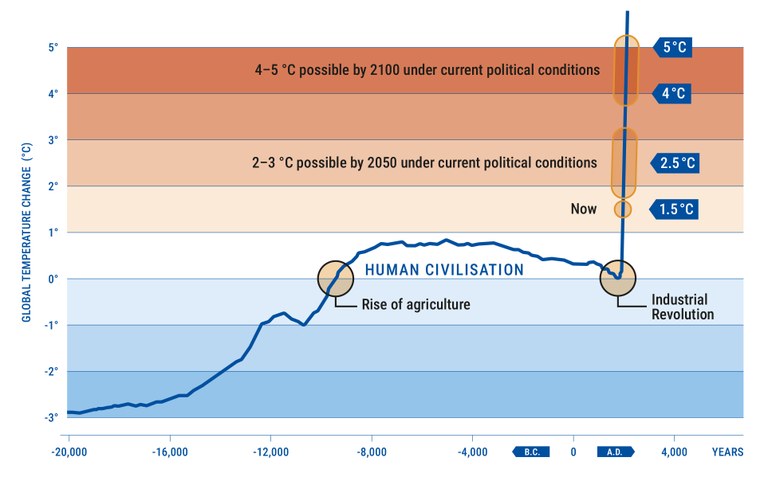
We can however not afford the consequences of fossil fuels. We are already severely impacted by global warming and it will get much worse very quickly. I think this chart conveys the severity of our situation very well: https://www.dpg-physik.de/veroeffentlichungen/publikationen/...
Affordability most definitely figures into which avenue forward should be taken. It cannot be used to justify fossil fuels over nuclear, but it can be used to justify renewables instead of nuclear.
Nuclear doesn't have a "get out of economics free" card just because fossil fuels are to be eliminated. I understand the desire of nuclear fans to pretend otherwise.
I'm not a "nuclear fan", I'm a "don't destroy the planet fan". I'm not saying we should build nuclear instead of renewables, I'm saying we should build it instead of fossil fueled generation. It seems you agree with this, so I'm not sure why you seem to be arguing against it.
Until the day that we stop burning fossil fuels entirely, we should be building nuclear to replace it. If it's more expensive that's fine, I don't think it would be, at least not significantly, but I can't prove it and I don't care either way, it doesn't matter. What matters is replacing fossil fuels as fast as possible. It's probably already too late, and the powers that be don't give a shit anyway so none of this will actually happen but this is what we should do.
In vast parts of America, the "local PC shop" doesn't exist. It's BestBuy's GeekSquad (of dubious quality) or Apple's Genius Bar. There might be a repair shop somewhere, but most of the time, they just repair cracked screens.
Full agreement. I'm double-taxed in Germany and the US. I don't have a residency in the US (so I cannot vote but still get taxed, nice!) so I'm completely unable to buy VFIAX or any other fund from the US. I cannot but them over an EU brokerage, either, because US ETF and its ilk violate European transparency laws. I can buy EU-domiciled funds, but those are treated as PFIC in the US with prohibitive taxation. I relegated myself to an old-school dividend growth investment scheme and it's financially working out much better than I anticipated but still, I'd like to have a core of a stupid ACWI tracker.
> I relegated myself to an old-school dividend growth investment scheme and it's financially working out much better than I anticipated but still, I'd like to have a core of a stupid ACWI tracker.
roughly same approach in Canada, for the same reasons.
if you look up most of the dividend aristocrat funds they'll give a breakdown of holdings... so duplicate those in roughly the same ratio (to the best you can) and call it a day
You're not being pragmatic, you're being myopic. Our current energy systems are the result of deliberate complex work. It seems shortsighted to think it's somehow the only system that can ever be built just because other systems have new challenges to overcome.


I use Linux since the year 2000 and it has been ruff in the early days, no doubt. The desktop competition were MS Windows 2000 and XP, often lauded as peak MS Windows. Apple had all but disappeared. But 2020 I'd wager that average KDE desktop vs. average MS Windows 10 desktop would be a draw. Today it would be a KDE desktop win, but that's more due to MS Windows 11 suckiness than the leaps and bounds Linux made.
reply