It's implemented using a few standard 74xxx TTL logic chips and a 256x16 microcode ROM. It's important not to ignore the microcode ROM because that's where all the smarts that turn it from an ALU unit and a bunch of registers and miscellaneous logic into a CPU that can actually execute instructions. All of the instruction decoding and the sequencing of all the operations that make up a CPU cycle is done directly by the microcode ROM.
That is right. That differs of course from early microprocessor designs, but still it is valid, since today's processors also rely heavily on microcode that is simply stored in ROM or similar areas.
I think, you can not give this design a negative, because it is much simpler than early microprocessors.
You know, lights out management is a wonderful thing and there's never been any kind of evidence that these features do anything but offer functionality that Intel's customers asked for.
The ROM is basically acting as an FPGA. After all, an FPGA is just a load of units of small ROM areas, with the inputs and outputs linked to each other. If all you need to implement your circuit is a single unit, then a small ROM chip is quite sufficient instead.
No, it doesn't; neither from a practical, nor from a theoretical point of view. Theoretically, ROMs are equivalent to the class of pure, total, mathematical functions (i.e., each input value maps to exactly one output value), while FPGAs are equivalent to the class of deterministic finite automata, because they contain internal state.
> After all, an FPGA is just a load of units of small ROM areas, with the inputs and outputs linked to each other.
You're forgetting the memory elements – they're crucial to the functionality of FPGAs.
True. But then again, that's like arguing over which organ is more important – the heart or the lung – when you can't survive without either of them ;-)
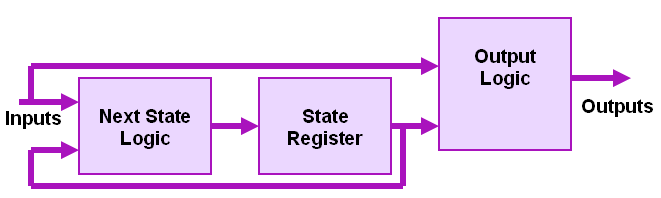
You actually don't need configurable (programmable) routing: We can model every synchronous circuit as a Mealy machine [1], therefore we need two functions and a register. Every function can be constructed from a hierarchy of programmable, fixed-size LUTs which are statically connected (for example, you can build a 5-input LUT from three 4-input LUTs). Now you don't need to build routing, it's implicit in the next-state and output functions.
I have a 12 bit CPU at home that is implemented out of standard 74xxx TTL chips, its called a PDP-8/e :-). Not to take away from the Nibbler design, its great, but using TTL logic to build CPUs was a thing for a pretty long period of time (computer wise), probably 10 years from 1971 - 1981. 1981 was the year IBM introduced the IBM PC and a lot of people realized that bespoke CPU architectures were a luxury they could no longer afford.
Of course the technique itself is not that new, but it is still amazing, because of the real few chips used. Of course the microcode ROM replaces plenty of those, but still it amazes me, how few chips make up for a workable CPU.
I guess, the PDP has at least 10 times more (equivalent) chips inside.
So 117 chips, so not quite 10X but the nibbler does have an LCD display and if you add the PDP-8/e programmer console to the mix you're probably close to 170 chips. So great estimate!
Of course, they are consequences of today's corporate capitalism!
To have a shiny vision of capitalism, that just is not compatible with reality, does not help. Communism's failure was not, that it was not a nice idea, it's failure was, that it's thoughts where not compatible with reality!
Reality is, that international corporations have huge stacks of money and plenty of lawyers and lobbyists. And they use it for the only ethics they got: profits.
And TTP, inequality, centralization, unemployment ... are results of the thrive to more and more profits for the owning people at the expense of the working people.
Today's capitalism is shaped by the profit motive -- and the profit motive has no morals and no ethics.
And when you talk about "free market" -- there is no such thing. A real free market would give everybody the same chance. But the situation today is, that the big corporations are shaping the laws and the small players can not. So there is no such thing as a free market with free and equal competition in reality.
I guess we should try and move away from labels a little bit - because a lot of time is spent discussing whether communism is true communism, or if what we have is capitalism, corporationism, corporate state capitalism or whatever.
Name it however you like, it doesn't change that there are processes you mentioned that bring about the results we don't like. We need to focus on those.
> Today's capitalism is shaped by the profit motive -- and the profit motive has no morals and no ethics.
In a way, our economy is a paperclip maximizer. It doesn't love or hate you, but you're an expendable resource that can be used to make something else (profit within the system).
I would agree. Labels and names are not helpful, because everybody has his own view of it. For some, capitalism is hell, for some it means the only rescue against the hell of communism and vice versa.
Your last sentence describes it very well. It is the mechanics, which are the driving force -- and the direction is predefined by the mechanics. The driving force we have today is profits ... and the result is a de-humanized and un-ethical society, because profits are not ethical at all.
This is very important to establish every time there is a discussion, in that there are politically convenient labels, and there are what we can consider terms that are useful to further the argument. The terms capital-ism and commun-ism refer to compatible aspects of reality. Like self interest and sharing for common good co-exist in reality. Trying to eliminate either would make us unhappy. USA economy has been favoring a less people consolidating more capital.
> the situation today is, that the big corporations are shaping the laws and the small players can not
Indeed! How about we fix that and don't let big corporations shape the laws? Crony capitalism is not an inherent feature of capitalism, it's a perversion of it which really ought not be taken as a given.
The only way to do that would be to have a government completely disconnected from the economy. As long as the officials need to eat, need to send their kids to school and need the money to increase their chances for reelection, politics is a part of market economy. Pretending those two are not connected is fooling oneself.
Because politics currently is a part of economy, period. You can't disconnect the two as long as officials participate in the economy themselves, because any such participation is a bridge between the two "worlds".
The global trend is, that governments in all nations loose more and more of their former power and (partially) dump it to international corporations which hold the real power in their hands.
There is an older documentary, that is still valid with the name "The Corporation" which shows, how corporations have used the US constitution and decades of lobbying and court cases to gain more and more power. So today, the corporations are difficult to held liable for things they do (in many cases they come away with small fees that don't even cover the harm they caused), but enjoy many of the rights which where meant for real citizen.
This documentary comes to the conclusion, that many corporations behave like psychopaths, because when a corporation has to decide, (for example) to keep the environment clean or make more profits, the corporation rule is, to go for the money and forget about the rest.
Anybody should watch this. Either on DVD, or I also spotted it on worlds favorite video site.
With international treaties like TTP and others, the power of international corporations is hardened and it gets more and more difficult to reverse this global trend. With all their lawyers and lobbyists, the corporations are bound to win over the democracies -- what dictators did not manage to.
This trend is undermining democracies and human rights, because corporations are not democratic and have only one rule to obey: The profit rule.
So finally, we are all governed by money and nothing else.
This is why some corporations should be forcefully converted to benefit corporations which have more stakeholders than profit alone. Big Pharma, Insurance, and Utilities should be converted first.
I would agree. The current trend (at least in Europe) is the other direction. In Europe we want to privatize more and more Utilities and other institutions that belonged to the public sector. Schools, water, electricity ...
Privatization isn't bad provided that key corporations are answerable to more than just profit alone. This is the key aspect of a benefit corporation.
A lot of what is wrong with large corporations is that they don't place any priorities on customers, employees, and the environment, when making the most profit is what they are legally mandated to do.
Making a profit needs to be balanced with the reason the company is in business, (i.e. the needs of its customers),
its employees, and the environment.
> Making a profit needs to be balanced with the reason the company is in business, (i.e. the needs of its customers), its employees, and the environment.
I completely agree. I also don't think, that public sector is always optimal. Public institutions some times tend to be inefficient.
The problem, I see in many privatizations, is that profits are the main (and sometimes only) motive and any efficiency improvements are put into shareholder value instead into public benefit.
The global trend is, that governments in all nations loose more and more of their former power and (partially) dump it to international corporations which hold the real power in their hands.
There is an older documentation, that is still valid with the name "The Corporation" which shows, how corporations have used the US constitution and decades of lobbying and court cases to gain more and more power. So today, the corporations are difficult to held liable for things they do (in many cases they come away with small fees that don't even cover the harm they caused), but enjoy many of the rights which where meant for real citizen.
This documentation comes to the conclusion, that many corporations behave like psychopaths, because when a corporation has to decide, (for example) to keep the environment clean or make more profits, the corporation rule is, to go for the money and forget about the rest.
Anybody should watch this. Either on DVD, or I also spotted it on worlds favorite video site.
With international treaties like that, the power of international corporations is hardened and it gets more and more difficult to reverse this global trend. With all their lawyers and lobbyists, the corporations are bound to win over the democracies -- what dictators did not manage to.
This trend is undermining democracies and human rights, because corporations are not democratic and have only one rule to obey: The profit rule.
So finally, we are all governed by money and nothing else.
In a documentary, I saw lately (in Europe), one person did not kill himself, but did loss weight and was sent to hospital for inquiry, but nobody did find out what was wrong ... after he died, they found out, that he simply did not have the money to buy food and was so ashamed, that he did not tell anybody.
It was a different scam, where the victims where enrolled in regular lottery gambling (with a monthly rate) and the twist was, that when they found a victim, it was enrolled in more and more games (every game costing maybe $50-100) which where just automatically drawn from his bank account. Even when the victims objected ... the letters where simply not read by anybody.
Restricting laws are always costly: Environment laws for example -- how costly it is, not to be able to pollute the air, the water, the people. Have filters, have restrictions, use of alternative fuels ... this all costs. And reduces the growth rates of our economies .... Better remove those laws and instead install strict intellectual property laws with unrestricted duration of protection.
That is, how (capitalistic) economy works: Put the costs of the business on the shoulder of many (the people of the country) and the benefits (the profits) on few people.
It isn't 'how' it works. It's something along with other many many things we may like or dislike, that happens in our complicated world. Evidently you can't resist the opportunity to push a political agenda.
Well, in terms of economic theory, he has a point. Markets usually don't take into account so-called externalities such as the environmental impacts of pollution (or individual loss of privacy) when setting prices. Perhaps a better way to view environmental (or data-protection) legistation is not as constraining the untrammelled workings of the free market, but as modifying the market mechanisms themselves to take certain externalities into account, so that they get factored into production costs instead of being passed on to society.
In the West -- at least in Western Germany -- the credit score is not your ability to pay.
It is, how the score company things, how likely you will pay.
I know, that for example, there street you live in is one factor used in your credit score. When you seldom have credits or the score company has to limited data about you, such information can be decisive.
There are known cases in Germany, where well off people, who also regularly pay their bills got a bad score, just because the score company used some very limited data and statistical guesswork to simply guess a score.
A similar thing could happen in the west. Some time ago, it was in the news, that Facebook got a patent on credit scoring depending on your friends and social network.
With the wrong (maybe leftist or file-sharing) friends, your credit score could drop in the near future.


Maybe, some of them might begin to realize what they have done ... but I doubt it.