You could use intersection observer to check the position of an element.
I can't remember if there was a native way of doing it in CSS (for some reason it's stored in memory that it was recently added to CSS)... The closest is scroll snap.
It's a beginner course on Linux administration - not networking. It will give you enough knowledge to understand and manage a server. It's free, and starts on the first Monday of each month (you can also do it self paced if you like).
Disclaimer: I have theoretical knowledge, not practical experience.
....And at the same time there isn't enough information to give a "proper" recommendation. i.e., how did you get your past customers? Who is your customer (persona)? Do you have a value proposition?
Since it sounds like you are pressed, ask your current client and your past clients for referrals. Be specific when asking (if he/she knows any friends, family, customers, etc). This will open up their mind to think of many possibilities.
If business is slow, what else can you offer to old customers and new customers?
Book recommendations:
Gap selling
Predictable prospecting
Overdeliver
Traction
Understanding SEO
Choose one book and when you have outgrown that book, choose another.
I was recently asked how to make an anonymous post to a local news organization where all they wanted to do was hide their IP. I said if their only worry is the news organization then a VPN would be enough... Now that I'm reading your comment I'm having second thoughts whether it was right.
Not exactly. The direct translation for "I dig a hole" is "Yo cavo un hoyo" which maps all words one to one. A more general translation "yo hago un hoyo" (verb. to make), removes the need for the hole to be dug and can be used for holes you cut or rip as well. There are very few cases where you are not better served by the verbs to dig or to make, and I don't think I've ever heard anyone use ahoyar before.
It means "I dig the hole(s)"
Example: Yo ahoyo, tu plantas -> I dig the hole(s), you plant [the tree(s)]
This is the first I'm hearing that - it is the first time we detect a planet outside our galaxy. Can someone remind me how it comes to pass that there are people in the scientific community who believe we are the only "intelligent" life form? (I know there are a few theories that explain why there aren't any, whose names escape me at the moment)
The idea that we are, or are not, the only intelligent life form is an opinion, not a scientific theory in the formal sense of the word -- there is no evidence either way. People's opinions on it are just that, opinions, and scientists can be wrong or biased like anyone else.
Statistical arguments, such as the Drake equation, strongly suggest that there is other life. The Anthropic Principle and the 'Great Filter' idea suggest reasons why there might not be. (https://en.wikipedia.org/wiki/Great_Filter)
Does the Drake equation really strongly suggest there is other life? It seems to me there are still so many unknown variables that we can't make that determination at this point. Sure, some people have some intuition about it, but intuition is often (normally...?) wrong.
Looks like an interesting paper. In fact, it looks like it's saying basically the same thing I'm saying, we really don't know enough to make assertions about the likelihood of finding intelligent life at this point.
It’s not a question of intuition. The Drake equation tries to make a conservative calculation of the factors involved in the formation of life. As you might imagine, those odds are extremely low. It then multiplies those odds against the number of expected candidate planets. Space is so mind-blowingly big that the result becomes extremely likely.
Again, that assumes no limiting phenomena, which is what things like great filter theory posit
There are multiple areas of the Drake equation that we have either no or only one data point on:
- Number of planets that can support life that will develop life
- Number of planets that have developed life that will develop intelligent life
- Fraction of intelligent life that will develop the technology to transmit signals of their existence
- The length of time that those signals will be sent
We only know anything about any of these processes on one planet. That means we are guessing when we put numbers to these factors. We don't know if these numbers are 1 in 100 or 1 in a trillion. That's what I mean by having intuition but not really having evidence.
Sure, my counter is just that the Drake equation uses conservative probabilities on those questions. Even pessimistic answers to those questions turn into optimistic projections given the scale of the universe.
We’re obviously discussing a bunch of unknowns, but my intuition was actually more pessimistic until I saw what the Drake equation observed
The problem is that we don't know if the "conservative probabilities" are actually conservative. There is only a single planet in the Goldilocks zone that we for sure contains or doesn't contain life.
Imagine if someone showed you a rock in the forest with some lichen in weird pattern and asked you for a "conservative estimate" for how many other rocks on Earth had that same pattern. Maybe pattern is common, but maybe it's something incredibly unique that no other rock has. Because you can't ever look at a different rock, there is no reasonable answer.
If you ask a layperson, yes sure. Ask a geologist/biologist/whatever. There is order in the chaos. Some things can be said with certain levels of confidence without (direct) evidence. There are patterns you know.
This is actually one of those things experts are very bad at. Experts make good predictions when they have feedback about those predictions. There is no feedback about this kind of prediction, so experts would be very bad.
> Even pessimistic answers to those questions turn into optimistic projections given the scale of the universe.
I used to believe this too, but the universe is not actually that big -- taking some not-so-conservative estimates, let's say there are a trillion galaxies, each with a trillion stars.
If a couple of the terms in the Drake equation turn out to be 1-in-a-trillion, the odds of finding intelligent life no longer look so good.
> Can someone remind me how it comes to pass that there are people in the scientific community who believe we are the only "intelligent" life form?
Because the universe is 15+ bilions of years old.
Considering the speed at which we have evolved technologically, assuming life developed on earth in a perfectly average way (i.e. we are not special), and given that our solar system didn't appear particularily early, there should be a lot of much older civilizations (and thus much more advanced) around, even within our galaxy. Thus, the fact that we are unable to detect any signal from even a single other civilization is quite puzzling, we should be inundated by those signals.
P.S: I don't know if many people in the scientific community really believe that we are the only ones out there, more so that intelligent life forms could be extremely rare.
> Thus, the fact that we are unable to detect any signal from even a single other civilization is quite puzzling, we should be inundated by those signals.
Or other societies realized widely broadcasting noise is bad for whatever reason. Maybe they're composed of something sensitive to certain wavelengths. Like humans don't use xrays to transmit data, maybe radio waves are harmful in some way.
Or maybe broadcasting widely resulted is a case study for getting your civilization invaded, so they avoided it it or only send signals as strong as they need to be.
Or maybe it's so consistently and universally done that we simple see it as cosmic background radiation.
Or maybe something like quantum entanglement someday makes wave transmissions for communication seem as backwards as smoke signals.
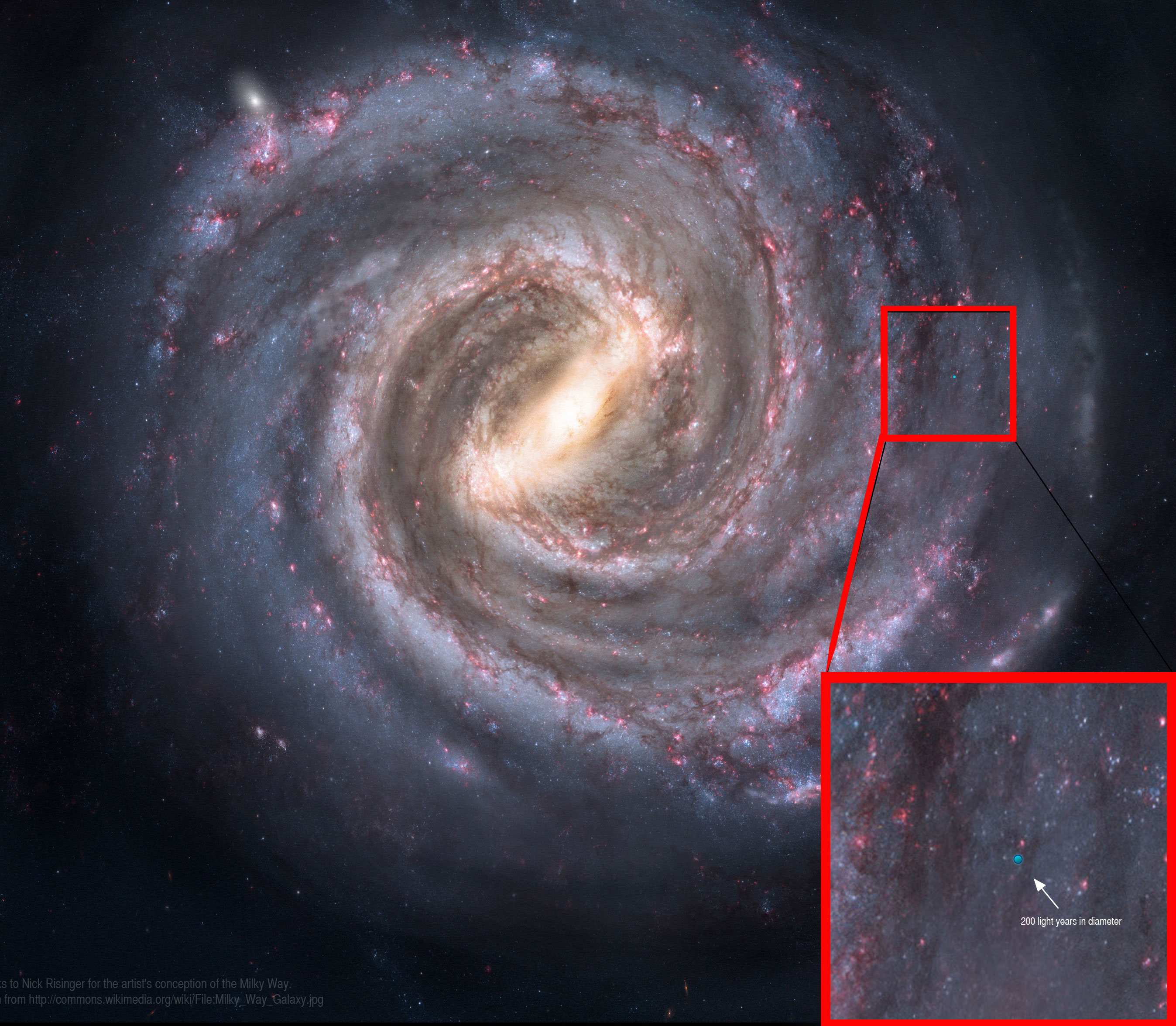
Humans have only observed a tiny slice of space over a very tiny time span--less than 100 years. It's like being born in a barren desert and never venturing out and realizing most of the world is ocean and full of activity. We don't know what to look for or where. An observer 200 light years away from earth could easily conclude that there's no life here, since all they'd have to go by is inconclusive signs of some gases in the air.
Star Trek posits that warp drive is the technology which merits contact from other civilizations. I would expect the technology to actually be access to interstellar communication. A planet joins the universe when it first logs in.
Note that I personally don't have a set opinion on this subject. I am only trying to respond to OP's question of why some people would think this is a possiblity. But I like to play devil's advocate so:
> Or other societies realized widely broadcasting noise is bad for whatever reason.
> Or maybe broadcasting widely resulted is a case study for getting your civilization invaded, so they avoided it it or only send signals as strong as they need to be
Every other society realized it at the same time? Which would imply every other society is roughly born at the same time, which sounds unlikely. So some of them (like us) should not yet have discovered the danger of broadcasting signals.
> Or maybe it's so consistently and universally done that we simple see it as cosmic background radiation.
I don't think you can possibly mistake the CMB with some artifical radio signals coming from point sources.
> Or maybe something like quantum entanglement someday makes wave transmissions for communication seem as backwards as smoke signals
Definitely a possibility, but again, that would assume some kind of synchronicity between all other societies (no one is still figuring out quantum communication). But since radio signals are hard to pickup at a long range, it's possible. But we also haven't seen any other traces of civilizations: probes, dyson spheres etc.
>Every other society realized it at the same time? Which would imply every other society is roughly born at the same time, which sounds unlikely. So some of them (like us) should not yet have discovered the danger of broadcasting signals.
And I'll play Devil's Advocate to your Devil's Advocate. :)
It's entirely possible that there have been other technological civilizations over the past 13.7 or so billion years. That's a long time. As such, any civilization that stopped broadcasting in our direction, if they ever did so in the first place, any more than 100,000 or so years ago, would be completely undetectable to us -- ever.
What's more, as was pointed out in another comment, we haven't been looking for such signals for long (~60 years) and haven't surveyed anything close to the entire galaxy.
I guess the most accurate thing we can say would be that we haven't detected another technological civilization within 60 light years or so in the few places we've looked.
Given the lack of data, the Drake equation[0] is less a predictive device than a way to categorize our ignorance.
The Fermi Paradox[1] and its "where is everybody?" question is more in line with what I perceive to be your point.
Given that we haven't looked very hard for very long (as I mention above) in an enormous galaxy that's existed for billions of years, it seems to be in a similar position as any predictions from the Drake equation.
It's interesting to speculate, but without enough data, speculation is all it is.
> It's entirely possible that there have been other technological civilizations over the past 13.7 or so billion years. That's a long time. As such, any civilization that stopped broadcasting in our direction, if they ever did so in the first place, any more than 100,000 or so years ago, would be completely undetectable to us -- ever.
But this is assuming radio signals are the only way we could detect a civilization, what about probes (von neuman or regular), dyson spheres etc. ?
> I guess the most accurate thing we can say would be that we haven't detected another technological civilization within 60 light years or so in the few places we've looked
The signals we received in the last 60 years come from the entire observable universe (it's how we define the observable universe), not just from a 60 ly radius. But the furthest the signal comes from the hardest it is to detect (or the strongest it would have to be to be detectable).
> It's interesting to speculate, but without enough data, speculation is all it is.
I certainly hope that everyone is aware that is pure speculation ;)
>The signals we received in the last 60 years come from the entire observable universe (it's how we define the observable universe), not just from a 60 ly radius. But the furthest the signal comes from the hardest it is to detect (or the strongest it would have to be to be detectable).
A fair point. I should have been more specific and limited my statement:
"we haven't detected another technological civilization, currently broadcasting electromagnetic signals in our direction, within 60 light years or so in the few places we've looked."
However, that doesn't mean such civilizations don't exist, nor does the fact that we haven't detected any such signals at any distance, or any other indications of such civilizations, extant or not.
> I should have been more specific and limited my statement: "we haven't detected another technological civilization, currently broadcasting electromagnetic signals in our direction, within 60 light years or so in the few places we've looked."
Why restrict yourself to those 60 light years? We haven't heard about any other civilizations in the entire observable even if their transmission happened a long time ago and they may be extinct by now.
It's only true in the other direction: only a civilization less that 60 ly away could possibly have detected our radio signals so far.
> But this is assuming radio signals are the only way we could detect a civilization, what about probes (von neuman or regular), dyson spheres etc. ?
That’s trying to find a needle in a universe sized haystack, and we’ve only just started digging. Concluding that there’s probably not a needle when we’ve only just started digging our hands in is premature.
> That’s trying to find a needle in a universe sized haystack
But that is the whole point of the fermi paradox. Given the staggering numbers of planets in our galaxy/universe, and given the staggering age of the universe (when compared to our history), it should not be like trying to find a needle in a haystack.
If it is, then that means life is extremly rare, which already answers part of the question.
That comes with the big assumption that in basically any given corner of the universe, civilizations in galaxies billions of light years away are pumping out radio signals strong enough to be detected from earth.
How likely is it that by the time humanity would be a space faring society that we’d be pumping turbo charged radio signals that are easily distinguished from noise when doing a quick sweep? How likely is it that societies are using radio signals or something similar for a long period of time, and not simply using some better method that humans have yet to discover?
No, the assumption is because our solar system and earth are not particularly old, if life is commonplace, then there are civilizations that should be billions of years older than us. Imagine where we would be (assuming we don't simply destroy ourselves in the next 50 years) with a billion more year of technological progress? We should be all over the galaxy, colonizing left and right, sending probes everywhere, creating dyson sphere like structures that would be easily detectable from afar etc.
And that is just one civilization on an single planet out of 100 billions planets in our galaxy.
Of course everything is just speculation, for every hypothesis on one side of the argument you can find 2 hypothesis from the other side that counter it.
But the point is, to go back to the original question, that the right answer is definitely not obvious and if someone's opinion is that we are alone, or at least that life is very rare, it's not completly crazy.
Even if it's as rare as one in a billion we'd still have to map billions of suns, their planets and actually look for it. Other than SETI I don't know any really serious, concerted efforts to looks for other signals of life.
Even the discovery here was somewhat random and required someone to start digging through recorded data.
>Given that we haven't looked very hard for very long (as I mention above) in an enormous galaxy that's existed for billions of years, it seems to be in a similar position as any predictions from the Drake equation.
Also remember the search space isn't even just a single galaxy, it's the entire observable universe with a hundred billion galaxies, give or take.
> Every other society realized it at the same time? Which would imply every other society is roughly born at the same time, which sounds unlikely. So some of them (like us) should not yet have discovered the danger of broadcasting signals.
Yeah, that's the Dark Forest book in effect.
If you broadcast, other civilizations could attempt to destroy you, so most civilizations find some way to dampen transmissions or limit them somehow.
Precisely, and in the Dark Forest book we (humans) did indeed detect radio signals from other civilization very early after we built the radio telescopes capable of doing so. So the fermi paradox is not present in this alternate reality.
In our reality we haven't detected anything yet, hence the paradox.
> Definitely a possibility, but again, that would assume some kind of synchronicity between all other societies
Does this not happen with eyes, limbs and especially blood which have evolved independently many times? Maybe whatever the reason is is actually quasi-inevitable and we're missing the few that fall outside of that evolution for some unrelated reasons.
IIRC, we wouldn't be able to pick up our own broadcasts from Alpha Centauri because of the loss of radio transmission power. I doubt we would know if an alien civilization was transmitting at us, even if it was trying to get our attention.
The Breakthrough Listen initiative claims that it is sensitive to “Earth-leakage” levels of radio transmission from all 43 stars within 5 parsecs: https://breakthroughinitiatives.org/news/3
Attenuation of radio waves (long membrane) is way too high, that's true, but radio isn't the only way to transmit that we could theoretically pick up. Gravity waves for example would be a way to transmit across the whole universe.
Gravity waves would still have similar issues. The only gravity waves we can pick up right now are from extremely dense bodies colliding with each other. Not exactly a feasible means for intergalactic communication.
Thus, the fact that we are unable to detect any signal from even a single other civilization is quite puzzling, we should be inundated by those signals.
People overestimate the detectability of our own signals. I don't have a reference, but I read an article a few years back where someone calculated how far away we would be able to detect our own signals with our current technology. The answer was about 20 light years. There are only around 100 stars in that sample. About all we can say is that there is not a civilisation similar to ours in that sample. Anything further away would have to be deliberately trying to communicate with us. If they are similar to us, they wouldn't know we are here. If they are much more advanced, we might be uninteresting to them for any number of reasons.
Technology advances, and this situation will change. The Square Kilometre Array, for example, will give us the resolving power to see whether excess radio "noise" is coming from a planet rather than a star (which might be an indication of an intelligent origin). This will increase our bubble of detectability much further out. Unfortunately, I don't have a number on that, but it is still an incredibly small volume compared to the size of the universe.
This is a very common trap. I see this way of thinking applied to the presence of life on Earth all the time. It’s gilded in the Drake equation. It is very possible that Earth is the only planet in the galaxy or even universe with life on it. As the most powerful species on that planet, we should make responsible decisions. There is zero evidence, or even a compelling argument using existing data, that contradicts this possibility.
Old enough to remember the times before the fist extraterrestrial planet was detected. The pessimist argument was then that circumstances leading to planetary system formation could be so extremely rare that we could possibly be the only habitable range planet in the galaxy.
It turned out since the planets are abundant. Planets being abundant increases the chances of life countlessfold, so there is a reason for cautious optimism.
> As the most powerful species on that planet, we should make responsible decisions.
I think you mistake the meaning of the "we are not special" statement. From a statistic point of view, we have to assume that everything about us is roughly average (and so far our observations kind of confirm this), otherwise any probabilty you come up with is completly skewed by the bias you introduced by assuming from the get go that we are special.
But interestingly, by assuming that we are average and knowing the abundance of other planets, we should see a lot of activity out there, but we don't. So maybe that indicates that we are, in fact, not average.
>From a statistic point of view, we have to assume that everything about us is roughly average (and so far our observations kind of confirm this).
This is the part I disagree with. It’s a hasty generalization to extrapolate from a single data point (Earth). The law of small numbers is alluring, but we must stick to our proper statistics guns and not fall into intuitive traps.
> It’s a hasty generalization to extrapolate from a single data point (Earth).
But we have no choice, we have to extrapolate. And if you have a single data point, assuming that this datapoint is average makes more sense.
If there is an urn containing 100 balls some red some green, 99 of one color and 1 of the other color, and you blindly pick one ball from it that is red, you should bet that there are 99 red balls and 1 green ball, not the other way around.
We do have a choice: not to make hasty generalizations. Your example is the exact classic case of hasty generalization as a fallacy. You can say next to nothing about a bin of balls from one sample.
We can ponder the possibilities as long as we don’t start playing favorites. Saying “we aren’t special” is playing favorites. Saying “we may be special” is not.
We aren’t even confident about the state of life in the solar system. There could be life on Venus, Mars, and/or Europa. Earth may have seeded that life or those places could have seeded Earth, maybe a common ancestor seeded all three, or maybe genesis is common. Maybe life is all over the universe, or maybe Earth is the epicenter, or maybe something in between. We can say next to nothing about the state of life in the universe.
All we know for sure is that we are alive and stars have periodic dips in light intensity. We should act like we are the only life in the universe when weighing the pros and cons of self-inflicted armageddon, at least until proven otherwise.
> We do have a choice: not to make hasty generalizations.
I don't think anyone is making a generalization in the sense you seem to be implying. No one is saying: given our current observation we have concluded that we are (or not) the only ones around. Things are being discussed in term of likelyhood, not in term of certainties.
> You can say next to nothing about a bin of balls from one sample.
You can definitely say something: That there are 99% likelihood that the urn was filled with 99 red balls and 1 green ball, and 1% that it was the other way around.
You can only say that the likelihood of a red ball is at least 1% and the likelihood of a green ball is 99% or less.
We can say the universe can support life because here we are. We can say nothing of how common it is other than it has occurred at least once in 10^24 planets over 10^9 years. It’s difficult to overstate how insignificant this amount of data is in a statistics sense.
Note that you will always pick a red ball because it’s the only color you can pick, regardless of whether there are 99, 50 or 1 red balls in the urn. I believe that makes such a single data point meaningless, sidelining any statistical argument about its averageness—we have to rely on our understanding of physics, cosmology, astrobiology, etc. when estimating how frequent a red ball can be, at least until we have a large enough sampling of red balls.
Consider that our civilization has really only had about a 50 year window were we were rather noisy in the radio frequencies. Now, our radio transmissions (with the exception of some short pulse military ones) are much less powerful and would be much harder to detect at a distance.
> uoting from Tarter (2001): "At current levels of sensitivity, targeted microwave searches could detect the equivalent power of strong TV transmitters at a distance of 1 light year (within which there are no other stars)..."
We barely have the sensitivity to detect the existing strong TV transmitters of today within a 1ly sphere. The inverse square law becomes rather cruel. For a 2ly sphere, we'd need 4x the sensitivity. 3ly, 9x. To get 100 stars in the sphere, we need 21ly sphere, and that would need 400x the sensitivity that we have... and in that list of 100 nearest stars, there's only 6 G type stars.
So yes... there may be. But we're very small ( http://www.rainydaymagazine.com/RDM2011/RainyDayScience/Radi... ). Our own radio signals have barely made any significant coverage of the galaxy. Our own signals are also becoming harder to detect as our radio technology becomes better (DTV only needs 1/5th the power of analog TV).
That we're not hearing any random signals akin to what we've been broadcasting for the past century isn't surprising.
That Stack Exchange answer from 2015 is quoting a primary source describing “current levels of sensitivity” in 2001. The Breakthrough Listen initiative, launched in 2016, claims that it is sensitive to “Earth-leakage” levels of radio transmission within 5 parsecs (16 ly): https://breakthroughinitiatives.org/news/3
Radio signal is not the only way to detect presence of other civilizations.
Von Neumann style probes, Dyson spheres etc.
Current estimates place the number of planets in our galaxy at 100 billions. And some of the stars in our galaxy are ~6 billions years older than our sun, that's a hell lot of time for a civilization to develop massively considering the technological progress we have had in a just a few thousands of years.
The issue with your argument is that earth is not a special place - there are tons of positive factors that helped life to develop and sustain. Position nearby stable sun, magnetosphere and just enough volcanic activity, our moon, big planets trapping most comets/debris that would make huge meteorite impacts much more common, oceans, tectonics. At the end, we don't know and everybody's opinion is just a gut feeling.
> The issue with your argument is that earth is not a special place
This is not my argument at all, it's actuall quite the opposite.
The argument is that, if everything about us is average (including our host planet), and given the tremendous amount of planets everywhere, we should see life basically everywhere.
But we don't! So there indeed maybe something special about us, maybe our planet, maybe some extremely rare step in our evolution.
What signal are we expecting to be able to detect? AFAIK the radio signals we've been emitting are garbled beyond recognition and way too weak even a few light-years away from earth. After all, most of our communication is directed at earth and the remainder is for at most geo stationary orbit. We generally don't transmit anything high energy that would stand a chance to be recognisable from afar.
Similarly signals from other civilisations will probably become scrambled by distance and because they might overlap heavily with the radiation emitted by their sun.
Well, to pick some nits, if radio waves didn't work the same way, that would be a pretty fundamental shift in physics, to the point of throwing all our assumptions out the window about our observational evidence.
> Can someone remind me how it comes to pass that there are people in the scientific community who believe we are the only "intelligent" life form?
Sure. I’m a strong-form rare Earther.
Interstellar pan-spermia is possible but unlikely across large distances. Independent seeding is the only way a 14bn-year-old expanding universe 93 Gly in diameter proliferates with life.
We don’t understand abiogenesis. All indications suggest it’s a difficult problem. The abundance of elements is set by the nuclear physics of stellar fusion and neutron star collision. Solvency further restricts biological chemistry. Given this, it seems likely that life in any form is quite rare.
Then we have multicellular life. On Earth, this is a product of the fusion of mitochondria and bilipid-barrier cells. Consider the number of cells in Earth’s history. The eucharyotic union occurred once. That is improbable.
I believe we will find scattered archae beyond our Solar System. (We may find single-celled life within it.) But complex multicellular life—let alone intelligence—takes so many variables perfectly aligning that it strikes me as vanishingly improbable.
We must as a species confront the moral implications of possibly being the sole light of life in this universe. That’s an uncomfortable burden. I understand why we shy from it.
It is an echo of the ‘centrist’ mindset. It was as difficult to understand that earth was not the center of the universe. Then our sun was not the center of the universe. Now that the human soul is not the center of all living things on earth.
If life is a possibility then intelligence isn’t simply a matter of time.
However, the bigger question is whether intelligence is the curse of life. Is intelligence self destructive by its very arrogance and nature.
Just published an article ‘Beyond Drake- Earth 2.0’ as the foundation for this very question. You can google and find it. It’s the start of a journey and a path to this question.
Its not about being the centre of anything... more like we had so much luck its unbelievable (stable sun, big planets cleaning asteroids, moon, magnetosphere etc.), and other life out there would quite a few more billions of years to get where we are. At least in this part of Milky way.
And its entirely possible light speed is the limiting factor that can't be crossed. Hence the civilizations of distant galaxies will remain unknown to us, same as we to them.
Once that we know of. I generally agree with the gist of your comment but we can't know what we can't know.
For me it makes more sense to admit we have insufficient data for a meaningful answer and leave it at that, until the situation changes. Science can't answer every question at any time.
They meant, it occurred once on Earth, or at the very least it has stopped occurring for a few billion years now. That is still staggeringly low odds of a living planet seeing this event.
The same is true of abiogenesis - here we have a planet teeming with life absolutely everywhere we've looked, and yet 0 abiogenesis to be seen anywhere today. So, in general, when seeing a planet like the Earth today, we should expect to find NO life on it, as we already know teh Earth today can't sustain abiogenesis.
I'm out of my depth here (I know a few things about computers but - biology? Not so much) but I suspect that once life gets going it kind of hogs all of the resources necessary for life to begin again.
So perhaps abiogenesis hasn't happened again on Earth because it's already happened and there's no space for it to happen again until the current batch of living things has been extinguished.
If that holds any water, then life could have started any nymber of times in the past and ended soon after, without leaving any trace we can detect.
I thought your argument was well reasoned; but I would like to make a point about Life: because once life exists, things get interesting.
Life as we know it is based on genetics, which -as we know- is a kind of natural optimizer. A lot of people play with optimizers these days in AI and ML. Of course life does not optimize for click-through nor for paperclips. Instead it optimizes for "survival".
So if it is known that certain optimal points (niches) exist on the optimization landscape (fitness landscape), then one can assume they will be occupied sooner or later.
Or, in normal English: If something is at all reasonably possible, then once life exists, "Life Will Find A Way".
So once you get to the point where Life exists, the likelihood of life-related-things actually happening would actually seem to be quite high.
Of course with just life on a planet; history still moves at a slower scale than if there are planet were have actual sapients or even civilisation. Those are much faster optimizers, of course.
That's what I thought as well. How do we know that it isn't a first-one-wins game, ie where a bunch of candidates have a reasonable chance of developing multicellular life, but whoever gets there first uses the advantage to out compete all the others?
We don’t, but we do know that there over the about 4 billion years of life, the first 1 to 1.5 billion years were purely prokaryotic. If it was a common thing to have work out, you wouldn’t expect such a massive amount of time before it occurred.
What I’m less confident on is that it’s the only path to complex multicellular life. It’s the step our history took, but it’s possible there are multiple rare pathways to the next step (or possibly different initial conditions could make the eucharyotic union or other options more probable? Just because it was unlikely here doesn’t mean that’s true on all planets).
> We don’t, but we do know that there over the about 4 billion years of life, the first 1 to 1.5 billion years were purely prokaryotic. If it was a common thing to have work out, you wouldn’t expect such a massive amount of time before it occurred.
Based on that evidence you could also conclude that it was impossible for it to happen for 1 to 1.5 billion years (because it didn't) and then it was suddenly very likely (because it did).
I don't think anyone in the astrophysics community thinks we're alone. But the physics also suggests that unless they are extremely common it's unlikely that we'll ever detect any (let alone meet any). So practically we are alone.
Outside the astrophysics community the majority of scientists I know also believe in life but similarly don't think we will detect/meet them. But there are some that don't believe (I don't know a single person in hard science that thinks we're alone but I do know engineers and those in soft sciences that reject the notion).
Because there are a lot of other things necessary for life. Usually we get the 'planet X may be suitable for life' PR news item first, and later in the scientific press we find out quietly 'planet X is awash in deadly gamma radiation, and the tectonics are such that there's a richter scale 13 quake every week'.
It turns out that when taking into account all known factors, us being alone is a nontrivial possibility:
I'm still pissed about the number of people who refuse to acknowledge cetacean intelligence. Even ignoring the scientific studies performed by people like John C. Lilly, Karen Pryor and Kenneth Norris, just swimming with wild dolphins or humpback whales, it becomes clear that these creatures are at least as smart as us, probably smarter.
The Earth today is not capable of sprouting life (abiogenesis). In fact, from the fossil record and genetic studies, the Earth has almost certainly been unable to form new life (out of un living substances I mean) for billions of years.
Then, the same is true for multicellular life appearing from unicelular life. All of the living multi-cell organisms today seem to be descended from 1 common ancestor, 1 time that multicellular life has ever appeared in more than a billion years.
So right now, the very basic needs for life to even start seem to be staggeringly unlikely. Even at the huge scales of planets in the universe, it could be that the chances we'll ever meet another civilization are un conceivably low.
Of course, simple life could exist 'all over the place', and most scientists generally believe that. But life capable of interstellar communication like us may well be staggeringly rare in the universe.
We'll probably know a lot more about this in the coming decades/century, as we'll hopefully be able to send probes to look for life on Mars, Europa, Venus and other potential candidates in the Solar System. Perhaps we'll even be able to create abiogenesis in the lab and be able to learn more about the possible requirements that way.
> The Earth today is not capable of sprouting life (abiogenesis). In fact, from the fossil record and genetic studies, the Earth has almost certainly been unable to form new life (out of un living substances I mean) for billions of years.
Playing devil's advocate for a bit, how do you know that existing life, honed by evolution, doesn't simply outcompete life that is continuously born abiogenetically in places like hydrothermal vents [1]?
Of course, we can't know for sure, but the fact that in all this time no other strain seems to have made it makes that theory implausible to me.
To be fair though, there is A LOT of life on earth, so we can't discount the possibility that we'll find some forms of life that come from a different tree than us.
We only have one data point. Earth. There is not enough information to do any kind of real statistical analysis. All we are left with is gut instinct. And that's not science.
I have a spare phone which I would like to flash but I have not been able to find any device specific information on how to do it.
I checked XDA but they don't have any device specific info. Google returns sketchy pages wanting to install software. The phone is not on the list of supported devices on lineage OS website. And I have been unable to find a how-to do it yourself guide.
I followed a guide on how to do it over a decade ago and that is as far as my knowledge goes. I suspect things have changed since???
I would appreciate if someone could point me in the right direction. The device, a blu G5 plus (which when I search on XDA it returns Moto G5 ¯\_(ツ)_/¯)
Layman with absolutely no understanding about any of this.
I currently live in a country with absolutely no infrastructure to handle this. Our first confirmed case was reported almost three weeks ago. Within a week we ran out of testing kits.
Last night I started researching on the topic to see if there is a formula to calculate the current number of infected people in the country. I don't care about accuracy, it just needs to give an approximate.
The current official figure is less than ten and I feel that by having an estimate (from what I've been able to read, time is a bad indicator, it is what it is) it would help change what I believe to be a false sense of security if one is looking at the official figures.
Is there any such formula or should I use the SIR model? (which currently is a bit over my head)
The model is oriented around companies, but could be applied to any gathering of people. There may be more sophisticated or accurate models out there, but I found his relatively quick to understand and apply.
I'm a bit late to this, sorry; one of my students let me know this thread existed!
I want to encourage you not to try to use this formula or anything like it to make concrete predictions. You are, unfortunately, right that the numbers we have access to are crap. But that doesn't mean that our modeling will be any better; we'd need to use the public numbers as input. And those public numbers are crap.
There are people whose entire job is to figure out ways to make useful predictions from the information we have. Their estimates aren't great, in part because the numbers they're using as input are crap.
But the numbers they have for input are as good as what we have, so we're unlikely to manage better. And in the worst case we can easily Epstein ourselves and generate predictions that are wildly, embarrassingly off the mark.
I'm not saying you should trust the official or expert numbers. But they're almost certainly better than what you'll manage on your own.