Exactly, the government is extremely large and not all the NSA. Sometimes the left hand doesn't know what all the thousands of right hands are doing and can't possibly care.
Tor has probably saved more than a few CIA agents' lives, not to mention free access to the Internet being a powerful tool for undermining authoritarian regimes.
> Tor has probably saved more than a few CIA agents' lives
Tor's main purpose is to allow agents of US intelligence agencies to communicate back with the home base.
"Giving free access to the Internet being a powerful tool for undermining authoritarian regimes" makes it harder for an adversary to focus solely on intelligence agency agent traffic.
I'm not saying Tor is backdoored or monitored, though it's heavily monitored.
When enjoying the benefits of Tor, it's wise to also remember Tor's main purpose.
Good list. I'd add the Rodins at Stanford (which is also a nice campus to walk around) and, for hiking, the Santa Cruz mountains (Big Basin, etc.) Also free guided walking tours in SF and the boat trip to Alcatraz (touristy but worthwhile--book ahead).
While the Computer History Museum in [EDIT: Mountain View] is great, if I were visiting the Bay area from halfway around the world, I really wouldn't spend much time in Silicon Valley proper, tech events, etc. I suppose I get the mystique but there are so many more interesting things to experience on a short visit.
I hope OP listens to this. Spend 80% of your time in SF/Oakland/Berkeley and 20% at most in SV. The former is one of the most interesting, beautiful metropolitan areas in the world.; The later is a fairly mundane suburb.
When I'm visiting the Bay Area I like to go to coworking spaces as well.
Certainly not everything--especially if you're talking the whole region from Pt. Reyes through Sonoma/Napa to San Francisco, the South Bay, and Santa Cruz/Santa Cruz mountains/Monterey. But 1-2 weeks is enough to give you a nice flavor of the area. I'd probably pick SF and maybe a couple select things to see/do in the Valley and then spend some time either north or south from there.
SF is one of my favorite cities (to visit :-)). And there's tons of other great stuff to do within driving distance from 1-2 hours on up. (You can reach the Sierras but I probably wouldn't recommend that for a first time visit of limited duration.) IMO, great choice for a vacation of just about any length.
Oh good lord. Not even close. Maybe Las Vegas is a bucket list sort of thing to do once for a few days. (I, sadly, have spent a great deal more time in Vegas than that.) There are very interesting places within a few hour radius of Vegas if the weather isn't too hot--Death Valley, Zion, Red Rock Canyon, Hoover Dam, Grand Canyon. But I wouldn't spend money or time to go to Vegas itself voluntarily.
Thank you for this. As someone interviewing with a handful of companies in SV and considering relocating, this whole thread reenforces a whole host of misgivings I have of the area. Maybe I'm too Midwestern, but most of the comments read as a big "eff you - don't even bother." Does everyone hate it there so much? I know it isn't perfect, but what city/metro area is?
Of the developers I've known in the Bay Area for the last ten years, three have recently left, two are planning on leaving shortly, and one only sort of lives there anymore.
The biggest issue is the cost of housing. It's like 5x more expensive in the Bay Area than housing in my area. The higher incomes available don't compensate.
In order to get "cheaper" housing, most people with families then live farther out with crazy commute times and traffic. Some people send four hours of their day in traffic.
Lastly the tech scene can be a little overboard at times with whatever the progressive flavor of the month. For example, is picking conference presenters in double blind fashion without regard to gender or race, a virtue or a crime worthy of a mob? Are men and women the same, or do they have differences? Either answer could get you ostracized, depending on which way the wind is blowing in SF or SJC.
State Income taxes is a small thing but will take an extra 8-10% of your income a year.
Lastly the Bay Area tech companies and startups seem to require a bit more than 40 hours a week of work. This isn't as common elsewhere.
None of these things may bother you if you are a young, progressive, single person with a high paying job.
But as you get older they can get to be an awful daily irritation.
I wasn't originally going to, but after seeing so many negative responses all over this story I feel like I should also add a response here.
I interviewed with several companies in the Bay Area before deciding on one and moving out here. Yes, the housing market sucks. When we were looking for a place to rent we were shown a house that wasn't on the market yet and already had an interested party who put an application down. Fortunately they went with us but the housing, even out in the East Bay, is expensive and goes fast.
But, for me, that ends the negativity that many seem to be echoing in here.
My family and I absolutely love it here. We lived our whole lives on the east coast and having been in the Bay Area for a year we never want to move back. The weather is amazing, everything is close (we live further out in East Bay but still we're minutes away from just about everything; shopping, restaurants, hospitals; everything!).
The schools in most areas that we looked have phenomenal ratings (some of the ones in SF, not so much and obviously we didn't look everywhere) and my daughter just completed her first year at a school over here and she's crazy sad the year is already over!
The work is interesting! It's also very refreshing to know that there are just so many opportunities here that should I decide I don't like my work anymore it's crazy how many companies will open their doors to interview you ASAP (if you're in the tech industry, I should clarify).
There is a ton of stuff to do here. Beaches, lots of interesting places for kids (like indoor play places everywhere) and for adults (kick ass stores and movie theaters and probably other stuff but I don't do much else lol). I love the california science academy and their planetarium. Fisherman's Wharf in SF has awesome food and is just an interesting place to walk around.
Overall the Bay Area, in my opinion as a semi-recent transplant, is absolutely amazing. I really hope we can make progress on the housing issues.
I'm from Minneapolis as are a number of my friends.
Some of them moved out to CA (Irvine) and some later moved to Seattle.
They /can't wait/ to move back to MN.
For a while, I didn't understand them (usually, when they tell me this in the winter). But the music scene, culture, and comparative lack of traffic make a big difference.
I've yet to go to CA outside of layovers, but I still want to experience it for myself.
Irvine is in Southern California. Southern California is a different state than Northern California, which is where San Francisco and Silicon Valley are.
Midwestern pride (and Minneapolitan pride in particular) is far stronger than most areas.
To me, it presents itself as a kind of Stockholm syndrome.
It develops because your brain is aware of the fact that the weather there is capable of killing you 3 months out of the year and it has to find a way to justify the fact that you're not leaving. Obviously there must be something really great about this place when it's not 20 below.
Minnesotans are unusually aware of the primacy of their bike paths, healthcare coverage, skyway'd cities and educational system. They talk to each other a lot about how great each of these things are, reinforcing the special shared status of this land of hardship, but good working folks.
In my experience, most people don't speak so highly of their hometowns as Midwesterners- Minnesotans in particular. When you move to a place where everyone sees the bad stuff and doesn't try to sugar coat it, it can be offputing. If you don't get enough milage between you and the cult of the midwest, you inevitably return to a land where people endure because everyone talks about how good it is when it's not too bad. It could be worse!
As a current Minneapolitan, the thing that wins for me here is the arts scene. Sooner or later, everyone becomes some sort of a hipster, deeply engaged in a local subculture. For me, it's music and theater. For my wife, it's dance. For my daughter, it's the restaurant scene. For my neighbors, it's gardening. But there are scenes here. I go to similar-sized cities, and their arts scenes are like a joke. They have a little four block ghetto of hip somewhere, but nothing like what we have here (as a hardcore Minnesota Fringe Festival nerd, visiting Indianapolis during their Fringe Festival was... ridiculous).
I see stickers saying "Keep Austin weird", and "Keep Portland weird". You never see those for Minneapolis. We don't need 'em.
Don't forget about Chicago, which is worst of all in the brainwashing department. I can't find the source sadly, but there's a crazy statistic about girls who grow up in Chicago being somewhere around 10x more likely to return to their hometown compared to their counterparts anywhere else in the US.
There are always people who are unhappy where they are. Because it feels like the entire tech industry is here people wind up moving here even if they wouldn't have otherwise.
I personally love being here but I also grew up around here. I'd rather all the people who didn't want to live here move on and out and make room for the people who do want to be here.
That being said the people who appreciate being here generally outnumber the people who don't appreciate it. Anecdotally of course.
I think people here are complaining about the tech culture more than the actual place of SF itself. SF is a big city with access to tons of great outdoor activities and tons to do. If you don't like big cities then yeah, you may have a bad time. I don't see how any actual city lover could have a truly bad time here.
As mentioned by others, because of tech, some people move out here despite not actually wanting to live in a place like CS. That number is a minority.
As a Midwesterner myself, the Bay area is my favorite place in America to visit, but I don't really want to live there. I'd consider it, though, for the right circumstance. If I were rich, I might well pay for a timeshare out there, but keep my permanent residence here in Minneapolis.
Dolores park is my trump card for showing off SF to (20 something) out of towners. There's usually nothing even remotely like it (when it gets crowded and boozy) wherever they came from.
And I'm in it for the al pastor and so far El Farolito has my favorite. I love Guadalajara too though, because you can get a burrito that's just two different (huge) portions of meat, and they also have some very spicy and delicious salsa. I've strained friendships arguing whether Cancun or El Farolito was better though.
To my taste, the best burrito in SF can be found at La Corneta in Glen Park. I lean toward the super carne asada, but the fish (salmon) burrito is also amazing. The Glen Park La Corneta has amazing food in general and if you go there, you will not be disappointed.
Be advised that La Corneta also has a location in SoMa (on Mission) but the taste of the food is entirely different, not bad, but not as much to my liking.
That would be unwise. It's not a particularly auspicious time to be a foreigner in the U.S., and the Trump administration just announced a crack down on even minor drug offenses. The Haight is pretty relaxed and the odds of getting caught are low, but the consequences at the moment could be particularly severe. Not a risk worth taking.
But do go to the Haight and watch people buying drugs :-)
Huh??? What does prop 65 (or any California state proposition for that matter) have do to with someone on a tourist visa getting in trouble with the federal government for buying illegal drugs?
Piggybacking off of your Monterey suggestion, take the slight detour there to check out Point Lobos, a particularly beautiful state park.
Also, strongly second Nightlife at the Cal Academy of Sciences. I try to design my trips to the bay area such that I'll be there on a the day of the week those are so I can go (Thursday I think?). It's a great museum, very hands on, and those nights have always had a really enjoyable vibe when I've been.
Oh, and taking 1 north of the city along Point Reyes for a ways is also an excellent drive. You can cut back inland through some rolling hills and get a very different vibe than the city and coast going south towards Big Sur
If you go to Santa Cruz, I recommend sea kayaking off the warf next to the boardwalk. It's a great way to get some sun, enjoy the ocean without being a surfer and see sea lions and aborable sea otters (but be careful not to get too close and disturb them).
I also highly recommend night life at the Academy of Sciences, and I think the exploratorium does something similar.
This is a great list! If you really want the city vibe, though, you should check out non-touristy spots as well, and witness some of the insane differences between neighborhoods:
- Check out Union Street in the Marina, then compare that to the Tenderloin (there are good restaurants around Geary/Hyde)
- Go to the Creamery in Soma (tech ground zero), and then take an Uber to Market & Castro, the historical center of the gay community
- Eat amazing Asian food on Clement Street, and then decent Italian in North Beach
You might find that "SF" is actually dozens of different towns fused into one. There are a few overarching similarities, but the most striking thing to me are the differences -- even the weather is different across neighborhoods.
There is better bubble tea further south in the valley with no line. I don't get the boba guys craze except for the fact that the amount of boba in SF is lower than necessary.
While the experts are chiming in: any recommendations for A). Sushi and B). Healthy Vegetarian / Wellness / Vegan / Juice Bar / Poke Bowl type spots? Thanks in advance!
Other thoughts (with very different ambience, price range, and focus):
Golden Era is generally delicious but maybe not that healthy in terms of salt and sugar.
Udupi Palace for nice dosa and uttapam options.
Dim sum at Lucky Creation for an unbelievably non-touristy Buddhist vegetarian experience.
If you're particularly looking for juice bar-oriented vegetarian places, Judahlicious is probably a clear candidate (they also have a specialty in raw food). Nourish Café is also a great option in this category.
I was personally not impressed by Seed+Salt or Vegan Picnic.
The vegan scene is stronger across the Bay in Oakland than in San Francisco proper. I love two spots that are not especially healthy: Souley Vegan (soul food) and Timeless Coffee Roaster (vegan baked goods that seem kind of impossible, plus coffee and chocolate).
But this is drifting quite some distance away from the original focus of the question.
You can also get a vegan poke bowl at, at least, Veggie Grill (a chain with its nearest location in Larkspur, over in beautiful Marin County) and Eatsa (a vegetarian bowl-oriented automat, with two downtown locations, where your food is made by unseen workers behind the curtain and appears inside of little boxes on the wall).
Hinata on Van Ness is omekase (chef's choice) and is among the best sushi I've had outside Japan. It'll set you back at least $90 (prix fixe, more if you drink the delicious sake), abd requires a reservation, but you'll be synced with two other couples if you sit at the chef's counter where you will get a detailed description of exactly what you're eating, why it's interesting, and what to look for.
Schedule your reservation to start before 7 and ask to sit at the Chef's counter with Dave (he's the owner, in his twenties and quite knowledgeable).
If you like Hawaiian/Asian fusion, for about the same price range, there's Liholiho in Lower Nob Hill. Liholiho has blown up for a year, so get there at 4:30 on a weekday to make sure you get a seat in the first wave. Otherwise, reservations are a 4-week wait (last I checked).
You can get good healthy vegetarian at just about any restaurant in SF (minus steakhouses and shabu shabu). For a quick delicious vegetarian lunch, check out Plant in the FiDi.
The Poke Bar at the Market at 10th and Market. It's by the Twitter building... so you get to experience the tech bubble at its apex plus amazing fish :-)
If you want the opposite of tech bubble, Ninki sushi in the Sunset has half price rolls many weeknights... instead of the tech bubble bursting, you'll be the one bursting because you'll be so full (and it's so cheap!)
Ahh the legend lives, I see. Unless you live somewhere with unbearable winters it's doubtful that the weather is actually "nicer" in SF. ~60 nearly every day, ~50 nearly every night. Just cold enough to make you wear jeans and a hoodie (what, we just thought that getup looked cool?) and rarely warm enough to take advantage of a pool.
Sounds perfect for me. There's a lot less to consider walking in 60-65 than 70+ - half the time I don't walk to work because I don't want to show up sweaty and have to change. I'm from Michigan, though (SoCal now) so maybe your point stands haha.
Yes, the light jacket is the official uniform of the west coast. Even if the days are warm where you are, the nights are cold. But it's also why it isn't humid in summer.
Silicon Valley, on the other hand, just 45 minutes south of SF, has a great climate. It's remarkable what a few mountains between city and ocean can do.
I'm sure it was intended as a, uh, warning to avoid those areas if 100% committed to avoiding being anywhere around drugs. Alternatively, a tip off for those employed in the War on Drugs. Never under any circumstances an encouragement to buy drugs. Not here.
Very much this - and it describes nearly everywhere I lived the first 35 years of life. Apartments, rural communities and smallish cities (50-60k).
The things these have in common were winters (indiana), employers without a decent area to change clothes in, lack of places to safely store a bike, lack of places to safely ride the bike, and a lack of public transportation. Some employers wouldn't hire you if you didn't have reliable transportation (a car) : Even McDonalds inquired about this in the late 90's. One job preffered one to have a vehicle occasionally to take deposits to the bank and get small change for customers. The penalty was crappier work hours because you could not meet business needs. The bank wasn't far away (8-10 blocks) and was in a tiny town (less than 3k people), yet the store was neither busy enough nor in a crime area high enough to qualify for an armored car service.
And that's not to mention things like having to go travel to wash clothes or, like some even smaller towns than the one mentioned above, not having even a convenience store in town to get basic items.
Perhaps pilots should be required to provide their own airplanes? It's ridiculous that the job wants to force their employees to provide their own $20,000 metal box. Perhaps what they want is a contractor, not an employee.
Slightly off topic, but this is hardly the biggest blunder of the airline industry. A company I worked for last year absolutely tore them apart in a talk at 33c3.
In short, information like your address or passport number is easily accessible, and while it wasn't in the talk (I think), we were able to recover plaintext credit card numbers during the research.
Because the children have no control over who their parents are, and we shouldn't punish with a lifetime of diminished opportunities because their parents aren't as "good" as others.
But we're not punishing them. We're simply not taking, by force, money from one person, to spend it raising the children of another.
If we force people to subsidize other people's poor children, we create perverse incentives to have a maximum number of children with minimum personal investment in each. It cannot end well for society.
If we force people to subsidize other people's poor children, we create perverse incentives to have a maximum number of children with minimum personal investment in each. It cannot end well for society.
You have it reversed. Not providing, say, an education to all children, regardless of parental investment, will leave us with a large number of uneducated citizens languishing to fend for themselves. That sounds pretty bad for society.
Not sure how your making the case that educating children ends up poorly for everyone...unless, of course, you mean that it's harder for the wealthy and powerful to control an educated populace compared to an uneducated one.
We're simply not taking, by force, money from one person, to spend it raising the children of another.
No one is forced to live in a country that provides for it citizens. People can always choose to leave if they feel it's unfair to have basic responsibilities like paying taxes.
First off, your link explicitly blames teacher's unions, not government involvement, for the lack of increase in education outcomes.
You think there are poor people out there thinking: "hey I can have a bunch of kids and they'll all get free educations, let's do it!" Why would they? So that the kid will grow up and get a great job and support them? That's not so much a get-rich-quick scheme as it is a get-rich-in-twenty-to-thirty-years scheme. Plus you'd still have to raise a bunch of kids, which isn't exactly a walk in the park.
Centralising spending in the hands of a monopoly inevitably leads to rent-seeking behavior, like the rise of teachers unions and legislation like collective bargaining acts.
I think the net level of support people can expect their children to receive from redistributive programs plays a role in their decision to have children when they have low income. It's also important to note that it won't just be schooling if the goal is to provide equality of opportunity. It will have to be food as well, and other resources needed to have an equal opportunity.
As for education and fertility rates, this is not guaranteed to last. Formal education is not something humans were evolved for. But evolution has a way of quickly adapting to maximize its programmed objective: reproduction.
> As for education and fertility rates, this is not guaranteed to last
That is not a valid retort. You can't just take a bunch of data points and discard all of them because "evolution has a way". I'm not extrapolating based on this data: these studies show that improving access to education in a wide variety of regions and cultures decreases fertility. These are completely valid statistics and research demonstrating that education is correlated with reduced fertility, you can't discard them with idle speculation. If you have evidence demonstrating your position, we can talk.
Evolution is a well understood phenomenon. It's reasonable to extrapolate its long term effect, especially when very high levels of government spending on education is such a recent phenomenon.
You have a hypothesis, but do you have evidence supporting your conclusion? A study suggesting that increased access to education, or welfare in general, increases the birth rate among the poor? Maybe an example of a species which, upon a decrease in difficulty raising offspring (I'd accept a decrease in infant mortality as an example), started to produce more offspring than normal?
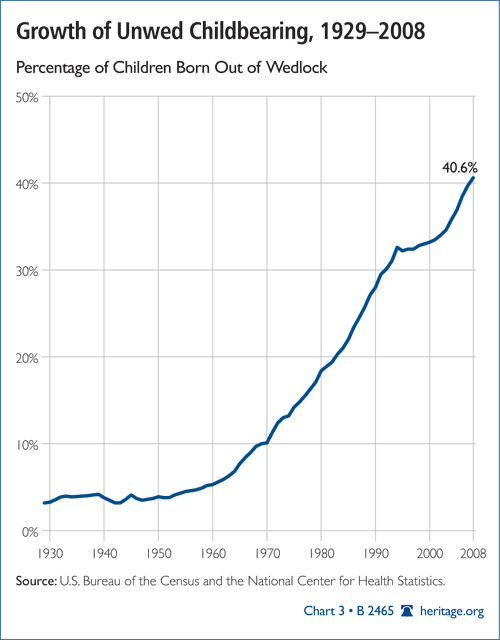
1. Welfare doesn't mean access to education. At no point have I mentioned welfare, only access to public education, specifically public primary and secondary education.
2. Just because people are having more out-of-wedlock children doesn't necessarily mean they are having more children over all. It could simply mean people aren't getting married anymore.
3. Your first link has the following quote in the introduction section: "a reasonable reading of the evidence to date is that the welfare system may increase non marital childbearing, but the magnitude of its effect may not be large relative to the effect of other factors in contributing to recent increases in nonmarital child bearing in the US. In fact, the simplest evidence indicates that the welfare system has not been largely responsible for the recent increases in nonmarital child bearing."
4. Feeding animals increases population, but that's not the same as increased fertility. If an animal normally gives birth to a litter of 5, and only 3 normally live to adulthood, but now all five live to adulthood, then population will increase even though each couple is producing offspring at the same rate. And I'd also like something showing that human beings would exhibit the same phenomenon, because human behavior is a complicated thing governed by more than evolution.
1. You wrote in your previous comment: " A study suggesting that increased access to education, or welfare in general, increases the birth rate among the poor?"
2. The fact that an increasing number of people are having children out of wedlock should be very concerning. Many social problems are strongly correlated with high single parenthood rates. The evidence suggests to me that more welfare encourages single parenthood by changing its costs/rewards.
3. Even that finding is shocking in how anti-welfare it is, given the well-documented leftist bias in the social sciences. Even accepting it at face value, it points to a definite negative effect. Over time, it could get worse due to natural selection.
4. I can do some research and see what I find. As for human populations, I think the most likely outcome is that they inevitably reach a state of evolutionary optimal behavior.
You're talking like we don't do these things already. We've have public schools for over a century, we have various forms of welfare, all kinds of special grant programs to help the poor pay for college, etc. And society hasn't collapsed, the poor aren't popping out a dozen kids because they know they get free primary education. All people are proposing is that we improve these programs. It's not an ideological argument, it's a negotiation over degrees.
How redistributive were public schools 100 years ago, when they were almost exclusively paid for by local taxes within communities where people had very similar levels of income, and when education spending as a share of GDP was miniscule compared to today?
I would argue that the harm of redistribution has historically been more than counterbalanced by the accelerating rate of technological innovation, but that the last 40 years suggests that the growth of the harmful effects of welfarism are starting to outpace the accelerating natural-rate of innovation. That's what GDP and income growth figures would suggest to me. Also the explosion in single parenthood.
Subsidizing education is absolutely not redistribution of wealth! It is an investment. Giving a child a good education increases that child's lifelong income, some of which is taken as tax, which can mean putting money into education can result in a profit over time. This is especially true when you consider that giving a child a good education decreases their likelihood of having to live on welfare or unemployment. Not to mention that having a better education decreases criminality! You think welfare is expensive, consider that it costs about $50K a year to hold a person in prison. And I'm just talking about money: there's all kinds of benefits to society as a whole when the populace is better educated. Decreased crime rates means fewer robberies, rapes and murders. A better educated workforce means a larger talent pool for high-tech companies, which is matched by an increased demand for various products.
So don't just write off publicly subsidized education as wealth redistribution!
It is a component of child-rearing. Forcing people to pay for the education of other people is redistributive.
If it's truly an investment, we could let the student loan market handle it, since the returns (in increased income) exceed the costs.
As for social benefits, I believe the negative effect of encouraging people to have children when they're not capable of personally supporting them, and of reducing the incentive to be productive, outweighs the positive ones.
Before the era of government education, the level of education in society was improving steadily. I don't see history suggesting that society, left to voluntary relationships and income distribution, enters into a downward spiral.
> If it's truly an investment, we could let the student loan market handle it, since the returns (in increased income) exceed the costs.
Student loans? I'm talking about primary and secondary education, not college education. I'm assuming you aren't talking about privatizing those and using students loans to funding things, right?
I'm saying that if funding primary education produces societal returns, that must mean the net increase in earning potential exceeds the cost of the education, and therefore it would be profitable to issue student loans to the poor parents of children who would make good use of that education.
It's not slavery when the debt is assumed with informed consent. We currently force people to pay taxes, and that is vastly less consensual than a student loan. If being compelled to pay a student loan that you chose to take on is slavery, what is being forced to pay a tax debt that you never agreed to assume? As for violent revolution, the history of education before the state got involved does not suggest that would be the outcome.
Only 100 years ago? A lot? It appears the federal government has been involved in public education nearly from the start. Article I Section 8 of the constitution provides impetus; "The Congress shall have Power To lay and collect Taxes, Duties, Imposts and Excises, to pay the Debts and provide for the common Defence and general Welfare of the United States;". From the very start the federal government has provided land grants for public schools, and States have been happily applying funds received from the federal government to the costs of education.
The federal department of education was only created in 1980. All government spending on education, as a percentage of GDP, was a tiny fraction of what it is today. And the revenue for the education spending was weighted far more towards local sources, making it less redistributive.
Which superseded the Office of Education, established in 1867. I don't believe the solid historical foundations supporting your point of view(or adopted point of view for playing devils advocate) exist. Even if it did exist I doubt many people are in a hurry to revert our society and education system along with it back to 1789.
I think you would have a hard time finding any credible sources that indicate public education has been anything but good for the world. Cherry picking historical facts and turning a revisionists blind eye to our country's history won't help. As well, the debate over which LEVEL of government should be paying for education is orthogonal to the merits.
From a quick reading, it seems like the Office of Education was a small statistics gathering department with a very limited budget and role. The redistributive aspect of government education spending has increased substantially over the last century and a half. This goes back to the debate over whether society benefits if it guarantees equality of opportunity, and whether history vindicates the claim. Education outcomes have been stagnant for the past 40 years, during the era with the greatest amount of government spending and redistributive spending.
Whether it's a small community, with high levels of income homogeneity, funding the public education, or the federal government, is not orthogonal to the debate on guaranteeing equality of opportunity. The massive increase in government spending (at all levels, federal, state and local) on education is also not orthogonal to the debate.
Several economists have looked at the history of education and concluded that we would have been better off if we never transitioned from nongovernment to government education. The trends in place before public education was created were toward greater literacy and education.
I'm not sure what arguing over the minutia even accomplishes. I feel like I'm chasing a goal post all over my Friday afternoon. Government support for schooling has been provided by every level of the US government stack(municipal, county, state, federal) since WAY BACK, even to colonial times, to varying degrees. Public access to and public funding of education has increased along the way, yes.
And has more than just not collapsed. Public education is an advancement just as important as any other I can think of. "The public school is the greatest discovery made by man." - Horace Mann. Possibly an exaggeration, but I'm not convinced the importance of public education to our society can be overstated. Everyone alive today is benefiting from a society rooted in public education.
Yeah, I know right? Those poor people's kids don't deserve:
Clean water, electricity, a home, education, or any of those "rich people" things. If they did deserve it, they'd have them. Since they dont, they deserve a life of misery, suffering, and edging to destitution.
^^^ If you can understand the above, its the reason why youre on the wrong side of history here. You can couch the discussion as "stealing from the rich"... But in the end, we all should have equal access and usage to the essentials of life. We have more than enough resources; there just being hoarded by greedy people who are great at explaining why they deserve it.
They don't deserve to take someone else's money by force, in order to pay for those things. I don't think opposing forced income redistribution puts me on the side of history.
And you're internalizing "take someone else's money by force". This really goes back to Americans being temporarily embarrassed capitalists, regardless their real financial livelihood. And working-class thinks that we're talking about them when it comes to "We're gonna take their money" - We are, some. But we're also going to provide a baseline for everyone no matter what.
> I don't think opposing forced income redistribution puts me on the side of history.
And here we go again. This is a matter of "How does the government serve the citizenry". And right now, not very well. Government's current modus operandi is to privatize the gains and socialize the losses. In other words, their gains is on the backs of our losses. And from that, we have a legitimate claim on those gains, as they should be socialized as well.
Why? Because people who are rich did not do so themselves in a little bubble. Their successes rest in part on all of us. And it is easy to say, and act, that they need to pay their fair share. And that fair share would be sufficient in providing basic necessities to everyone, regardless of financial need.
People can still make profit, and thrive. I'm not advocating traditional communism. I'm advocating a blend, where the minimums are taken care of. People can still thrive and profit - they just won't be able to stand on our backs for them to get ahead.
>This is a matter of "How does the government serve the citizenry".
By taking other people's income? I don't think that's fair.
>Because people who are rich did not do so themselves in a little bubble. Their successes rest in part on all of us.
That doesn't seem like a scientific way to determine how much one owes another person. In my opinion it's not consistent with the principle of justice. It's a very sweeping generalization.
>People can still thrive and profit - they just won't be able to stand on our backs for them to get ahead.
How would they be standing on our backs in the absence of forcible redistribution?
> By taking other people's income? I don't think that's fair.
But you don't ask that when they extract peoples' money on the upswing. Only when I express that "socialism for losses and privatization for profits" do you have any problem with fairness.
> That doesn't seem like a scientific way to determine how much one owes another person. In my opinion it's not consistent with the principle of justice. It's a very sweeping generalization.
You want scientific and fair? We the people should own the proceeds from public lands. And that should be used to bolster lowering costs on food, electricity, water, and other resources.
Instead, our government is making "Deals" like selling whole trees for $3 to a wood cutter. Trees are usually in the range from $1000-$50000 , yet some private entity benefits on public's socialism.
Or we have eminent domain so some company can build something. Doesn't matter if it's not for public works. Again, socialism for the rich, and capitalism for the poor.
> How would they be standing on our backs in the absence of forcible redistribution?
Well, you seem to be an Ancap type, given your economic theory. Well, they'd just pay people to serve as a private militia to protect them. Like Somalia. Because people with pitchforks would come out, and take care of this and properly distribute.
Yeah, people can be richer than others... But there's a point that fairness surpasses when you have 1 person (or company) that owns an impressive amount of goods. We only look no further than environmental, societal, local, and government destruction due to extreme clout.
>But you don't ask that when they extract peoples' money on the upswing.
I always ask that.
>You want scientific and fair? We the people should own the proceeds from public lands.
The proceeds of public land is not sufficient to pay for a sizeable welfare state. All land in the US is worth $23 trillion. Assuming a tax equal to 3% of its value is levied per year, that would raise a little less than $700 million.
That has to first be spent on the essentials, like interstate highways, federal courts, and national defence. There's nothing left for welfare. Even if there were, it would better serve society to spend it on general goods to boost productivity, rather than private goods for the poor that discourage it.
No I'm not an ancap.
>But there's a point that fairness surpasses when you have 1 person (or company) that owns an impressive amount of goods.
I don't see this being based on a principle of justice. It's just a gut feeling, which will be highly susceptible to our biases.
Every capitalist fortune can be trace to appropriation of shared culture and resources. Nothing is created from nothing. The people cede control of culture and resources so that they might maximize the shared good. Intellectual and physical property rights are a grant by the people. Redistribution of income as a condition of that grant is an agreement, not stealing.
If you're alleging a particular fortune traces its roots to an illegitimate acquisition, then prove it in a court of law, in front of a jury of your peers. Your statement is a sweeping generalization, and prejudicial indictment, and that is in my opinion not consistent with basic principles of justice.
I personally believe we have a natural right to our private property. Otherwise, why stop at our physical possessions, and not go to our physical body as well?
Look, if you want to drag out the old "taxation is theft" chestnut, I'm going to drag out the "property is theft" chestnut, and everyone else can drag out their old chestnuts, and we can totally derail the thread.
Do you want to derail the thread just to vomit out slogans we've all heard a thousand times and found wanting?
I don't think that's very constructive. The parent comment said [X] should be the rallying cry. I said in my opinion it shouldn't, and I gave my rationale. By all means bring out your chestnuts. I welcome a rigorous discussion, instead of blind conformity to mainstream political mores.
No, you don't welcome a rigorous discussion. You want to repeat discussions we've already had, in which you were not persuaded to others' points of view, and you didn't persuade them either. The likelihood that we'll all see the divine light of von Mises and convert this time is extraordinarily low. Stop trying.
> The likelihood that we'll all see the divine light of von Mises and convert this time is extraordinarily low.
I disagree with Jabanga but the "market incentive to pay for smart kids to learn" is interesting - I'd say it's also very risky - a poor child's parents don't want to pay for the child's education, they're not smart, they decide to rob people, this isn't good for anyone.
But I welcome the discussion and Jabanga has been polite so far.
>But I welcome the discussion and Jabanga has been polite so far.
No, I don't think he has been. His core premise is, "taxation is theft", that is, providing government services with tax money is morally wrong. From there, he has dragged us all into trying to refute his entirely rationalized ideological structure, which claims descriptively that taxing people and using it to provide services has inferior results to simply privatizing everything.
He's rationalizing descriptive data that don't fit the real world to maintain a strictly normative premise that he believes for strictly normative reasons. He then wants us to spend effort engaging with his descriptive claims as if they were the core matter, or even as if they were real descriptive claims and not rationalizations.
No, if they were actual descriptive claims, and he was actually engaging in consequential rather than deontic moral reasoning, he would notice that his descriptive claims contradict reality and change his mind on the core moral proposition. Instead, he's solid as a rock on his original claim, which means he's reasoning deontically, not to mention fallaciously: Thou Shalt Not Tax, therefore tax-funded schools are inferior.
I'm expressing my views. It's not constructive to tell people with minority viewpoints to stop expressing them.
I did nothing more than what the parent comment did.
I also don't think we're in a position to judge the full impact of our words on others, so I don't accept your assessment that no minds were changed by the previous discussions.
> I'm expressing my views. It's not constructive to tell people with minority viewpoints to stop expressing them.
Nobody's telling you not to express your view. The obnoxious thing is to snidely pretend everyone else has to justify their own positions in terms of your view.
If you want to say, "taxation is theft", just say it, instead of dragging things out from, "Well why should children have equal opportunities to other children anyways?"
My position is not that "taxation is theft" though. I do oppose certain kinds of taxation, because of the rights that I believe we have. I thought the way I addressed the parent comment was much more on-topic than the response you insist I should have provided. It was within the context of what the parent comment's argument was, making it relatable and relevant. It also expressed exactly what I believed. I don't think it's constructive to attack me because I expressed my view in a manner you disapprove of.
You're right, it's not a justification. The reason I think we do all those things is because it's good for society: there might be talented kids that have poor parents, so giving them a good start in life creates more successful adults. More successful adults is good for the economy and for the harmoniousness of society.
We could provide people with the market means to provide student loans to the parents of promising children. Then the market will take care of it, without any compulsion, and far more effectively than a nondiscriminating blanket redistribution based solely on reported income levels.
I personally think that guaranteeing equality of opportunity will have more negative social effects than positive, by reducing incentive to produce resources in order to provide for one's own children, since one can instead be poor and let the state force other people to pay for their upbringing.
What cannot end well for society is an underclass with limited social mobility and access to guns.
If justice is the greatest happiness for the greatest number, some degree of equitable income redistribution is a moral imperative. The exact degree needs to be experimentally determined, as income redistribution does reduce individual autonomy (which has the side effect of reducing happiness) and incentive to work (which results in less wealth to redistribute). The exact amount is also probably population specific, with cohesive, homogeneous populations tolerating more redistribution.
The standard of living of the world's poor is improving faster than ever. I don't see cause to be concerned about a violent revolution.
As for the greater good justification: given income redistribution reduces how much wealth is generated, which you acknowledge, it goes to reason that over an infinite timescale, the society without income redistribution will become infinitely wealthier than the one with. A permanent boost to the exponent of economic growth leads, over a long enough time period, to a cumulatively larger gain for the welfare of the poor than any increase in redistribution could provide them, since the benefits of a permanent increase in the growth rate are recurring.
I'd argue that Society is literally the business of using force to align incentives towards global optima.
In the same way that society taxes you to pay for goods and services that others use, others are taxed to pay for services that you use. Society does this because it has been historically more adaptive to make everyone pay for roads, fire departments, and strategic bombers regardless of whether or not they actually want them.
If you don't think people should be forced to pay for things that others use, I challenge you to find a society where this doesn't happen.
I find that to be an odd definition of society. I think you mean government. And I don't believe redistribution from effective producers of economic resources to less effective producers is societally beneficial.
..and any child with "bad" parents has to work ten times as hard because they've spent their entire life swimming against the current.
There's a reason why certain communities have radically different outcomes. The more motivated kind set their offspring up so that the default outcome is, on average, success. They have to try hard to not succeed.
That is utter crap. They do have to make some bad decisions, but it's not like success is guaranteed for everyone who grows up in a white middle class neighborhood.
Just because it's possible to fail doesn't mean that it isn't easier to succeed. Consider the case of Eric Couch, who stole two cases of beer, drove 70 mp/h (30 miles per hour over the speed limit) and crashed, killing four people. Two hours after the crash, his BAC was .24%. He was 18.
His lawyer argued that he suffered from 'affluenza', and he was sentenced to probation and therapy; note that Eric was a repeat offender (having been previously cited for Minor in Possession and Minor in Consumption of Alcohol.
Eric Couch wasn't sentenced to a jail term until he violated the terms of his probation and fled to Mexico.
Success isn't guaranteed, but does everybody get the same leeway as Eric Couch?
>it's not like success is guaranteed for everyone who grows up in a white middle class neighborhood.
You know, if people can grow up in a privileged, middle-class neighborhood, unharmed by want or oppression, work reasonably hard, put in a normal level of effort, make reasonable-in-expectation decisions... and then wind up poor? Something is very wrong.
The hash functions are totally unrevertable, so it is impossible to come back to the original identifiers.
We added these anonymous ids, in order to know which commands are the most used per users.
Anyway, if you have better ideas on how to manage this, feel free to make a pull request or create a Github issue. And if you prefer to disable it, you can also do it easily with the source code (you just need to comment a few lines).
You don't need to break SHA256 to de-anonymize these values.
`awless` collects account number hashes. AWS account numbers are 12 decimal digits long, meaning there's a total of 10^12 unique values. Values are anonymized before submission using a single round of SHA256, so in ~2^40 hash operations, anyone with your database of hashes can invert every single account number.
For comparison, the bitcoin blockchain presently has a hash rate of ~2^61 SHA256 hashes per second. (Edit: I incorrectly stated 2^41 based on a hash rate of 3 TH/s, when it's actually 3 million TH/s.)
On my not-so-special spare server, I'm able to pregenerate the hashes with that fixed salt at 344,191 per second. So, it would take only about a month to compute them for every 12 digit AWS account number. And, as mentioned, that's on my not-so-fast spare server, running in one process, one thread.
acct [000003441910] has hash [d2a52833a6e434d2a55be0ce852c2dd9c5260c49a7c28ea4fa3fe2ac6d054d7e] (the last one it finished in 10 seconds)
A little effort with a decent GPU + hashcat though, would take this exercise down to a few minutes.
Good point. Thanks for the advice, we will study quickly how we can improve this.
Our goal is above all to make the usage of AWS easier, and as a result, more secure. We do not want to expose the CLI users to any new threat. We made the source code available to anyone (even the anonymous data collection), to be transparent and get feedback on our work to correct it when needed.
PBKDF2, bcrypt, and scrypt are all used where a database needs to store something and check for equality, but where the values in the database need to not be reversible even if the database is breached. They might be suitable here.
None of those can deal with the case of having too limited of an input range. Even if you use a million rounds, you've only added 2^20 to the workload.
You can create a randomly generated cookie of sorts instead of doing anything with a users' credentials. The supposed accomplished task and end goal would be the same, and yet, people would feel more comfortable.
Your claim that you are using an irreversible hash is not comforting.
Your forced data collection is also not comforting.
> You can create a randomly generated cookie of sorts instead of doing anything with a users' credentials.
That throws off their statistical analysis. Random cookies generates a new cookie for each new install or re-install, inflating the "users" count. If someone installs this on five different servers, the stats under random cookies will show five separate streams of data, and they will draw improper conclusions that a particular operation used on all of those servers if five times more popular than it really is. A configuration flag to disable the data collection is reasonable, but using a well-known hash like Whirlpool to anonymize the data stream is also reasonable.
If someone doesn't like data collection, then they shouldn't use cloud products, and they should just as vociferously declaim cloud services. With cloud services, whether or not the usage data collection is anonymized is at vendor discretion, but here, you control the source. Using a utility for a cloud service, and complaining about usage data collection, is ironic, considering AWS surely collects the same data.
Well of course they do, since all of these commands send off calls to AWS servers. And is you're using AWS products you already trust Amazon, that doesn't mean you trust a random person who put some code on Github.
This whole mess should be opt-in, but it's shocking that anyone thought uploading account IDs hashed with known salts was a good idea. How long did it take you to generate the rainbow table? What you did was more difficult than simply generating a random string as you should have done.
As the project is Apache licensed, you're free to modify it if you don't want this. Also, if you're conscious about privacy you should use application firewalls on your client side like Little Snitch etc. since many software that you install on your machine also do this.
I like the look of this, so on the software side it's a thumbs up.
However, the fact that the code is active at all will rule it out for some companies (firewall or not).
Perhaps make it something users can turn off in a config file? Not everyone can code in go, especially if their job is as a sysadmin, which isn't unlikely given that this is an infrastructure tool, so it might not be as simple as forking and editing the code for them.
Or make it turn-off-able (?) with an environmental variable. There are a couple of ways to make the tool default to report and allowable in non-reportable environments. The key thing is to make what is happening transparent.
I appreciate that your folks released this OSS tool.
However:
Where I work, as long as the data collection code is in there, whether I can modify it or not, they won't allow it on our computers. I know this is not uncommon.
Dismissing this concern by saying "other software does this" while awless falls into a different category (small CLI tool) is also problematic.
What does the data payload look like? I'd like to see the actual data you're sending, even if it's just a mock. From digging around in the code, it looks like you're sending infra data, including instance IDs. How do I know you aren't sending my AWS access tokens[0]?
Bitching? You kidding me? This is user feedback. Someone posted here to promote the tool out here, and we are asking them to remove it, that becomes bitching? That's insulting from your end.
Maybe you're right and I'm being unfair. It just seems kind of dick-ish - what's wrong with even "Cool, but I don't like stats being collected, please make this opt in"?
This kind of functionality is generally frowned upon in the Free Software world. For example, in Debian, it'd be treated as a bug and patched out. So I disagree; calling it out to inform others is entirely appropriate.
The tool phones home. Their website doesn't have HTTPS. It's plausible that the tools phones home over an unencrypted channel (I didn't look, so I could be wrong).
My overall impression is that they don't do security very well.
@heartsucker If you want to judge on previous things, we are the team that created http://opalang.org and have no tie at all with the company static and outsourced portal. Also, will be in Berlin soon, contact me will gladly meet there.
Sure, and if we imagine a hypothetical entity that has 10 products with security holes and then releases and 11th, it might be worth looking at the 11th more suspiciously. Things don't happen in a vacuum.