I'm trivialising, but a lot of software in medical devices is turning a GPIO pin on/off in response to another pin, then announcing that it did so. The piece missing from the article is that the assumed probability of software/firmware (or anything really) failing is 1.0. Everything is engineered around the assumption that things (_especially_ software) WILL fail and minimising the consequences when they do. LLM's writing the code will happen soon, it's a GPIO pin control after all. LLM's proving the code is as safe as possible and that they have thought about the failure modes will be a while.
The co-leads on drafting the code are rather interesting:
> Drafting of the code was co-led by Digital Industry Group Inc. (DIGI), which was contacted for comment as it counts Google, Microsoft, and Yahoo among its members.
Do you suppose this is born of a desire to more easily identify people, or primarily as a regulatory fence to prevent upstart competitors? Perhaps both?
Yes. As usual people commenting based on their biases instead of comprehending the text. This is a proposal made by predominantly US companies (a country that actually has mandatory proof of age to access digital services in several states) to a US born eSafety commissioner who previously worked for Microsoft, Adobe and Twitter.
Not really sure what this has to do with the Australian government or Australian people. We can't even properly tax these foreign companies fairly. If we did try to regulate them the US government would step in and play the victim despite a massively one sided balance of trade due to US services being shoved down our throats. We need to aggressively pursue digital sovereignty.
Underwriters Laboratories, UL. Look at the back of pretty much any mains powered device and you'll see their mark. They were founded 130 years ago, and test and warrant devices (typically high voltage) to be safe. Security is a new thing for them, but they're well suited to provide the services.
Thanks for that context, quite interesting and very much appreciated. I ought to have looked them up proper, but their name is unrecognizable in the security scene.
I am not sure I understand why UL are "well suited" to provide these services. Is it that they have a compatible business model? I do not see how 130 years of solid experience in one domain means (much of) anything for an entirely different domain. Sounds like they have a nice round 0 years of experience in security. To make a crude analogy, this is like telling CERN to go start building spaceships. I mean, CERN has a proven track record for building complex things, right?
> Underwriters Laboratories, UL. Look at the back of pretty much any mains powered device and you'll see their mark.
I just looked at the closest mains powered device I have here (a fancy humidifier/fan), and only saw an Inmetro mark, there's no UL mark at all.
(My point is: plenty of people are not from the USA. I happen to have already heard that the UL is sort of the USA equivalent of our Inmetro, though like many things in the USA it's a private entity instead of a government entity, but the parent poster probably hadn't heard of that.)
Ignoring the common trope that developers are bad testers (I am, but not all devs are), QA presence allows teams to move faster by reducing the developer test burden to automated regression, and developer acceptance testing only. Good QA can often assist with those tasks too, further improving team velocity. Also, moving tasks to people who specialise in them is not usually a poor decision.
The best way I've found to sell QA to management (especially sales/marketing/non-technical management), is to redefine them as marketing. QA output is as much about product and brand reputation management as finding bugs. IMO, nothing alienates customers faster than bugs, and bad experiences result in poor reputation. Marketing and sales people can usually assign value to passive marketing efforts, and recognise things that are damaging to retention and future sales.
If I was a prosumer/hobbyist video equipment company, I'd be terrified about what Apple does next. They already have significant penetration into the editing market (both with Final Cut, and codec design), they control a number of the common codecs, and they have _millions_ of devices in the field along with substantial manufacturing capability. The cinema end aren't in trouble yet IMO, but the rest should be concerned...
This is just the mop-up operation. The only products left are going to be super-telephotos for live sports (sales: a hundred a year, if that?) and 4K+ IMAX digital cine cameras.
Not even close. The pocketable point and shoot cameras? Sure. DSLR’s? Not a chance. I’ve gone the upgrade path from a canon 6D to 5D4 to R6. The R6 especially is phenomenal and there isn’t a single phone that can even try to come close to what it can accomplish even in “auto” mode.
The point isn’t technical ability, it’s market share. And smartphones have decimated DSLR market share despite being less technically able.
I’m a data point in that: I bought a DSLRs and a few lenses probably 15 years ago. Over the years I used them less and less to the point that they’re gathering dust now. It isn’t worth the extra bulk when I head out the door, smartphone cameras are good enough.
It's the content of the photos that matters though, and on that front unless you're into very specific types of shooting most people don't care about any advantage "Pro" gear brings.
If you're out there shooting a hundred basketball games a year or you're camping out in a swamp every weekend to get a picture of a bird it matters.
But that was never the majority of people buying "Pro" and "Prosumer" camera gear. For the vast bulk of the market the smartphone camera gets the job done at a fraction of the cost, way less stuff to carry around, and a much better workflow.
Too many hobbyist photographers seem to miss the forest for the trees here, no one cares about how sharp the picture is or how much dynamic range there is if the content of the photo isn't compelling.
Also, for someone doing street/landscape/portrait photography just for fun and instagram, iPhones will give you a nice image out-of-the-box. Fuji and Ricoh also do this with their built-in "filters", but it's more involved and specific. And you still need to send the pictures to your phone after.
But my experience with a Sony is that you need to do at least an auto-correct on Lightroom/whatever before sharing.
You’d be surprised. Quite a few “amateur” or “instagram” photographers are buying them now because mirrorless tech has greatly improved affordability. The sales numbers show a nice uptrend over the past 3 years.
I feel like that niche is primarily occupied by the GoPro as most people who put cameras in such extreme situations seem to enjoy posting videos over photos. For anything more than that you might as well get a dive case - the Tough’s water depth rating isn’t that deep and you can get a dive case for an iPhone that will give you 2-3x the depth.
They aren't diveproof though. Even the entry level PADI Open Water qualification allows you to dive deeper than the Tough series is capable of. Past the 15m mark you need a housing, at which point you would be better off with an SLR in a housing.
The R6 is marketed as a mirrorless DSLR. Obviously the SLR part isn't accurate but the way you use the camera with interchangeable lenses is about the same. So for the user it's just a technology and feature upgrade more so than a new product.
Smartphones changed the market such that people who just want to shoot good photos of their family don’t need to buy expensive cameras anymore.
But photography with dedicated cameras is alive and well, and won’t go anywhere anytime soon even as these phones get better and better.
The super telephoto market is alive and well, and Wildlife photography in particular is a big contributor to this. When Olympus released their 150-400mm (300-800mm full frame equivalent) super telephoto aimed at wildlife shooters, it was sold out for almost a year.
For me, the new iPhone means I can shoot B-roll footage that looks great, but this will not replace my main camera anytime soon. It’s currently far more viable for high quality video than it is for high quality photographs.
maybe for the average consumer. but how many professional photographers do you see using an iPhone?
sensor size matters for low-light stuff too. sure, an iPhone can do a pretty good job at taking several pictures over say a 2s. exposure, but there _will_ be artifacts in the shot as there isn't physically enough light to form a legible image regardless of post-processing.
this is just one of many reasons why digital cameras are NOT at the brink of collapse yet.
The folks working for your local news org are getting paid to take photos on phones. Almost all of the people you would probably consider “professional photographers” in that industry got laid off years ago.
Watching them take photos on their iPhones at high school sporting events is always painful.
I've never seen a wedding photographer using an iPhone, and the ratio of wedding photographers to news org photographers is probably 100:1 if not more.
If we’re including the journalists using iPhones then no, that’s not going to be the ratio.
For what it’s worth, I’m a professional sports photographer (side gig obviously), and I don’t get paid for iPhone photos. I’m not disagreeing with you that iPhones cannot replace dedicated cameras, but they are a lot closer to replacing them for weddings than they are for sports.
I think the only reason why wedding photographers won’t stop using their dedicated devices is the appearance of professionalism they give.
But yeah, there is only so much advanced computational photography can improve - you can probably do a fairly good job for a slow scene like a wedding, but fast movements are hard to capture with small sensors.
Yea, but wedding photogs are businesspeople, who respond to customer expectations. If they show up with “non professional” equipment, they tend not to get referrals, in spite of whatever photo quality they deliver.
It’s not the sensor size they matters (larger sensors actually have more noise: that’s why phone photos can look as good as they do). Stop and think for a second: where does the extra light captured by a larger sensor come from?
What actually matters is the physical aperture of the lens. What a large sensor forces you to do is use a larger physical aperture to get the same focal ratio (“f-stop”) and field of view. That’s how you get more light. (the larger physical aperture and constant focal ratio implies a longer focal length, so the math works out)
If you do the math, the larger physical aperture more than compensates for the extra noise of the larger sensor (signal to noise of the system scales as sqrt(sensor_dimension)), so camera systems with larger sensors and the same focal ratio have better noise figures. But it’s not directly due to the sensor.
You can compensate for a lot of that effect by simply installing a lens with a larger focal ratio on a small sensor. That’s because it turns out to be easier to have a high focal ratio when the lens is small: the shorter focal length (for a given field of view) requires a smaller radius of curvature, so controlling chromatic aberration and circle of confusion is easier at higher focal ratios.
I honestly see a heck of a lot of wedding photographers using them in some capacity now.
I also see a lot of outdoor photographers using them to save on weight (and pairing with some type of spotting scope when needed).
Digital cameras are definitely not on the brink of collapse, but I do see phones being used to either augment or replace specific scenarios more and more.
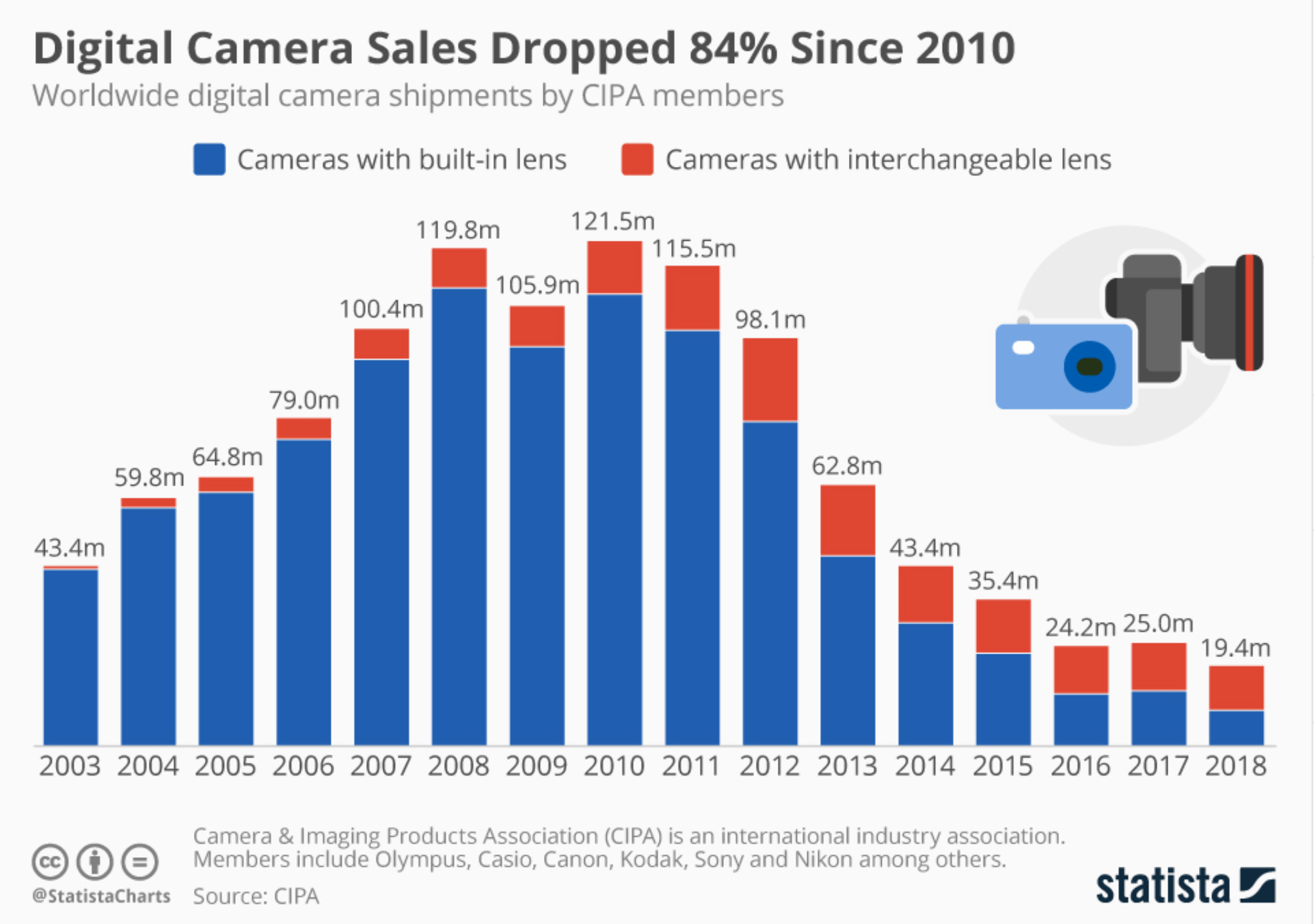
Looks like they killed cameras with built-in lenses. Cameras with interchangeable lesnes, which would've been used by the pros, have kept their market share identical if not grown a bit.
For taking photos and sharing them in the digital only space, sure I’ll buy that for the regular consumer. Making prints will expose all the small sensor flaws that exist quite quickly. I know it gets better every year but I used my phone camera (14 pro) to capture a few important shots that I would do anything to go back and had on a full frame sensor or film for.
I hate pixel peeping on phone photos. Have a 13 Pro Max and it has a really weird mushy postprocessed look. I always bring an oldschool Nikon DSLR with me when I care about getting some nice shots.
Using a third party app and capturing native raw photos helps avoid that mushy post processed look. It trades it off for more noise, but the trade off is worth it imo. Halide is my app of choice but there are a number of good ones.
Well, Apple seems very cozy with blackmagic design but that doesn’t mean that they aren’t going to be sherlocked. Apple already has offerings in all these categories, it’s just that the markets are different and will stay different some time more because of workflows and laws of nature but the laws of nature don’t seem as safe anymore.
Currently, the best editing software for social media appears to be CapCut as its ease of use for the power it provides is miles ahead of anything else.
Cell phones already killed compact point-and-shoots with their small lenses.
But DSLR's with their large lenses aren't going anywhere, because physics. If you want to capture high-quality footage under low light conditions, or work with a variety of lenses, the tiny aperture on a phone is never going to be enough.
The RICOH GRIII/GRIIIx is still alive and kickin'. Really nice sensor, super sharp lens, and small enough to fit into a pocket. I don't really use my iPhone camera anymore.
Agreed. I keep my iPhone in my right pocket and my Ricoh GRIIIx in my left pocket whenever I go out. It’s such a fantastic camera given its size, especially with the APSC sensor in such a compact body.
I also have a Sony A7C but I haven’t used it since getting the Ricoh. Being pocketable is a massive factor in how much I use a camera.
Setting aside the existing pro video pipeline... it's for this reason that if I were Meta, I'd be terrified about what Apple does next, from the perspective of photorealistic capture for VR/AR applications.
Even if the next-gen Oculus had parity with Apple Vision Pro in how vividly they could display VR/AR content - and I doubt this is the case - only Apple (perhaps among any company in the world) can mirror that with a battle-tested supply pipeline for creating pro-level video capture equipment and for integrating those sensors into consumer devices at scale.
While I'd leave the branding to better minds than my own, I'm bullish about Apple's ability to make an "iPad Vision Pro" that has two cameras at eye distance apart as well as laser rangefinding. That would allow for binocular Apple Log capture, and with the advent of Gaussian splatting for point cloud rendering, and increasingly better generative AI for inferring colors/textures of occluded points in the point cloud, you could have professionally color-graded interactive scenes. All that's missing is better ergonomics for this workflow in DaVinci Resolve etc., and one imagines Apple's war chest could go a long way towards incentivizing this.
Apple products will be where high-quality VR content is created, proofed, and consumed. They're not rushing because nobody else has a hope of being close.
> Apple products will be where high-quality VR content is created, proofed, and consumed
Eh... I think this is a bit like claiming "Apple hardware will be where high-quality video games are created, proofed and consumed" in the 90s. You'd be right given the circumstantial evidence, but the industry doesn't really want to play ball. Besides AppleTV and Apple Arcade, I don't think Apple has a huge constituent of VR developers the same way they did for Apps. Simply building the infrastructure won't be enough.
And plus, I don't think your argument rules out a world where Vision Pro is used for recording and Quests are used for content consumption. Unless Apple intends to reinvent the wheel again for 3D video, nothing should stop it from being playable (or at least portable) on other platforms. For most people, the $3,000 price difference will probably not be worth the recording capabilities (especially if they already own an iPhone).
Anything could happen, I guess. Even if you're entirely right though, I don't think Content Creation will be the killer app you think it is. Games and video moves millions of units; productivity and capture are both unproven features poised to reprise Hololens' failure.
I think what is terrifying is that they're better enough to kill the details.
Sort of a contrived example... you're a pro and let's say you NEED a headphone jack, but apple just killed headphone jacks.
But more indirectly, they killed the lower volume, higher margin folks with alternatives that offer a headphone jack, and maybe even XLR headphones and microphones.
An analogy might be tesla giving you a 90% better car experience, except they have killed off the dashboard. (now they've killed control stalks like PRND and turn signals)
I don't know. If I were a pro like that, I would just have a dongle for that headphone jack. It would probably also have a better DAC than iPhones ever had.
A big factor in buying a "pro" camera is controls. It's really difficult changing the focus in a controlled way while shooting with a phone. While in theory you can imagine Apple giving you API control for that and hooking it with an external focus pulling device, it's still a sub-optimal solution.
Cinema is safe from the optics point of view as achieving some of the effects of large sensor + large lens is impossible with a phone size camera. But Apple has it cracked and they could easily crush that market. They have a great sensor with enough resolution per inch, great dynamic range, ability to produce lenses with super low defects and have enough processing power. Sensor wise ~100 megapixels should be enough to replicate fine grain of a good movie film and iPhone 15 sensor's dynamic range of 12-14 stops is on par with film already.
And it turns out, Sony already has significantly better sensors in their cinema cameras than what they sell to Apple, which is why almost half of Oscar and Emmy nominations are filmed on Sony Venice. Even the low end of their camera line is extremely capable, e.g. the FX3 which shot The Creator.
Apple is far away from actually competing in that market.
The market for 'actual' pro & prosumer cameras and such is pretty tiny. I think they'll be pretty safe for quite a long time.
But they have pro video editing features! Yes, but it's a subfeature of their general platform, so they can 'count that low' for a hardware feature like that, that will also be useful for their entire userbase since everyone takes videos with their hardware and watches video on their devices anyway.
I don't see this as a high risk. Rather adding log just increases the choices for different types of filmmaking and adding it to the professional workflow. The iPhone hasn't killed the professional stills camera market, instead many photographers have implemented it as a supplemental tool into their work where a larger camera is not suitable.
At the end of the day, a professional camera with good glass and a larger sensor gives you much more control of an artistic vision, and better performance in challenging imaging conditions. I've never seen a cellphone camera that gets anywhere near the image quality I can get from my mirrorless camera in still images. This is likely to be even more apparent in video production due to how the cameras are used.
They owned the editing market with Final Cut and completely dropped the ball with Final Cut X. To the point they had to start selling the old version back. Then Premiere came back from the ashes and took the throne.
One of the most glaring mistakes Apple did to its Pro market. And they did quite a few.
Some sensors do this internally, unusual though. The rest of the high-end ones apply curves manually in software directly at the egress of the sensor. The reason they don't in all cases is that it complicates black level correction, gamut transforms and demosaic operations (without some assumptions).
Still ending really... There are still travel restriction from metropolitan Melbourne to regional Victoria - expected to end Sunday at midnight. Retail capacity is also limited still, but ramping back up.
I've been using Kicad for the same workloads as you, and Altium + Cadence for heavier ones over the years, and I must say they hit the nail on the head here with their comments about KiCad:
https://horizon-eda.readthedocs.io/en/latest/why-another-eda...
I'll have to find a simple project to test this out on though, because as you say, It needs to be a huge improvement on KiCad to warrant a switch.
Thank you for linking to this. That's a pretty compelling story he's telling, I'll have to give it a go if I can find a low-pressure project to experiment on it with!