I use caddy rather traefik. It's much easier to manage the Caddyfile compared to the traefik YAML config IMO, and we just keep three separate Caddyfiles for local, production and on-prem deployments. There are a plethora of great plugins, we use the coraza WAF plugin for caddy and it works well.
Having had used traefik, caddy and now caddy proxy, I like the latter because labels are simple pointers to actual caddy features (reasonably documented).
I used to have all my docker compose files in elaborate structures but moved to portainer for simplicity. Together with caddy proxy it rocks (well, there are several things missing but I have hope)
Same here. I enjoyed Traefik for being able to use docker tags for my reverse proxy configuration. The mechanism is great, however I did not like Traefiks internal config structure. Caddy is much easier for me to understand and matches my (small scale) use cases much better. Using Caddy via Docker labels through caddy-docker-proxy is about as perfect as it gets (for me).
I love Caddy, I wish the docs were better on production deployments, too many unanswered questions about best practices especially RE: storage and config management. Like how local storage is supposed to be handled when you're using external storage? Allegedly it can be treated as stateless but maybe not?
You basically just have to pray the guy who made the module you need knows what he is doing, because there's no standards for documentation there either. Maintainers really need to put their foot down on random ass modules with 0 documentation providing critical functionality (i.e. S3 storage backend).
Yes. If you don't need all of the service discovery and auto-scaling shenanigans (or are willing to script it yourself), you can gleefully skip Traefik, Docker Swarm, Kubernetes etc. and just use Caddy! It can really do most things and it does them well.
Nice. ListMonk is by the CTO of a very popular company in India, Zerodha. Another of his tool is right now on the top of HackerNews - DNS.Toys - https://news.ycombinator.com/item?id=38899290
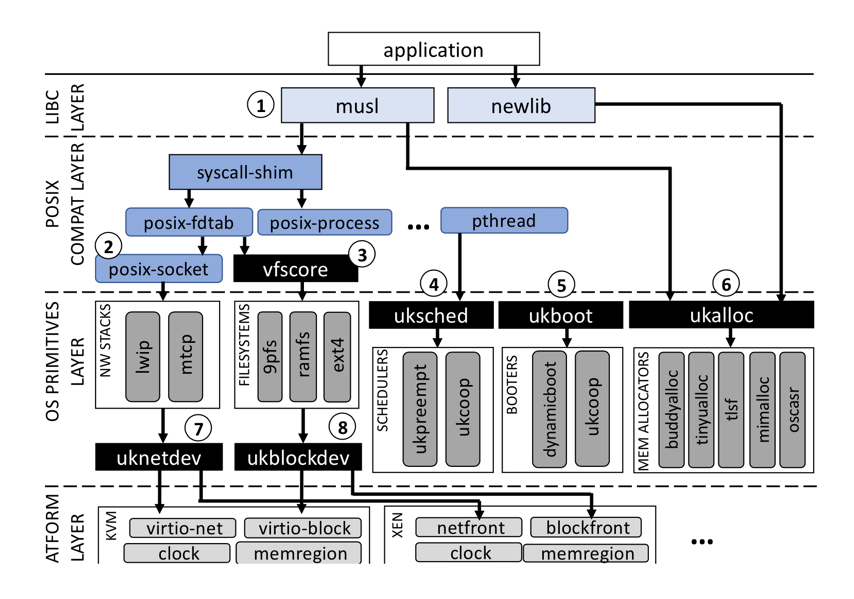
That's why I like the modular approach by Unikraft where the value is you can select which high level abstractions and libraries you want baked in the OS (including your application) [1].
Compared to other unikernels designs where the OS layer is minimal but mostly fixed.
Nuitka is a pretty good compiler! I tried it this year for a small script that was used to automate generating Excel sheets with macros in them on Windows. It worked surprisingly well, but the ~100MB size was a turn off (and our Go binaries seem tiny compared to it). Though, we ended up writing a much faster and practical Powershell script for the same.
But python code as a statically compiled native executable is really cool, compared to other solutions like using pyInstaller.
Wails is great! I've been working with wails v2 on Windows, and it's been a great experience. Built and delivered a Windows desktop application in Go + AntD for a customer really quickly.
It's a little complex app dealing with Win32 API's directly from Go and the binary being just 10MB is amazing, which can be compressed further with UPX.
Though, UPX-compressed Go binaries has a very high rate of being flagged by antivirus software (especially MS Defender).
The goal was having the convenience of building UI in React and have the heavy lifting done by Go. Both, stacks I am very familiar with and work with daily.
I failed the interview for an internship I really wanted in my 2nd year of engineering; I did get a shit internship that summer, but being really shaken at my incompetence, I took up this book, and quite honestly, it changed everything!
It truly sparked an interest in systems for me. The book helped me build a strong foundation in systems; Processes, memory, filesystems, networks, concurrency, synchronization and more. After reading OSTEP, it felt like an epiphany, and I charted a path for the rest of 2 years of college around distributed systems, systems research, and virtualization.
And the best part is that all this knowledge is free! Kudos to Professor Remzi and his work!
Authors deserves respect for keeping this book free.
We were lucky to have a paperback low-cost-poorer-countries edition of The MINIX Book[1]. The code in the Minix book was an eye opener.The code clarifies the concept and sharpens the understanding.
Later on in my career as driver/firmware programmer, Computer Systems - A Programmers Perspective[2] and Unix Systems for Modern Architectures[3] helped a lot to clarify confusions and mysteries.
This book broke down a hard and mysterious topic (operating systems) for a new CS student like me into everyday analogies, which almost eradicated my fear of the subject matter. It had the appropriate amount of technical details to be usefully informative for a college class while also inspiring a more in-depth read of other material that are much more boring. The book is the reason why I love operating system so much, and I continued to take more CS classes as a math major.
Although I haven't completed it fully, but it is absolutely a masterpiece. The structure and the lucid explanation is something every author should learn from this. Not too yechnifal and yet covers every fundamental aspect.
This alongwith Nand2Tetris course can make your understanding of computer and programming works almost complete.
I was lucky enough to take Remzi's OS course. Both he and his wife are excellent teachers, and really truly caring people. I haven't kept up with him since school, but he was the best professor I had and it wasn't close.
Remzi was my favorite teacher by far. His OS class took me from being somewhat interested in computers and CS because I knew there were good jobs on the other side, to being fully interested in computer science and learning everything I could. Truly a wonderful teacher.