My biggest issue with this is that Google wants to inject a piece of hardware into my home that acts as the gateway to my data. A device through which all :
> Incoming data runs through
> Internal data runs through
> Outgoing data runs through
And then wants to be vague about what data they will be pumping to their back-end for analytics/data mining.
I have had a long standing proposal for home automation and I'm curious to know, in this era of insecurity and people vacuuming up all your data, how many of the tech minded people here would be interested in a device which ensures your 'home automation' data stays in your home. This can be quite clearly achieved in hardware and by having an out-of-band oversight controller that literally will not allow certain data to exit the physical domain of your home...
Cloud nonsense? It's called an application and a home automation application doesn't need to run in someone's cloud...
Whose interested? I think it's about time this cloud foolishness for the sake of monetizing someone else's data in an insecure manner come to an end. Everyone loves to rant about 'disruption'... I feel its about time this data monetization cloud bananza be disrupted.
Oh, come on. Just connect your Google router to your Google fiber connection and connect to it with your smartphone or laptop running a Google operating system and Google browser. Visit your Google home page (using Google's DNS servers, of course) to read your Google Mail, or perhaps catch up on the news with Google News, or use Google+ to see what your friends are up to, or get a little work done on Google Docs. Should you do some Google searches and end up on some non-Google sites, don't worry - you're still safe under the watchful eye of Google AdSense and Google Analytics. What have you got to be so paranoid about?
Don't use Google Fiber. Well, shucks - there's not a lot of 1,000 megabit ISPs in my area.
Don't use a Chromebook. Okay. What virus scanner should I install, then? And where should I store my data for backup? And didn't we hear that Microsoft tried to have Windows 10 phone home every damn keystroke or something?
Google browser. Fair enough, Firefox is decent.
Google DNS. Fair enough, unless I have Google Fiber. Then it's kinda weird to not pair them.
Google Mail. Something that looks like GMail has all of the problems of Google Mail. Is Microsoft really a better solution in your mind?
Google News. Come now, the problem of monopoly in news existed long before Google News did. I'd rather people also use Google News than JUST CNN, MSNBC, or shudder, the other one.
Google+. Right, because Facebook is so much better at respecting users.
Google Docs. Again, is Microsoft really better? Or Microsoft + Dropbox?
Google Search. What, I should use Bing?
AdSense and Analytics. Not really my choice, is it?
I genuinely ask this question. What do you think the common person could or should do, that would be better for them?
What, the Apple computer, Apple router, Apple browser, Apple Mail, and Siri?
You have pointed out many of the reasons why this is indeed a hard problem. That's why some of us have been trying to warn about these dangers for almost 20 years. The problem was significantly easier to fight 10 (or even 5) years ago, but everybody - including the technically knowledgeable people that should have known better - decided that shiny features were more important than paying attention to the larger picture and defending their future freedom.
> What do you think the common person could or should do, that would be better for them?
They should not use any service that goes against their long-term interests. While having a replacement is nice, this might require making a sacrifice. The lack of an alternative doesn't justify supporting the bad option[1].
Do you think that this problem is going to get any easier as time goes on? The cost of leaving Google is only going to increase, so it might be a good idea to find a way to pay that cost sooner rather than later.
At least by using a non-Google "free" mail service, file storage service, etc, you're distributing your mineable information among competing companies instead of handing it all over to a single entity. Or, you can do as I do and just find a reputable service you can just pay and not worry about it. (I pay Zoho $24 a year to host my mail.)
> What, the Apple computer, Apple router, Apple browser, Apple Mail, and Siri?
The difference between Apple's services and Google's equivalents is that Apple makes its money by selling you the boxes that the services run on - it doesn't directly profit on the services themselves. For Google, the service is the product, so if they can't make you pay for the service, then it has all incentive to data mine it for profit.
I fail to see how copying my data to more companies reduces my attack surface.
> all incentive to data mine it for profit.
Yes, and it has all incentive to protect my privacy, because if they screw that up, they lose all of my business, and all of everyone else's business, too.
> I fail to see how copying my data to more companies reduces my attack surface.
I'm talking about your privacy and mine-ability, not your attack surface. (Though it does help with that too, in a way - a bigger chance someone will get some of your data, perhaps, but a smaller chance they'll get all of it.)
No. That does not help minimize my attack surface. You're confusing surface with depth. And unfortunately, someone doesn't need to steal very much of my data in order to screw me over royally. If my Social Security number is held by more companies, that does not help me.
>Yes, and it has all incentive to protect my privacy, because if they screw that up, they lose all of my business, and all of everyone else's business, too.
There have been innumerable data breaches and we haven't seen those companies go bankrupt.
Firefox may be a decent browser, but unfortunatly Mozilla has given in when it comes to adopting data kraken integration and has embedded software that can make Firefox en par with Chrome et al in the future.
No more good guys, I am afraid. Mozilla profited greatly from being spread by hackers initially, but now they no longer qualify for being supported.
No source here, I am on a crappy notebook, on the move.
And still, the HN crowd uses Gmail a lot. Here's the most technical crowd on the planet and people are obsessed with Gmail as if it was impossible to get email to work by any other means.
Furthermore, I will never understand why people would use Gmail, if there's IMAP and hundreds of email clients to choose from.
Same is true for Google Reader, that apparently caused a lot of buzz when it went away. Never understood this.
The only Google product I use is Google Maps, and Google Search occasionally. Replaced the latter with DuckDuckGo mostly and works well most of the time.
I would gladly use email client with IMAP server but desktop mail clients are really still in the 90ties.
Do you have a good to alternative Gmail/Inbox which has Inbox like archiving, and easy cleanup of the ... inbox, hiding emails for some period of time, pinning emails?
As for the hosting of emails (assuming I don't want to have 10GB dedicated to emails on my machine), do you have anything that gives me 10GB of mail and has the ease of use of Inbox on all the devices (desktop and mobile)?
Disregarding the (slow) advancements of E-Mail encryption (DANE), and the fact that's desireable that no one company has your data. The big point is that it's fair to assume that everybody has access to your mails while in transit, but using gmail Google has access to all your mails at rest.
"Ditching GMail changes nothing about your privacy situation."
Actually, there is quite a bit to be gained by running your own mail server - especially in relation to other people on your mail server.
For instance, everyone at rsync.net logs into (al)pine over SSH. So yes, if you email rsync.net and we converse, that is like the postcard - every hop it goes through can see it.
But no piece of internal rsync.net email has ever traversed a network of any kind. Internal rsync.net emails are just local copy operations from one mailspool to another.
The same could be true of your company ... or your family.
Agreed. Even if Gmail is superior in some regards (I don't know - is it? There must be a reason so many people use it), as a tech savvy person I consider it a matter of pride (and privacy of course) to run my own mailserver with project like Sovereign https://github.com/sovereign/sovereign
I have been thinking of doing this for a while. Thanks for sharing https://github.com/sovereign/sovereign. Is that all one needs (whatever if mentioned on the README)?
This is a common belief but it hasn't been an issue in my experience of running my email server (with Sovereign) for the last two years. I run about a dozen email addresses over a handful of domains for myself and some friends and colleagues.
Sovereign includes instructions/configuration to run an upstanding email server citizen, including SPL, TKIP, MTA encryption, etc. Remote mail servers seem to respect it at least as much as gmail.
It also runs a rbl-check script once a day to notify you if your IP ends up on a blacklist. In two years running on both DigitalOcean, I've had no issues. Even gmail routinely gets added to RBLs from time to time.
I use Mail on OS X and it is good enough for my purpose. Could certainly be a bit more sophisticated, but most of the time, it works. I like to have a real email client for my mails and not use a web app.
There might be dedicated search engines for emails though, if search is very important.
See, if you use search a lot and Google has the superior product for your use case, that's totally fine. But I guess most people use Gmail out of habit and not because it is truly superior to other email clients.
I'm with you here - I also find OS X's Mail plenty "good enough," including for search. And it works great for connecting to Google Mail accounts via IMAP…
Searching is a solved problem if you use OfflineIMAP to mirror your mail store locally, then run mu or notmuch on top of it. Honestly, it's faster for me to search my local mail store than using some web interface. Plus, i can do it in the train when i have no internet connection. I happily pay a few euros a month for an email server which provides me with IMAP.
I tried Bing Maps the other day and was surprised how much more usable it is. It loads faster, moves faster, and actually has a nicer interface because it uses semitransparent text to show names of areas.
Just finished reading 'The Circle' by Dave Eggers - think Google's monopoly and totalitarianism come true - and this just further reiterates how Google are become so pervasive and invasive in monetising off everyone's data and lack of privacy awareness.
I'll go back to dial-up rather than have all my activity centralised in the Google ether.
The NSA should stop the charade and just buy Google and Facebook already. They already have us by the balls, lets at least make it official and make the world embrace the heroic and always rightful eye of the US government.
I'm glad that people found this to be a point of significance. I've worked in the commercial networking hardware industry for some years and shelved several consumer ideas due to a lack of interest in security/privacy.
I have watched over many years as this 'cloud' software bonanza has eclipsed the tech industry. It went away from its original intent a long time ago and now is used as the holy-grail method of :
> ensuring (rent) is always paid for service(s) people should OWN
> vacuuming up and selling people's data.
I have several projects on my plate. However, I have a solid one for securing people's data when it comes to the IoT movement (in hardware)... It revolves around the same hardware/technology that the industry uses to scrape and funnel your data except the home user will now have it at their disposal as well.
Users should have 100% control of their data. If someone wants to 'monetize' it or use it to 'improve' their platform, the user should be rightfully paid for the opportunity to do so.
Disruption? Yeah, I think it's time. The foolishness has gotten far too long in the tooth.
.. And the backwards thing about it is: there are simple and straight forward ways to secure data (in hardware). It's only because everyone in the industry wants to ship your data all over the place and data-mine the snot out of it that things are as insecure as they are.
The very (loop-hole) or (door) that is used to funnel/mine/monetize/cloudify data is the very one used as an attack vector. Complicating the crap out of things at that point defeats the whole purpose.... Get rid of the door all together and the home is the least of all places where you should be exposing yourself.
Therein lies the 'product' ... I'm working on several projects so I wasn't shy to put the general idea of this one out there... It's one of many things I feel passionately are going to be changed by disruptive paradigm shifts ahead.
That being said, you come up w/ the 'solution' and you'll have your 'product'... I already have a general architecture/approach outlined for myself. Create one and, from the looks of the interest here, you'll have an audience to buy it.
Also, with the scale and depth of hacks occurring around the world, you'll soon have an even broader audience.
If you get funded, look me up ;). I'll be looking for work in the coming months =P.
I'm wondering if / how the identity problem, blockchain proof of physical ownership and ...
Well, firstly applications should stop thinking they are CoW - data is something that gets passed in and operated on.
Secondly data operations should be side effect free - and distributed, so that we can ask for processing- in many ways I would expect not to share my data but to accept payment in return for some slice of processing someone wants
This may work ok, and generally the things we want (social networks) will be fine with local data sharing - facebooks walled garden would have to be replaced with open protocol (ie AOL -> SMTP) and no idea how to achieve that.
So im not setting the world on fire here. But I think the shape of future is clear - just getting there ...
That is why i don't buy into this hype what so ever. Anything that has 'cloud' on it when it doesn't need to I avoid.
I'd rather set up my own router with pf-sense and a industrial WiFi access point.
I really love the concept of complete home automation however the data needs to stay in the home and companies need to ask for permission to mine it.
I have nothing against data mining it can be incredibly helpful but i want full control over weather i choose to share it or charge a small fee for my data.
The whole idea of home automation (and most of IoT) over cloud is absurd. The devices in your home should not communicate by sending packets around the entire globe. The data should never leave your internal network unless explicitly meant to (web interfaces are cool and all, and you want to have remote access).
I'm actually somewhat surprised people don't seem how wrong the current model is, but I suspect it's a mix of cloud being The Hot Sexy Thing and being paid not to understand this (via business models that rely on monetizing users through cloud solution; as some of my hardware startup friends told me once after talking with the investors, hardware won't be making money, the cloud platform will).
So yes, I would be very willing to help reverse this and make local network communication the default for home automation and relevant technologies.
Google's model of how it wants computing to work is fundamentally flawed and now it's infected Microsoft. Really the only shelter is Linux, when will the ignorant masses wake up and realize this?
"Please note that some features may not function with certain privacy settings turned off, and some information (such as the association of your Google Account to your OnHub) is stored by Google even if all privacy controls are turned off"
I am sticking with my Asus AC66U which has more features and is also cheaper than this Google device
http://amzn.com/B008ABOJKS
All software has security vulnerabilities, but organisations have vastly different attitudes toward fixing vulnerabilities as they are identified, and potentially different capabilities when it comes to fixing vulnerabilities in a timely manner.
But Google will fix the security flaws automatically.
You have to compare this device to the typical home router, which is NEVER updated.
And even if you do run an Open Source firmware, you have to make sure it's kept up to date.
Please don't bundle Android and the rest of Google software. They are two different teams with two different philosophies, and one team doesn't like to have it's reputation hit by the other teams faults.
Remember Android wasn't originally designed by Google, and many of it's security design decisions and culture were inherited.
Unfortunately when it comes to data and cloud companies these days, that's a little like saying you'd trust Blofeld more than Dr No because he's a more competent villain.
In case HN is wondering about the reception: it's great by default, but I had some hardware mounted in inaccessible places, which could still have issues with reception.
So I replaced the middle antenna with a WL-ANT-157 from Asus, and wow. It's the best home wifi experience I've ever had in this price range.
Hmm, that "pretty clear about exactly what date they're collecting and why" seems a bit too similar to what the proposed Australian data retention laws ask for, which the community usually refers to it as "vague and overreaching". They make a vague note about not collecting the content of network traffic (but you can infer almost everything important from source, destination, time, protocol, etc anyway) and the table on the page is just described as "examples" of what it collects, and is never stated to be the full list. Given that Google is in the data collection business, and has a licence to update the device (and what it collects) automatically, I would assume that within a short timespan it will be collecting everything it can get away with.
Even what they do mention is enough to start inferring things about your personal life:
With "historical data consumption" they can determine who is in the house and when. With the number and make of connected devices, they can take a pretty good estimate of family size, annual income, how many of your household are working, etc.. (Though they probably first care how many Apple devices there are connecting... maybe we need to send you some more Samsung adverts)
And sure it strips the URLs from the logs -- but between Google DNS and Google Analytics being on much of the web, they can piece back together every site you visit anyway and now your router has a Google account they can tie it right back to the router in your home.
And of course it's a $199 router with a license agreement that says Google can stop it working at any time they like (clause 5c).
Proposed data retention laws? They are in fact actual laws, but they just haven't agreed on how much money the telco's and ISP's are going to get for implementing it.
Good link, thanks for sharing it. I gotta say, though, when I saw that wall of text my first thought was that this is going to be a tough sell for some of us. Thinking about it for half a second, I have to say that I would gladly prefer my router to be as dumb as possible. Maybe I just don't understand, at a gut level, how a cloud-connected router will actually improve my life?
OnHub seems to have a bunch of features which the cloud connection enables that are helpful, but not vital. For some people, having those features isn't worth the potential for additional complexity, and potential vector for privacy or security issues, that having a smarter router entails (or the increased device cost). For some people, it will be totally worth it. I personally think there's value in having options for both kinds of device on the market.
Of course it's going to be a tough sell for some people. We could launch a potato and it'd be a tough sell for some people, let alone launching a WiFi router. :) At the end of the day you either trust the information made available by Google or you don't. If there was less text there, plenty of people would be suspicious that something was being hidden (heck - people are suspicious even with the current amount of text)!
It's okay to decide not to adopt the device in question, and it's fine to weigh how much you trust Google against what benefits you might get from any given device. For the average tech-savvy user, perhaps there's a lower value prop, perhaps there isn't. Some people like having absolute control, other people like someone managing things for them.
I personally think the real answer is not to have a central device, but to spread it out into a peer2peer 'fog'.
There's been some movement in industrial applications via stuff like https://twitter.com/FilamentHQ which leverages hardware accelerated ECC and telehash, using blockchain based DNS systems and other decentralized methods of command and control.
I think a similar direction needs to be taken for consumer hardware and data. The cloud needs to become just another peer.
I've been working with a bunch of interesting ideas on trying to get a distributed IoT network setup using programmable blockchains and Eris industries stack as part of an internship with them.
In P2P networks you'll need reliable peers with sufficient capacity. Making a home server into an always connected peer could solve plenty of issues, such as with routing and hosting.
I would be very interested in helping write some code or contributing money towards making improvements to lock down phone home and other unwanted behavior. I think an excellent starting point is to see if you couldn't take a Mikrotik or OpenWRT/Tomato router and bake a lot of this extra filtering and functionality in. For some of the things that Google advertises like speed checks or choosing an optimal channel or whatever, should be do-able in open source firmware, so I think it would be hugely beneficial, at least for me (and probably many others).
This is exactly why I found the Google branding a bit weird. The smart guys over there surely must know that a lot of us would be suspicious of this device. Why didn't they brand it under Nest, or a new Google subsidiary that would take the initial suspicion-edge off? I think it's a good router at a decent price, but no way I'm putting that inside my house!
> The smart guys over there surely must know that a lot of us would be suspicious of this device. Why didn't they brand it under Nest, or a new Google subsidiary that would take the initial suspicion-edge off?
Why? Most consumers aren't in the ultra-suspicious-because-it-says-Google camp, and most of those who are in that camp are likely to take using a different branding for a project from the same ultimate corporate parent as evidence that not only is the project trying to violate privacy, its also trying to be extra sneaky about it.
I'm not buying it precisely because it is Google branded.
Unlike most of the comments here it isn't a privacy issue for me, I totally respect the privacy argument but personally just don't care enough to make decisions based on it... for me, the issue is that when I think of Google and hardware I think of the Nexus Q, Google TV, etc. Google suddenly (and relatively quickly) drops projects like this on a fairly regular basis and when the whole thing is all "cloud-this-cloud-that" dropping support basically means you've got a conversation-starting paperweight.
It's unlikely Google drops projects any more frequently than startups fail. I have (or have had) a lot of paperweights manufactured by failed startups, so I know it happens. I'm sad when startups fail, but they usually failed for the right reasons. It doesn't taint my overall perception of the startup concept.
If you think the Nexus Q was a fantastic product and that Google made the wrong decision to kill it, that's one thing -- you're saying they have bad taste, or bad product sense, or an inverted sense of quality vs. crap. I wouldn't agree with that assessment, though I admit it's an valid, internally consistent opinion.
But it's more likely you never owned a Nexus Q and are just using it as an example of how projects at Google get killed. Sure, Google kills projects. Just as startups fail. That's no more astute an observation than saying that sometimes it's sunny and sometimes it rains. You wouldn't expect Google to keep funding a stalled or not-quite-thriving project any more than you'd expect investors to keep plowing money into a startup that can't find product-market fit. Sure, the opposite outcome sometimes happens. But generally it doesn't, and that's OK.
Some think Google is valuable because it takes more risks than companies its size. The implication of your opinion is the opposite -- that Google should be more risk-averse (not starting this router project because a router is a crazy thing to build), or innovate more slowly (launching it later than today because it's not ready), or ignore market feedback longer than a startup would (damn the torpedoes, it sucks and nobody wants it, but let's keep its team on a death march). Is that how you'd run Google if you were its CEO?
"It's unlikely Google drops projects any more frequently than startups fail."
I don't disagree, which is why I also don't spend money on startup consumer goods that have any sort of requirement on "the cloud" (if the company dying makes the product virtually worthless, count me out) and also why I virtually never back tech kickstarter-style projects.
My opinion on google is that they are extremely bipolar (or at least give the external impression of being so) when it comes to experimental projects, they seem to go through periods where they are open to trying new things and then (very quickly) to periods of retraction where things that aren't ad focused are left to wither and die or just killed outright. I don't want my money caught up in their mood swings unless the value proposition is amazing, and in this case it really isn't.
The difference is that a non-cloud-reliant device can be sold to me and then abandoned by the company that made it some time in the future -- yet it still remains a usable device. Now whether the OnHub falls into that space or not I can't really say for sure; in this instance I actually doubt it does (my guess is it would remain a useful router even if the cloud-connected features were dropped for some reason).
It's also the frustrating potential that the product will be 98% awesome but with niggling problems that don't seem to get fixed as it's abandoned quickly; ie- my recent Ask HN submission about Android TV.
The yellow Google Search Appliance for enterprises is about a decade old. You can still buy them today.
The Nexus One was branded Google. I wouldn't say it's supported by Google anymore because it doesn't receive firmware updates. Google first released it in early 2010.
The Chromebook CR-48 was first released in December 2010, but it wasn't a Google product (unbranded). It still receives software updates today.
BTW the new router isn't a Google product. TP-Link makes it. Google just controls the software, the way Microsoft updates Windows on third-party PCs.
The ratio of people who think about the implications vs the general public who consume rather than question is weighted in favour of big name companies.
There should simply be more coursework on privacy, classroom discussion on information monopoly, corporatocracy, ect... To level the field, it takes Education. (and I'm not saying the router is evil)
"I feel its about time this data monetization cloud bonanza be disrupted."
Ironically, having users controlling their own routers could be the best chance to do that. That is, toss out the crappy consumer routers and instead embrace the router as a user-controlled computer that sits between the user's devices (including IoT devices) and the ISP connection (e.g., modem). This router could run an open source source OS and be programmed _by the user_ to do all sorts of useful things, such as block ads, block tracking, perhaps even create private overlay networks among family and friends, protected from spam.
In a world where the Internet user can have some respite from radio, TV and other advertising, Google (=slave to advertisers) should not be selling routers. Should they come to dominate the market, the respite will come to an end. Users probably will not even know what happened. No one pays attention to routers as computers. They just want a strong WiFi signal.
I don't think there will be a significant market for your idea. One of the most rapidly adopted technologies of the 20th century is Color Television [1] and it still commands 36% of our attention [2].
Consumers have made it crystal clear that they are willing to trade their time and data for lower prices and more convenience. Watch the commercial on that landing page. It couldn't be targeted less at technical people.
False choice. It's not impossible to make something that tastes good and is also good for you. Some people find that Apple products are desirable, and incidentally, Apple provides a relatively high level of privacy.
But you can never expect Google to provide such a product as long as it makes money off your data. Maybe it needs to be under a different letter of the Alphabet.
Well I don't think there is anything inherently wrong with Google. So suddenly people have started to become suspicious about what data a router is able to collect, while in fact various routers which are well capable of executing malicious applications have been around forever? This is just a trend and Google is not some inherently evil guy that acts outside of the norm. Ditch Google? Fine. The next alternative you find is equally, if not more, likely to perform some data collection. Of course you can go full Stallman and ensure your data are truly guarded by your own in every possible sense. But the heavy price that comes with it, we all have seen.
I started developing a self hosted home automation framework for my senior project last year. Been on a bit of a hiatus, partially because I don't have my own place currently, but its here: https://github.com/terramod. Central web application that can run "apps" on your house, with raspi nodes that connect the hardware around the house.
I too am a bit surprised to hear tech minded people get excited about products that basically exist to collect their data.
From what I can see though, the hardware looks decent... Personally I'm curious for when someone does a teardown, to make sure there are no hardcoded callbacks to Google servers that shouldn't be.
If not, this wouldn't be so bad (for $200) running DDWRT/OpenWRT?
[edit] Also, does anyone know if the base firmware will be open source similar to Chromium? If so, one could theoretically still take advantage of their security updates (which would honestly be leaps and bounds above current consumer-grade hardware) with open source tooling.
I agree with you, but is this specific to only home automation? Shouldn't the same paranoia / concern (depending on who you're talking to) apply to critical company data (documents, source code, etc.) as well as personal health information (biometrics, etc.)?
It isn't just specific to home automation. The same paranoia should apply to all data and will once people understand the gaping holes in existing cloud centric/data funneling architectures. In the meantime, a new approach to the problem is worth looking into. As the speed of technological innovation increases more and more, so will the disruptive paradigm shifts.. and this cloud model is long overdue for one.
Yeah, but by giving more data you let software to personalize better. So by reducing your data exposure you are acting as techno-Luddite stiffing progress.
I don't think we will suddenly abandon the cloud. If anything, we will centralize even more information. My biggest philosophical debate is what will happen to people who deliberately protect their information. Surely they are meatier targets by various adversaries, but the thing that bugs me most is the fact that you will become irrelevant. Lack of data will impede even some most basic services and probably you won't be trusted because Big Cloud doesn't have your profile.
> Yeah, but by giving more data you let software to personalize better. So by reducing your data exposure you are acting as techno-Luddite stiffing progress.
Is this sarcasm? I guess I fail to understand how Google now knowing all the details of my life impedes "progress". It shouldn't stop them from developing new technology; why does the "cloud" need to figure out how to "personalize" things more for me anyways, outside of the obvious answer to serve up better targeted ads (which I'd rather make go away by any means necessary)?
Google's core is still about serving you information and possibly some knowledge. To get better insights they need more information. It is as simple as that. MS entered the same field with Windows 10. They need more data to give better Cortana experience. If it's not all the data, Siri, Now & Cortana would suck. Now we are witnessing them going mainstream.
Merging cloud tech (automatic redundancy, intelligence) with P2P tech and giving the user full control is what is needed.
Secure smart home servers that act as rendezvous servers for your end-to-end encrypted connections so you have smooth links and network switching, routing, file hosting for your privately shared media (using tech like Tahoe-LAFS), anonymization (why run multiple Tor/I2P clients in a network when you can have one trusted device do it?), simple access control so you can easily determine to gets to connect to your home automation hardware, etc...
Worried about Security then look @ this wolflink routers. They are far better than this onhub and it can be controlled directly from mobile and the highlight of this router is that it comes with parental control https://www.wolflinks.com/
"As a side note, I'm surprised this isn't marketed alongside the Nest branch. It really has the look and feel of Nest products with the LEDs and the speaker aesthetic. Also surprised this isn't an "Alphabet" product."
It pretty much is... it's their way of sneaking the 'home automation' core/aggregation box into people's homes masked as a wireless router (for now).
I'm sure the capability you mention will come heading into the future. The only question will be : execution/security and will a competitor come up w/ a more secure/well executed product which won't serve as a data vacuum hose to google.
This kind of product launch on the heels of their massive alphabet re-org with no understanding where it came from (division wise) or what its goal is leads me to question whether the re-org is really going to move google beyond its former execution flaws ...
Deeper than that, even. It seems like this is intended as a local-network cloudlet[1] substrate.
Launch an app on your phone that needs a companion frontend server instance to talk to? One gets launched "in the cloud"—specifically, in a virtual cloud owned by the app author. But where is that instance, physically? Usually a provider like AWS... but with a cloudlet peering arrangement, that instance could instead end up running on your router. (Not as crazy as it sounds if your app has an N:M frontend-backend server topology.)
I've been toying with terminology to deal with the idea of a decentralized p2p cloud. Calling it a 'virtual cloud' seems off, and 'fog' has been co-opted by other kinds of tech. Any thoughts on what would be a good terminology for this?
Come to think of it, that's why Google is so behind Thread - they want a mesh networking protocol that's not exclusively local, but can connect each one of the embedded systems directly to the Internet with their own IPv6 address. Although, the protocol does support using a "gateway", too, but I have a feeling that won't be made the priority for most Thread-enabled devices.
There are decent solutions to this already. INSTEON works great. It's got dual-band connectivity (wired and wireless) and you can either use a cloud hub if you want, or control it locally with a computer.
I can't tell you how many Insteon switches I've replaced in anger because they start flashing, stop responding to button presses, start beeping - one didn't even stop when I pulled the air gap switch. I'm well versed in their tech and in electrical systems, and everything was installed correctly, in some cases with fresh neutral wires pulled through direct from the neutral buss bar in the service panel, just to avoid potential crosstalk/current leakage, since they communicate over wires as well as via two way radio (newer spec switches).
I know it's anecdotal, but the Insteon forums are filled with similar stories. I was a very early adopter and have been through several generations of devices, and I'm committed to using another platform when I start replacing the remaining Insteon switches that will inevitably die.
I wouldn't recommend Insteon to anyone. X-10 was more reliable in my house. I'm evaluating Zigbee options now.
I just bought a Zigbee Winkhub because I was looking into something to play around with to remotely control lights. I also wanted something that I could hack and run my own code on. The Winkhub is relatively easy to hack. I've only been using mine for about a week now but am very happy with it. I've only tested mine with lights so far.
Why is that every such time a system is extorted/exploited to the point of disaster, the same individuals who pushed it to that point then want to say 'We need to deal with the problem'.. The problem they very well and knowingly created.. And they never speak up before this point.. It's only after they've sucked every last drop out of the system.. And Oh' b.t.w:
> lets not solve it by fixing the exploits that created the problem in the first place
> lets not go after the individuals who exploited it the most and their gains
Lets solve it by :
> extorting/exploiting the income of everybody
> Putting a band-aid on the problem
> And Oh', btw, lets put the people who created the disaster in charge of administering the program
Is this supposed to be a joke? And why does society fall for it every-time?
And I like how socialism is being promoted as a solution while the very same jokers who decimated American culture/free market capitalism are pumping in illegals by the boatloads. It's as if they're already prepping to tank/exploit the next system that gets paraded as a solution. Yeah, so there's not enough jobs and the jobs there are don't pay enough because we allow corporations and individuals to extort the crap out of everything a person needs. So, lets ignore all of that and have :
> Guaranteed income
> Free healthcare
And since there isn't enough to go around in way of jobs, lets have :
> Open borders so people can overload the system
> Tons more legal immigrants
> Tons more illegal immigrants
And lets not focus at all on education so people can actually be productive... In fact, lets make it harder for the educated individuals by importing tons of competition from outside the country...Yeah, that'll work out great
Who pays for all of this? Certainly not those who create/created this disaster. But yeah, socialism will fix things. After-all, it works in Europe where they have all of the things we don't have :
> Far more strict immigration
> Far more Homogeneous culture and population
> Far less exploitative economic system
> Far more educated and involved populous
> Far less corrupt government
*Facepalm .. Here we go again .. For anyone who doesn't see that this country is in sharp decline, I wonder.
Every time, America puts the foxes in charge of the hen house and then people wonder why it ends in disaster...
When you fix a bug, do you target the root or do you try to find the most inefficient and indirect way of fixing the code issue? If you have an unreliable code base (economic equality), do you initiate an unbridled code blitz among your worst software engineers (Unbounded illegal immigration)?
I feel like I'm in the twilight zone sometimes in this country... But then, I stop and look around and I decide to see it for what it is and then things don't see that strange after-all.
Who says we are falling for it ? Most people think: "What are we going to do about it ?" And that's actually a rather good question. At this point the best solution are avoiding buying from abusers, and voting better (if that is a choice where you live).
The alternative are mobs/pitchforks/revolutions. But that's a bit like war, you only start one (well any sane person/country anyway) if it's (one) of your last resorts.
It's simple ... Everyone got 'hip to the game' of extorting other people's productivity vs. being productive themselves (aka rent at elevated prices)
> The housing bubble that blew up was re-inflated to keep tax revenue alive and keep the economy afloat (High entry cost warranting high rents)
> Fed rates have been kept low attracting speculation
> Tons of investment firms got into property management/real-estate
> Money seeks easiest method of return.. My father once said "People will always need a roof over their head"
> The U.S is pumping immigrants in hand over fist to offset lowered U.S birth rates (to keep the hamster wheel turning)
> Housing is a need and, as such, there is a ton of room to exploit people... (Markets they call it)
The funny thing about people highlighting wealth inequality is that those in the middle exploiting the crap out of each other for their own gain don't get the huge role they are playing in the over-all outcome. Meanwhile, it's those at the top who are making the lion's share of the profit while the dummies below eat each other. Of course, this eventually ends in tears but myopia causes one to ignore that and get what you can while the good is still gettin'. Bay area landlord "I heard your salary went up.. Your rent has just went up too"
A true zoo.. and to think what American society would be like if we were trying to elevate each other as opposed to coming up with creative ways to exploit and keep others down. Instead of focusing on academic or economic interpretations, the biggest thing manifesting is : greed/selfishness/lack of comprehension of a greater whole
We also set up regulations to make building truly dense affordable housing impossible. Where it is possible, it offers lower returns than low density luxury housing.
> [affordable housing] offers lower returns than low density luxury housing.
Not true - as a RE investor you're always looking for around 1% of the property's value per month as rent ($1 in rent per month for every $100 the property is worth). Much below that and you're not going to have sustainable cash flow.
It is much, much easier to get $1k per month in rent from five $100k properties than it is to get $5k per month from a $500k property. Especially in areas with high property values (California), you're lucky to break 0.4-0.5%, which is not going to support any meaningful level of investment, only speculation. Which in turn helps drive a cyclical market, which helps pump up the higher end home values, which further hurts cash flow, etc etc.
Lower value housing may offer lower returns in an absolute sense but as a far as ROI it's much easier to make it on the lower end of the scale.
The 1% is based on those costs. If the costs to build affordable housing are greatly inflated due to permits, city fees, professional services, zoning waivers, subsidy to BMR, and additional construction costs, the ROI will be artificially lower than single family detached luxury homes.
In addition to building, it is harder to buy. If I had bought a large SFH, I could have put 3% down (FHA loan). Instead I bought a smaller townhouse, and 95% of lenders would not accept any less than 25% down.
It does make intuitive sense: build profitable luxury housing and the affluent will move in there, and while it ought to depress prices on cheaper places, a bunch of new condos does wonders for property values, which in turn drive up taxes, and therefore rents.
> The U.S is pumping immigrants in hand over fist to offset lowered U.S birth rates (to keep the hamster wheel turning)
What is your evidence for your claim that the US is 'pumping immigrants'? Like immigrants are sludge? It strikes me as a particularly absurd conspiracy theory with debasing connotations.
The entire town I live in is single family homes owned by a few slumlords renting $400k-500k houses which they bought 5 years ago for $200k-300k. The rent has gone up 20-30% in the past year; however, the demand to rent is still high since no one can afford to actually buy anything.
Where $900/mo got you a 1BR apartment over someone's garage 20 years ago. Wonder what it gets you now? I forgot how bad Fairfield County was after I left.
Your thesis seems to be that landlords have massive pricing power that allows them to exploit people by raising prices. But in most (not all) places it seems like that shouldn't be the case...
- There are many landlords in an area, ranging from large to mom-and-pop's with one unit (ie, lots of competition)
- There's virtually no barrier to entry
- Information is freely available via Craigslist, Zillow, Padmapper, etc
- Switching costs are reasonably low (yeah, it's a pain to move, but it can usually be done for about a month's rent, or cheaper if you do more work yourself)
- There are substitutes readily available, such as renting in a nearby area, larger/smaller/better/worse units, buying a house/condo, moving in with friends/relatives, etc
About all landlords have going for them is that it's a moderately illiquid market (due to year leases), and units are not completely fungible. So this all looks to me like it should be a reasonably efficient market, with landlords having little ability to push prices away from the supply/demand balance. And indeed that what's I remember from renting, and what I've seen from being on the landlord side.
How exactly is it that you think landlords can ignore all of the above and charge unfair rents?
(Note, all of the above only applies for markets that are large enough. If you live in a market with only 3 landlords, then welcome to the oligopoly and prepare to get screwed.)
Wouldn't having the upfront capital to buy another house be the first barrier to entry? Buying a second house these days is much more difficult than say 10 years ago.
>How exactly is it that you think landlords can ignore all of the above and charge unfair rents?
Because if you don't have a down payment you can't get a loan to buy a house. So you rent, but you are also competing for a rent house from the other 1.2 million Americans that lost there in 2008 and are not likely to be able to buy a one since then. This pushes the balance of ownership to the rentor, they can now build up large down payments for second, third, or more houses that the people with higher rents can no longer save to reach. Renting farther away or worse units isn't necessarily a reduction in costs, for example driving farther is, in fact, not free in time or gas.
>Information is freely available via
To both parties. Which means, and has been happening that one landlord decided to go up in price and the others followed because that person was successful in doing so. Most renters will stay where they are even if prices go up because moving has large physical, monetary, and opportunity costs. Even if 50% of the rent is what would be considered cheap it will remain at 100% capacity and rarely show up on the market.
Buying a property does take some capital, but large amounts of financing are much more easily available for property than for nearly anything else. There's also lots of tricks like getting a near-zero-down FHA loan, live there for a couple years, then move and turn it into a rental. Anyway, all that is looking at the individual person. If landlords were actually getting outsized returns, you would see outfits with tons of money going into it. There has been some of that, but not a ton, and that has the effect of increasing supply and reducing returns.
>>but you are also competing for a rent house from the other 1.2 million Americans that lost there in 2008
You seem to be assuming that those houses they lost were bulldozed or something. The amount of vacant housing increased by the exact same amount. Those houses were available for other people to buy (perhaps instead of renting) or to increase the stock of rental housing.
>>one landlord decided to go up in price and the others followed because that person was successful in doing so.
If there's sufficient demand for everyone to raise prices, then it was underpriced before, or demand has increased, or supply has decreased. In any case, that's just how markets work - it's not the Evil Cabal of Price Fixing Landlords.
>>Most renters will stay where they are even if prices go up because moving has large physical, monetary, and opportunity costs.
There's some inertia there, certainly. But it's not at all difficult to shop around and see if your new rent is out of line, so it's hard for landlords to get too far beyond the market.
Also, contrary to what tenants seem to think, smart landlords don't casually kick tenants out. Turnovers are expensive (vacancy, repairs, cleaning), time consuming, and risky (the new tenant could be worse than the old one). Tenants that pay on time, don't wreck the house, and don't piss off the neighbors are like gold. Smart landlords only raise rents on good tenants when they're pretty far below market. Of course, bad tenants are a whole different story.
I lived in LA for many years and I took the bus for a lot of them. I saw people commute for up to two hours across the city to get to work and the same amount home. I agree that is not ideal. But one option is to commute farther in order to pay less for housing.
But imagine that you have a family, youre established have kids - they have school you have you network of family and friends etc...
I think that the only people who actually ever make this argument are young singles with no kids that think "duh, its so easy to just commute farther!"
The rent difference in say Pittsburg CA to Oakland/SF is NOT that much different -- but the commute costs (time & money) are enormous.
What you may save in rent, you lose in every other aspect of daily life.
To make the argument of "just commute farther" is just too simplistic a view.
It reminds me of Bush saying how industrious and admirable it was for a single mother to have to work three jobs to support herself.
Actually I have two kids. As I suspect many of the people on the 534 bus in LA did.
"What you may save in rent, you lose in every other aspect of daily life."
What you're suggesting is that you might value the other aspects in life over the money saved on rent. I agree with you there. I love spending time with my kids. But know that other people are also trying to place that same value themselves. When a majority of the people are reaching the same conclusion then the housing prices will go in the direction demanded by the majority based on supply and demand.
If the majority of people decided that commuting farther was worth the trade off then housing prices would ease up. And then more people could afford them. Eventually a market price would be established.
I feel like bringing Bush into the conversation is a red herring as many people will have a strong reaction to that in one way or another and lose sight of the conversation we are having.
No, options are situations that which work with all factors weighed in.
Got kids and have them at daycare like the person I replied to (and me)? You MUST pick them up by a certain time, but lets add two hours to my commute, and even if I can pick them up later now they get dinner later, bed later, my after hours work or routine gets later.
The commute farther argument is naive for many many situations.
What you've just explained is that some options are very much preferable to others. What you haven't explained is how preferences means that less preferred options cease to be options at all.
By all means, call this a "simplistic lens", but please don't try to avoid that you have options.
Agreed as far as stealing others productivity goes.
There's also another explanation: millenials prefer to live in cities, where there is a higher density of jobs and similar people. Millenials grew up in the suburbs in large numbers, and are migrating to the city as soon as they can afford it comfortably. Affording city rent comfortably means that there's room for the rent to rise, so it does, until they can't find someone to pay.
>millenials prefer to live in cities, where there is a higher density of jobs and similar people
lets focus on something else here too...
A millennial is very likely to be working in an job that high speed internet service or connectivity in some manner. It is much more expensive or impossible to get these in rural areas. For example 'digital media worker' > 'large files' > 'good internet service' > 'urban area'. If you've ever been out in the country and had 1.5Mbit down 768Kbit up DSL and tried to work on it, it's extremely frustrating. Even though the rents much cheaper, you'll go broke trying to live there.
I've asked this question many times to people deeply educated and versed in economics and never got a a good answer...
In a world of currency pairing (ratios)
A:B:C:D:E
Assuming parity among A:B:C:D, if each country prints 1 Trillion in their respective currency, what is the net effect aside from inflation 'potential'?
100:100, 1000:1000 .. It's still 1:1.
Assuming there are deflationary forces countering the inflationary force of printing, nothing changes beyond maintenance of status quo.
The more and more I look at this picture, the more it appears to be global maintenance of status quo to, in the face of destabilizing systemic forces, keep things stable via countering forces (printing)
The only thing I can see suffering here are the variables outside of the clown show :
> Natural resources
> Environment
^ (Economic system becomes disentangled with underlying condition of resources/environment)
I guess this is where the eventual selling of 'global control' of these variable comes....
> Assuming there are deflationary forces countering the inflationary force of printing, nothing changes beyond maintenance of status quo.
In the net, yes, but another way of looking at this is as a wealth transfer inside each country.
In the net, the pies remain the same size, but each individual slice is worth less and less.
The result is that as each government is playing the devaluation game to keep up, the organizations with early access to the newly printed trillions in respective currencies increase their relative percentage of the pie.
It's the status quo at the inter-country level, but it's a huge wealth transfer to the politically and financially connected at the local level.
All of this works in cycles.
There once was a time when people were flocking to the suburbs. Now, it is fashionable to live in the city. This too will pass when people (a generation maybe) comes to understand the little value obtained from all the chaos and activity.
What are people chasing? Technology has made it easier to be in touch and socialize w/ people beyond physical geography. Transportation is getting better. Yet, people are centered on cramming into cities. The concrete jungle... Living among all the action but having no time to enjoy it because you're too busy busting your ass to pay for the insane cost of the 'privilege'.
I used to live in Mountain View, CA and knew more about San Francisco and the cool things than most of my friends who lived in the city. Many times, I could get to places in the city faster than friends living in it.
What's the allure? When I think of California, I think of the beautiful outdoors and geography... Not cramming into a concrete jungle.
Hey look, I live in the city. I don't have a car. I pay a company to clean my place. I pay a company to do my laundry. There is no parking available for friends visiting me. I can't host anything at my place because its so small. I have to do all of my get together events 'out'.
The city generally provides the illusion that you are part of something that's bigger than you really are. Young people haven't formed a clear definition of this. So, they flock to the city which provides it in 'instant' form. This changes when a generation after realizes the cons of one thing and seeks out the pros in another. Or, when you get older and wiser.
As the saying goes, a smart investor is selling when everyone is buying and buying when everyone is selling. With all of the distractions of technology around me, I desire peace and quiet when i am at home. When I want noise and chaos, I go to the city. The big thing is, I have a choice in the matter and live by the beat of my own drum.
When you are young, you have no sense of this 'beat'. The city provides a steady one. Will the youth be able to maintain affordability of the city? How long will this cycle last?
When I think of California, I think of the beautiful outdoors and geography...
Which an office park isn't, either.
Of course the outdoors and mountains are very attractive but they're not a viable workplace. While many of your city complaints are valid, it's not as if the suburbs solves all of them.
"There is no parking available for friends visiting me."
Sure, and if you live in the suburbs there is plenty of parking but nothing to do.
>Sure, and if you live in the suburbs there is plenty of parking but nothing to do.
It all depends on the person. When I was younger I enjoyed city life, but now that I am older and have kids I prefer hanging out with them at the park near my suburban dwelling.
The city offers certain people plenty to do, and the suburbs offers other people plenty to do. Finding out which one appeals to you and getting there is one of the tricks to enjoying life.
100% agreed. That being said, there are larger trends beyond an individual. Dominant ideology exists beyond my experience and your experience. When I was younger, I had a blast in SF. I wanted to be seen. I wanted to be discovered. I wanted to discover. Then you find out the truth and grow beyond it.
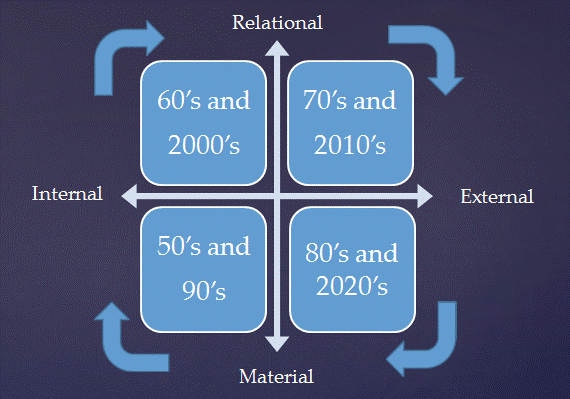
Some generations grow up believing they need to be in the city .. Some generations grow up believing the city offers nothing but noise. A more external generation loves the idea of a dense city. A more internal generation sees it as a chaotic detraction. This sets the tone beyond our anecdotes. Right now the tone is : external (city). This larger trend will change. It already has been demonstrated by the huge suburban dwellings that built en masse and the multiple generations who grew up in them w/ no desire for the city. I developed lasting relationships .. What did I do as a kid in the suburbs? LOL, I got an education and enjoyed an innocent and beautiful childhood. College/20's .. I enjoyed the city but never frothed over it (I was part of the suburban generation). There's a new wave that feels that no life exists beyond the city ... It's a cycle.. A trend ..
Taking the bay area as an example, living further towards south bay allows me to shoot out to the outdoors much quicker than being in the city. Office park? When I'm at work, I want to be focused on my work .. Not distracted by the noise of a city.
As for the city, when I want to go there and enjoy something in particular, that's what I do. You can list off every music venue, club, restaurant, cultural event, park event in the city .. I've probably been to the majority of them. It's called getting off your bum, and going to where you want to be. I can jump on 280 and can get to many places in the city (40-45 min) a lot faster than my friends who live in it.
Weekend in the city? Jump on BART and go explore. Bike around the city? Jump on BART and bike around the city. Uber/public transportation are there for me just like it is for people in the city.
The thing is : When i want peace and quiet I can get it. When I want to focus in my own space, I can have it....
The noise/chaos is attractive when you're young and have not found your own sound. When you have, the city becomes a lot less attractive. More interestingly, the city doesn't necessarily help you find yourself any faster.
The noise/chaos is attractive when you're young and have not found your own sound. When you have, the city becomes a lot less attractive. More interestingly, the city doesn't necessarily help you find yourself any faster.
Absolutes like this don't really help. That may be true for you, but it isn't for all of us.
Of course the outdoors and mountains are very attractive but they're not a viable workplace. While many of your city complaints are valid, it's not as if the suburbs solves all of them.
Given all the technology that supports remote working, it's a terrible shame that we still take this for granted.
This is not a cycle. What happened to urban development in the mid 20th century was a historical anomaly. People have always lived closely. Look at any historic town; they were designed for walking. And if you lived outside of a town or city, it was because you farmed the land.
Cities grew for thousands of years. Suburbs have had a 50 year run. Maybe it's oscillation on a exponentially increasing frequency, but I'm more inclined to think that suburbs were a temporary aberration.
People seem to like to be together, and throughout technological history the infrastructure scales better in cities as well, so even if people were indifferent to isolation vs. socialization the economics would favor urban development.
I'm skeptical that you can call this a cycle when we have no idea what's going to happen... Suburbanization isn't some recurring thing that's happened countlessly throughout history.
It's also possible to have urban, walkable neighborhoods where parking isn't extremely difficult or expensive. SF is pretty atypical in the US when it comes to population density.
Actually it isn't (several studies have highlighted this).
The reason why a lot of cities aren't better for the environment is that the insane cost force many people out to the cities edge who then have to commute in... negating a good deal of the concentration benefits.
Further, cities can wreak havoc on health due to the concentration of pollution, noise, etc ... Increase mental health issues due to stress/etc.
Human beings weren't meant to be crammed into concrete jungles in shoe boxes filled with noise and chaos.
We have decades of data from dense European cities that indicate better health and quality of life. Also just look at the health of rural people versus urban people in the US--the obesity crisis ain't happening in cities.
>The reason why a lot of cities aren't better for the environment is that the insane cost force many people out to the cities edge who then have to commute in
That's not urbanization. Urbanization is where people live densely, removing the need for so much driving. Half of a suburban family's energy use is devoted to driving.
My data is on the analysis of U.S cities. Please use Google. That's what were talking about right?
Dense European cities are not designed like U.S cities namely in way of transportation systems... That's the number one point you're missing. Europe != US. Europe has tons of suburbs btw. You should travel outside city cores the next time you're there. Europe's transportation network doesn't revolve around highways and individual vehicle transport. Thus, they don't have the problem the U.S has in way of how people get into city cores.
Not to mention, you're missing a huge difference w.r.t to how jobs are scattered throughout the U.S vs europe and the affordability of housing therein.
Since the U.S's transportation system is not like Europe's nor are the city centers, the U.S's cities are most definitely not more efficient when you consider the total cost (the huge pollution cost, the time cost, and inefficiency of people who can't afford/fit in the city commuting in)
I really wish people would do more research before down voting people's comments and rebutting commentary with unsound rebuttals .. Downvotting is not for voting down comments you don't favor. You express that in comments and allow for responses to clear the air... which I have
> All of this works in cycles. There once was a time when people were flocking to the suburbs. Now, it is fashionable to live in the city.
American suburbs are something of an anomaly. They've existed for a relatively brief period of time, and they seem to be waning now after a few generations. I think you may be conflating "small town" and "suburb" to some degree, when I wouldn't consider those things to be exactly the same. Towns have more centralization and more personality. Suburbs are characterized by sprawl and you tend to end up with chains and nothing really unique or notable.
> Hey look, I live in the city. I don't have a car. I pay a company to clean my place. I pay a company to do my laundry. There is no parking available for friends visiting me. I can't host anything at my place because its so small. I have to do all of my get together events 'out'.
I don't have a car payment, or a car insurance payment, and I don't have to deal with maintenance (cost or time associated with sitting at the mechanic). I actually do clean my own place and do my own laundry, but I've considered paying for these things to free up more of my time. I don't see essentially buying more time as a bad thing. I frequently host things at my place, but then I prefer smaller gatherings anyway. We cook, we drink, we talk, we play games. There's plenty of room for that.
> The city generally provides the illusion that you are part of something that's bigger than you really are. Young people haven't formed a clear definition of this. So, they flock to the city which provides it in 'instant' form. This changes when a generation after realizes the cons of one thing and seeks out the pros in another. Or, when you get older and wiser.
This seems like maybe a weird over-generalization of personal experience. I don't think I know anyone that's moved to the city to "feel like part of something bigger". There are a ton of good jobs here. I rarely have to leave a 2 mile radius because my favorite restaurants, doctor's office, grocery store, parks, museums and stores are all right here. I live a pretty quiet, comfortable life where a lot of nice things are very convenient.
> I have a choice in the matter and live by the beat of my own drum. When you are young, you have no sense of this 'beat'.
I honestly don't even know what you're talking about here, maybe another generalization of personal experience. I didn't move to a city to "find the beat of my drum" or learn who I am as a person or any of those things. I've lived in rural, suburban, small urban and massive urban areas. Both urban areas were far and away more enjoyable than the suburbs or rural.
I visited a friend out in suburbia recently and found the identical office parks full of identical grey rectangular prisms and identical houses and Chipotle after Chipotle depressing. All there seemed to be to do was drink shitty beer at depressing "Irish" pubs. She complains that my city is too dirty and requires too much walking. To each their own, I guess. But I don't think your change in personal preference is indicative of any massive cyclical shifts. I'd also argue that it's not neccisarily indicative of being "older and wiser".
> Suburbs are not an anomaly. They even exist in Europe in good numbers if you get outside city centers. The biggest reason why this is not so apparent to tourist is that they never go outside city centers. Many people commute and Europe has a good transportation network as the U.S will soon have to? Then what .... then city centers become less attractive as you can more easily get to where the action is without living a stone's throw from it.
Suburbs are not characterized by sprawl. There can be some suburbs that have sprawl. Others that don't. You're saying that the majority of the bay area is an anomaly? San Francisco is not the center of life. It used to be an average neighborhood with lots of poverty..(Cycle) ..
Most of the good restaurants are outside of it.. This clamoring to live in the city core is a new thing sparked by a generation in search of an advertised lifestyle of activity... The bay area's layout flies in the face of your sentiment.
> I live in the bay area too. I spend lots of time in the city. There are pros and cons. I have lived in both dense urban areas and suburbs. As such, I am not disillusioned about either.
> It's the stuff of million dollar research studies. There are macro social trends that function beyond your or my specific experiences. I am speaking about those and I am speaking about the general drivers that compel a whole generation to seek out things beyond a previous generation. It is a generational trend... One that will be cut short by the insane costs, the true economic correction, and technology that better improves transportation and telecommuting. And again, i have lived in dense cities and have been in every corner in SF.. I hear you. It's just not that serious. Take a look around you.. The majority of tech companies aren't in San Francisco. You think that's an anomaly? It's not. Start thinking beyond your own experience. Just because a bunch of social app companies are in the city and some scattered tech companies doesn't make for a big macro trend. The majority are outside of cities in suburbs.
> Your lack of understanding of what I'm talking about speaks to either your lack of experience outside of a city core (urban) area, lack of experience due to age, or bad experiences in Podunk suburbs. The majority of the bay area is a suburb. Get out of SF and talk to the people who live in it...
The majority of the bay area is a suburb. Get out of the city sometimes. It is most definitely not marked by shitty beers and chipotle. Some of my worst eating experiences have been in the city .. Some of the best restaurants are outside of it.
The bay area isn't some podunk suburb or rural area.. That's the big difference.. If you came from middle of nowhere suburbs to the bay area (straight to San Francisco), I'd question your 'experience' a little more and suggest you ask others for details about things you don't understand.
> Suburbs are not an anomaly and exist all over the world. The world outside city cores are not marked by chipotle and shitty beer. If you've traveled places and gone outside tourist areas or even explored the bay area beyond San Francisco, you'd know this.
The night-life in the city is unbeatable. That gets old as you age and desire more engaging experiences. Most things in the city can be enjoyed without having to live there. Insane costs push out culture anyway... A lot of the attractive/cool things in SF went to Oakland in search of a more affordable foundation... The upcoming generation isn't doing too hot in way of wealth.. As a result, interesting things are popping up in lower-cost areas.
Look up the demographic change that has happened in San Francisco in the last decade. The writing is all around you regarding cycles... Whether or not you're seeing it or not is another thing and you can live a long and enjoyable life not seeing any of it. To each their own w.r.t to personal happiness. Beyond that, you're going to have to dig a little deeper and draw from more varied experiences if you feel you want to chime in on such matters.
> Many people commute and Europe has a good transportation network as the U.S will soon have to? Then what .... then city centers become less attractive as you can more easily get to where the action is without living a stone's throw from it.
This is the crux of the issue. Cities were built around different modes of transportation (walking, biking, driving, trains) whereas suburbs were built up entirely around the automobile. This aversion to driving is something unique to Millenials; owning a car meant freedom and marked success to previous generations. These days, young people are comfortable with streaming services and the new shared economy, so "owning" something isn't important as it once was. Additionally, we face economic concerns (we're making less money and cars are expensive), political concerns (oil, in many cases, directly supports oppressive regimes), and ecological concerns.
In a generation or two, suburbs will have had to adapt to this change in lifestyle and commuter rail/light rail projects are already underway to connect the first ring to the urban cores. Additionally, I think more emphasis will be placed on rebuilding a town center/main street in the areas that can support it. Finally, self-driving electric cars will calm traffic immensely (imagine if all vehicles report to a centralized dispatch AI that can calculate the most efficient routes available, knowing exactly when to turn, stop, accelerate, etc using computer vision, path finding and flocking algorithms.) Cities and suburbs around the country are already adding bike lanes and pedestrian to roads.
From what you've said, it sounds like SF and the Bay Area may be more of an exception than the rule for the US as a whole. My only experience with it is one trip to Santa Clara, so SF is not what I'm basing my opinion on. Most suburbs that are not immediately outside of a major city are probably what you'd consider pretty podunk.
I've lived in places that really ran the gamut from middle-of-nowhere bible belt where we shared a party line with the few other trailers, podunk suburbs, to a small city, to NYC.
I don't do night-life, and I know a number of other people that don't really do the club/nightlife thing either. So maybe the whole find the beat of your drum/chaos/excitement thing is more referring to that. I have a pretty quiet, boring life in the big city and I love it. I'm a short walk away from a great greenmarket, tons of parks, a great bookstore, tons of good food, coffee, beer, etc., etc. And I never have to drive or sit in traffic.
Or, when a generation who flocked to it, realizes it wasn't all that instrumental to their formation .. Just served as years of noise and chaos. So, they'll flee the city in droves , set up in the suburbs and then suburbs will be all the rage for young people hoping to have a more peaceful (involved) experience beyond the hustle and bustle of the city...
You say that will never happen? It already has and will again. It's the reason why there are seas of built up suburbs and a generation of kids and their kids who grew up in them.
There are cycles that exist beyond you... And sure, when you age and have had all your 'experiences', you get to reflect on which ones were of most value and you try to provide those for your kids. Of all my years of partying/being in the city and living it to its fullest, my biggest take-a-way was : I'm glad I experienced it enough to know I have no grand desire for what a city has to offer.
It makes you angry to think?
Is this the modern day internet in which lots of individuals say stupid things to get a rise out of people (troll for the lulz)? or is it a tech industry problem
Turn your base emotions off for a second and try to use your higher level brain facilities to target the actual root of this.
I'm an african-american in tech. Lots has happened to me. What has ever happened to you such that you can relate?
So, you're emotional.. angry about someone trolling a woman. So, you're going to go on an irrational rampage and fight any man to death who tries to bring clarity to the issue beyond your emotional white knighting?
Cheers man.. you're no better than the trolls who function on the same base instinct. Rise above it. This isn't the stone-age.
> So, you're emotional.. angry about someone trolling a woman. So, you're going to go on an irrational rampage and fight any man to death who tries to bring clarity to the issue beyond your emotional white knighting?
Cheers man.. you're no better than the trolls who function on the same base instinct
Yes, we call this sort of thing a straw man.
I do enjoy, however, that the OP is blogging "because she feels she's the center of the world"[1], alaroldai is an irrational, rampaging white knight, but you're just bringing clarity to the issue. No, you don't seem irrationally invested in the issue in the slightest.


> Incoming data runs through
> Internal data runs through
> Outgoing data runs through
And then wants to be vague about what data they will be pumping to their back-end for analytics/data mining.
I have had a long standing proposal for home automation and I'm curious to know, in this era of insecurity and people vacuuming up all your data, how many of the tech minded people here would be interested in a device which ensures your 'home automation' data stays in your home. This can be quite clearly achieved in hardware and by having an out-of-band oversight controller that literally will not allow certain data to exit the physical domain of your home...
Cloud nonsense? It's called an application and a home automation application doesn't need to run in someone's cloud...
Whose interested? I think it's about time this cloud foolishness for the sake of monetizing someone else's data in an insecure manner come to an end. Everyone loves to rant about 'disruption'... I feel its about time this data monetization cloud bananza be disrupted.