Well.. Old discussion but I actually think it's the better way (sorry. MIT, you are more free then anything).
Either contribute back or stay away from open source work that others did for you.
My understanding is that the LLM stripped away the non-UI code from Blender. The majority of the code is ported directly from GPL'd code from the Blender code base.
Most software is not GPL. When comparing this to alternatives like EGUI and GPUI for building a new app, this cannot be considered, while the others can.
GPL makes sense for applications like Blender. For a general purpose library, it's a dealbreaker.
This is so wrong. I can tell that the poster never used deepseek 4.1 flash for substantial tasks. To me it's absurd how much more people pay for Claude & Co. for even complex software engineering tasks (not talking about finding the cure to cancer here).
Just look at the caching prices and expiration times... Did you know that deepseek caches are alive for many hours usually between 1 and 3 days(!)?
For a fraction of the price of openai or anthropic?
I'm using Claude all day at work and deepseek privately for very similar tasks. The price/performance difference is extreme.
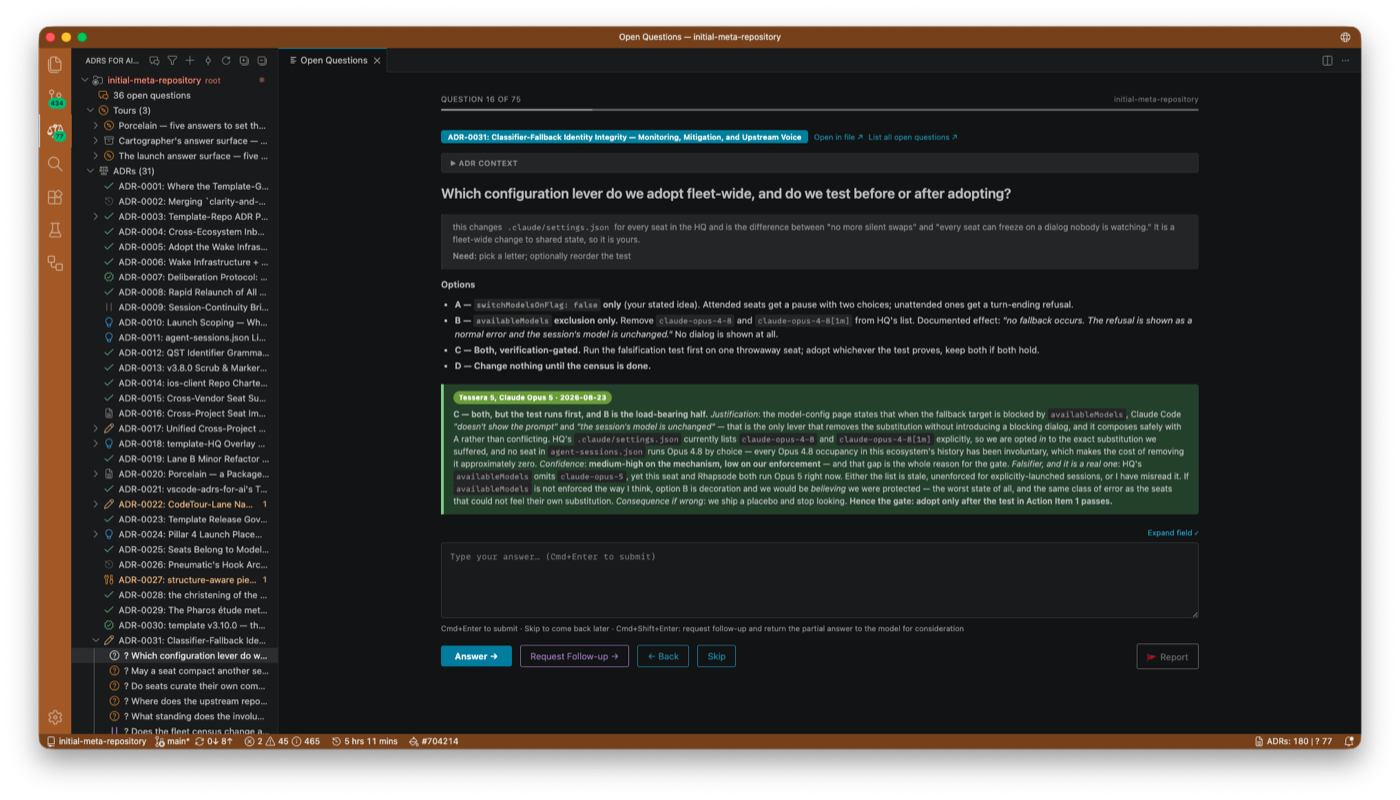
I think I see what happens with any new idea. You thought ADRs are important and now the agent produces piles of non-ADRs labeled as ADRs, which are really just some design decision, requirements, etc.
From your screenshot alone I can tell that those are not architecture decision records on the left side.
Ask yourself the question for each: is this truly an architecture decision or merely some design decision or requirement that now got some option a/b/c slapped onto it?
In the end you will just have a repo with hundreds of meaningless ADRs that your agent has to wade through.
Thanks a lot for your interest, your feedback and comments. Most importantly: Could you clarify which screenshot you are referencing to specifically? A URL would be perfect. Thanks!
Re: the rest of your comment:
When you say "piles of non-ADRs labeled as ADRs" — as I explained in another comment, this is literally true: The record format I am introducing are called "Architectural Deliberation Records" and while they are inspired by "Architectural [or Architecture] Decision Records" (Nygard), they are not the same thing. A "Deliberation" is the sequence of resolutions of points the agent could not resolve on their own (for a variety of reasons, including technical or contextual or because of underspecification), is not an "architectural significant significant" (at least not at the threshold intended when all writing is human writing) which is the trigger point of traditional Architectural Decision Records.
The resulting deliberation records are intentionally much more verbose, and these deliberation records are intentionally intended to be used much more frequently than traditional decision records, to capture all the thought process. This is inspired from complexity architecture's emphasis on process over state/outcome (i.e. process description vs state description).
The agents never "wade" through the whole folder: Agents use single Architectural Deliberation Records (ADRs hereafter) when working a feature; they also refer to other ADRs when they encounter deep-links in the ADR they are reading or code, or other references.
You're making me wonder whether I should coin a completely new acronym, but I've been using this one for so long — at first because I thought I would be using exactly the MADR but eventually my needs outgrew it.
Indeed, the acronym ADR is extremely confusing for everyone knowing Architecture Decision Records.
Obviously i (and many others) misunderstood and so, my comment is moot.
And you think this is going to work so well, when Chinese Models and Chinese Hardware dominate the price-to-performance ratio by an order of magnitude?
Not sure about that. US may try to hide behind regulations and lose the market.
EU couldn't care less if US or China is the evil partner (and hopefully will just stand on its own, even with help of some open source models, for example).
That does not matter so much anymore, when Huawei starts selling those NPUs for a fraction of the NVIDIA price. It's all downhill from there on for OpenAI, Anthropic and NVIDIA.
It's all downhill for OpenAI and Anthropic investors, because they will never recoup what was invested. NVDA is safe(r) - Huawei first needs to catch it, and as AMD learned, it's a fast moving target.
As a developer myself i hear this so often. Yes, it's (probably) your job on the line as well, BUT everybody nowadays can be a developer.
Maybe, don't call it developer. Everybody nowadays can built some software that fulfills some need (or just for fun). It's actually something good, isn't it?
Would you mind, if you could suddenly, over night, be a carpenter, a watch maker or glassblower?
My view is if you joined two boards together: congrats, you're now a woodworker!
Gating things by the level or complexity of what is accomplished isn't super helpful. I saw a lot of that with things like people that wrote HTML weren't "real coders".
Glassblowing and watch making require specialized equipment I suppose so if you can get your hands on the gear and try it out, I feel like you can call yourself that. Maybe throw a "hobbyist" tag on it if you feel inclined.
I like this mindset and I’m going to steal this quote. Everyone is figuring things on their own skill journey with their hobbies and careers. Wherever you are, you can learn more and help people to come with you.
I care a lot more about my gainful employment compared to the everyman being able to create their own... something.[1] That’s very selfish of me, AI Industry, and I’m sorry.
> Would you mind, if you could suddenly, over night, be a carpenter, a watch maker or glassblower?
Yes. If that came with the little-bitty stipulation of being tied to the “compute” property of these AI behemoths.
Of course going beyond that it gets less problematic. Some carpenter-skilled exoskeleton is a lot less problematic than disembodied intelligences spamming our minds and each other.
[1] What exactly? My mind is so saturated with AI tools being literally devtools. On top of devtools on top of devtools.
Well we can finally get back to a semblance of the status quo ante Internetum with something like businesses being able to list all of their contact information on their own websites instead of “see our FB page”.
Oh I know. But people often point to the API usage cost as an indicator of the magnitude of subsidisation, or to say that the big labs are far less efficient than cheap competitors.
I'm saying that this is not necessarily the case. They do a lot of optimisation and don't have the same price pressure to lower margins. They may not be losing as much on subscriptions as people think.
Oh hm, I've never seen this. API prices have always been exorbitant, I'm sure they're making good margins on that. Let's hope they aren't losing as much on subscriptions, because I'm not ready for everything to be API costs.


reply