Transparency of pricing models does not immediately result in better outcomes for consumers. In some cases, it may actually result in worse outcomes.
Consider when there are few companies within an industry, like rare metal mining. If they chose to use the same, open-source pricing model, and any changes to that pricing model would be reflected by all companies, the optimal pricing model would be to price at the monopoly level -- to raise the price to where it would be if there were no competition and a single firm in the marketplace.
In the case of lending, however, different firms have different levels of risk acceptance. Many firms (big banks) avoid high-risk borrowers. A few firms (pay-day lenders) are willing to lend to those borrowers, but only at a high interest rate. Somewhere in the middle is a collection of scrupulous lending opportunities.
Any regulation that would restrict the acceptable interest rates to a narrow band would reduce not just the (unscrupulous) loan sharks but also the banks lending to high-risk customers.
This would necessarily result in loss of borrowing ability to those labeled "high-risk".
Is this a desirable outcome? Maybe, maybe not. But it should certainly be discussed.
It's true openness isn't free of side effects. I think a mining company that has exclusive possession over a public resource should be rewarded with the value creation (mining) and not by possession (natural resources). A government should designate the natural resources to public welfare and is ultimately achieved by openness. A resource greedy mining company would rather dispense with transparency in this case.
Regarding the borrower problem. This is a common fear of revealing one weaknesses by openness. I believe society will invent new alternatives to support the new needs. Again, it seems openness is positive overall, despite new challenges it presents.
The benefit of transparent elections outweighs the costs of counting paper.
If we really wanted to do elections cheaply, we'd just hire a couple of undergrads to write a Node.js script and give polling stations some desktop PC's loaded up to the page. Would hardly cost anything. But doing elections cheaply is not the point.
For the USA, precinct-based paper mediated voting is the cheapest option.
We don't need PCs. Self contained scanotronic style systems (think SAT tests) work just fine. In fact, all but the largest jurisdictions (because of ballot size, complexity) could get away with manual counting.
This is very impressive. I wonder what the server costs to run a website like Reddit would be if they hadn't used Python and instead used assembly, C or C++.
The benchmarks game [1] suggests that C++ can have a speedup of 10x to 100x for many toy benchmark programs and use far less memory. A highly optimized assembly version could add another factor.
While code closer to the metal would require higher investments in coding, it would be drastically easier to scale. And in the long run, server costs will dominate, so it would be beneficial to reduce those.
Who knows if Reddit would be cash positive if their codebase were written in a different language?
Two stories. Years ago I wrote code to parse email messages in C. And by "parse email" I mean parse the headers into usable C structures. Looking back through git history, it appears it took me about a week's worth of coding to get all defined email headers parsed using 1375 lines of code. And I never did fine an acceptable structure to store the contents of say, the To: header (can't be an array since you can include named groups).
More recently, I re-approached the same problem, but this time using Lua (and LPEG). It's easily half the code (658 lines) and this time, it was rather easy to store the contents of the To: header (given the nature of Lua tables). And while I suspect the C version is faster (honestly, I don't know---I haven't actually measured it) the Lua/LPEG version probably does give it a run for its money (LPEG compiles into its own parsing VM). It took a days worth of work (plus a few bug fixes here and there).
I can't imagine doing this type of project in assembly language (and I did nothing but assembly work for ten years, mid-80s to mid-90s). It'll be largely the same as C (read byte by byte, jump tables etc.) but you also have the overhead of dealing with calling conventions---you either juggle parameters into registers, or spend half your time pushing data onto the stack. It becomes real tedious real fast.
Second story. At work, I was told to look into this SIP stuff. So I did. And I wrote code in Lua/LPEG to parse SIP messages (given that it's the same base format as email messages, why not use something easy write to play around with this stuff?). Pretty soon, it became the product (sigh---the prototype is the product, but that's a rant for another time) but it turned out to be fast enough to handle actual telephone network traffic levels. It also received an unexpected load test as fewer instances were running than expected, and a routing issue caused about 3x the expected traffic. All that and I've yet to profile the code [1].
So, would Reddit have more money with a different language? Well, it was rewritten once from what I understand, but I think that was from a language only a few have experience with to one that has a larger coding base. I don't think you'll find the number of programmers capable of out-writing a compiler with assembly that you will with PHP, Java, Python or Ruby experience, never mind the negative responses you'll receive from the anti-C crowd.
[1] To be fair, the code is only taking SIP messages, parsing for some expected information, repacking that up into another (proprietary) format to call the business logic component, which is written in C++ [2], taking the results and sending a new SIP message. So it's not doing that much overall.
[2] Because the developer thought he was programming this for a 1MHz 6502 with 16K of RAM, even though it's running multiple 64-bit SPARC [3] boxes with 24 or 32 cores and gobs of RAM but again, that's another rant.
[3] Because of telecom requirements for power; I suspect if we could have found x86 boxes that met the requirements, we would have used them.
Maybe older people are better at rationalizing low errors.
e.g. if there is a small error, older people can convince themselves that they were right and the world is wrong. (My reasoning was correct, but the answer was wrong by chance. Therefore I won't change my reasoning).
However, younger people are less able to rationalize these small errors, forcing them to accept the conclusion that they are wrong.
Vermeer was also suspected to have used optics to help him paint, as highlighted in the documentary Tim's Vermeer [0]. Although their evidence is circumstantial, some color artifacts are difficult to explain in other ways. For instance, the falloff of light matches what would come from a video camera, but would be extremely difficult for an artist to see by eye.
I used to be a fine arts student and my favorite painters were/are Vermeer and Rembrandt and their circles. I always hated the theory that they used optics, but couldn't quite put my finger on why until I started reading press coverage of that documentary. The problem isn't with the argument (at this point I'm convinced that they did, it stands to reason given the context of them being artisans in the same time and place as people like Antonie van Leeuwenhoek, etc.) but with the way that some people in the press and public seem to see it as lessening their achievements.
I.e. Tim's Vermeer copies are held up as examples of how anyone can paint like Vermeer given the tools, whereas to me a direct comparison makes it even more clear how perfectly Vermeer chose when to use a technological aid and when to change things:
Things like the bluriness of the paintings in the background and the slightly softer and more abstracted faces, the additional creams and blue tints in the whites of the walls, the blues that are picked out in the rug in the foreground, etc are what make me love Vermeer so much, not that he's photorealistic.
Anyway, I realize I'm constructing a partial strawman here because I don't think people like David Hockney or others supporting the optical argument are trying to claim that Vermeer is less talented than we thought, but it does seem like the press sometimes spins it that way.
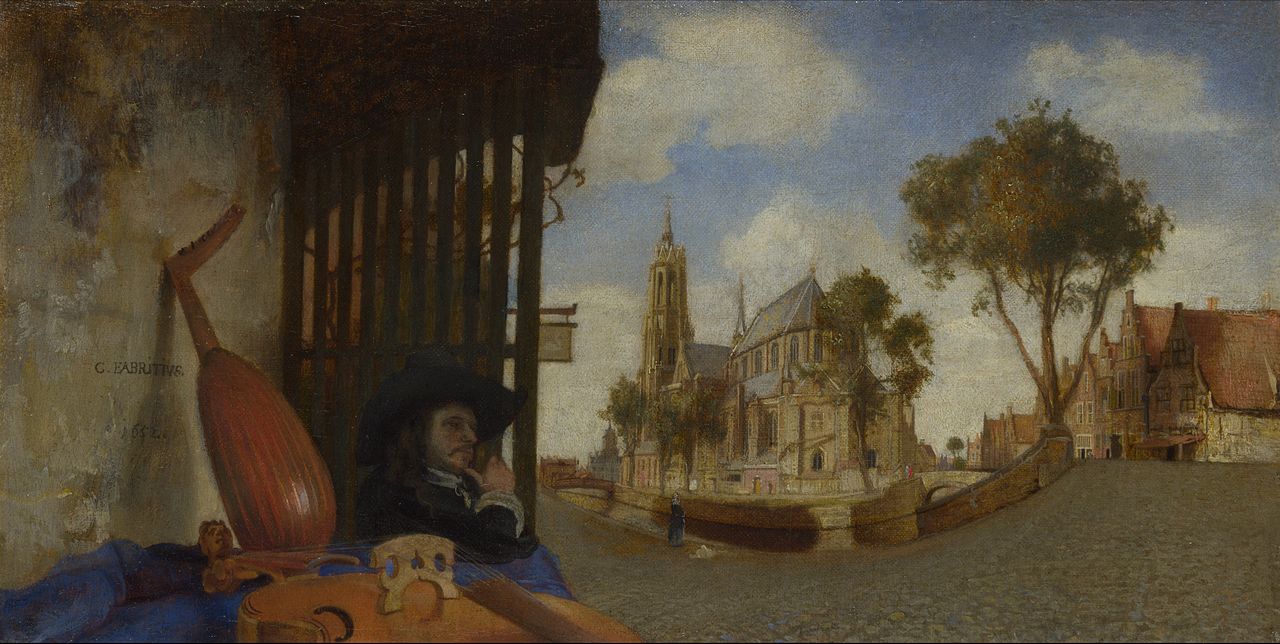
As an aside, one of the only paintings of Carel Fabritius to escape the gunpowder explosion that killed him as well (made more famous recently by Donna Tartt's 'The Goldfinch') is a really cool example of a painting from the time that was clearly made using lenses. It looks to my eyes more or less exactly like a photo made using the iPhone's panoramic setting. Would be really cool if someone could find the same location in Delft and take the same type of image:
It seems as if what they were doing was merely a different kind of talent than painting purely by eye is. Creating and using the apparatus is its own kind of art, sort of a hybrid between photography and painting. Both arts on their own, so surely an art when done together.
Questions like this are why, I think, realism became less valued on its own in the art world, after the advent of photography. Then it became merely about how the painting looked, rather than how difficult it was to produce.
Right, and it's worth pointing out that even Italian renaissance artists from the 15th century, presumably working without the same optical technologies, were still using techniques for duplicating images. It was very common for instance to make a full scale mockup on paper, then punch holes along the lines and rub charcoal in them to make an imprint on the canvas before painting. Not to mention the fact that engraving and printing are themselves new technologies for duplicating images in the same period, so it was clearly in the purview of artists to think about this sort of thing from a technical as well as artistic angle.
The more I think of this stuff the more I love it as an example of the incremental nature of technology - photography wasn't just invented in a certain year, it was a process over about two centuries of experimenting with ways of replicating images that finally converged with advances in chemistry to lead to a breakthrough that we then demarcate as the beginning of a new era. But in some ways it was just the culmination of a process of optical and artistic tinkering that goes back to the early Renaissance (or arguably even earlier, with Grosseteste's experiments with lenses in 13th century Oxford).
If it means anything, I was not nearly so interested in Vermeer until after I heard the press about optics.
I find technological cleverness, and maybe a bit of hustle, more fascinating aptitudes than mere technical skill.
(Or maybe that's still disappointing, because I'm similarly focusing on technical choices rather than artistic choices, just going the other direction...)
There are also hardly any search queries on Google trends [1], and less than 10 total tweets in Turkish between 2014-01-01 and 2016-07-16 [2]. Very strange, indeed.
one of the tweet says: beware people in the government, these guys use some app called bylock, I hope you haved "cracked" it already.
another(from a gulenist it seems) says, guys don't use the same app for communications over and over, try to be more diverse (talk about an app called kakao)
Obviously, this app was known by public. So, I am not sure if they would risk themselves to use it to plan something illegal. Yet, things in Turkey are getting very amateurish in every aspects for the last decade. So, luckily for the sake of bits and pieces of Turkish democracy, this coup attempt was also amateurish.
However; I have the tendency to believe that Erdoğan knew that they were working on something nasty and he might had even encouraged it indirectly. So that, he could control it and benefit from it.
I must say that I have biased opinions against Erdoğan.
*@pazartesi2014 says
@kuscusencer ByLock programınıda umarım çözmüssünüzdür Reis paralelciler buna sardılar şimdi
--
@kuscusencer I hope you have decrypted the ByLock app, Reis (an informal expression, meaning superior). Gulenci People have started use this.
And this guy seems like from the movement
@nifaksavar
Arkadaslar sürekli aynı servis sağlayıcıyı kullanmayın bylock kakao vb..
---
Friends, don't always use the same service provider bylock, kakao etc..


Consider when there are few companies within an industry, like rare metal mining. If they chose to use the same, open-source pricing model, and any changes to that pricing model would be reflected by all companies, the optimal pricing model would be to price at the monopoly level -- to raise the price to where it would be if there were no competition and a single firm in the marketplace.
In the case of lending, however, different firms have different levels of risk acceptance. Many firms (big banks) avoid high-risk borrowers. A few firms (pay-day lenders) are willing to lend to those borrowers, but only at a high interest rate. Somewhere in the middle is a collection of scrupulous lending opportunities.
Any regulation that would restrict the acceptable interest rates to a narrow band would reduce not just the (unscrupulous) loan sharks but also the banks lending to high-risk customers.
This would necessarily result in loss of borrowing ability to those labeled "high-risk".
Is this a desirable outcome? Maybe, maybe not. But it should certainly be discussed.