Our particle screening dashboard is online! Read the article below to learn how you can use TerraScreen (https://github.com/mars-terraforming-research/TerraScreen) to calculate the warming effect of engineered aerosols for Mars terraforming.
The article quotes Prof. Troian as saying, "JPL acted honorably throughout. They did the right thing and filed the right report. That part of the system worked well. ... My complaint is strictly with Caltech."
There's tension between the openness that a research university (Caltech) needs, and the secure handling of information that a lab doing some classified research (JPL) requires.
This tension exploded in 1952, when Caltech took government money for PROJECT VISTA. After that, Caltech decided that having faculty working on things they couldn't talk about was antithetical to the purpose of a research university [1]. Today, Caltech says [2]:
"The Caltech Way: Caltech policy does not allow the acceptance of grants or contracts supporting the conduct of classified research or other classified projects on campus. Exceptions to this restriction may be considered by the President of Caltech in times of national emergency or critical need upon an urgent request of the government." ("Standards of Conduct for Research on Campus," Chapter 1, Section 1.1).
At JPL, there has always been some classified research. In the 1980s, JPL almost become a weapons lab (it did not) [3].
Even if Dr. Gat's electrospray work wasn't classified, one can imagine how different attitudes to classified research feed over to different attitudes to ITAR violations.
I'm a former Caltech postdoc and a research associate at JPL. I know neither Gat nor Troian.
I haven't figured out your conclusion. I think you are giving credit to Caltech for supporting Dr. Gat's "openness" with Israel? Does that excuse Dr. Gat hacking into Dr. Troian's computer, or the Caltech administration's apparently dishonest and sinister behavior towards Dr. Troian?
Giving Mars an atmosphere that you or I could breathe is science fiction. It would require designer microbes, or enormous energy input.
Extending life beyond Earth - establishing a simple biosphere that's mostly plants - is much simpler. It's an engineering problem.
Loss to space is geologically slow [1]. Photochemical degradation of greenhouse gases is a bigger problem, but not a likely showstopper. Optimal mixes of greenhouse gases are so powerful that the output from one mine and one factory could be enough to dramatically raise temperatures [2]. We know where the halogen deposits are [3,4], and already have most of the technology to mine and process them robotically [5,6], but it would be expensive. The problem is to make it cheaper.
My basic gripe with Bell-curve arguments against female genius is that at the high end, in the exponential tail, fine-tuning is needed to explain why a non-negligible fraction of professors at MIT (say) are women. Even a small difference in variance would lead to overwhelming male dominance.
On the other hand, if there were no difference in the distribution of intelligence, but cultural factors held women back, then the current "one-tenth to one-third" fraction of women in jobs needing high intelligence is naturally explained.
A recent PNAS paper showed that International Mathematics Olympiad teams from countries with high gender equality contain more women. http://www.pnas.org/content/106/22/8801.abstract
IMO team members are one-in-a-hundred-thousand people - deep into the exponential tail of any Bell curve.
A study in 1999 showed 70% of psychology professors hiring Robert, and 45% hiring Ruth, on the basis of an identical CV. The waters of geek sexism run deep.
It's totally anecdotal, but the young people in the canteen at JPL are about 50/50.
Notice also the political fine-tuning of the variance argument: it doesn't dare suggest that mean female intelligence is lower (because we'd all reject that). God of the gaps, anyone?
Getting this right matters. If you must hire very good people, and you have the wrong model of how very good people are distributed among the population, you will fail.
My basic gripe with Bell-curve arguments against female
genius is that at the high end, in the exponential tail,
fine-tuning is needed
Well, actually no fine-tuning is needed. The Central Limit Theorem is most valid for a sum process in the middle of the distribution. It converges most slowly in the tails [1,2]; indeed, if your goal is to model the tails you really are dealing with a max-phenomenon rather than a mean-phenomenon.
In this case, the underlying sum process could be a bunch of small alleles of roughly equivalent size, each contributing to high IQ (viz. a QTL model for a multifactorial trait [3]). In that case, if you cared about the tails rather than the body, the discrete chunkiness of the underlying binomial distribution becomes more crucial.
Put another way: Bell Curve arguments (aka "statistical genetics") are at the lowest level based on discrete alleles, not perfect Gaussians. Now, those in the field would love to get better models of the genetics of highly intelligent people -- but to study that kind of thing you need to move to China and work at BGI. Remember, thoughtcriminals who propose genetic explanations for behavioral phenomena are "berated" in the US [See jackowayed's wonderful admission against interest up thread].
  International Mathematics Olympiad.. Notice also the
  political fine-tuning of the variance argument: it doesn't
  dare suggest that mean female intelligence is lower
  (because we'd all reject that). God of the gaps, anyone?
While we're talking about fine-tuning, why do you cherry-pick a few stats without acknowledging that the history of science is male? Do the thousands of male names (Newton, Maxwell, Einstein, Gauss, Euler) that have inscribed their name into history count as a datapoint here? Do the Fields Medals? The Nobel Prizes in Physics? The faculty of math and science departments around the world? The gender of the inventors of the locomotive, the aeroplane, and the automobile? The names of those men who built steam engines and search engines?
I know why. All the conquests and murders in history are counted against men; but is a little odd that every male invention is counted in the demerits column too! I think the idea is that said ancient men ostensibly discriminated against women, shoving them out of the way before they could figure out the value of pi. Without said invidious discrimination women - biologically, neurologically, hormonally, genetically different women - would have been tearing it up on the math tip at the same rate. Just as they have been dunking from the free throw line ever since we started the WNBA.
Bottom line: you can't have it both ways. If achievement in science and engineering is to be a signal, if you are to cite any stats related to IMOs and whatnot, you need to take on board the enormous imbalance in the favor of men on historical measures of sci/eng aptitude and achievement. All due respect to Noether, Daubechies, and Curie -- but the prior probabilities of achievement are not equal.
  If you must hire very good people, and you have the wrong
  model of how very good people are distributed among the
  population, you will fail.
That's right. Your statement is: if you have the wrong model, you will fail.
The logically equivalent contrapositive is: if you succeed, you didn't have the wrong model.
So given that Google, Facebook, Twitter, Youtube succeeded with highly male software engineering staffs, logically they did not have the wrong model of how very good people are distributed among the population.
Geologist here. Earth's thermal evolution is unsolved decades after we figured out the stars. The Sun's temperature adjusts to energy production and loss on a 10^6 yr timescale (scaling as the time for a photon to diffuse from the heart of the Sun to the cold surface): << the Sun's age. The Earth's temperature adjusts to internal energy production and surface losses on a billion year timescale: of order the Earth's age. Planets have long memories and history matters. The Sun is reasonably well-mixed. Surface spectroscopy probes the make-up of the whole star. Earth is less well-stirred. Seismic imaging of the deep earth maps the edges of vast pods of material, radioactivity unknown, composition unknown (but definitely distinct from the near-surface stuff), age unconstrained but plausibly as old as the planet [1]. Structure and composition matter [2]. It's a hard problem.
But it matters. When you look up at the night sky far from cities, for every star you see there's a habitable-zone Earth-radius planet that's closer [3]. We didn't know that six months ago. We think (for good, but circumstantial reasons) that complex life requires volcano-tectonic resurfacing - necessarily, a hot interior. Given that habitable-zone Earth-radius planets are not in short supply, the difference between fast and slow cooling for planets like Earth is the difference between a Galaxy where most every star system is habitable and one where almost all the planets are cinders.
The core-mantle boundary heat flux Q_CMB estimated in this paper constrains the mantle energy balance
d(E_mantle)/dt ~ Q_CMB - Q_surf + H_radioactive
Surface heat flux Q_surf is ~46 terawatts. Mantle radioactivity H_radioactive is not well constrained but about 10 terawatts [2]. The implication is that despite the high core heat flux, Earth's mantle is cooling fast - maybe 100 microkelvins per century. Volcanism will therefore shut down in much less time than the remaining main sequence lifetime of the Sun. Absent human intervention, the reddening of the Sun won't kill the biosphere, the Earth will.
As the mantle cools, the temperature contrast between the mantle and the core will no longer sustain core convection. Then Earth's magnetic field will power down. Without geo-dynamo shielding against galactic and solar radiation, bad things may happen: the rapid shutdown of Mars' dynamo is one hypothesis for the deterioration of Mars climate ~4 Gyr ago [4]. On the other hand, Earth's magnetic field strength decreased by a factor of 20 during the Laschamp Event ~41000 years ago [5], with no known effects on biology (or human culture).
Diamond-anvil experiments are tough; few grad students make it past quals without breaking a diamond or two. The diamond-anvil technique is hitting diminishing returns, so modest advances are (rightly) celebrated. The same is true for deep-earth seismology and mantle geochemistry. A good new method is mapping the antineutrino flux from Earth. Antineutrinos are produced by radioactive decay and move in a straight line from source to surface. Mapping the Earth with geoneutrino observatories in the deep sea would help determine the power source for plate tectonics [6].
[5] Known from ice-core spikes in beryllium-10 (isotope produced by cosmic radiation hitting Earth's atmosphere) as well as magnetic paleo-intensity measurements in sediments.
[6] http://www.phys.hawaii.edu/~sdye/hanohano.html. A knuckle is that SSBN reactors also emit neutrinos and neutrinos cannot be shielded, so deep-sea geoneutrino detectors could be strategically destabilizing. In practice either angular resolution or massive size would be needed to make deep-sea neutrino detectors useful to militaries.
I am a postdoc working on planetary habitability. This arxiv paper is a mesh sieve masquerading as a boat.
Complexity's rise is a messy business [1]. There's some evidence for steady progress, easy steps [2]. At the other extreme, the machinery of oxygenic photosynthesis came together once after an inexplicable billion-year delay and completely reset the biosphere. No oxygen, no complex-eukaryotes-with-twisty-genomes like you and me. Inference: that was an very improbable, difficult step, and we got lucky. Survivorship (as conscious, therefore complex creatures) biases everything we see on Earth. Nobody knows whether the origin of life was an easy or a difficult step. We don't have a geologic record of the origin of life. But the existence of even one difficult step is enough to prevent you from playing Moore's Law games.
There ARE good papers in this field that get traction out of very little data [3].
There are also reasons to think that Earth life may have originated on Mars. Joe Kirschvink (Caltech) is the big advocate of this [4]. Continued Mars exploration could test this.
Interstellar panspermia, on the other hand, is vastly improbable.
Send people when there's a coherent plan for them to do something useful.
Not before.
(1) Oliver Morton: "The fact that there are plenty of people who might volunteer ... does not mean that it would be right to indulge them.
If they live, they do so because of unparalleled spending. A world where a select few gets hundreds of millions, at the very least, invested annually merely to keep them alive while equally deserving people die in large numbers for want of far less is not a very attractive place.
Human Mars exploration is indeed a fine goal, and it is quite possible that fairly early on there will be some who elect to stay. But the only real argument for doing it sooner rather than later is the selfish one of wanting to see/participate in it personally.
There is something poetic about the notion of death on Mars, or of choosing to die there - Clarke's Transit of Earth caught that nicely. But Liebestod is not a good basis for public policy."
(2) Funding large risky space missions through advertising is not credible. Cash needs peak ~3 years before Mars arrival. The team building the British Mars lander tried hard to raise money from advertising - with help from M&C Saatchi - but "failed to raise any external funding guarantees." Hunting for sponsors "seriously hindered the orderly build-up of the project engineering team," contributing to the 2003 loss of the spacecraft over Isidis Planitia.
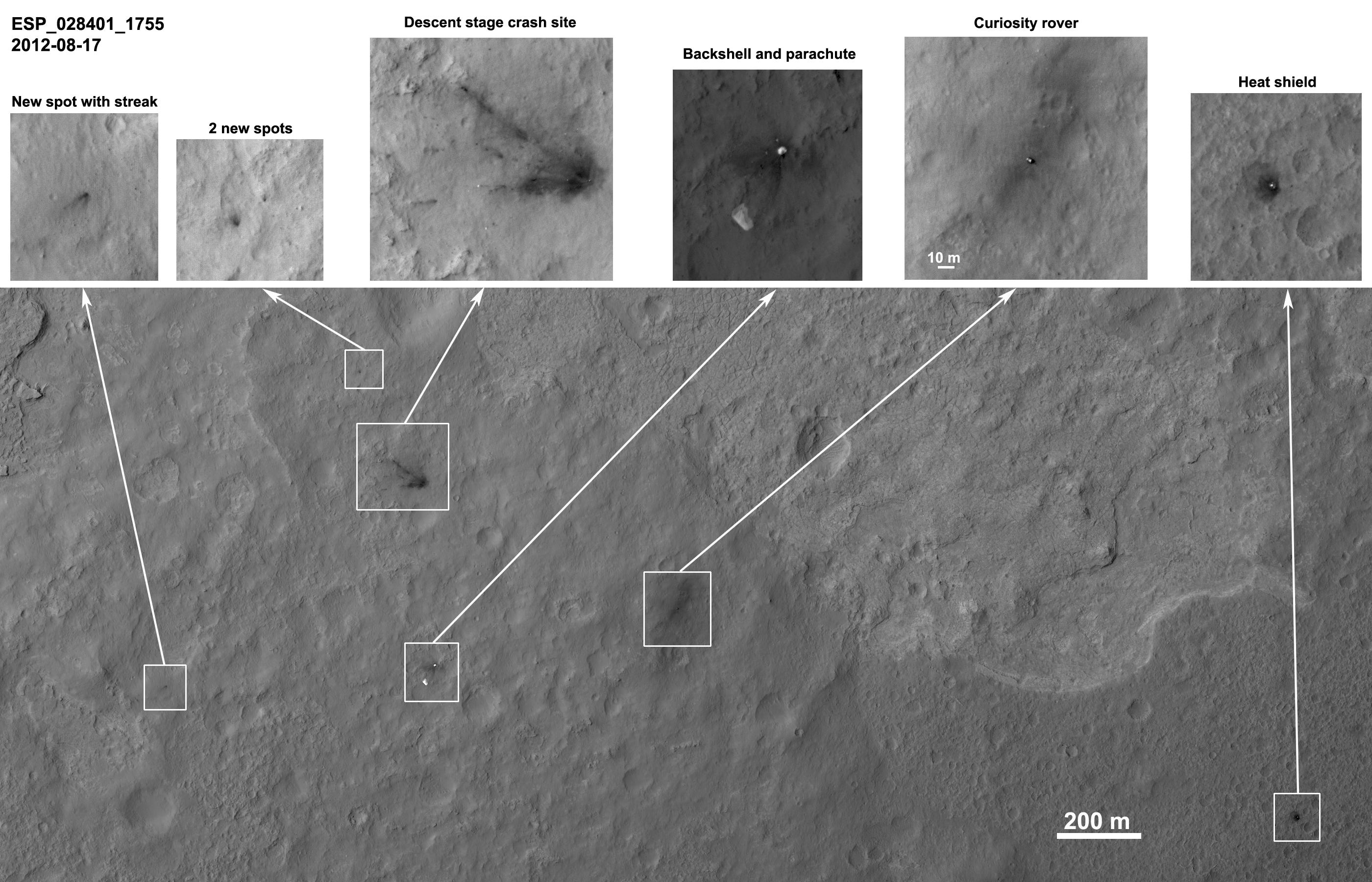
The landing created an extensive debris field [1]. For example, the descent stage energetically disassembled on impact with 100+ kg of unused propellant still on board, as planned [2]. Bits of plastic and metal are strewn across a 30km-long strip. Curiosity has imaged several of these pieces already [3]. On the other hand, some 'bright material' that was thought to be spacecraft fragments turned out to be soil material. These fragments are important: they're a science hazard. A big goal for the mission is to find Martian organic matter, so the project is keen to avoid accidentally ingesting Earth plastic into the exquisitely precise onboard laboratory, SAM [4].