I mean if I decide to go to the beach, but I arrive there and don't like it, I just go home again, tomorrow looks the same regardless probably. Deciding to have a child, or other more "long-lasting" decisions, definitely impacts how your tomorrow most likely looks.
Deciding not to have a child also impacts your future. You might change your mind in the future and be unable to have a child or have other health problems that make raising a child difficult. You might reach old(er) age and be alone. Regrets are a thing.
I think the times I felt like I wanted a child, I've always wanted to adopt anyways, not just add more people to the world but help the ones that already exists here.
So with that comes the flexibility of not having to worry about any biological clocks :)
Even without children I'll never be alone though, luckily I live in the greatest place in the world!
> Regrets are a thing.
People keep telling me this, but after 35 years on this planet with still zero regerts, when is that supposed to be happening exactly? ;)
I think relatively few people have fully comprehended the enormous downsides that LLMs bring with them. I do think they are useful tools in many situations, but the fact alone that they have "flipped" the "takes time and energy to write something useful so others can more quickly read and comprehend a complex idea" equation is very, very bad.
Not just reading, videos have been ruined in many ways as well. My base reaction to seeing anything surprising on video form has switched from "Interesting!" to "Probably fake". Novel events caught on video are now immediately suspected as being AI and discounted by many people.
Same for software for that matter. GenAI has killed my interest in releasing web apps outside of work. Before I used to find value in putting stuff on the web for others to find and enjoy, and it sparked some interesting interaction with other people. Now anything I publish will mostly be consumed by bots and thrown into an AI blender that completely divorces it from the creator.
You're comparing almost three millennia of text, to a couple of years worth of text.
Let's see this play out.
Plato also threw shade on writing. Which is an invention that turned out alright for humanity, imho.
Maybe it'll turn out that we can push through to a yet-unknown-but-better state, as we've so far done, rather than relying on just going back to a previous state that we were content with.
Sorry for the somewhat sarcastic tone. But the hyperbolism deserved it.
The comment they’re replying to didn’t add anything new - it’s just the same old regurgitated ideas and has a lot of misconceptions. Almost exactly like LLM content. Taking the time to respond in detail would be a waste.
No actually it made a few specific historical analogies that I’ve never heard before and that absolutely could be responded to. The responder just chose not to.
Nothing they said demonstrated any understanding of what they replied to. They simply restated their opinion with no reference to any of the points made in the comment they were ostensibly replying to.
Am I really the only one who doesn't care whether or not prose was written by AI? Assuming that a text is signed off on by a person, then surely what counts is its substance, not who or what actually strung the words together. I'm constantly surprised by this obsessive need to falsify what is unfalsifiable. And among nerds of all people. It feels religious, like a modern form of heresy-purging.
I care because in most (not all) cases, (a) AI UGC is one- to few-shotted with no concern for accuracy or readability, and (b) why would I read the results of someone else's prompt if I can achieve more or less the same result for free on ChatGPT?
Now, this is for disc brakes, so not applicable in my situation. I've never ridden a bike with disc brakes, so I can't vet for the accuracy of this guide. Maybe it's totally right; I'm sure someone reading this will know.
However, just look at this article! Zero pictures for a process that _really_ needs it. It just drones on. Imagine following this guide only to discover that the 12-15 Nm rotor torque the article is asking for is actually too high!
A similar article from before AI would at least have (stolen) pictures describing the process. It would also very likely be shorter. Which creates the rub: if I know how to write something engaging and correcting AI's copy will take _just as much time_ as writing it myself, why would I use AI to do it?
In short, AI content is lazy content. My time is valuable and finite; if I'm reading your stuff, I want to know that you at least tried to give a shit about my time as a reader while producing it.
> However, just look at this article! Zero pictures for a process that _really_ needs it. It just drones on.
Buckle up, because the next phase of this AI content generation nightmare will be articles like this featuring AI generated images of a bike repair in progress, except the bike will only kinda-sorta be like the real bike the article is describing.
Sure, I get that argument. I just don't buy it. What counts is whether the article helps you fix your brakes. If it doesn't, it seems immaterial to me whether or not the bylined author sweated over it for hours. Not least because I have no means of knowing.
But the OP already addressed this-he can just ask ChatGPT directly how to fix the brakes. He’s gone looking for a human expert because (for whatever reason) he doesn’t want that.
For me the issue is very clear: I happily use AI to answer tons of questions each day, but if I’m reading your website/blog/article/Jira ticket, I expect real human input.
It should matter whether the author “sweated over it for hours”, because that means they actually considered the best way to communicate something. If they didn’t do that, then they clearly don’t care enough about about the quality of their output and I shouldn’t spend any time at all on it. In fact it’s worse than that because if the author doesn’t respect the reader enough to craft their output, then I as a reader have no respect for their work, and I resent that they’ve taken my attention for the time it takes me to realize it’s ai generated. If you’re publishing Ai content, then I can only presume you have an ulterior motive than plain communication- in the case of OP I’d assume this is for ad revenue or clicks.
There are many types of writing, and I struggle to think of many where a statistical model could feasibly produce an acceptable output for the given intention.
Eg. A poet chooses their words extremely carefully; a good instruction manual is written by the designers of the product (not just guessing at a common or plausible method); a news article has an angle/story beyond just the facts.
If you or OP suspect (suspect) that a blogger's taking shortcuts, and that's a problem for you or OP, then you or OP can just skip that blog and find another that appears (appears) to meet some criteria for labor input. To the extent that this is all unfalsifiable, it just should not matter.
I'll go further. Even if it were falsifiable, why should it matter? An example: I subscribe to a reputable US publication and I enjoy its journalism. If it turned out that one of its writers had (somehow) used AI to generate their article (which I enjoyed) in a click, here's what I would say to them: Hats off to you! How did you do it?!
I don't care if the article took them two minutes or if they used AI any more than I care if they used a spellchecker or wrote it while standing upside down. Why should I? The author put their name to the article and I got something out of it. That is all I was ever looking for.
Assigning blame doesn't fix the brakes either though, does it? And now their time has been wasted by bullshit they had to carefully analyze, in a field they're unfamiliar with. And yes, this was a problem with lazy writers before, but AI makes it the default, and makes it worse by reducing even the tenuous grounding to reality of a content mill writer, and makes so much more of it. Are you seeing the problem? Do you want to?
> Assuming that a text is signed off on by a person, then surely what counts is its substance
Unfortunately that's a big assumption and for many their "signing off" process will amount to "skimmed it and seems ok?".
When I get an LLM-generated doc or runbook, my first thought is that its very possible that I'm the first person who has ever read this. It used to be that writing something took a big time and energy investment up front by one person so that many others could comprehend the ideas with less time and energy needed. LLMs flip this equation around which is a very bad thing.
The problem is that AI writing uses a pretty distinctive style and when you read a whole newspaper that was written or edited by AI it is very monotonous. Also, I can't really trust it because I know that the author probably phoned in his fact-checking.
I would be fine with it conceptually, if the result was not as grating as Claude's ramblings about load-bearing seams and the real shape of the problem.
It's just exhausting to read, and it displays a lack of effort put into communication.
Yeah, I keep feeling the same thing once I know I'm reading something or watching something purely AI-generated - that there are good points being made, but the delivery is just so off that it kind of ruins the points themselves.
If people used AI to get the scaffolding of their article going and then re-humanized the entire article, it might be really good, still at a fraction of the time it would have taken to write it themselves, but no one seems to want to expend enough effort to go the extra mile.
With video it's pretty well hopeless, unless the AI helps accelerate fully human traditional production techniques.
With music, there might be a middle ground, I have had some success getting AI to generate good sounding loops to use in electronic music production, but it was just a matter of brute forcing enough outputs to finally get something decent, which isn't fun at all.
Why shouldn't people be upset if authors are being replaced by like a handful of the same ghostwriters?
An LLM can't convey your ideas and your voice better than you can convey them to the LLM, right? It's a middleman between you and those you want to reach that adds more points of failure, an additional entity that must be understood and made to understand, or else meaning is lost.
EDIT: Never mind the motivations behind a majority of LLM-generated articles, which is to be One Unit Whole Content, a colloid for ads.
people who generate entire blogposts with claude probably do not care about substance, tho. before llms, people would have to put effort into what they write and be mindful about the things that they are saying. now it just generates the whole thing, the people who "signs it" barely reviews it fully most of the time, IF they review it at all, proceed to say "eh, good enough" and publishes it.
Ironic anecdote. Although I don't care about AI, I'm triggered by your own carefree attitude to orthography (no capitalization, unpronounceable words like "llms"). At least AI is easy to parse!
The former. As did everyone else who read it, including you. Capitalization and punctuation are not decorative extras, they were invented for a reason.
In addition to the sibling comment, which I agree with [edit: the one starting with “people who generate entire blogposts with claude probably do not care about substance, tho”], I want to add another point. Even when the substance is key, the delivery has a quality to it that encodes a useful signal.
To illustrate what I mean, imagine two blog entries on the same subject, but one is written by an expert on the subject and one by a layman. As humans, we can generally (not perfectly) tell which is which. The expert will write in a certain quality that comes with expertise and is genuinely difficult to fake without it.
LLMs disrupt this pattern. LLMs are able to write with the expert’s quality even while writing bullshit. I don’t mean quality as “measure of goodness” here but merely a set of traits or properties. Humans reading LLM text are far more likely to misjudge the author’s level of expertise.
The next step is unscrupulous humans exploiting this to trick unsuspecting readers into misjudging a text, and now you have an internet where you can’t trust anything anymore, at least not at first glance. Even relatively discerning readers now have to waste time reading more of the text before being able to dismiss it as having substance of little value.
So, as I see it, the upset is not simply from AI provenance of a text, but from this level of dishonesty and subterfuge, coupled with the helplessness with which we’re exposed to it.
Indeed, I also don't listen to music after 2024. I'm also not interested in anything my friends have made (with claude or others). Or how so much of creativity is now a prompt away.
A lot of our culture is disappearing before our eyes and people are defending it.
And make sure "follow" means "buy their stuff on Bandcamp or directly from them". Streaming platforms send most of the money you pay to bands you probably never listen to.
Yep. Almost all of the top results I get from my searches are AI-generated garbage if the content was published after 2025. It's essentially guaranteed now. Whatever; let the people have what they asked for. At least there's an infinite supply of old books.
I was just thinking yesterday that it might actually be worse than nuclear weapons. Both in terms of likelihood to destroy all of humanity and in terms of “how did nobody working on this see that this was an obviously horrifying idea”
A similar thing is going to happen to young graduates and young scientists, or is already happening. Most new technical accomplishments are now devalued because they can plausibly be AI. There's an increasingly narrow path to establishing yourself as a credible person.
Come on you know what he means. Blog posts, articles, that sort of thing. AI has definitely made reading things posted to HN a much worse experience (even if they aren't all slop). It doesn't seem to have infected the comments yet, mercifully. I guess for a quick comment it's still easier to write it yourself than get Claude to do it.
It has infected the comments. Our patrons are fighting a good fight, but good slop is mostly indistinguishable from a worthless karma-farming comment. Mods are probably just cheating because there are people with 15-20 year old accounts, many of whom they personally know, and you can assume that the stuff they're interacting with is not slop or is at least worthy slop.
What's more realistic; 50+ year olds of today just parroting sensory experience where they heard their dead or dying elders complain about the kids back in the 00s, 90s, 80s, 70s, 60s... etc etc
Or the 50+ year olds actually figured out how everything must work for the next 1,000 years they won't be around for
The olds who grew up in a PTSD addled post world war and cold war social reality while huffing leaded gas smog? They figured it out forever, everyone!
...No. You figured out yourselves relative to technology of your day. Tech will change and the living will figure themselves out relative to their technology.
You're just engaged in parroting specifics of your own experience.
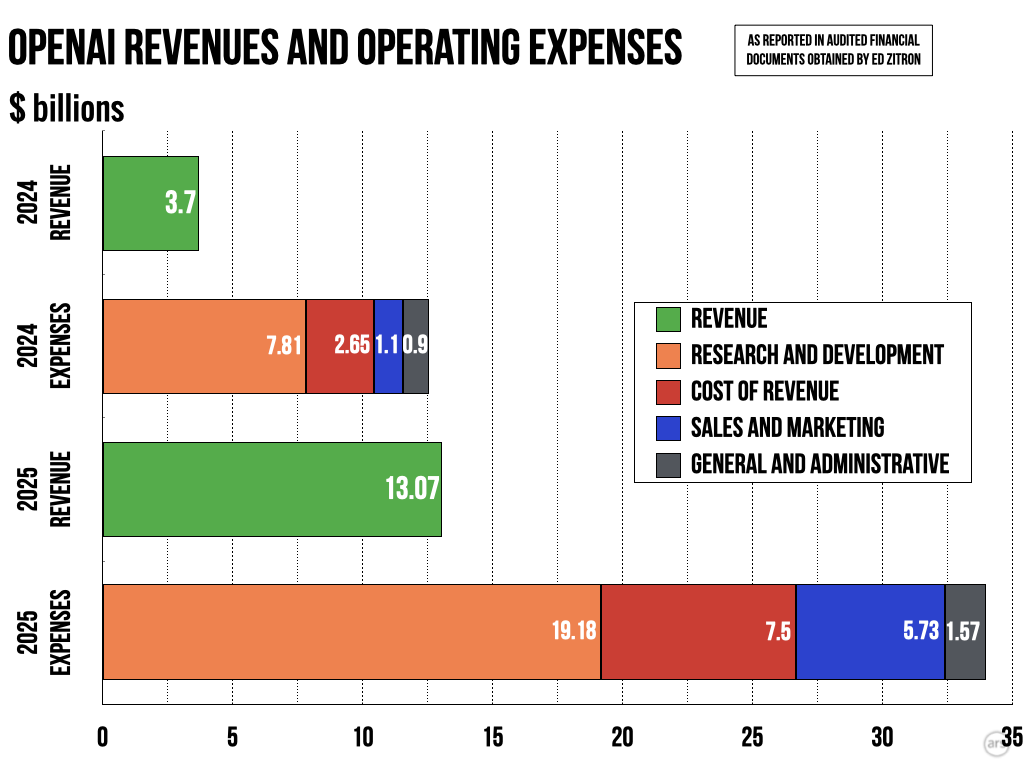
Data from OpenAI shows their 2025 inference revenue exceeded their cost of inference by a good margin (https://cdn.arstechnica.net/wp-content/uploads/2026/06/opena...). Saying this is being subsidized is like saying any investment in future productive assets is "subsidized".
Anyone can claim they are profitable, simply by reclassifying their expenses as some other thing or shuffling them to separate corporate structure. Until we will real financial audit, the CEOs claims are just a hot air.
OpenAI's leaked documents also said OpenAI was profitable on inference. The small resellers of open models have nowhere near the resources to optimise their models or inference and yet usually have a lower cost, why wouldn't the big labs?
That is exactly the document I've been thinking about while writing top comment :) . Oh, our "cost of revenue" is smaller than the revenue, we are so profitable guys! If we just don't count our marketing expenses, our administrative expenses, and our unspecified losses from operations to the tune of x3 times higher than our revenue. But if we don't count them we are totally profitable guys! If we will just stop all RnD and also stop paying our salaries, support and marketing departments (and also cut 20 billion of operational losses too, whatever that is) we will earn soo soo much monies guys!
Fair to include A&G, but their marketing and training cost is about generating future growth. People say that the subscriptions are highly subsidized as if its fact -- it's certainly not a well-established fact. These people simply don't know the truth one way or another, but portray their not well supported opinion as fact.
I don't understand this argument. How does it make the subscription any less subsidised if the losses are only because developing the product is just so darn expensive?
Feels like arguing that it's not clear if Bugatti's losses came from selling the Veyron instead of designing and developing the Veyron.
The equivalent is when Amazon was running a loss because they were spending all their money on building warehouses. It exactly make sense, but that's the argument.
this argument assumes that capex and training costs will go down over time. but theyll have to keep up with one another and stay on top of latest knowledge so Im not sure if thats true
> What is happening here is that leading AI labs are charging not only for inference but also for research in model architecture, training data collection and curation, model training cost (which can be tens or even hundreds of millions of dollars), paying their employees and recovering the marketing costs.
Great, but that's only a part of operational costs. A craftsman's revenue may exceed the electricity bill for the power drill, doesn't mean the business is sustainable.
"Otherwise". If the craftsman revenue isn't enough to recover the investment expenses, the business is operating at loss. But that's beside the point, because research investments are not the issue at hand.
As said before: Interference costs are not the only operational costs. Same as electricity costs for the craftsman. Running a power drill is not the the whole expense to consider. The craftsman has to eat, AI company's employees have to eat. The craftsman has to learn about new building standards, the AI company has to train their models because no one wants to use a product stuck in time (that's not "research", just maintenance). If not even interference was recovered in revenue, nobody would even start to argue about sustainability.
I can't debate this further, because HN is rate limiting my account for dissenting opinions in the past.
They are not. They are necessary for the development of future models, which does not influence the availability of the current ones. Plus you have chinese models distilling current SOTA for pennies on the dollar, so as a consumer I never will be worse off in the long (1-2 years) run.
Is this supposed to be some sort of gotcha? Apart from research and marketing, that's operational costs. I mean, every product could be cheaper, if you didn't have to pay for employees and means of production.
No it doesn’t. Judging by a few of your other comments, you probably just don’t like the flavor of this particular kool-aid. This kind of low-effort, ad hominem comment is typical human-generated slop.
Even if AI does automate some jobs (or even most of them) then people doing them will just do something else. It's not like the world has a limited demand of computer code.