"You are an AI assistant designed to assist users by providing accurate information, answering questions, and offering helpful suggestions. Your main objectives are to understand the user's needs, communicate clearly, and provide responses that are informative, concise, and relevant."
You can actually bypass the censorship. Or by just using Witsy, I do not understand what is different there.
Plus there are hordes of academics using Clang/GCC as targets for bug-finding papers. The Csmith [1] paper alone has over a thousand citations at this point. I'd assume most of the low-hanging fruits are picked.
In my humble experience, both in academia and the cybersecurity industry, there are relatively few individuals and teams with the drive necessary to discover the most challenging bugs, especially compared to the sheer scale of the challenges. Fuzzing is just one example of this. Additionally, with billions of lines of code, it takes significant time for research to translate into real-world engineering practices.
One example of a higher order reasoning about this is [1] (includes metrics).
>So my question is - just how serious should she (and others like her, who denounce 'mainstream' academia as much as those other fringe groups who go on and on about the corruption of 'mainstream' media) be taken? Anyone have an opinion on this?
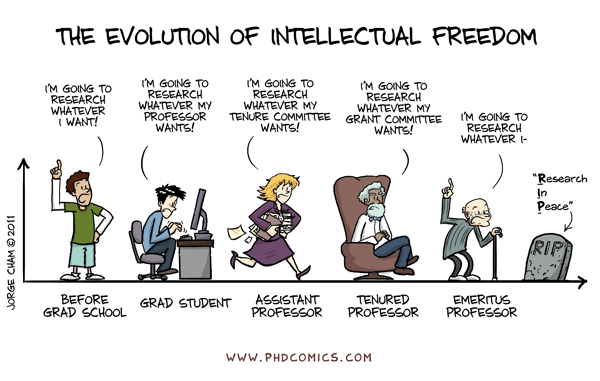
I know nothing about her but the video on her experience in academia is spot on. It's a pretty common experience among STEM academics. You will face the point where you have to compromise your academic "purity" and curiosity for trendy topics to survive. This also implies publishing "bullshit" papers and "bullshit" grants. Only certain types of people make it through that.
Can I ask what you mean with "pretty common"? Do you think more than half of all STEM graduate students had a similar experience as she did? Do you have actual data to support this?
I am asking this because HN neems to be so much more negative of academia than what I am seeing around me.
More generally I think it is worth stressing that any site like this can be a terrible echo chamber at times. Generally there are smart people here, but on some topics I suspect that the consensus could be completely misguided.
Let me add another point of anectdata. I did my CS PhD with a full scholarship in the UK. Then a 3.5 year postdoc in a great Leinbiz institute in Germany. Part of a huge EU project (in Framework Programne 7)
By all measures, I was "living the life" in academia. with both my parents being academics (both researchers and pretty published in their fields)
Yet, I left it after the project finished. The prospect of having to write papers just because. The amount of trash papers I had to review for free but then looking at the cost of proceeding books (I got them for free through my institution... but what a racket it is!!)
The prospect of the "academic path" ((abitur, lecturer, associate prof and then prof) praying the stupid game..
I left it all and turned to the startup world . Maybe it was my engineer mind, but I feel way more fulfilled after 12 years in industry.
I was a biological anthropology postdoc for a year or so. My office mate used to refer to the process of turning one decent idea into as many papers as possible as producing LPUs ("Least Publishable Units"). He was joking, but it wasn't a joke.
It was depressing. I dropped out. I have love for academia, but there is a pretty overwhelming amount of gamesmanship in surviving that system. I found becoming a developer a much easier career to navigate.
> Do you think more than half of all STEM graduate students had a similar experience as she did? Do you have actual data to support this?
Yes, her entire description about her experience (safe for that weirdness with the textbook sweatshop) is relatable. I am not sure what you are looking for but STEM PhD attrition rates speak for themselves. Those do not include PhDs that decide to leave academia after retrieving their PhD. Not to mention the frequently discussed mental health crisis that consistently gets Nature articles.
I did a PhD in CS. There were certainly some students who had a bad experience, but I don't think it was the majority or even near the majority. I think 1 in 5 is a reasonable guess. The ones who did do tend to be more vocal about it, which is natural.
I don't think this is generally true and the generalization is actively hurtful. Promoting a skewed/miserable perspective on academia. It all depends on the institution, your funding situation, your field etc. The miserable academics are the ones that moan the loudest. There is often an online circlejerk of whining academics that wind themselves up (esp PhD students). Also the ones that are barely scrapping by are the ones that need to resort to bullshit. You may be able to game your stats but people can smell bullshit from a mile away. Everyone will know you're just good at playing the system
"Complainants and their critiques can be safely discarded because they need to git gud."
She states in the first three minutes of the video linked above that she was excelling academically. How bizarre to observe a lack of research in a thread complaining about how the academy has drifted from the conduct of pure research. Three minutes. One hundred twenty seconds. That's all it would have taken.
The customer reaction to this decision spoke volumes. The official reason given is margins compared to hardware such as the IPU but, personally, I chalk it up to turf wars. Barefoot had a distinct culture to Intel's other networking units. There is a reason many of its engineers ended up at FAANGs and not other semiconductor companies.
Most of the locals do enjoy the Oktoberfest (speaking as someone from there). It is a fun two weeks of the year and the entire city enters a special kind of mood.
But it is not surprising that the HN crowd would find it distasteful. People here are definitely not the type for these kinds of festivities.
Don't get me wrong: I have no problem with drinking beer, I used to be able to down an entire case of Augustiner in my best days in one night. Personal record at Oktoberfest is something around 6-7 Maß.
The problem I have with Oktoberfest is that it's gotten way out of hand, it's too much impact for the local population for way too little gain for common people - and it's increasingly unaffordable: 15 euros for a liter of beer? That's bloody ridiculous.
Munich locals pay the most expensive rents in Germany, and those who have the cash to buy are facing the second-most expensive real estate market in Europe [1].
New-Yorker-style long-form articles are a different reading experience compared to an article intended to deliver factoids. These articles are not meant to just deliver news. They are meant to be immersive and also educational. They end up being long-winded because they paint a more comprehensive picture of a particular topic's history, outlook, and also the proponents and detractors involved. The descriptions of the people are intended to give you sense of their mentality and what drives them to champion or fight the article's topic.
Quality can also vary wildly of course. Tight writing also applies to long-form. You do not want to end up meandering.


https://imgur.com/a/ZY0vNqR
Running ollama and witsy. Quite confused why others are getting different results.
Edit: I tried again on Linux and I am getting the censored response. The Windows version does not have this issue. I am now even more confused.