The main problem comes from under maintenance. I am spanish, we have known this for years.
15 or 20 years ago when I took the train it worked well.
Now there are more trains and they increased the traffic like by 70% if I am not wrong and the budget for railway infrastructure by only 17% and it seems to not scale well enough, for whatever reason I do not know all the details.
There are a lot of railway tracks that are not in good state so speed must be lowered. There are incideents and delays routinely, all the time.
This did not happen until like 10 years ago and it has gotten worse and worse since then, not only in high speed trains.
The roads is a mess also: 52% of infrastructure for roads has bad or very bad defects in it.
The thing is that we have a record in government incomings and the services, ALL of them (healthcare, roads, infrastructure...) slowly collapsing.Part of the money is not going to the right places. I think that nearly 40% of the budget goes for retired people. We have 9.5 million pensionists in Spain.
We have to change that system and rationalize government spending and welfare or eventually everything will collapse.
I’m very wary of finger-pointing like your comment that ultimately serves to advocate for cutting quality of life for citizens.
Roughly 31% of Japan’s budget goes to social security. They don’t have problems keeping their high speed trains safe.
Cutting pensions won’t make trains safe.
I will also point out that on its own without further context, a high percentage of government spending going toward something doesn’t make that spending irresponsible or misappropriated. In the United States, a very high percentage of federal taxes are spent on Medicare and Social Security. But it should come as no sirprise that a very large percentage of federal income tax revenue is directly appropriated to pay for those things.
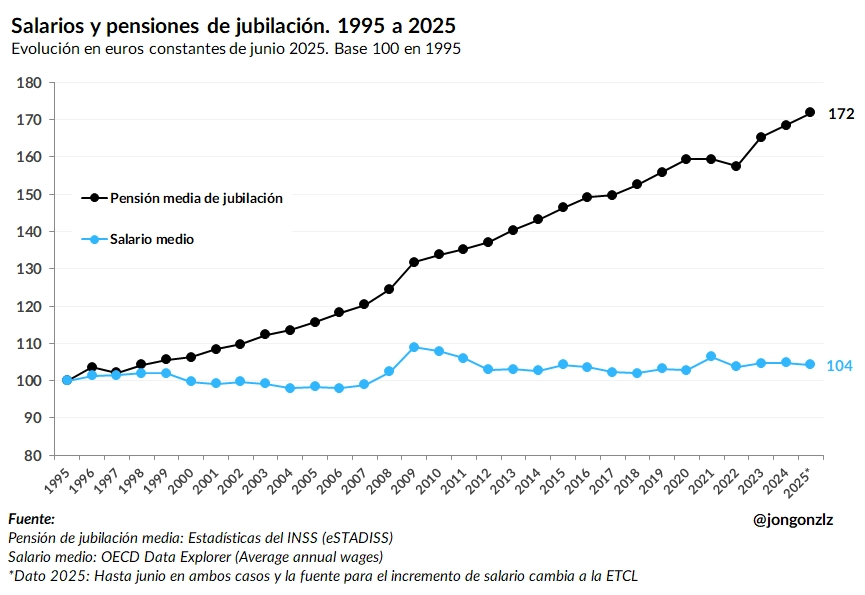
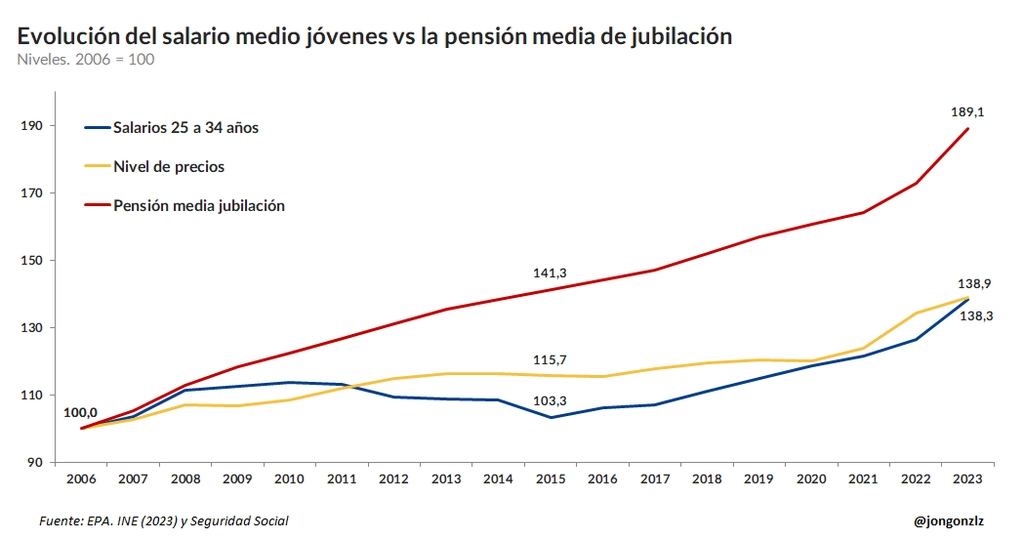
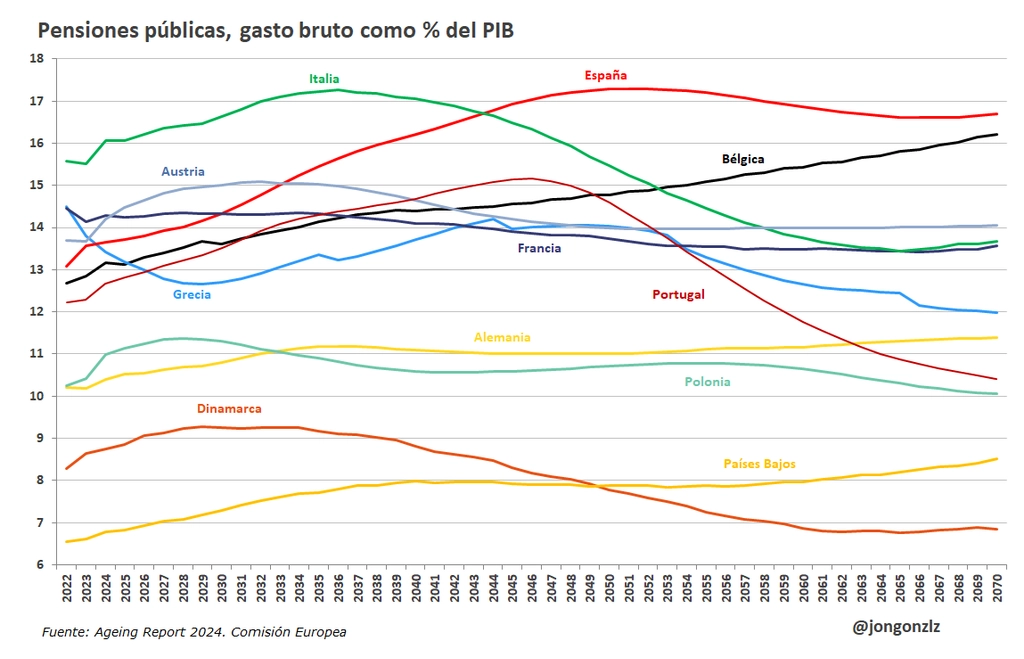
Pension expenditure in Spain is out of proportion from any point of view, though. I'll provide links to some graphs because I think they give more information than my words could:
So yes, the reason why we are underinvesting in pretty much everything is basically pensions. GDP is up, tax collection is up, debt to GDP is sligthly decreasing... but pension expenses keep growing at a fast pace so there's less and less money for everything else. And I say this with both of my parents earning the maximum pension, so I don't have an axe to grind, but it's just reality.
I am not suggesting cutting down pensions. My own parents are pensionists... so that you get an idea.
I am giving an objective explanation in all honesty: Spain needs a pensions reform probably at some point bc it is 40% of the expenses in the yearly budget, with a deficit and a demographic deficit. This will explode.
If it can be taken from elsewhere, better.
But you know how much are pensions in Spain and know our pension system in detail (it is literally a Poncy system...)? They are often higher than people working!
Whether we like it or not, we need to reform or collapse in the future. I wish it could be taken from elsewhere, but 40% is a lot...
There is a lot of useless expenses in public work in our "federal system" (comunidades autónomas).
Japan is a terrible comparison here because their rail network is privatized. They're also paying their pensions with debt, and their economy is really stagnant and not a shining example of a country doing well with a pension burden that high.
> They don’t have problems keeping their high speed trains safe
Their trains are safe, but they also have 2X the national suicide rate as Spain, which amounts to about 17000 more deaths per year. I'd attribute a big chunk of that to their work culture treating people like machines, whereas Spain's work culture tends to lean towards treating people like humans.
That isn't an excuse for railway mishaps, of course, but I'm just trying to de-romanticize Japan as some kind of magical perfect place. It's not. They might have gotten their railways right, but they have massive safety issues around mental health.
Not saying maintenance isn't a problem, it probably is. It's a problem everywhere in Europe. Have you seen train service in England, Germany or Sweden? Absolutely terrible, compared to just two decades ago.
But under-maintenance causes trains to stand still and be late. It does not cause them to crash.
Crashes are caused by running at speeds higher than the (under-maintained) rail can support, or (against all rules and every regulation) no cap on speed when the signalling system is down.
The latter can not be solved with more money and resources. It is a culture problem. Rules can not routinely be disregarded for arbitrary reasons, especially not when they are completely in line with common sense.
The rumor is that staff is being pushed to restore service as fast as possible after a problem is "solved". EU push for green transport and privatization means lines were opened to competition, increasing the number of trains compared to some decades ago when only one operator used them with less trains than it does now. IIRC currently the lines have two operators (3 in some places?), meaning that traffic more than doubled. Those in power do not want the service to have more delays. And instead of updating and maintaining the infrastructure, Adif stresses it even more, both in the technical and personal fronts. Thus the accidents. But nobody at the top resigns, blame low level scapegoats instead.
The Iryo train was stopped and unable to restart, because it's safety system did not allow that until the signalling issue was corrected. The AVE was commanded to move again like normal (200 Km/h or more). When the Iryo reported to be stuck, all the trains in the line should have been notified to stop once more, or go at line-of-sight speeds (40 Km/h). Both options are bad for delays. Current news is that five minutes after the Iryo call, the AVE rammed its back at 160-200 Km/h.
CEO of Iryo company complained 3 weeks ago about LZB being problematic, their trains taking a long time to recover connection. Safe but old, he said. It should have been replaced by ERTMS by 2024-2026.
Over here in Finland our road infrastructure sucks too, and pensioners take lion's share of all the resources. Yet our trains aren't crashing. There's something wrong with systems and safety culture in your railroads. Bad maintenance doesn't cause trains to crash into each other if proper procedures are followed.
Still I agree, pension systems in most EU countries are unsustainable.
Deterioration started long before that, according to my sources it started on 2008, but yeah, last 5 years or so it has gone worse. The budget for it has been increasing year by year. It seems that the main problem is not just lack of maintenance but that there's more traffic and new construction.
Pensions is 13%PIB which is on the European median.
The problem is demographic. Also take into account that retired people have paid for their retirement.
Your rhetoric is not what I'd like to be promoted as the first answer entering. Just reading the title of the news I knew what kind of messages I'd see promoted.
Any intervention to protect adults with laws infantilize.
The cause is clear in my mind: the world outside is what it is. If you cannot take good decisions (whatever that is for you) and you need someone to get protrcted and you soend your day whining about your own problems bc the world is not perfect, then you did not become an adult, ever.
There are extreme cases: for example you cannot say aperson in a country with no weapons is infantilized bc the complain for being abused by an armed gang. Something like that is legit.
But for many things I see around I just see people complaining instead of changing strategy, solve a problem, change their choice or just plain skip things they do not want. Instrad of that they demand some kind of protection.
For a very narrow set of exceptions I would agree. For the rest, we sre just adults, we should know what to do.
> For the rest, we sre just adults, we should know what to do.
We should. Yet a significant portion of mental health issues would be solved if psychiatry provided mother as a service: Teach interpersonal skills and to take care of yourself. They don't teach that stuff in school and parenting is a hit-or-miss.
The world indeed is what it is and your diagnosis is spot on: Most people didn't become adults as defined by being able to make consistently good decisions without support. Can either let them hang themselves or infantilize just a bit to let most dodge the worst pitfalls.
Don't really have a strong personal opinion on where the pragmatic optimum is, but surely a long way before banning porn. Tangentially it'd be far more ideal if that pragmatic optimum could cater to the ideal adult without catastrophic social consequences, but that'd literally be a generational effort.
You could say natalism as opposed to maltusianism, or that is not a thing? One with a worse outcome IMHO given the aging of population and low birth rate.
Industry: agree.
Addiction: true, many things can be addictive, I think this is in big part a matter of education but there are some things that are more addictive than others also.
As for better option than prostitution. I would say this is kind of prostitution is some way.
So in the absence of religion, there is no racism, no interests and no wars?
You seem to suggest that banning religion would end up wars or human nature.
And yes, noone should force everyone else, but not only om religious stuff. Sometimes there has been non-religious truths to which people are forced and that collides ireemediably with other thinkings.
I am not sure why one philosophical thinking should be better than other just bc it does not contain religion.
In fact, I consider a big part of most religious a compilation of wise advice about human nature. You can believe it or not, take it or not, that is a choice, but when not taken into fanatism I do not think it is harmful.
Again, that is not anreason to force a position to others. But there are a handful of things that are very controversial.
Very few people reach "worship" levels of things like that.
The desire for wealth is one of the main things that makes it "somewhat less". But I think your "leave a void, someone will fill it" framing is too simple. Big religions don't block much greed, they overlap. So the increase in greed from knocking out religion would not be very much. Because of that and other overlap, the void is a lot smaller than the size of the religions that would be disappearing.
I’ll take “Things You Learn In Introduction to Logic” for 500, Alex.
In places where supposedly most of the people are in engineering or software, I’m surprised how often 1) people have to point this out, 2) people are willing to loudly pronounce their lack of basic logical skills.
Religion acts as a mechanism for perpetuating and giving social acceptability to certain kinds of bigotry. If it didn’t exist, it’d be much more difficult to justify that kind of bigotry.
Institutionalized Othering, literally. This is my in group and we spend every Sunday morning talking about everybody else. Sometimes with extra separate classes for the children.
My workflow leans on AI for some tasks: review what I wrote, drop me a one-off script (this one is the generative exception), and so on.Or even initial scaffolding.
For the rest I do not. I do not place AI-generated code anywhere.
You lose all control AND UNDERSTANDING.
When things go wrong it gets very messy.
I will keep doing this, I think it works well, I emjoy programming and I think it is productive.
For testimg I tend to write randomized testing, which takes a bit of design but oncr you have it, well, it os test-generatove and increases the quality of checks.
I did not see a single bold claim of these discoveries or those "self-building models" that Claude and others have internally with a proof of their existence.
So yes, I am also skeptical. I think these companies are more intoncartelizing and colluding via propaganda than delivering stuff. They do deliver some, but very far from their promises.
These companies dangerously mimic behaviors I usually attribute to politicians.



15 or 20 years ago when I took the train it worked well.
Now there are more trains and they increased the traffic like by 70% if I am not wrong and the budget for railway infrastructure by only 17% and it seems to not scale well enough, for whatever reason I do not know all the details.
There are a lot of railway tracks that are not in good state so speed must be lowered. There are incideents and delays routinely, all the time.
This did not happen until like 10 years ago and it has gotten worse and worse since then, not only in high speed trains.
The roads is a mess also: 52% of infrastructure for roads has bad or very bad defects in it.
The thing is that we have a record in government incomings and the services, ALL of them (healthcare, roads, infrastructure...) slowly collapsing.Part of the money is not going to the right places. I think that nearly 40% of the budget goes for retired people. We have 9.5 million pensionists in Spain.
We have to change that system and rationalize government spending and welfare or eventually everything will collapse.
reply