“This makes it not really usable as a daily driver, but keeps it in this beautiful sweet spot where it has a shocking number of commercial and agricultural uses.”
$52K per engineer per year extra cost to the company. I think at an Apple scale that level of ROI should be easy. I wonder if they were not seeing the ROI they wanted? As an indie hacker AI has been amazing for me and has freed me up to do so much more.
I’ve been talking to a bunch of companies about how they use LLMs and I’m seeing dramatic differences in costs, with very few concrete measures of value. Mostly just PR counts. We’re talking order-of-magnitude differences in spending, from hundreds up to many thousands. (API pricing, not subscription prices.)
I’m not surprised companies are pulling back. That’s a decent chunk of money and CFOs are going to want to know what they’re getting for the money. “More PRs” isn't a good enough answer.
That is peanuts to Apple. It is possible engineering and programming is getting too much done and Apple doesn't have the means to push it all out live to customers.
Or, get this - figuring out what customers really want and need is super hard and churning out code doesn't solve the truly hard problems of software development.
I don't see any indication that LLMs help with requirements gathering or user studies, especially live ones.
The article does say that AI agents could go through the web interface, but it's not clear if Doordash is counting those orders as AI orders or not. I agree, there's no real information here.
By all accounts, Anthropic has taken on an enormous amount of technical debt in Claude Code (and presumably its other software). What isn’t clear is whether this is actually a problem.
At normal startups, tech debt slams the brakes on product growth, but it takes a lot of years for it to happen. At Anthropic, they’re speed running tech debt, but they also have AI to help them navigate it. Will it be a problem? Don’t know, looking forward to finding out.
I think it’s far more likely that most voters are completely unaware of the inside baseball, and vote based on how they’re feeling about things that affect them personally. As Clinton said, “it’s the economy, stupid.”
You’re implying that Apollo is biased, but the thing you’re quoting is a very brief report on publicly available research. This is the entirety of the article:
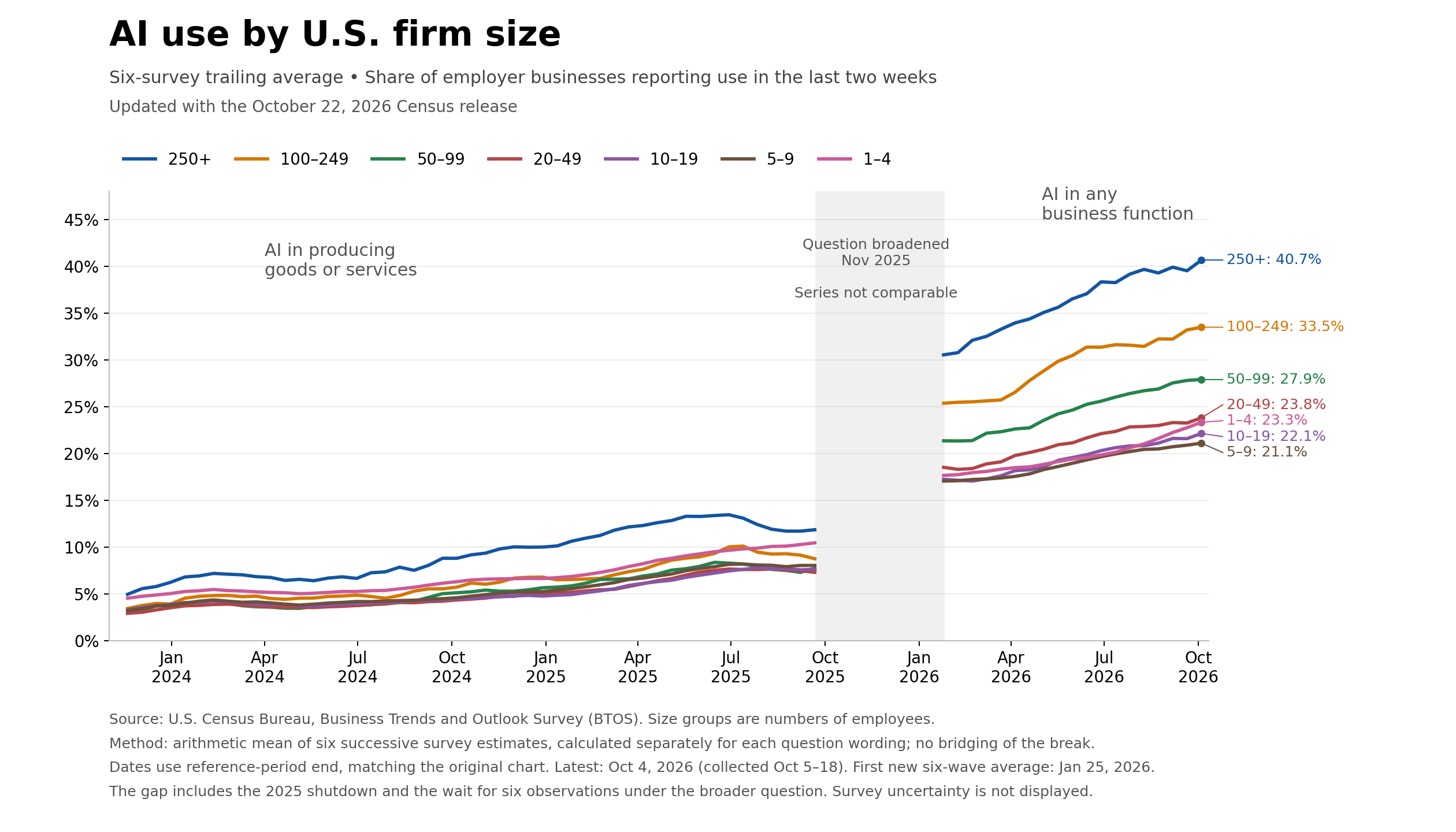
“The US Census Bureau conducts a biweekly survey of 1.2 million firms, and one question is whether a business has used AI tools such as machine learning, natural language processing, virtual agents or voice recognition to help produce goods or services in the past two weeks. Recent data by firm size shows that AI adoption has been declining among companies with more than 250 employees, see chart below.”
Two questions:
1) What does that chart show today? (Genuine question. I’m curious and don’t know where to find it.)
2) Regardless of what it shows now, why do you think Apollo reporting on it is noteworthy?
I'm implying they may be biased in what they chose to report on and how they frame it, yes. Deciding which figures to turn into a chart is an editorial decision.
> I'm implying they may be biased in what they chose to report on and how they frame it, yes. Deciding which figures to turn into a chart is an editorial decision.
I think the Apollo thing is a fairly dumb hot take based on a near-term wiggle in a graph, but it's hilarious that you are calling them biased.
Pot, kettle, black, etc.
Substantively, I don't think it's surprising at all to see those lines go up -- it would be shocking if they didn't go up, given the intensity of the hype. The slope is what matters. In particular, I wouldn't argue that your graph shows any kind of acceleration in adoption over time.
I’m surprised it’s so low, actually. AI is defined so broadly that it includes voice recognition and machine learning of any sort, and in any business function. It’s hard to draw conclusions from that. I wish they had kept it narrowed to LLMs specifically.
It’s too bad they changed the definition midstream, too. It would have been nice to see the two lines side by side.
> Of course Apollo is biased. They are a hedge fund.
They are not a hedge fund, they are a Private Equity/Private Credit fund, a financing firm and a venture fund all wrapped up in an alternative asset management company that does almost everything related to private credit.
But such a thing should not be prosecutable in the first place. Opening an unlocked door isn't breaking and entering. If you walk inside and steal something, that's a different thing. But if you just close the door and alert the owner that their door is unlocked, what sane person would consider that a crime?


reply