Companies do not change their whole strategy from a capex-driven traditional self-hosting environment to opex-driven cloud hosting because their IT people are lazy; it is typically an exec-level decision.
Bitcoin incentivizes miners and energy companies to use otherwise wasted energy. It incentivizes them to innovate in the energy industry unlike other networks bitcoin is able to pay the people that innovate and build better technologies in the space.
No, it really doesn't. It incentivizes the use of the cheapest energy. That's why PE firms are re-opening coal power plants. Burning waste coal is about the worst thing you can do with it. Flaring needs to stop, too. Transmission of power is about 97% efficient within the current network, and there's a whole world of things we can do with that energy - desalination, metalworking.
[edit] Given a choice between reliable power coming out the back of a coal furnace in town and unreliable power in the middle of nowhere coming out the back of a waste plant and a solar farm, for probably 50% more, I know which I'd pick if I were running a business.
> However, that wasn't really the question at issue.
Weren't you the one who brought up the question in the first place?
> wasting it isn't green
The point is that renewable energy sources tend to produce maximum power at off-peak times. So to serve peak times, we need more wind and solar generation than is required for off-peak times.
Since we don't have good ways to store and time-shift electricity, intermittent Bitcoin mining is one way to soak up the excess capacity off-peak to make the generation capacity economical.
Should we just turn the windmills and solar panels off during off-peak times?
Or should we leave them on and get clean energy at a price that's cheaper than coal?
> Weren't you the one who brought up the question in the first place?
Apologies if I was unclear. I was referring to the parent's statement that "fortunately, in Bitcoin whale ownership does not imply control over the network. Fortunately, Bitcoin is PoW and not PoS."
My retort was that whales in Bitcoin control such a disproportionate share of the currency that if they wanted to control the network itself too, they could simply buy the miners which isn't really too dissimilar from staking in a proof of stake coin. My understanding is that each mining pool provides roughly the same security as a PoS validator.
When I replied "however, that wasn't really the question at issue," what I meant that the "greenness" wasn't really the crux of my reply, rather I was suggesting that network control falls to those with the most coins regardless of whether you're operating PoS or PoW, the only difference is whether resources are consumed or not along the way.
  Location: Broken Arrow, Oklahoma, United States

  Remote: Yes

  Willing to relocate: No

  Technologies: Python, Golang, C, Rust(In order of most experience), OpenBSD, FreeBSD, Linux, ZFS, PF, AWS, GCP,
  Git, Unix Systems, Scripting, Automation, System Administration, Entry Level Software Developer.

  Résumé/CV: https://docs.google.com/document/d/157acCC9jtbSvaWusIyen8fTsigyFu04M0RIqhosAU0M/edit?usp=sharing

  Email:[email protected]
Why hire me:
  6 years IT experience working with Unix and Windows based systems, Self taught entry level programming and
  scripting. I am super passionate about Unix based systems specifically OpenBSD and FreeBSD. I love learning new
  technologies but see the extreme value in the long term projects that have been around almost longer than I've been
  alive. Young guy looking to learn, grow, and gain experience from others in the industry. Willing to accept when I
  am wrong.
Why not to hire me:
Looking for a person that has been in the industry for over 7 years. You want a manager. Looking for someone a DBA.
I switched from pfsense + Ubiquiti to OpenBSD + Ruckus and couldn't be happier. While the web UIs were cool for a day, with the command line I feel as though I understand exactly what I have setup a bit better. Ruckus UI is also much more friendly than Ubiquiti's - I had to actually install mongo db + VM/dock just to configure my Ubiquiti WAP? Seriously?
I just wish I had completely deleted my Ubiquiti account when I sold my WAP.
Ya I did some research and it's not bad at all. And ruckus is pretty good with their firmware options.
In fact I'm buying two new R710s to replace my very old UAC AP Pros. Was going to get the new AP 6 LR but after UIs current woes (and them dropping support for my APs way too early) I'm done with them.
I ran into issues with firmware on a ZoneDirector 1200 and some R610's that were out of support contract. Totally functional and all, but couldn't bring them current.
Though, After using Ruckus in Corp/Enterprise they've sold me on how capable their APs are, it's real deal high density stuff.
OpenBSD’s base system (without extra packages) includes PF and has a focus on security.
PF in freebsd is several major versions old.
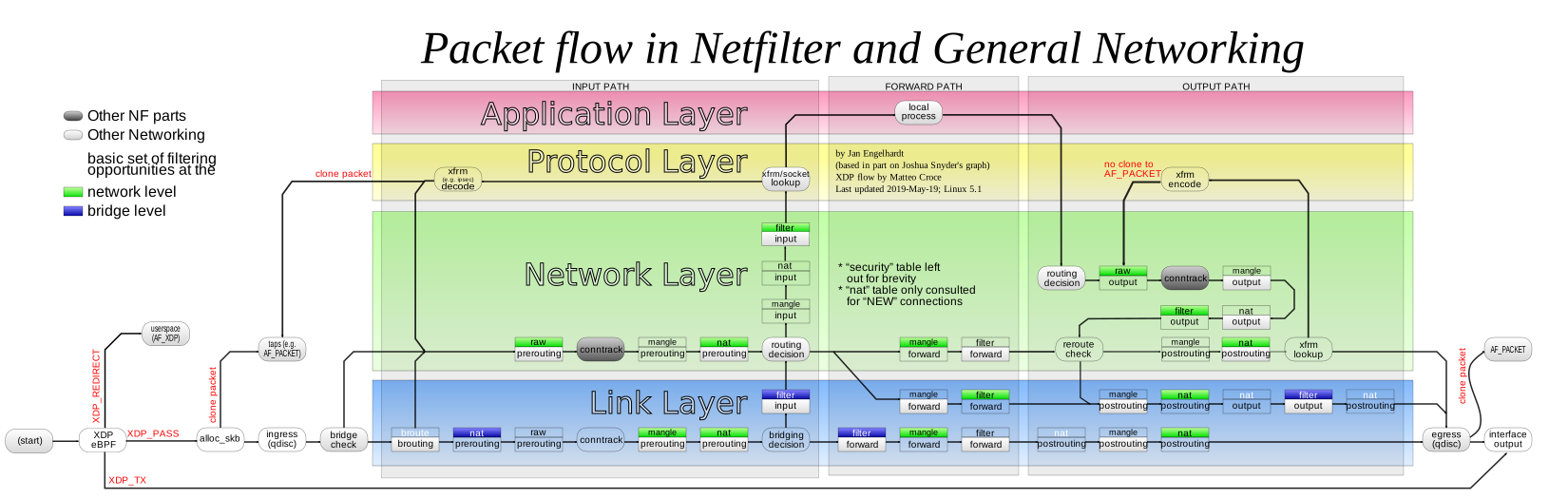
nftables (like iptables before it) is rule based and not bucket based. So high numbers of rules will not affect pf’s performance like it does with nftables.
But, for home users, probably not noticeable. Though I prefer the syntax of PF personally.
The key is “for each packet”, because it’s bucket based it will entirely skip evaluation for packets that do not match. This is due to how the rule set is compiled, but I can see how it could be confusing if you’re used to iptables and only think in those terms.
I posted the architectural diagrams of both in another comment on this thread yesterday, I think you missed that.
>The key is “for each packet”, because it’s bucket based it will entirely skip evaluation for packets that do not match.
That is how it works in nftables.
>but I can see how it could be confusing if you’re used to iptables and only think in those terms.
Considering you're misunderstanding some basics about nftables and iptables here, I think you need to look in the mirror.
>I posted the architectural diagrams of both in another comment on this thread yesterday, I think you missed that.
I saw, and it only reenforced the fact that that's how nftables works. Hilariously enough, the OpenBSD webpage crashed and wouldn't load, giving various 500 and 42X errors.