I don't know maybe just be worried instead about being on the side of justice and what is right and not be so worried if that side has people you don't like on it.
a lot of people determine what is right by who is on that side - the right side is the group that they identify with, and the wrong side is the group they dislike.
And you get the hilarious (if not sad) situations often, where the exact same actions is wrong if committed by one group, and right if done by some other group.
Maybe I dislike a party because they're wrong, not that I think they're wrong becuase I dislike them? I usually don't have any reason to like or dislike a party until I see behaviour.
That's not hilarious or sad. It's valid to oppose your enemies and support your allies. It takes a certain kind of educated liberal bubble to think that is "hilarious"
I'm just so sick of people in our tribe who REFUSE to ever name their enemies. We're doing everything in good faith against people who hate us and want us to die. It's silly, and standing on some principle of equality while we continually lose over and over is sad to watch
It's a matter of integrity. Support or oppose whoever you like, but if you change your principles based on the person in question, then you don't have principles at all.
It leads to keeping the bad people on your "side" just because they share some of the values
> It takes a certain kind of educated liberal bubble to think that is "hilarious"
No, the hilarious part is that the "educated liberal bubble" will do exactly that thing, and then wonder why everyone else is seeing them as crazies; because they'd rather side with bad actors on their side purely because other side is attacking them, no matter the reason.
And of course, not only them. It's natural human herd behavior. And it leads to absolutely terrible end results
The crime is the crime. No matter the leaning of the criminal
What happens is that it takes the form of attributing bad things to enemies and good things to allies, such that you are blind to where your allies are not your allies. If your allies are acting opposed to your interests but you like them because they signal to you as an in group, then you are being fooled by them. Thus, it is good to actually evaluate things on their merits once in a while.
The "blind" ones are people like you! doing everything in good faith against people who aren't and fundamentally oppose you and your existence. Foolish!
doesn't that undermine the entire reason to have laws? if they are really just excuse to punish our enemies and reward our friends, why even bother with the pretense of a trial?
Wow you got my demographics and political opinions wrong entirely! We almost certainly vote for the same people. I'm just so sick of people in our tribe who REFUSE to ever name their enemies. We're doing everything in good faith against people who hate us and want us to die. It's silly, and standing on some principles while we continually lose over and over is sad to watch
Presumably the parent’s objection to ISPs and copyright cartels is precisely that they are so frequently (and to such a large degree) unjust. FWIW, I don’t think the parent’s objection was subtle about that point, I’m frankly not sure how it was overlooked.
Frankly, I don't see how you can't parse that their point, as written, is "I'm on the side of bad guy A because bad guy B is worse than bad guy A" which is completely orthogonal to "A is in the right and B is in the wrong".
I said "allow it". It was mainly about my feelings. I can feel what I want. It also just so happens that Cox was in the right and Sony Music was in the wrong.
If you look at the whole scenario, this will mean that Cox won't pass $1 billion dollars of punitive fines off to their customers, because, after all, the customers generate the money.
In reality, this would have made their innocent customers pay for the crimes of their guilty customers and made both Sony, and in the long run, Cox richer, because once paying an extra $5/month becomes normalized, then there's no way they're going to go back down in price just because the fine is paid off, any more than the government will ever stop charging tolls on a toll bridge that was paid for by tolls no matter how many times the cost of the toll bridge is paid off.
It really has nothing to do with Sony as such though. This is a common finding; 9:0 is also a clear message. If service providers are held accountable then arms producers also have to be held accountable. Or politicians who drive up prices via racket scheme such as a certain guy using orange powder on his wrinkly face. Someone is stealing money from stock exchange - that is also becoming increasingly clear from the trading pattern. Krugman pointed this out not long ago, without naming anyone specifically but I guess we can kind of infer who was meant.
It's always seemed fundamentally flawed to me that the exchange laws are designed to prevent people benefitting from insider information but then the entire purpose of the stock exchange is to make money by leveraging information asymmetry to make choices other rational actors wouldn't make because you have more knowledge or data than they do.
It's a very "leverage your info to make money no wait not like that" scheme. I think I just don't understand what the difference is between an insider who sits on a board (illegal) or has a nephew who's an SVP at the company (illegal) and a politician setting the laws that shape the whole industry (legal apparently?) or gets tips from same (legal apparently?).
> I think I just don't understand what the difference is between an insider who sits on a board (illegal) or has a nephew who's an SVP at the company (illegal) and a politician setting the laws that shape the whole industry (legal apparently?) or gets tips from same (legal apparently?).
This example is just standard issue corruption. Politician gets to exempt themselves, so they do.
> It's always seemed fundamentally flawed to me that the exchange laws are designed to prevent people benefitting from insider information but then the entire purpose of the stock exchange is to make money by leveraging information asymmetry to make choices other rational actors wouldn't make because you have more knowledge or data than they do.
Insider trading laws are designed to prevent people that can affect business outcomes from benefiting by affecting those outcomes. For example, a senior executive screwing up a crucial delivery to gain money from short positions.
The idea is society benefits from the assumption that all executives are ideally holding long positions on their business.
The problem with insider trading is that incentivises people with power to do unlikely things with that power because private knowledge of the upcoming unlikely event is unusually profitable, especially if it is destructive. This ship may have sailed.
That's why i would rather see insider trading made legal, but transparent.
Instead of quarterly filings, if you are considered an insider (or is affiliated with one), you are required to have your trades be instantly reported and be public the nanosecond you make them. You are allowed to make use of the insider info, as long as you adhere to these transparency measures.
> ...you are required to have your trades be instantly reported and be public the nanosecond you make them.
That doesn't do anything at all to remedy the situation. Better would be to require trades by insiders (and the particulars of those trades) to be locked in and publicly announced at least seven calendar days in advance. You need not announce the reason for the trade, but you must announce the amount of whatever it is you're selling and/or buying and the date at which the transaction will happen.
Yes, I'm aware of the whole "scheduled stock sale" thing that folks at a certain level have to do when trading in the stock & etc of the company they work for. IMO, that should be mandatory for all employees and their families.
It makes more sense when you realize that insider trading laws came after it was a problem, not before.
Before the insider trading laws, the stock market was much more volatile and was more akin to gambling for people out of the know. For people in the know, it was an easy way to extract wealth from those on the outside just looking at the numbers and publicly available information.
I don’t think the American right wing has any concerns about being perceived as inconsistent. They will reverse their positions overnight if it suits them, as they have illustrated every week for since the start of 2025 (most recently “no new wars / america first” to cheerleading the war in iran.
Cox cable pays legislators to limit people’s access to wired broadband internet service at their home (by banning government internet utilities), allowing them to charge higher prices due to having a monopoly. And they provide substandard asymmetric broadband because their customers have no choice.
Proof: compare the quality and price of their service in neighborhoods with access to fiber to the home as opposed to just having access to Cox via coaxial cable.
I realize I'm in the minority but I side with whomever I think is right under the law, regardless of my (sometimes extreme) feelings about the parties and even about the law.
A case only reaches the Supreme Court if there is confusion over who is right under the law. The Supreme Court decision itself is not a definitive guide to which side is right under the law, as they’ve overturned themselves multiple times. So how do you decide which party to side with?
Your view on the law seems a bit alien to me. My opinions on what the rules of the law should roughly look like, are largely independent of who specifically is involved in a legal dispute. Sure I guess if Hitler was being sued and the only way to stop him was this lawsuit by Sony, I would probably concede that on balance it's better to have a slightly worse legal standard around copyright. Otherwise, I think having a law that best reflects my moral views and creates the best incentives for society in general, far outweighs how i feel about the plaintiffs.
As for how I arrive on my views, it's obviously not an entirely rational process, but the rules you get from viewing property rights and self-ownership as fundamental seem to lead to the most preferable outcomes to me. If I were forced to adopt a more deontological philosophy, it's also the one that has the fewest obviously absurd conclusions, though not entirely. From this it's, in my opinion, pretty obvious to be skeptical of copyright law more generally (Ayn Rand would disagree) and therefore I welcome any precedent that weakens it.
I just told you: I side with whomever I think is right under the law.
And your first sentence is not remotely true--or rather, it is quite conceptually confused. Whose "confusion" are you talking about? Not mine, generally. There are of course disagreements about which side is right under the law, but often those disagreements are a result of bad faith--take just about every case Trump has ever appealed up to the SCOTUS. And many of the decisions made by the current crop of right wing ideologues on the Court are made in bad faith, especially Alito, Thomas, and Gorsuch, in that order of corruption. Many of the "disagreements" are based on bogus "textualism" and "originalism" frameworks that are applied completely ad hoc and hypocritically and were invented by conservatives solely in order to provide them with a basis for making rulings based on their ideology (the historical record is quite clear on this).
Anyway, the point was that I decide based on my view of the law, not who the parties are. Since you seem to completely miss the point, have poor reading comprehension, and are just adding muddle, I won't comment further.
Yup. The Facebook brand was long dead, and Meta is a good tech name even outside of AR/VR or metaverse. The fact that no one calls the company Facebook anymore shows that the rebrand was successful.
It's very different though. Alphabet was created more for financial book keeping. Google apps have no Alphabet branding. On the other hand, Meta was created because the Facebook brand was down in the rabbit hole, almost every product of it has the Meta branding prominently displayed.
Anecdotal but my parents know about Meta, because they use FB/Messenger daily. They have no idea what Alphabet is.
I’ve heard MANGA suggested as the acronym with Facebook’s new name. Though maybe it should be MAAAN, said in a tone of exasperation at tech company activities
Is it really? Instagram, arguably the most popular (or maybe just behind TikTok, I'm not sure) social network currently, has successfully disengaged from the tainted Facebook name entirely. It may seem like a small thing but I do think that has a deep impact on the average person's perception of the service. Especially in the younger generation, the Facebook name has a definite "ick" to it (is that what the kids say these days?), even if it's just because it's the "boomer social network" and not because of the myriad privacy concerns associated with it.
The EGA version is the original version of the game, and is gorgeous. Most people don't realize that by playing the more colorful VGA version, they're experiencing an inferior redrawn remake.
Well, I think I prefer the slightly less...uncanny character portraits in the EGA version. The rest of the game seems a bit of a wash; some of the backgrounds are a little more striking in EGA, some look much more refined in VGA. And the sprites look much better and more colourful in VGA. I don't think it suffered as much moving to 256 colours as Loom did (what that original thread was about).
And we should also remember that looking at it unfiltered on a modern display isn't really giving a great sense of the warm glow either version would've had on a CRT; neither of them really looked the way that video suggests, so it might be a bit misleading.
> I think I prefer the slightly less...uncanny character portraits in the EGA version.
I'd personally say the EGA portraits look far more uncanny, resembling early CGI, while the VGA version looks like a hand-drawn book illustration. https://youtu.be/86O3PxdLrg8?t=181 Still, opinions can differ.
> looking at it unfiltered on a modern display isn't really giving a great sense of the warm glow either version would've had on a CRT
Great video. I think both ega and vga look good, depending on the scene (I prefer ega backgrounds but vga close up).
The music however, floppy is best and the cd version is the worst. I played with the internal speaker myself. The cd music sounds off to me, but cannot pinpoint why exactly.
Cga seems to be 1-to-1 conversion of ega. It only looks bad because of the strong cyan and magenta. But thats a hardware limitation not an artistic choice.
I'm not sure. The dithering is obviously different, not only harsher but in different places in many scenes. Also, the splash screen doesn't have scrolling clouds in the CGA version. And there are other subtle changes.
Call me weird but there's a certain charm to the CGA version, though it's obviously the worst of them. My favorite is the EGA version.
This comparison is a bit misleading, as you are not watching the game full screen, but at 1/4 screen size with video compression artifacts. This helps the EGA dithering tremendously.
In reality, dithering can only help you so much, when you have gigantic pixels and 16 colors... It is a remarkable feat what they achieved despite the limits of EGA, but it can't really compare to VGA.
Old CRTs helped blur the image. For that matter, C64 games on TV screens (which is how most people watched them, even though there existed dedicated Commodore monitors) blurred the image so much, the games barely resembled what you can see now with an emulator and a modern screen. Graphics were designed with this in mind.
> It is a remarkable feat what they achieved despite the limits of EGA, but it can't really compare to VGA.
In many cases, especially in the early days, artists didn't know what to do with so many colors, and produced inferior versions. Loom is a good example. The conclusion is that it's less about hardware capabilities and more about artistry, and technical limitations often force artists to be ingenious.
Well yeah, the good old CRT monitors (the worse, the better in this case) also helped with the EGA dithering, while viewing the EGA graphics fullscreen on an 1080p LCD display, you'll have ~30 pixels for each original EGA pixel.
Amiga versions seem the best of all the Lucasarts adventures, music is just much richer and although Monkey Island and Loom are done in the reduced color palette so look more stylistic I think they use a few more colors or better shades of colors than the harsh looking EGA set.
I won't go over the details, but if you look at the website mentioned in the other thread from 2021, you'll see I'm not being hyperbolic.
EGA Loom is a work of art. VGA Loom misread the style and completely obliterated it, in its eagerness to deploy that early VGA "pillow shadow" style so typical of games of that era. (I love the term "pillow shadow", so apt now that I've learned it!).
Every nightly blue gone, light sources broken, every shadow gone, ominous deep-black tree shadows converted into gray/brownish things, etc.
To be clear, I think this is less a limitation of VGA and more a case of the conversion done lazily and/or by an inferior artist.
I must be in the minority, but I really prefer the EGA versions of many of those games. Probably nostalgia.
Even less defensible, I've come to appreciate the (awful to me at the time) CGA 4-color palette. You know, the games that were either cyan-magenta-white-black or red-yellow-green-black? I hated it at the time, but now I look back on that time with my rose-tinted (or should I say, magenta-tinted?) glasses firmly on.
I even bought the fake retroremake Eternal Castle, which is a loving homage to that era.
I for one prefer the Amiga version, because that's what I played back in the day. The Amiga supported 32 colors (without tricks like EHB and HAM) in 320x200/240 mode, so only twice as much as EGA, but they could be picked freely from a palette of 4096 colors, so IMHO it looked much better than the EGA version with its fixed 16 colors. But if you look at screenshots (https://scummbar.com/game/the-secret-of-monkey-island/versio...) it's obvious that they really put in a lot of work, with custom assets which fully used the capabilities of the various platforms. Of course, the higher the limitations, the more artistry was needed to make it look reasonably good, but I don't think that should be held against the "higher-color" versions...
I was going to say this. I never liked the 256-color VGA game (and now comparing, it does look bland) but Amiga struck the best, IMHO, balance between good hand-crafted pixel art but with realistic enough colors to give sufficient depth and athmosphere in the scene.
For a game like that, while I agree with the Amiga version looks good, frankly the Amiga port still feels like a good example of why there were lots of complaints about "lazy" ports for the Amiga that didn't take proper advantage of what it could do.
For a relatively static display like that EHB would've not been a problem, and the amount of gradual changes would've made it easy to exploit in the palette. Using the copper to modify the palette a few places would've also allowed for more, and switching to 640x200 below the graphics to make the text smoother would've been outright trivial. Even HAM might've been reasonably feasible.
Watching this, neither version seem as good as I remember the Amiga version looking, which was still dithered but looked better than the EGA version. Obviously hard to say without a direct video comparison.
Did you play the Talos Principle Reawakened? They took a great performing game made with their own engine, re-released it with UE5, and now it performs like doggy doodoo.
I did. Was kind of underwhelmed by the graphics too. Although that may be in line with a remake. Ie, I gave it benefit of the doubt since I don't know how much effort they put into it beyond "making it work".
It's "standard" for a reason. Humanity settled on these numbers long ago because they work best. It boggles my mind why anyone would choose otherwise since what we do at any given hour is arbitrary.
A lot of people hate standard time in winter because the sun sets at 4 or 5, and they want the sun to instead set at 8 or 9 like it does in summer. DST in winter doesn't actually give you the 8 or 9 sunset, it gives you a 5 or 6 sunset (which doesn't get you all that much) combined with moving your sunrise to 8 or 9, which causes its own set of issues most people don't think about.
The last time we went to year-round DST, we stopped almost immediately because people experienced what winter DST was actually like and went "wait, this sucks."
Obviously(/s) the solution is to change to a sunset centered day. new day starts at sunset so people can get up late and enjoy the maxim number of daylight hours.
I always find it strange how particular people are about the numbers attached a purely astronomical phenomena(myself included, but I am pretty hard in the "let the sun figure it out camp"). If they want more "daylight" hours then get up at a time to enjoy them. But people would rather bend over backwards fiddling with the numbers as if that is going to change how long a day is.
I think fundamentally it comes down to energy for me. I have very little energy in the morning so I am not going to harness the pre-work daylight hours to do something outside like taking my dog to the park, biking, or running. For me I don’t actually start feeling energized until maybe 9-10AM.
After work however, I have much more energy to do things outside with the daylight.
After college I moved from the far western edge of one timezone to the far eastern edge of another zone. I grew up with 5-5:30pm sunsets in winter, and now I live with 4-4:30pm sunsets. I moved here 25 years ago, and every single year when November/December come around and I get those early sunsets I hate it. It's one of the reasons I'd like to move away from here.
I know it's just one person's opinion, but to me those extremely early sunsets in the middle of winter are a huge quality of life reduction.
I believe part of the problem is that if you're in the middle or western edge of your zone, the winter sunsets aren't so bad. I suspect a lot of people who would prefer DST year round live on the eastern edge.
I live in Atlanta (western edge of US Eastern time) and permanent DST sounds horrible - the sun would rise at 8:45 in early January. Honestly I'd prefer we be on permanent standard time. Call it permanent Central Daylight Time if you must.
On the other hand, I used to live in Boston (eastern edge of US Eastern time) and those 4:15 sunsets were pretty depressing. Permanent DST sounds reasonable there.
The main driver of people wanting year round DST is so they can have sunlight after work in the winter. Those late sunsets in the summer are awesome too though.
They worked best when everybody were farmers and had to get up early and go to bed early. Now most people don't live their lives centered around noon, our free time comes after our work is done at around 17:00, so having more light in the evening instead of worthless light in the night makes sense.
Farmers have to wake up early because their animals wake up at sunrise and some tasks are best performed at that time. So they wake up before sunrise regardless of the clock time.
Human, like farm animals, are better off if they wake up at sunrise and go to sleep in full dark. At the equator that's easy, wake at 6, bed at 10PM. And standard work hours are 7-3 or 8-4.
So, it sounds like you're actually arguing that the numbers are just a construct and that we should all just use UTC and set appropriate work hours to the times that most correlate to the solar day in our region rather than adjust the clock approximately 1 hour per 15 degrees around the equator and have an International Date Line.
I think this would make way more sense, when they say the Olympic Opening Ceremony start at 18:00, its 18:00 for everyone around the world. No one as to work out which TZ Italy is in or scheduling meetings with Tech Support in far flung locales does not require knowing IST is how far ahead or behind.
> He promoted worldwide standard time zones, a prime meridian, and use of the 24-hour clock as key elements to communicating the accurate time, all of which influenced the creation of Coordinated Universal Time.
The one bit where this would be problematic would be "what day is it?" When does today become tomorrow?
There are a lot of systems that we've built that depend on that distinction. Things like business days and running end of day so that everything that happens on March 2nd is logged as March 2nd. I've encountered fun with Black Friday sales where the store is open over the midnight boundary and the backend system really wants today to be today rather than yesterday (sometimes this has involved unplugging a register from the network so that it doesn't run end of day, running EOD on the store systems, and then plugging the register back in after it completes and then running a reconciliation.).
Other than that particular mess of banks and businesses... yea, running everything on UTC would be something nice in today's world.
Aside on the "changing clocks" and realizing my flexible schedule privilege at a company I worked at I switched my schedule from 8-4 to 9-5 with the change in daylight savings so that I maintained a consistent "this is the hour I wake up".
When people propose switching to UTC what they are actually proposing is that everyone nominally switches to UTC but still uses local time informally in everyday life, which is a worse system than time zones. At least with time zones there is a way to know what time it is in any given place. With informal time you lose that.
No. that does not follow. Abstraction is useful. Having commonly understood terms (in this case hours of the day) that share certain traits regardless of where you happen to be in the world facilitates communication.
Right, but where I live sunrise is in the middle of the night in the summer (around 03:30). Using standard time in the summer gives me one less hour of useful sunlight in the evening, and while it doesn't technically disappear it gets moved to where I can't use it because that's when I sleep. It's the same for people further south as well, another bright hour in the early morning before they wake up is a wasted bright hour that would make more sense in the evening, when most modern humans are awake. The argument "noon should coincide with solar noon" is nonsensical to me, the clock is a social construct and should make sense for how most of us live our lives.
But the social construct of work hours shifted later by more than that one hour during the last century, so this is not what people actually prefer by their actions.
People disagree on whether to prioritize mornings or afternoons in the winter. For the summer, only very few people care if the sun rises at four or five (or whatever), but most people like having long summer evenings. Therefore the summer tips the scales.
Then they are also social activities that you just need to wait for in summer, because they can only happen after sunset. Viewing a movie (outside), sitting around a fire, having a party all just really happen after sunset.
We don't use standard time because it works best, we use it because it's "correct" relative to the position of the sun.
Now, standard business hours (9-5 or whatever) were probably chosen for working well in the circumstances where they became standard, and it might be interesting to watch for whether tweaking the clocks leads to tweaking the nominal time of things...
The US decided (and Canada followed) that daylight time was more correct for the larger portion of the year, presumably it's easier to transition the remaining 4mo to daylight than it is to move 8mo to standard.
But also, all the opinion polling (business and individual) was like over 90% in favour of year-round daylight time, so here we are.
> The US decided (and Canada followed) that daylight time was more correct for the larger portion of the year, presumably it's easier to transition the remaining 4mo to daylight than it is to move 8mo to standard.
How is transitioning permanently to one easier than transitioning permanently to the other?
How to transition to permanent DST: wait until we are in DST and then stop switching.
How to transition to permanent Standard time: wait until we are in standard time and then stop switching.
If you adopt permanent DST, the there's a 1 hour difference between the current clock and the future clock for 4 months, and nothing for 8 months. If you adopt permanent ST, the difference between the current clock and future clock is 1 hour for 8 months and nothing for 4 months.
It's a 4 month-hour difference over the year, instead of an 8 month-hour difference.
Personally, I'd prefer standard time, but having all days be 86400 seconds is a pretty great improvement over status quo. I find what most people really would like to change is the amount of time with sunlight in the winter, especially the more north they live... but changing the clock doesn't change the number of hours of sunlight; Vancouver, BC just doesn't have much sunlight in the winter.
If we assume that the ideal time for 8 months of the year is DST and for 4 months is standard, but we want to eliminate the switch, then permanent DST gives you only 4 months out of the ideal timezone rather than 8.
The reason is that with standard time, solar noon coincides with local noon, so the day is approximately symmetric about noon, not regarding atmospheric refraction lengthening the day. It wasn't done on a whim.
Sadly, this isn't really right. Humanity settled on solar time. For somewhat obvious reasons.
Alas, I don't see my preferred method of changing the clock by 10 minutes every month taking hold. Basically ever. :D
I also don't think this is nearly as important for places that are not further away from the equator. If you are on the equator, you are almost certainly fine with no change throughout the year.
That method wont work, that is a too large change that happens to seldom. What you want is a leap second every hour for five months to switch between standard and daylight savings time and back, with a month of constant time around each solstice. That gives you a smooth transition without perceptible discontinuities.
Only works during the day? Which, come to think of it, I'm not entirely clear how humans kept time at night long ago. I'm assuming they learned roughly where some constellations were?
I challenge the idea that 10 minutes is too large of a change?
I accept that it was too many changes back when we didn't have smart phones/clocks controlling the vast majority of time pieces. Even most cars, nowadays, set themselves off of a GPS signal.
Nowadays, though? A surprising number of people flat out don't notice that the time even changed until people tell them about it.
As the other response said, though; if you look at when people were on solar time, the length of an hour just flat out wasn't constant. Such that most animals are already used to wake times changing throughout the year. It was specifically our move to a mechanical method that was constant that is causing this.
To that end, shifting to a change every month would, in many ways, be a step back towards how sundials worked with constant changes. As you say, we could go even more continuous someday. That feels like it would have slightly more complications. But by the time everything is controlled by a central computer like thing, most of them would be completely obviated.
> Humanity settled on these numbers long ago because they work best.
Standardized time zones are a recent invention (late 1800s through early 1900s). Working hours in that period were determined by what factory owners could get away with, and later shortened by pressure from labor movements.
Some time-related practices, like high school in most of the USA starting especially early in the morning are at odds with what research suggests would work best (teenagers on average perform best later in the day than adults or younger children).
It's wise to consider the reasons behind existing standards before changing them, but unwise to assume they're what works best without examining whether that's reality.
I’d guess that there is less of a need for light at the beginning of the day since most people don’t farm. Personally I prefer more light at the end of the day.
I don't get that argument. The numeric time is just a measure for the state of the sun in the sky. When you choose your day to have ended is completely independent. There is already a high enough variance of people deciding when they go to sleep, that DST is hardly relevant. Some people have dinner at half past 5, some do at half past 8, the hour daylight saving time can't possibly make that difference.
It's not just a measure for the state of sun in the sky, it's also a measure for the state of society on the ground. It's an arbitrary number in a sense, but it also strongly influences my schedule.
And yes, we could have all the schools and everything else open later in the winter than the rest of the year, but it turns out it's easier to change the clocks.
But the school schedule does already shift and it shifts later, so in the opposite direction. The policy trend is going in the opposite of what you want to achieve with year-long DST, you could instead vote for the status quo and have the same effect.
Do BC schools have a different winter schedule? That's not how it is where I live, at least. It seems like it would be pretty annoying to have to reschedule activities around getting to/from school twice a year.
I can only comment on some parts in Germany, and no I don't know of different seasonal schedules. I meant that the general trend is for the school day to start later, so that the teenagers get more of their precious sleep. Year-long DST would get them to get up earlier again compared to the sun. This trend is the same for office hours and working shifts, they become later, since people just want to sleep longer. (Which is obviously bullocks.)
Exactly, here in Spain we have lunch between half past 2 and half past 3 on workdays, which can extend up to 5pm in the weekend and I usually finish dinner at half past ten.
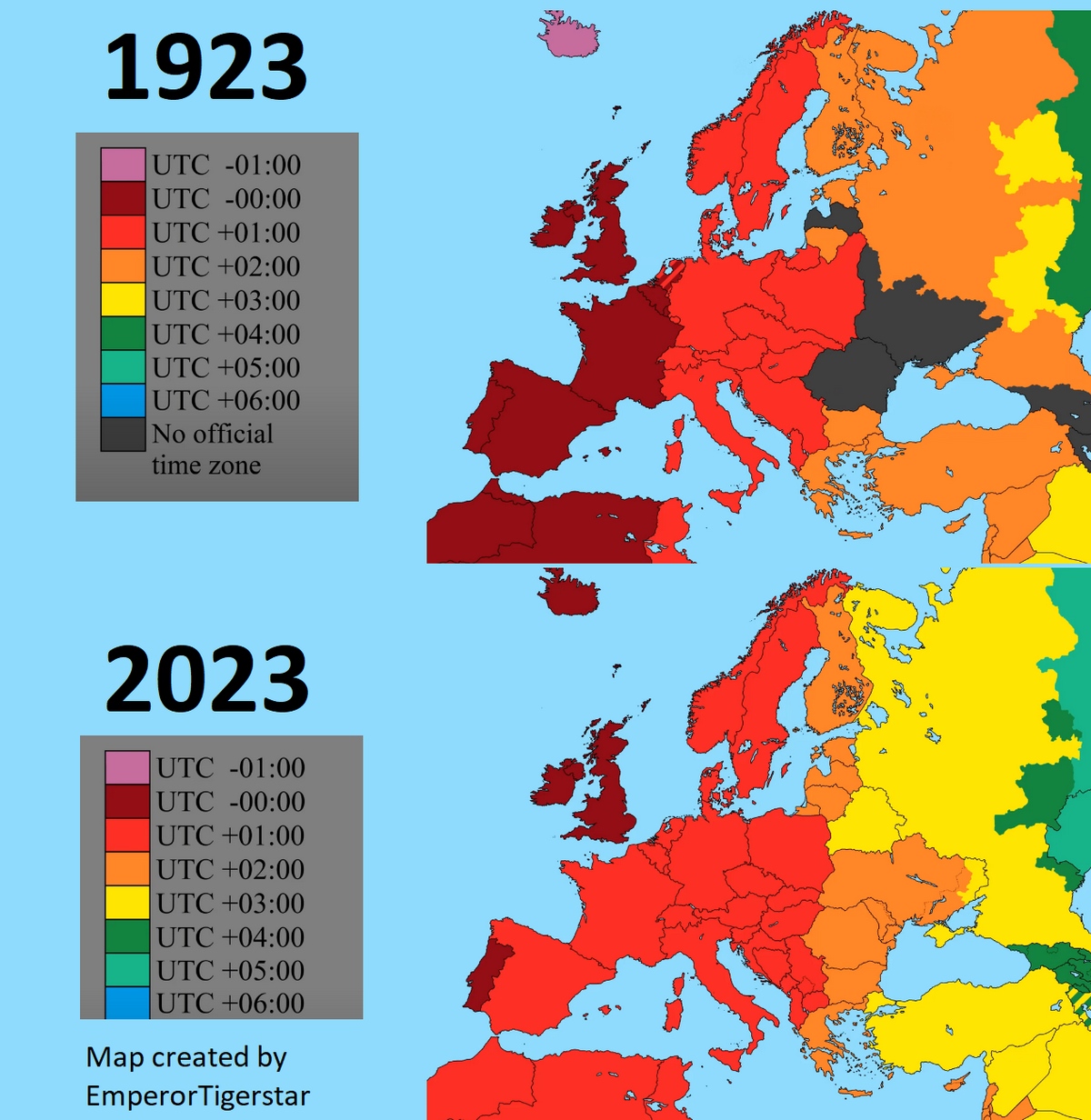
Why? because they decided to be on the same timezone as our eastern neighbors in Europe.
The eastern part of Polonia is on the same timezone and probably have probably the opposite with much much earlier lunch and dinner than we do.
The timezone centered across Görlitz made a lot of sense for the German empire, because it was nearly in half longitude wise and 15° away from Greenwich. It is still somewhat centered in Europe. If you wanted to divide it again, you would need to decide whether the border should be between Germany and France or France and Spain. If you place it between Germany and France, which side will the BeNeLux countries be on? France still has some parts that are nominally in +1 and we don't want to disturb the German-French "friendship", so maybe place it between Spain and France, where there is at least a mountain border? Would that be acceptable? Railways connections between Spain and France are also much less and concentrated than between Germany and France.
Farmers don't care about clocks, they do the work whenever needed. Roosters crow whenever they want. There's literally no point in talking about farmers in this debate.
Not that long ago, and we keep fiddling with them. The US time zones were adopted just over a century ago. The dates for daylight saving time were changed less than 20 years ago. Much of Western Europe changed time zones (much of it rather violently) in the 1940s, as did China. The tz database often requires updates for changes.
If you want to go with what was settled long ago, that would probably be a return to each town observing its own time based on local solar noon, which would be pretty annoying.
Yeah they started work at 6. So the working schedule shifted later by three hours, but with year-long DST it will shift back only one hour. Sounds like people don't actually want what they now vote for. My bet is that the work hours will just move later yet another hour in the future.
And that reason was that it was the standard before the standard was rethought. There's no deeper meaning to it.
And we rethought it yet again, should we go on the time standard (DST) that we're already on for ~65% of the year, or the one we're on for ~35% the year.
It should be pretty obvious why DST is the new winner, it's the current standard.


reply