if you click through to the linked Vannevar Bush article and scroll down there are a bunch of vintage ads around the prose that are kind of interesting. And some of the predictions have been well overtaken by events!
They needed a major star, so John Landis got him to do it as a favor. He did all his scenes in one day. They offered him either $35,000 or two points (two percent of the film's gross). He took the $35K. The film made over $140 million.
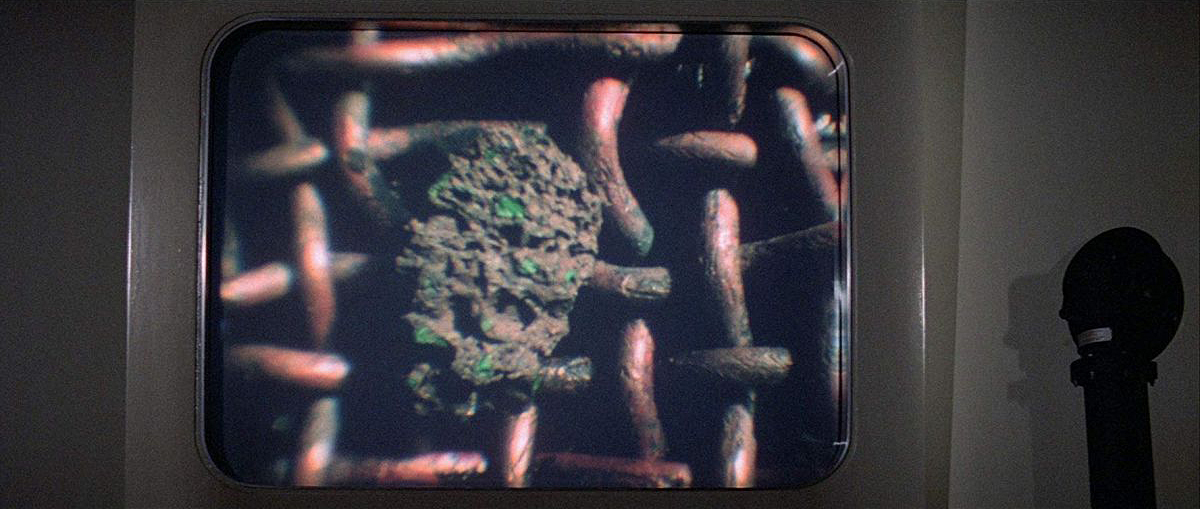
I wondered the same thing but then I concluded it was coincidental. If you're trying to filter for meteorites, you're going to be using that exactly hardware (a wire mesh basket), using a level of magnification that gives a view of the retained object, whose size is similar to the mesh screen hole diameter.
I would imagine that the props department went to a nearby micrometerologist who gave them a basket with a micron mesh and maybe some small volcanic rocks.
It is better stated that: since there are "so many more" irrational numbers than rational ones, if you were to pick a real number "at random," the probability that it would be rational is zero. The "many more" and "random" ideas are made precise in measure theory (and elsewhere).
If you actually look at how real numbers are constructed. They are quite bizarre. The simple concept of the number line becomes a quite complicated set of sets that follow certain conditions.
(Sqrt(2) as a real number, is actually encoded as the set of all rationals less than sqrt(2) on the number line).
There is an infinite quantity of both rational and irrational numbers, so isn't it therefore impossible for there to be more of one than of the other? Or is the reasoning that, because there is an infinite quantity of irrational numbers between any two given rational numbers, there are therefore many more irrational numbers than rational numbers? I would have thought that there being an infinite quantity of both, makes it impossible to compare the quantities.
There is a mapping from counting numbers (1, 2, 3, ...) to rationals and back again that shows these quantities are the same; for every element in set A there's an element in set B and vice versa.
This is not the case for irrationals... therefore it is concluded that the infinity of irrationals is a larger infinity than the infinity of rationals.
> There is a mapping from counting numbers (1, 2, 3, ...) to rationals and back again that shows these quantities are the same; for every element in set A there's an element in set B and vice versa.
That is true, but it's never taught. I don't even know what that mapping is, though I've seen it mentioned once in a popular treatment.
What's taught is always the mapping from naturals to rationals that overcounts the rationals, hitting them all an infinite number of times. (Because it's very easy to show a bijection between the naturals and the ordered pairs, but while (2,3) and (4,6) are distinct ordered pairs, they do not represent distinct rationals.)
But then all you've shown is that the naturals are at least as numerous as the rationals. To show that the naturals and the rationals have the same cardinality, you either rely on the idea that the naturals are the smallest infinite set, or you appeal to the fact that the naturals are a subset of the rationals.
There are also infinitely many rationals between any two distinct irrationals.
My favorite way of visualizing the difference uses the fact that every rational has a repeating decimal after some nth decimal place, and no irrational has a repeating decimal. Say you want to construct a number x, where 0 < x < 1, by drawing integers 0 through 9 randomly from a hat. Each integer drawn from the hat is placed at the end of the decimal; for example, if you draw 1,3,7,4 then the decimal becomes 0.1374. You then draw, say, 1, and it becomes 0.13741, and so on. If you could draw infinitely many times from the hat, what is the probability that you'll construct a number with a repeating sequence? That would give a rational number.
> There is an infinite quantity of both rational and irrational numbers, so isn't it therefore impossible for there to be more of one than of the other?
Mathematicians can even meaningfully compare infinities.
You can also look at eg a uniform random variable on the interval between 0 to 1. The probability of hitting a rational number is 0%. The probability of hitting an irrational number is 100%.
> Or is the reasoning that, because there is an infinite quantity of irrational numbers between any two given rational numbers, there are therefore many more irrational numbers than rational numbers?
No, that's not enough. There are also an infinitely many rational numbers between any two given irrational numbers.
> because there is an infinite quantity of irrational numbers between any two given rational numbers
Indeed, you've grasped the core of it. There's no rule you can write for irrational numbers such that "b is the next number after a", because there are infinitely many numbers between a and b that you'd be missing. You can't count them, i.e. you can't map them to integers.
While the thrust of your argument is correct, you're missing an important point. There are infinite number of rational numbers between any rational a and b as well, and the rational number don't have the concept of the 'next' number either. Yet the rationals are Countable.
The argument as to why the irrational numbers are uncountable and the rationals are countable is more involved than what you've made out. But very simply you can think of it as you need an infinite string of digits to describe each irrational number, but each rational number can be written as two finite strings of digits (in the form A/B, where A and B are integers). So to write our the irrationals you have an infinite number of strings, where each string is also infinitely long, while with the rationals you have an infinite number of strings, but each string is finite.
> the rational number don't have the concept of the 'next' number either. Yet the rationals are Countable.
That's literally the same thing. What is counting if it isn't being able to say what the next thing is? Do you have a mapping to integers or not? If so, then every n has n+1.
I know it was more complicated, but jaza had the essence of it. Without what they observed the whole thing falls apart. Yeah, it still needs proof, but I'm pretty sure five other comments went there.
> So to write our the irrationals you have an infinite number of strings, where each string is also infinitely long, while with the rationals you have an infinite number of strings, but each string is finite.
You've set the table but forgotten the feast! You're missing the step where you demonstrate that there's a number that isn't in this list. (Hint: think diagonally.)
What is counting if it isn't being able to say what the next thing is? Do you have a mapping to integers or not? If so, then every n has n+1.
The point I was trying to make is that there is no concept of 'next' inherent to the rationals, nor is there any natural or canonical ordering. The ordering and what comes 'next' is entirely a property of which arbitrary mapping you choose (I'm partial to Gödel numbering). The resultant order that your mapping imposes on the rationals is rarely useful or meaningful.
The rationals are a totally ordered set. There definitely is a natural, canonical ordering to the rationals. It's the same numeric-magnitude metric we use all the time. 1/3 is less than 2/3.
That ordering doesn't have the property that all sets of rationals contain a least element, or that any rational has a successor rational. (That would make them "well ordered".) But it's a natural ordering.
>> The argument as to why the irrational numbers are uncountable and the rationals are countable is more involved than what you've made out. But very simply you can think of it as you need an infinite string of digits to describe each irrational number, but each rational number can be written as two finite strings of digits (in the form A/B, where A and B are integers). So to write our the irrationals you have an infinite number of strings, where each string is also infinitely long, while with the rationals you have an infinite number of strings, but each string is finite.
This argument doesn't actually work. If there were only a countable number of irrational numbers, you could specify them all fully by doing no more than a countable amount of work, even stipulating that describing a single irrational number requires listing a countably infinite number of digits.
>> because there is an infinite quantity of irrational numbers between any two given rational numbers
> Indeed, you've grasped the core of it.
What? That's not the core of anything. It tells you that the irrationals are dense in the real number line. You know what other set is dense in the real line? The rationals.
How is that possible? We've made the same observation about the irrationals and the rationals. We want to make a followup observation that is true of the irrationals but not the rationals. Our first observation obviously can't be related.
I’m not the parent but do you know if there is a system/language that renders programmatic equations in-line in the editor? The closest thing I know of is the usage of Unicode symbols and Greek letters in Lean. I’m imagining a vscode extension that would interpret scientific code/equations and render those in-line or in a preview line above/below. Not sure about the utility of such a thing but it sure seems fun
It’s a bit of a stretch but if you write your equations in sympy in a Jupyter notebook, you can display nice LaTeX renders of the expressions and then either do math with them or just evaluate them as if you’d written them as a normal python function.
I have reverse-mode (purely functional reverse mode at that!) sitting in a branch, and will get this going at some point soon. Even more fun will be compilation down to XLA, like JAX does in Python.
When I was in high school my desk had a graffiti carved in it of the three most important numbers: 69, 2112, and 714. 2112 was the Rush album (which I liked), and I had to ask a friend about 714: he explained that it was the number printed on Quaalude pills (as if everybody knew that).
My own thought (I know there is a great deal of room for disagreement) is that the J6 crowd saw no consequences for the attempts to obstruct the Brett Kavanaugh confirmation and thought the rules had changed. One of them was shot in the neck, many others are still incarcerated two years later despite a clear constitutional right to a speedy trial. I'd rather the Capitol Police had just cracked heads at this point. You might think one protest was more justified than another, but the differential in response works to dissolve confidence in the fair application of the law. At any rate, the participants in J6 have been broken, so you're not likely to seen that again...yet I feel we could get another riot season provoked by police brutality at any time.
There is garbage and tent encampments thoughout much of my city, and I am told that nothing can be done about it. I've been invited to engrave something on my catalytic converter. I wonder what good that would do.
> You might think one protest was more justified than another, but the differential in response works to dissolve confidence in the fair application of the law.
in 2018, the capitol was open to the public, no one broke in. 78 were arrested in the Capitol on Oct 5, 2018 and charged with Crowding, Obstructing, or Incommoding [1].
in 2022, the Capitol was closed to the public and people broke in. 12 people were arrested on Jan 6, 2021 and charged with Unlawful Entry or Assaulting a Police Officer [2].
Assaulting a Police Office is a felony; Crowding, Obstructing, or Incommoding is a misdemeanor. Seems there was a differential in severity of breaking the law as well.
I must have missed the part where the Kavanaugh protesters showed up in body armor with zip ties and plans to hold members of the Senate Judiciary Committee hostage.
The J6 crowd broke through windows and members of congress were literally barricading themselves into rooms for protection. Some brought zip ties for the purposes of apprehending individuals. They beat a capital police officer to death with a fire extinguisher.
I’m not sure how once can fail to see a difference between that group and the one protesting Brett Kavenaugh’s confirmation.
> Although widely held, the belief that merit rather than luck determines success or failure in the world is demonstrably false. This is not least because merit itself is, in large part, the result of luck. Talent and the capacity for determined effort, sometimes called ‘grit’, depend a great deal on one’s genetic endowments and upbringing.
Heads-I-win, tails-you-lose, or: since merit is mostly luck, you might as well choose your students at random. Show us how it works, Princeton!
I have done the translation from Scheme to Clojure which raises the possibility that some of the typing could be done gradually with spec; I haven't worked with typed scheme. There's a lot of code in the simplifier which is designed to work with S-expressions containing symbols. Changing them to work with an enriched type carrying unit information would be a big undertaking