Well, they made a big deal about saying that while they sold their software to the Defense Department, it wasn't actually being used to kill people. Except for well-known military contractors (e.g., Raytheon), who have sold plenty of software specifically to kill people.
I guess there's a reason we saw plenty of articles about software used somewhat defensively -- such as distinguishing whether a particular "bang" was a gunshot, and where it likely came from -- instead of offensively -- such as improvements to targeting software.
I'm sure it was meant as "kills the wrong people."
People are always worried about getting rid of humans in decision-making. Not that humans are perfect, but because we worry that buggy software will be worse.
It's easy to say "I will never let the Department of Defense use my search engine for evil!" Or "the more money they spend on me, the less they have for weapons!" ( https://en.wikiquote.org/wiki/Theo_de_Raadt ) when you aren't really expecting money. But when somebody shows up with a check, it becomes much harder to stick to your principles. Especially after watching Palantir (and "don't be evil" Google) rake in plenty of dough.
If somebody has a really stupid proposal -- such as "make all 3D printers refuse to print guns" -- I don't see why I have any obligation to "compromise" with them. Or to talk with them at all. Other than, perhaps, explain that they ought to learn about the things they want to regulate before they start making proposals. The fact that they have an incredibly long track record of bad proposals, and many strongly-held opinions based mostly in ignorance, is just entertaining.
It is, in fact, legal (but very expensive) to own a tank ( https://www.drivetanks.com/ , yes, that's a company, but a rich enough motivated person could fill out the same paperwork). Apparently each exploding shell is a NFA taxed destructive device ( https://youtu.be/GW2U0qORdLE ).
The gun manufacturer's trade association has consistently said that 3D-printed "ghost guns" are more fantasy than reality, and that legal designs don't cause any more trouble than other legal guns: https://www.nssf.org/articles/3d-printers-cannot-produce-und... .
The people who wrote the constitution had plenty of experience with the First and Second Continental Congresses, and the Congress set up by the Articles of Confederation. And Parliament, and state legislatures. They both loved and feared democracy. Not everything in the constitution is meant to be democratic.
Senators were originally appointed by state governments to prevent the federal government from slowly weakening the states ( https://constitution.congress.gov/browse/essay/artI-S1-2-3/A... “To further allay Anti-Federalist concerns regarding concentrated federal power in Congress, the Federalists emphasized that bicameralism, which lodged legislative power directly in the state governments through equal representation in the Senate, would serve to restrain, separate, and check federal power”). That’s not really “democratic.”
In grade school, we focused on the fact that states with small populations weren’t enthusiastic about letting larger states set national policy. Sure, New York would have been happy to have more influence in both the House and the Senate than any other state, but Rhode Island, Delaware, and Connecticut weren’t going to sign under those terms. Horse trading to get them to join wasn’t “democratic” either, but they wouldn’t have joined any other way.
You completely avoided my question and just gave a lecture on why it is the way it is.
I am well versed in why the Senate is structured the way that it is. That is beside the point. The simple fact is we have a legislative structure that does not properly give voice to voters in larger states while over-representing people who choose to live in small states. It is patently unfair and should be fixed.
There is no universe in which the vast swaths of unpopulated land in Wyoming, Vermont, Alaska, or the Dakotas deserve the same amount of legislative power as the densely populated states of California, New York, Texas, and Florida.
But here we are, and this country has borne the painful lessons of a Constitution that over-represents residents of these lightly populated states through the tyranny of minority rule.
"Yes, but it only has two senators. The 39.5 million people in California have the same Senatorial representation as the less than 600 thousand people in Wyoming.
"In what world is that fair or remotely democratic?"
I answered "Not everything in the constitution is meant to be democratic."
I'm sorry if you are not capable of understanding how that answers your question.
I know what Colbert said, and what Colbert claims CBS said. But I feel like something is being left out.
The equal time requirement wouldn’t prevent Colbert from interviewing a political candidate. And it wouldn’t require Colbert to send invitations to anybody. It would require Colbert to allow a competing political candidate to appear if the candidate demanded it.
CBS could decide they don’t want that hassle. Colbert could decide he doesn’t want that hassle. But the law as it stands doesn’t prevent the interview.
I actually remember when Reagan’s FCC decided to stop enforcing equal time. Plenty of people complained about how the change would ruin America. Now they seem to believe Reagan was right after all.
Yes, this comes up, but the Court tends to say things that didn’t exist are covered by constitutional rights. I can’t imagine think of any time they asked “could the founders have imagined this?” Television, radio, and the internet are all protected by freedom of the press without anybody ever showing that the founders could have imagined them.
From Heller v. DC:
“Some have made the argument, bordering on the frivolous, that only those arms in existence in the 18th century are protected by the Second Amendment. We do not interpret constitutional rights that way. Just as the First Amendment protects modern forms of communications, e.g., Reno v. American Civil Liberties Union, and the Fourth Amendment applies to modern forms of search, e.g., Kyllo v. United States, the Second Amendment extends, prima facie, to all instruments that constitute bearable arms, even those that were not in existence at the time of the founding.”
A few years after that ruling, the Massachusetts state supreme court upheld a conviction for a woman who had carried a taser for self defense. The Supreme Court accepted her challenge, allowed it to go forward without paying court costs, and unanimously overturned that ruling without asking for oral arguments ( https://supreme.justia.com/cases/federal/us/577/411/ ):
“The court offered three explanations to support its holding that the Second Amendment does not extend to stun guns. First, the court explained that stun guns are not protected because they ‘were not in common use at the time of the Second Amendment’s enactment.’ This is inconsistent with Heller’s clear statement that the Second Amendment ‘extends . . . to . . . arms . . . that were not in existence at the time of the founding.’
“The court next asked whether stun guns are ‘dangerous per se at common law and unusual,’ in an attempt to apply one ‘important limitation on the right to keep and carry arms.’ ... In so doing, the court concluded that stun guns are ‘unusual’ because they are ‘a thoroughly modern invention.’ By equating ‘unusual’ with ‘in common use at the time of the Second Amendment’s enactment,’ the court’s second explanation is the same as the first; it is inconsistent with Heller for the same reason.
“Finally, the court used ‘a contemporary lens’ and found ‘nothing in the record to suggest that [stun guns] are readily adaptable to use in the military.’ But Heller rejected the proposition ‘that only those weapons useful in warfare are protected.’
“For these three reasons, the explanation the Massachusetts court offered for upholding the law contradicts this Court’s precedent.”
The fact that Caetano was a unanimous and thorough ruling says a lot to me. Perhaps you’re holding out hope that Heller will be overturned soon, but the chances for that are very slim ( https://youtu.be/nFTRwD85AQ4 ).
> the Court tends to say things that didn’t exist are covered by constitutional rights.
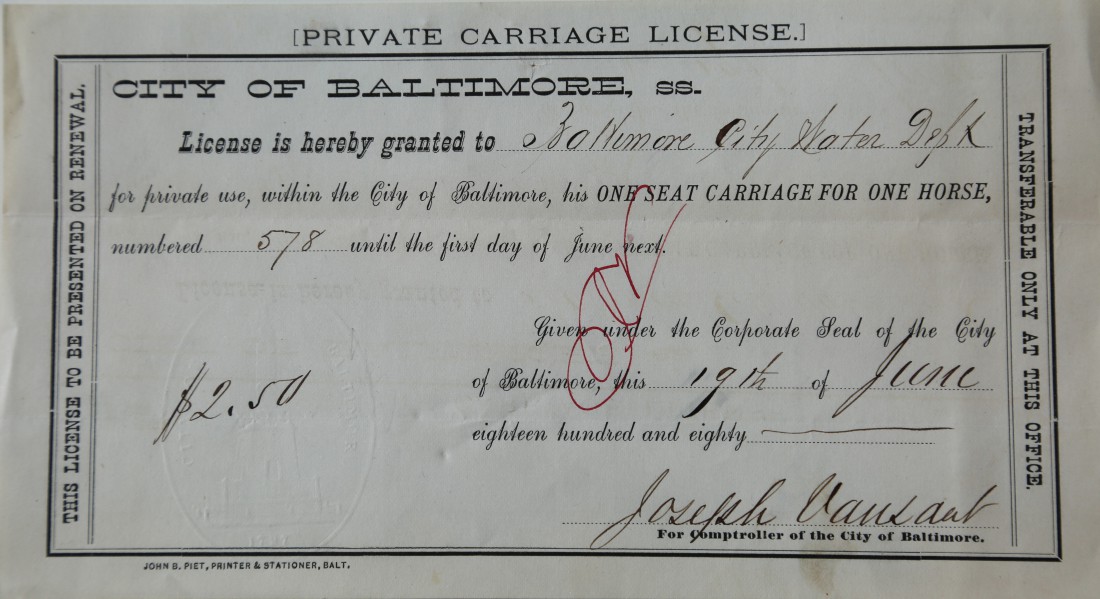
Sure but drivers licenses exist when no similar requirements existed for horse drawn buggies because the clear increase in relative danger to the public. When comparing newspapers with radio, the limited spectrum on radio was accepted as justification for more restricted speech etc.
Really citing when the court ruled one way vs another is less important than recognizing which kinds of arguments tend to resonate with the court as in the end specific cases are arbitrary decisions influenced by the specifics of the case.
That’s closer to a vehicle registration than a license for the driver.
That example also expires in 1880, but there’s various regulations around carriages going back to England in the 1600’s. They were more about congestion and taxes rather than the capabilities of the drivers the way a drivers license tests vision, knowledge of road rules, and practical skills is focused on just how amazingly dangerous cars are.
Critically, you can legally own a street legal car without a license and a license without a car.


I guess there's a reason we saw plenty of articles about software used somewhat defensively -- such as distinguishing whether a particular "bang" was a gunshot, and where it likely came from -- instead of offensively -- such as improvements to targeting software.
reply