> [...] At that time, John was interested in pure functional programming, with no side-effects on storage or the external world. I advocated extending the language to allow writing complete interactive applications. John conceded the importance of this, and came up with a scheme in which one would write a function to express the complete transformation of an application on the global state. I struggled with John’s variable free style, and suggested we allow lambda variables when defining a new functional form (higher-order function), but he stuck to his guns.
(In my project) I’ve reduced extensibility to the meta-composition rule, and I’m using an IO monad for interaction because I believe all functions should remain as simple as possible.
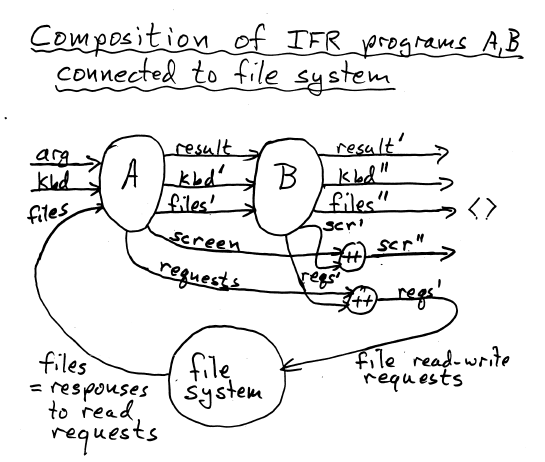
I have looked at the diagrams. If a side effect occurs between Program A and Program B, then referential transparency is violated. Referential transparency is the "sacred principle" of algebra; if it is violated, no algebraic transformation is possible—unless I am mistaken or we are talking about a monadic continuation.
Thanks very much; I in turn will add a link the Related Resources section. If you'd like to be recognized as other than metazip then let me know via email.


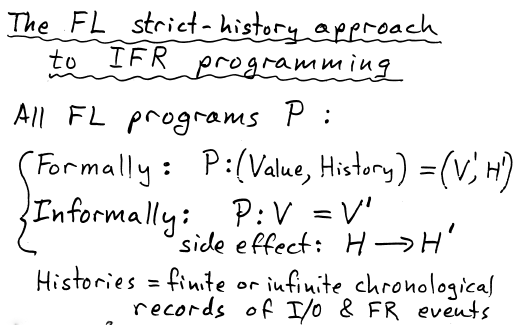
> [...] At that time, John was interested in pure functional programming, with no side-effects on storage or the external world. I advocated extending the language to allow writing complete interactive applications. John conceded the importance of this, and came up with a scheme in which one would write a function to express the complete transformation of an application on the global state. I struggled with John’s variable free style, and suggested we allow lambda variables when defining a new functional form (higher-order function), but he stuck to his guns.
(In my project) I’ve reduced extensibility to the meta-composition rule, and I’m using an IO monad for interaction because I believe all functions should remain as simple as possible.