I spent a truly obnoxious amount of time importing my music library into beets. It took a couple of weeks to get to 95% imported, and got so bogged down in the last 5% that I never completed the import and never switched over.
This isn't necessarily a fault with beets, really, but a model mismatch. The model of beets is very, very strongly tied to associating each imported item to one well-known, commercial release. While it's possible to stray from that, it takes tons of time and experimentation to cram some things into its model.
Purchased, popular albums are a breeze; they import nicely and make sense. I struggled differing amounts with:
* brand new indie label releases (bandcamp)
* commercial albums variants missing from musicbrainz/discogs
* non-commercial albums (self-released CDRs)
* fan-recorded concerts
* fan-recorded festivals (a special case, a true nightmare)
* fan edits/remixes of commercial releases
* playlists & mix tapes
* mixed media releases
Each was eventually possible, but sometimes it took hours to figure out how to import a specific folder. Worse, after doing one festival it didn't necessarily make it easier to do the next festival. Even if I get to 100% imported, additional imports will still take thought.
This isn't an argument against it, I still think it's a fantastic tool. Just understand that the farther you stray from collecting commercial releases, the more of a struggle it is.
> * commercial albums variants missing from musicbrainz/discogs
I fixed those two by adding the missing releases to the database beets uses as its data source (musicbrainz.org), and importing the album in Beets afterwards. I still get notifications for edits to entries I contributed over a decade ago!
Everyone else is telling you to go update musicbrainz, and that's a sensible course of action for the first two bullets, but the much easier path is to import all these files with whatever metadata they have.
There is no canonical metadata for a fan recording of a concert or DIY CD-R, so you lose out on nothing by importing the files as they are today.
Once you're over the hump of the first import, beets is a fabulous tool for ingesting new music. It's well worth it.
This is the answer I arrived at myself a few hours into importing my own music library. Cleaning up metadata for commercial releases is a nice feature beets offers, but the real value (IMO) of beets is it's a powerful toolbox for managing a large music library, and that's true even if you were to eschew musicbrainz integration for all your music.
I do think it's a pretty fair complaint that it really feels like the software is fighting against you when you first encounter something absent from the musicbrainz database (especially if it's something fundamentally unsuited to be added to the database), but I'm not sure if there's an easy solution other than telling people "just hit the `import with existing metadata' button, it's totally fine" when they complain about it.
That's really surprising! I would think they'd want some kind of "official" source for such things, otherwise you'd end up with numerous entries for random live recordings of varying quality.
I think the only thing I've seen is that there should be at least some notoriety to the bootlegs. Like that it's a bootleg that's been circulating around in fan communities or a batch of fake CDs sold in some shady market or a leaked version of an upcoming album shared on P2P. Something that makes it beyond just a thing between a couple of people.
I think if you read through the MusicBrainz about page, it makes a lot more sense:
>As an encyclopedia and as a community, MusicBrainz exists only to collect as much information about music as we can. We do not discriminate or prefer one "type" of music over another, and we try to collect information about as many different types of music as possible. Whether it is published or unpublished, popular or fringe, western or non-western, human or non-human — we want it all in MusicBrainz.
Can I ask what you choose to manage your library with today? I feel like streaming has made me stray so far from the joy (and pain) of library curation, and I’d really like to get back to it, I just don’t know what folks are using these days.
I have all of my mp3s on a NAS and point plex at it to index. I’ve also set it up as a source for Sonos (which I’m growing less fond of as each day passes).
I guess my point is that I like having a directory of music (organized by artist/album) and make the discovery applications I use do the work of finding and playing the music I want.
I've always struggled to get my classical CDs tagged in a way that makes sense to me. Apple has figured it out in their classical music app and I should probably see if I can copy what they did in my personal library.
> fan-recorded festivals (a special case, a true nightmare)
I've long enjoyed extracted audio from eg Glastonbury sets. I've only got a few that I particularly enjoyed and where the specific track was on youtube - is it that sort of thing? Is there a community of such reprobates?
It provides a nice interface for managing and editing tags that integrates well with other command-line tools and keeps your file system well-organized/up-to-date as you edit the tag contents. The batteries-included integration with datasources like musicbrains and discogs is nice, but, at least for me, beets is mainly a better tool for accomplishing the same tag and file janitoring I was doing with things like foobar2000 and eyeD3 a decade ago.
I'm sure it has increased over time as people imitate their heroes, but first-person journalism is certainly not at all unique to "this generation"; it was already a big element of New Journalism in the 1960s: https://en.wikipedia.org/wiki/New_Journalism
Is it surprising that journalists who grow up reading Hunter Thompson go on to write like Hunter Thompson? I think that's a pretty natural progression, without needing to blame generational narcissism. If anything, it seems like World War II was the major turning point for involving the author into the story.
Hunter Thompson is who authors like this are trying to be, but his entire brand was shirking the establishment, not clout chasing. This reads like glorified livejournal.
I wrote something remarkably similar a few years ago, for similar reasons. I was pretty baffled that nothing similar already existed. Auto-wake with the RTC timer was what I really wanted.
I have a "NAS", which is really an enormous desktop tower crammed full of hard drives. It auto-wakes once per day, pulls backups from my various servers all over the place, then returns to sleep.
I've been tracking my costs for ~13 years. The cost here includes all equipment and ingredients over that time, including all of the unnecessary stuff that I bought for fun, like pH meters and titration gear.
It obviously matters what you brew and what you brew with. This is mostly pale ales and stouts. They certainly haven't all been great, but I've never dumped a batch, so there's no waste to account for.
Huh, that's interesting. The Android team was absolutely hounding me for an interview back in ~2009, to the degree of finding my parents' home phone number and asking them to convince me to take an interview.
I reluctantly obliged, and had a couple of phone screenings where they said they were looking for experienced embedded systems developers for low-level hardware development. I was specializing in 8-bit microcontroller firmware and Linux kernel drivers, and the recruiter said it was exactly what they wanted.
When I took the first technical interview, they grilled me on MapReduce and cluster storage, and then asked me to design a collaborative text editor for the web. The interviewer didn't have a copy of my resume, hadn't seen it, didn't know what position he was interviewing for, and didn't know anything about hardware. We had a really awkward moment when I explicitly said, "there must be some mistake, I'm supposed to be interviewing for an embedded role." I bombed the hell out of that interview, and never heard back from them again.
If my experience was typical, then no wonder the Android team had trouble with staffing.
Your interview experience is typical - I've interviewed 4 or 5 times at Google (never once after applying), and each time I've "failed" some portion of the prescreen script interview that's done by incompetent "recruiters"
Just to back that up, it had a clear meaning because -less is a valid suffix to append to English words. When grandma runs out of cookies she is cookieless (when a website doesn't use cookies it is also cookieless). It doesn't have to be "in the dictionary" to make sense in conversation.
Yes, this is what I was trying to say. It wasn't a thing people would throw around like a buzzword but if someone used it in conversation and especially in context (like the SQLite page, which was written over a decade ago, does) people would understand what you meant.
I know an animation/media rendering company that buys every model of Mac Pro in bulk. They'll buy dozens of these things. I assume that many similar companies do the same.
HN really shows a lot of ignorance whenever Mac Pros are discussed. HN readers, for the most part, are not the market for these devices. The market is non-tech companies, with little or no IT staff, that have extremely resource-intensive tasks. They buy Macs because non-IT people can figure out how to use Macs on their own. They buy the top of the line because it makes their jobs easier. They don't care about the price tag because it's still cheaper than staffing an IT department.
The price of a Mac Pro isn't the price of a good computer. It's the price of a good computer that is guaranteed to work, under warranty, and comes with basic IT service from at the local mall. That's useless to someone who knows how to build and administer their own machine, but easily worth $50k to a profitable business.
Oh, I am absolutely sure, the intended audience will be delighted with the Mac Pro and get great value. The problem is, that this audience is a very small one and more generic professionals don't have a real alternative in the Mac universe. A lot of users are looking for and not finding a Mac with a
- powerful desktop processor
- good desktop graphics card
- extensible storage
Bonus points for a machine that can be repaired with a reasonable effort.
I feel like Apple has a huge hole in the market here by not having beefier Mac Minis available with matching-form-factor Thunderbolt enclosures (hard drives, eGPU, etc) that are easily stackable. That could get most of the way to a traditional high-end desktop system but with each part of it purchasable separately over time.
Yes, stacking the Mini would be kind of an option, but it lacks a powerful desktop processor. And when you are done, your desk is covered by your Mac cluster :)
Yes, I don't get why the external enclosures for graphic cards don't have some space for disk space. But I found this link today: https://www.ifun.de/animaionic-desktop-untersatz-fuer-den-ma...
If that sees the light, that could be some improvements. If only Apple would offer the Mini in a not so mini enclosure :)
> Yes, I don't get why the external enclosures for graphic cards don't have some space for disk space
eGPUs currently are kind of a wild west of development and are still trying to decide on basic stuff like form factor and how to route USB passthroughs. That concept you linked looks like it sidesteps a lot of that by using multiple Thunderbolt connections at once, though.
A minimal Spotify controller for the menubar/systray. I mostly play on speakers, though sometimes librespot on my desktop to avoid running the hog of the Spotify app. The main feature for me, though, is the alarm clock; I set a raspberry pi to push a new release playlist to one of my speakers every morning.
Huh, I thought the original was a sarcastic question. In that case, let me explain:
I keep a browser window open at all times. It is never full screen, because if it were full screen I wouldn't be able to see multiple windows at the same time.
I keep my browsing window as close to 1024x768 as possible. In 2019, a lot of websites can't handle a browser window using a mere 75% of the laptop screen, so they either render incorrectly or, worse, switch to a mobile view. When that happens, I either blacklist the website forever in a contemptuous fervor, or just resize the window. Apparently, this resizing action is trackable.
When I say "as close to 1024x768" as possible, I mean exactly 1024x768 unless I have resized it and forgotten. I use a little AppleScript thing to resize it to 1024x768, precisely for browser fingerprinting reasons. When you resize the window by hand, you typically end up with a VERY unique window dimension.
Since maternity and paternity leave are frequently more than 6 months long, employees temporarily leaving for a big chunk of the year is just a fact of doing business here.
Granting unpaid leave to go try your own thing for a while is, from the employer's perspective, not any different. Some people never come back, most people do. The same is true for parental leave (many quit their jobs towards the end of their leave, if they had already been thinking about it).
Even when they aren't required to grant it, larger Swedish companies will often give you unpaid leave if you just ask. The fear is that otherwise you will quit. Hiring is hard here, so it's better to have a promise of someone coming back in 6 months than a job opening that can take 12 months to fill.
Sweden has an enormous market of consultancies compared to the U.S. for filling these temporary gaps. Obviously consultants are expensive and not trained on your projects, so it's not the same as a long-time employee, but it gives options to "control the bleeding."
> The fear is that otherwise you will quit. Hiring is hard here, so it's better to have a promise of someone coming back in 6 months than a job opening that can take 12 months to fill.
This is what a strong economy actually looks like.
It's hard (in my experience) to get Americans to understand this, because our economy here has been so bad for so long, most people here have never experienced anything like this.
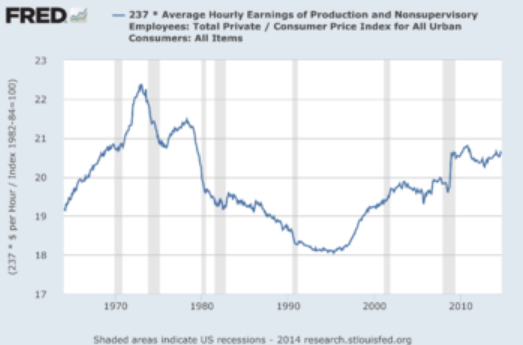
Exactly. Male real wages have been stagnant since 1973, and that's without considering the situation around health care, where costs have risen much faster than general inflation. Counting health care, male real wages have declined noticeably since 1973. Meanwhile, returns to capital have grown dramatically. This is precisely what you would expect in a weak economy, where the workers necessarily lack bargaining power. In a strong economy, the percentage of national income going to workers would increase, as it did from 1935 to 1973.
Additionally, in 1973, there was a good chance you had a partner who could stay at home to watch the kid(s). Now you have both people working whether you like it or not, because you're competing with two-income households for housing.
Of course, not trapping women in domestic servitude is a good thing, but making it (on average) necessary for two people to work to afford a home when before it took one is a bad thing.
>Of course, not trapping women in domestic servitude is a good thing
Alternative is 'trapping them' (horrible choice of words btw) into corporate servitude. Which of the two is better? Which of the two is better for children?
"Domestic servitude" is a poor way to present homemaking, but calling its historical pull a trap for women isn't far off. Obviously anyone who's struggled in the business world understands joining the game is only liberating along a couple of dimensions (economic, mainly).
The choice should be there for men and women to work or rear. Applying that freedom appropriately is the individual's responsibility.
> "Domestic servitude" is a poor way to present homemaking
It is when you are absolutely economically dependent on the outside of the home work, from which you are functionally excluded, of a partner for survival, when even searching for an alternative in the same line is grounds for termination without support, and where the one on whom you are dependent has a legal right to use you sexually without consent (criminalization of marital rape in the US began in the mid-1970s after the mass entry of women into the workforce)? I think “domestic servitude” is an overly positive euphemistic description of the condition women were generally trapped in before their out-of-the-home work became normalized.
I'm absolutely not making a case that women weren't effectively forced into domestic servitude in the past (and, depending on a a range of factors, in the present). I'm also not making a recommendation that anyone be a full-time homemaker. Given the state of the world, that's a very risky path.
But.
There are women (and men) who would prefer to work in the home and they should be free to do so. It's demeaning to equate a person's effort in homemaking with servitude. There is not something inherently inferior about maintaining a home and it's only a perverse economic system rooted in traditional misogyny that tells us otherwise.
As I said initially, the choice should be there. The social and institutional compulsion obviously should not.
> It's demeaning to equate a person's effort in homemaking with servitude.
No one did that upthread. Someone compared the condition women were trapped in prior to the normalization of their choice to work in the general market as being trapped in domestic servitude. This is not equivalent to equating freely-chosen homemaking with domestic servitude.
As I see it, he compares being trapped in domestic servitude (the problem before the economic transition since ~1973) with being
forced to do work in the general market (the problem after.) He's not comparing two freely chosen activities, he's noting one undesirable compulsion was traded for another (less undesirable, but still undesirable and less recognized) compulsion.
Exactly. It's the lack of real choice. In 1950-whatever your chances of making it on your own, as a single mom, ESPECIALLY when the entire culture is built on the assumption of stay at home moms, were pretty slim. You didn't just move out, sign up at the local montessori, and go get your "pays roughly similar even if still lower" professional job, and go to the bank and get a mortgage, etc.
Corporate servitude also sucks but that's a result of nimby housing cartels (you're competing with two income households for homes).
> Of course, not trapping women in domestic servitude is a good thing
Any reason you used the term servitude which implies a negative connotation, when many women were happy with that arrangement? It also implies none of the women received positive utility from staying at home with the kids and it was always a chore, which seems a little ridiculous.
We should be embracing every opportunity for more personal involvement with our children and family, not calling it servitude. It does all families, past, present and future, a huge disservice.
If it's something either parent does because it's what they want, then it is indeed not servitude.
But in 1973, it fell almost exclusively to the female parent, whether it was what she wanted or not. Many women may well have been happy with that arrangement, but practically no men would have "received positive utility". And either there's something unique about the Y chromosome that makes it impossible for them to enjoy that, or a lot of women weren't so much "happy" as "accepting".
We should indeed embrace opportunities for more personal involvement in families -- for both parents. Generous leave is a big start on that. But "100% leave, as long as you're female" is not.
the term presumably is used because at that point it was not a choice. Many women may have been happy with it, but there was scant alternative for those who were not.
This has changed, but it reveals a lot. It also might relate to why it's so hard to find teachers for the price government is accustomed to paying - if you were a well-educated woman in the 1950's you had far fewer options (aka bargaining power) than you do today, and teaching was likely to be one of the few options with a bit of prestige and mental stimulation available to you.
It's true that women weren't FORCED to not work, but to suggest that they didn't face a strong disadvantage is disingenuous. Hell, it's still a rampant problem - how many tech bros get off an interview and then say "ah but she's 32, she'll want to take maternity soon". This is a good reason for making maternity and paternity leave equal, incidentally...
Though for all that, my wife stays home with our kid by choice. She went back to work when our daughter was 6 months old, and after six months of barely seeing her outside of the weekends she just couldn't bear it (I didn't much like it either). The only reason we can do that is because I have a good paying job in tech making something over the 90th percentile of incomes in my country. I wish other people had that choice. Hell, I wish I had that choice. But few do.
I think we would all be happy to be financially independant with our families but reality is different. Every society is severely broken by patriarchal norms which is hurting everyone. Most of all women. Enabling domestic servitude (which is both negative and the appropriate term) by catering to utopian fantasies only is only enforcing these norms and directly crippling women.
I've always wondered how much of the lack of wage growth can be explained by financial institutions investing in other countries. If the actual growth happens somewhere else, and some of the profits make it back to the US economy, also growing it, overall wages wouldn't really be affected, would they?
The US is the world's largest recipient of foreign direct investment and maintains a substantial capital account surplus. Capital inflows finance our current account deficits.
This is a weak economy if you're a laborer and not a capitalist. Overall, it's still been a VERY strong economy since '73. The US has been either first or second in GDP growth EVERY YEAR FOR 40 years! China has been killing it recently, but over the given time period, the US is still by far the best: https://en.wikipedia.org/wiki/List_of_countries_by_GDP_growt...
A real weak economy would look like Japan, Ukraine, Russia, Zimbabwe, etc.
Life for the laborer has been under systemic attack since Reagan, but the US economy as a whole has been doing swimmingly.
> This is a weak economy if you're a laborer and not a capitalist.
Replace capitalist with monopolist and I'd agree.
How many capitalists make losses for 20 years and not only stay in their job, but actually become the world's richest person? Where would Uber be if they couldn't use VC money to undercut taxi companies, and subsidize hundreds of millions in losses. And let's not even get started on the issue of offshore tax avoidance, something your local hardware store will never have access to.
You are thinking of average compensation. Most reasonable people avoid talking about average compensation, since income has concentrated into the hands of the top workers. The top 1% of Hollywood actors, sports athletes and Wall Street hedge fund traders make several million dollars a year, and therefore they grossly distort the average. Their income hides the reality. If we focus on median income, of all forms, total real compensation for men has declined since 1973.
>This is what a strong economy actually looks like.
Is it actually though? Couldn't it also be a sign of an aging population? Sweden's population is growing, but it's mostly due to immigration. Considering the type of immigration that's mostly happening it's not bringing in lots of skilled workers.
The problem with hiring is from what I've seen not due to ageing population. Instead, due to very protective employment regulation employers in Sweden are absurdly slow and picky when hiring. Resulting in a very large temp staffing sector. They are also surprisingly conservative in expectations.
Contrasting anecdotal rant:
In 2014-2018 I was trying to help a Swedish company get a tech dev project going. They needed to bring in about five experts. For years this project was delayed until it was no longer relevant, because they had a pointlessly limited view on who they needed to hire, at what cost and under which structure. They would not accept a 15% salary increase above their opinion of the norm, and neither a distributed project nor a collaborative partner network construct. This loss of opportunity was huge for them.
During the same time I was staffing, running, and completing two projects in Switzerland, total of 25ppl. No issues, quick handling, excellent outcome. The Swiss investors understood that it's ok to run a project distributed across five countries and pay an extra 20-50% if it's difficult to find good people locally in a given field. Skill and speed is more important than location, cost, surname, language[2], etc.
This is not the only such situation I've come across in Sweden. I work as an R&D consultant specialised in setting up and running distributed collaborative high risk tech projects. Despite being a native Swede it's easier for me to run projects in Switzerland than in Sweden. Kind of sad.
For your second point:
For skilled immigrants (stem university degree) the situation is quite good.
From what I've heard, 2nd-3rd generation immigrants and onward tend to outperform the "native" population. This may change in Sweden after the large influx of unskilled refugees in the last 20-30 years, vs the predominantly work based immigration of 1950-1980s.
Statistically [1]: Sweden has one of the highest gaps in unemployment between European and non-European unskilled immigrants. If you're uneducated you _really_ should migrate to somewhere else if you _ever_ want to get a job.
> In Electrical Engineering(US), its vicious the amount of competition trying to get me.
When did that start? I left EE in about 2006 because I felt like all the employers were very demanding of specific skillsets and treated engineers like they were easily replaceable.
Is the Swedish case the same even for non-high demand fields? I suppose by definition every job (irrespective of compensation or skill needed) would be a high demand field if it takes 12 months to fill; at which point I suggest that what Sweden has is a demographics problem, not a strong economy.
I think it depends on the company too. For tech companies especially in Stockholm and Malmö, It's really easy to hire developers. If it's a startup good luck getting unpaid leave during huge rushes as well as during industrisemester. So of course as always it depends.
However the thing I think that is more unique to Sweden and drives these kind of nice benefits is that it's really hard to get rid of an employee. Employees are protected so much with rules and regulations that even if you get let go you have a required three month grace period unless otherwise negotiated with the employee.
It's not uncommon I would say to see tech workers "fired" but then still on the payroll for an extra 2 months while they are arbetsbefriad (paid leave)
It's confusing and depends on the industry. Sometimes they're used interchangeably. In some disciplines consultants literally just 'consult' and don't fill a role.
In the accounting world we have employees that we call 'contractors' but they aren't self-employed. Rather, they are employed by a specific accounting staffing agency that contracts with our firm to fill positions temporarily.
Sometimes contractors are employed by the company they are working with directly but the position isn't guaranteed to last before
Basically, like much of the English language, there isn't a hard rule. I imagine there are country, regional, and industry specific uses for the terms. There may have once been a hard distinction, but misuse of terms eventually permeates into local parlance, which gives way to a new accepted use of the term.



This isn't necessarily a fault with beets, really, but a model mismatch. The model of beets is very, very strongly tied to associating each imported item to one well-known, commercial release. While it's possible to stray from that, it takes tons of time and experimentation to cram some things into its model.
Purchased, popular albums are a breeze; they import nicely and make sense. I struggled differing amounts with:
* brand new indie label releases (bandcamp)
* commercial albums variants missing from musicbrainz/discogs
* non-commercial albums (self-released CDRs)
* fan-recorded concerts
* fan-recorded festivals (a special case, a true nightmare)
* fan edits/remixes of commercial releases
* playlists & mix tapes
* mixed media releases
Each was eventually possible, but sometimes it took hours to figure out how to import a specific folder. Worse, after doing one festival it didn't necessarily make it easier to do the next festival. Even if I get to 100% imported, additional imports will still take thought.
This isn't an argument against it, I still think it's a fantastic tool. Just understand that the farther you stray from collecting commercial releases, the more of a struggle it is.