The fact that the only rating published is ‘junk’, and that it was from a small agency tells us quite a lot. Given the fact that Anthropic (or its representatives) likely ‘shopped’ for a rating means that this was the best anyone was willing to give them, and that the larger agencies probably refused to rate them without more information. I would have been surprised if the bankers hadn’t lobbied for the highest rating possible, as higher ratings increase their profits from the IPO.
The whole point is to slowly build credibility, starting with easily $wayed small ratings entities, then launder that credibility into a slightly larger one, rise and repeat until financial disaster.
>"They frame anything other than complete capitulation to Russian invasion as crazed aggression against Russia..."
This has been common among many groups for a long time; I recall the GWB administration proposing a missile interceptor system based in Eastern Europe in the mid-oughts, and Democratic Party members in congress opposed it as 'provocative'. The (Liberal) Canadian government of the time opposed that as well as the Alaska based 'shield' as being 'aggressive'.
I suspect this has something to do with (politically self-identified) disempowered groups generally wanting to 'shoot down' initiatives, but the Trump administration seems to have a different motivation.
Just like Iran has been aggressively being encircled by our helpless inmocent bases for decades? Can't believe people are still swallowing this imperial propaganda. A tale as old as time and people still refuse to learn from it.
No, those two things are not equivalent. Posture and capabilities are open to interpretation in a way that armies crossing a border and bombing your cities simply isn't.
Shipping weapons, ammunition, and other supplies to one side in an active conflict is much more 'provocative' than building a facility located hundreds or thousands of kilometers from the border of a potential adversary.
Most things which differ are not equivalent; pointing that out isn't helpful.
Lots of things are threats, including long-range stealth bombers, of which the USA already fields 19, and is manufacturing more. Attack submarines are a threat as well, because they can destroy SSBNs, which are the only credible second-strike credibility.
But Europe isn’t really supporting Ukraine, they’re just providing enough supplies to keep them in the fight. No state seems willing to provide enough assistance to allow for Ukrainian victory, because of the costs and risks associated with that aid. Even countries at little risk of reprisal from Russia are reluctant to do much at all.
As such, all of us doing nothing more than “voicing support” on the internet and some far-away rally, should offer our empathy, and not presume to tell them how much we’re “helping”.
None of the European countries are doing much relative to their economies. Russia's GDP is about the same as Italy's. The rest of the EU and NATO countries together have an economy that is enormously larger than Russia's. So why do they allow Russia to push them around?
Ya, that's basically nothing. None of those European countries have asked their citizens to sacrifice. The welfare state continues uninterrupted. They were still buying Russian fossil fuels instead of telling people to put on a sweater.
As a US citizen I think that our country should also do more to assist Ukraine. But fundamentally this is a European problem. They need to find a solution instead of expecting the US to bail them out again.
If 3% of GDP is basically nothing (US defense budget or Medicare), then why isn’t the expectation that the US puts in “basically nothing” (3%) as a token gesture towards its promise to guarantee their sovereignty?
Again, I think the US should do more but it's really not our problem. We never guaranteed Ukraine's sovereignty. If you're referring to the Budapest Memorandum, it contains no such promise.
The other states under the US nuclear umbrella find no comfort in the legalesing the difference between "a guarantee" and "an assurance."
If we want nuclear proliferation, breaking our promises is the way to do it.
The idea that a marauding steppe warlord succeeding in Ukraine and taking control of by far the most advanced and experienced near-peer military on the planet, with aspirations to advance further into Europe, is "not our problem" is laughable.
"Nuclear umbrella" is not a well-defined term. It is the set of promises the US made to non-nuclear states. It made a set of guarantees to some set of nations (e.g. NATO++), and a set of assurances to other states, like Ukraine.
Our reneging on our assurances indicates weakness in our guarantees, which risks a proliferation spiral.
For example, NATO's Article 5 can be legalesed the same exact way you're trying to legalese the Budapest Memorandum.
Budapest Memorandum:
> The Russian Federation, the United Kingdom of Great Britain and Northern Ireland, and The United States of America reaffirm their commitment to seek immediate United Nations Security Council action to provide assistance to Ukraine, as a non-nuclear-weapon state party to the Treaty on the Non-Proliferation of Nuclear Weapons, if Ukraine should become a victim of an act of aggression or an object of a threat of aggression in which nuclear weapons are used.
NATO Article 5:
> The Parties agree that an armed attack against one or more of them in Europe or North America shall be considered an attack against them all and consequently they agree that, if such an armed attack occurs, each of them, in exercise of the right of individual or collective self-defence recognised by Article 51 of the Charter of the United Nations, will assist the Party or Parties so attacked by taking forthwith, individually and in concert with the other Parties, such action as it deems necessary, including the use of armed force, to restore and maintain the security of the North Atlantic area.
Both agreements promise assistance. Do you think the US's view that your position of "not our problem" qualifies as assistance under the Budapest memorandum, but that somehow "not our problem" would not qualify as assistance under Article 5?
What a weird non sequitur. Unlike the North Atlantic Treaty which established NATO, the Budapest Memorandum of 1994 was explicitly not a mutual defense treaty (or even a treaty at all). It merely required the USA to bring violations to the UN Security Council, which we did in 2022. Promises made, promises kept.
But again, in a legalistic sense, even NATO Article 5 also doesn't obligate the US to do anything.
No document (Budapest memoranda or NATO treaty) can require the US to do anything, so all that matters is whether the US is signaling itself as a country that defends its partners.
If you believe that Article 5 obligates the US to do anything more than what we've done so far in Ukraine, please explain why.
If you don't believe that Article 5 does that, then I'm not sure why you seem dismissive of the idea that we're creating conditions for a nuclear proliferation spiral.
If you don't understand the basics of how NATO operates then I really can't help you. All of the signatories clearly understand that it's a mutual defense treaty, requiring more than just diplomatic or economic assistance. Which is why the US threatened to withdraw from the treaty after repeated failures of many other members to meet their defense spending targets while freeloading on US security guarantees. If the US government didn't believe that the North Atlantic Treaty obligated us to do anything then they wouldn't have bothered to threaten to withdraw in the first place.
You should go listen to some international law experts talk about it. No, Article 5 does not obligate the US to more than "assistance." We can send them a dollar and call it done.
"All of the signatories clearly understand..." just like all of the signatories of Budapest understood that it meant that each side would prevent each other side from invading Ukraine.
Good luck getting anyone else to give up their nukes, now that the world has seen what the US is made of. We, yourself included, are less safe because of Trump's treachery.
The Trump administration has made numerous foreign policy errors but when it comes to nuclear proliferation there is plenty of blame to go around. The Budapest Memorandum was signed under the Clinton administration, and it specifically didn't require the USA to defend Ukraine. Russia first invaded Ukraine in 2014 and the Obama administration didn't do much about it (and other EU/NATO countries also did effectively nothing). Russia then re-invaded Ukraine in 2022 and the Biden administration provided a little support but still the Ukrainians were largely left to fend for themselves. I'd like to see the Trump administration do more (short of direct military involvement) but still this is primarily a European issue. Why have the other European countries been so lazy and passive instead of asking their citizens to accept the risks and sacrifices necessary to defeat Russian aggression?
We'll probably see more nuclear proliferation going forward, regardless of who sits in the White House. No way to stop it now.
The combination of tax policy disincentivizing capital investment, and regulatory policy making physical things hard to do has shifting increasing amounts of investment into finance, software, and services (and away from resource extraction, processing, and manufacturing).
This is all a function of the dollar as a reserve currency. The US is optimized to be the place to own things. The rest of the world is where people make things.
Is it really all a function of the dollar being a reserve currency though? The UK has gone through a very similar transformation starting with Thatcher.
>"Bulgarian Interior Minister Ivan Demerdzhiev told parliament that additional security measures had been introduced at similar facilities, even though responsibility for their protection rested with their owners."
It seems absurd that the government is blaming SpaceX for not securing its property against trespass and vandalism/arson, especially when it seems likely that the violations are by foreign-state-sponsored actors. If this sort of issue is not the responsibility of local police and federal agencies, I am not sure what is. I understand that railways in some countries have their own police, but it is my understanding that SpaceX has not been granted such powers in any country.
Demerdzhiev, Radev and their entire cabinet in general just avoid blaming Russia for some “unknown” reason as a blanket policy. Yesterday, Russia bombed two Ukrainian ships super close to Bulgaria’s waters in the Black Sea, 11 civilians died, and the PM still says we can’t make any conclusions about the perpetrators when questioned in parliament today.
I’m trying to say that the logical conclusion is to shift the responsibility explicitly to SpaceX, since otherwise you have to admit the attacks are state sponsored and you have to name the perpetrator.
They just move the burden of proof and responsibility as needed. 4 ships carrying Ukraine cargo sunk by drones in Bulgarian waters, one of the ships Ukraine owned and the crew full of Ukrainians? No evidence whatsoever on who could have done it so we don’t blame anyone. Yes yes logic says it must be Russia but we need concrete evidence, so unfortunate.
Ukraine responds to Russian attacks? Why Ukraine doesn’t want peace! Why Ukraine doesn’t just capitulate? The coalition of war(he means countries who support Ukraine militarily) is causing so much suffering.
> They just move the burden of proof and responsibility as needed. 4 ships carrying Ukraine cargo sunk by drones in Bulgarian waters, one of the ships Ukraine owned and the crew full of Ukrainians? No evidence whatsoever on who could have done it so we don’t blame anyone
Well, the official stance of the EU a couple of years ago, when the Nordstream pipeline was attacked, was that it was Russia (even though it was against its interests). So we can have something similar here, right? That it was Ukraine that sunk those vessels. I understand the Bulgarian PM, he's just trying to be a regular EU politician.
Ukraine innovates and Russia copies/addapts. Russia has ALWAYS been good at this game. Russia reminds me so much of the roman military in this sense, extremely good at copying and incorporating foreign military tactics/equipment.
Think of the initial long convoys ukraine destroyed, the bayraktars -- Russia addapted, the then the brilliant Eastern campaign where Ukraine managed to route the russians -- Russia adapted, that stopped working, then the indiscriminate massive artilery strikes Russia was doing -- ukraine started using better western artilery and himars, stopped the russians but the russians also addapted spread their logistics and so on; then the drones -- russia copied those even innovated with fiberoptic drones, then the Shaheds, ukraine adapted with fpv interceptors, then Russia started using jet powered interceptors, balistic missiles -- Ukraine initially stunned the world with Patriot interceptors but Russia kept firing until Ukraine ran out of interceptors, then the USV -- Ukraine had and still has great success with them, but look, Russia started using USVs also and Ukraine has no response to those.
It looks like the end will be decided by the country who just has more resources and willpower to continue.
I'm seriously scared for the next years -- the US is clearly turning hostile to Ukraine, Europe is turing far right with russian puppets everywhere.
I think more precise language is important here. It is my perception that a small faction that currently controls the federal US government is hostile to Ukraine. A large majority of the general population of the US seems to support Ukraine.
You might argue that this distinction doesn't change the reality for Ukraine's prospects, but I disagree. The small anti-Ukraine faction in the US is becoming increasingly unpopular within the US. It is doubtful its dominance of the US executive branch will survive the next general election in two years. Its total control of the US government may not survive another month.
The willpower of Ukraine has been underestimated throughout this conflict. It seems a cinch it will hold strong for three more weeks. Then the US campaign for President begins in earnest and it would not be surprising for many US politicians to press against the anti-Ukraine faction in a bid for control of the US Presidency. The US Congress may try to remove itself from under the thumb of the current president and you might see sweeping changes in as little as three months. Or you might not.
Take courage. I think Ukraine's resolution to survive will outlast the influence of Putin fans who happen to have an outsized influence in US politics at the moment.
> large majority of the general population of the US seems to support Ukraine
“61% of Americans sympathize more with Ukraine, compared to only 3% who sympathize more with Russia; 22% who take neither side” [1]. (45% of MAGA supporters, 63% of GOP.)
>Today too, after western proclamation of Ukrainian victory for the last 3+ years, it is clear that Ukraine is facing defeat and cannot win
It was equally clear - also to me - that Ukraine is facing defeat in two or three days after the start of large scale invasion. And yet here we are, three years later.
They're doing great. Even if they surrendered today, they exceeded my initial expectations like 300 times already.
They've lost around 20% of their territory with no hope of getting it back because they don't have the required number (or armaments) to wage a proper counter offensive. They've lost around 1/4th of their armed force personnels and are now earning the ire of their citizens who are being forcefully conscripted to fight a war they don't want to fight. Huge number of their citizens have migrated to other countries. Their economy is totally devastated. They cannot re-build their country without the mercy, charity and exploitation of foreign powers. As the war drags on, they are getting to the point of no return from where they will not be able to recover from this destruction of population, territorial geopolitics, economy ...
Sure, those who hate the Russians can enjoy how much the war costs them and weakens them. But only racist Europeans have a vested interest in cheering Ukraine's leader to keep fighting an unwinnable war, while they cleverly stay out of it, because they don't care about Ukraine too - Slavs fighting Slavs is good politics for them.
> They've lost around 20% of their territory with no hope of getting it back.
I don't think that's the winning end game for Ukraine, but I also don't see there being a realistic winning end game.
One scenario would be that Russia f..ks of with that 20% taken and calls it a success (though strategically it is an enormous blunder), like they did in Finland and leaves Ukraine alone after that -- but is this realistic to happen?
Or Russia collapses internally and Ukraine does take back all the theritory.
Or the world steps in and secures a lasting peace for Ukraine.
Or Russia realizes Ukraine will outlast it because of external support and realizes how stupid and lose-lose this war is.
Or Ukraine collapses and Russia takes an even larger chunk and installs a puppet regime in Kiev.
But Russia seems unwilling to fuck off and call it quits because it's backed by China and has extended its influence in the USA and EU so it bets it can outlast Ukraine.
In WWII, it took the USSR 14 months to fight against Germany all through Ukraine, for about 1.4 million killed. The current Russian war against Ukraine is in its 56th month, losses are ~0.6 million killed and Russia holds about 19% of Ukraine, having gained 0.3% over the past year with ~140k killed.
The numbers speak for themselves on who's winning and who's losing the war.
> ... having gained 0.3% over the past year with ~140k killed.
Don't forget, against a NATO trained, NATO armed, NATO supported and NATO financed army.
Also, if one assumes that capturing territory is their only military goal, that does sound bad. It isn't though, right? With Ukraine, their major goal is to ensure that it remains a neutral state whose army and territory can't be used to economically or militarily threaten Russia ever. And their military goals have focused on this task - dismembering the country (which, as you pointed, they have done so by capturing around 20% of its territory, with maybe another 5% still to be occupied?), destroying their economic infrastructure (the captured territory had an impact on Ukraine's GDP loss, 75-80% of Ukraine's energy infrastructure has already been decimated, and their only port was targeted this year - if the war continues, Russia plans to capture Odessa too and convert Ukraine into a land-locked country), destroying Ukraine's military infrastructure (Russia has destroyed most of Ukraine's local missile and drone manufacturing units this year), and by destroying Ukraine's army through attritional warfare (nearly a quarter of Ukraine's army has been killed or injured - sure, way less than that of Russia, but unlike Russia Ukraine can't afford to lose its people).
(In other words, Russia is in no hurry to capture the remaining 4-5% of territory it seeks, because Ukraine will not stop fighting even after that is captured, and dragging the war helps Russia ensure that it can meet its other military goals too).
But ofcourse, why should Europeans care if Ukraine is being destroyed, as long as they kill as many Russians as possible?
> Russia is in no hurry to capture the remaining 4-5%.
The grapes are sour.
Russia is absolutely in a hurry because the war is hurting it tremendously, it simply is unable to do so at the moment, but it hopes it can undermine Ukraine's external support, which is indeed going much better than its campaign on the ukrainian front.
You are basing this on the assumption that the war will end if Russia captures this last 5% of territory. Why do you think so? Do you believe that Ukraine will suddenly stop fighting and agree to all of Russia's terms of surrender if Russia manages to occupy this last 5% territory? No (at least not with Zelensky). Do you think Russia will stop fighting? No, because Russia doesn't want a ceasefire (a stalemate). Remember, territorial occupation is just one of its military goals. If Ukraine is not willing to reduce the size of its military, through diplomatic treaties with Russia, then the Russians will strive to achieve this militarily. And for that it needs them to keep fighting. From my perspective, that's just a tragedy because there is no point in fighting a war you cannot win, and one that actually benefits your opponent as the war drags on.
> Don't forget, against a NATO trained, NATO armed, NATO supported and NATO financed army.
The tendency among Russian apologists to belittle Ukraine at every opportunity and deny its independence is a defining trait, isn't it. The credit for keeping the Russian invaders at bay goes to Ukrainian drone manufacturers and drone crews, who are responsible for about 80% of all battlefield deaths. NATO countries have neither comparable expertise nor gear.
> Russia has destroyed most of Ukraine's local missile and drone manufacturing units this year
"Mostly" sounds modestly, if we take into account that Russia claims to have destroyed Ukrainian air force about three times over, yet Ukrainian MIGs keep flying. Likewise, the remaining drone manufacturers must be working overtime then, because the monthly Russian casualties in September were the highest of 2026, climbing from 32k in January to 46k in September. There are early reports that at least some Russian frontline units are no longer receiving reinforcements as they did before, because the people allocated for this year have been expended and there is no-one left to replace them. Earlier this year, Ukraine estimated that the breaking point would be somewhere around 50k casualties per month.
> With Ukraine, their major goal is to ensure that it remains a neutral state whose army and territory can't be used to economically or militarily threaten Russia ever.
The only place where I see such narratives besides the dead comments on HN is Russian state TV. Elsewhere, even among the Russian domestic experts, taking these propaganda narratives seriously is a quick way to discredit oneself. Hitler said that he invaded Poland to break Anglo-French encirclement of Germany and secure the country against aggression, yet we don't take such nonsense seriously, do we?
Let me know when you Europeans are ready to fight alongside the Ukrainians, so that they can actually win the war. Then we'll find out who is a "Russian apologists" or a "western troll" here ...
It is a fact that Russia is fighting a NATO trained, NATO armed, NATO supported and NATO financed Ukrainian army. (Otherwise, why is Zelensky worried that the US might cutoff intelligence access to it?). And it is a fact that western superpowers don't like this fact to be highlighted because it reminds the rest of the world (the Global South) of the callousness of the superpowers in using other countries for their own political games. While most Europeans might be ignorant about it, the rest of the world recognizes the simple fact that this is actually a proxy war between western superpowers and Russia (+ China), where neither side actually cares much about Ukraine and sees it as a pawn. And the blame for this lies squarely on the inept and corrupt leadership of Ukraine for not understanding this.
It is common knowledge that Ukraine moved most of their Air Force assets to other countries, to prevent its destruction. It was the right move, but also makes them less useful as it isn't immediately available when needed. And it is also factual that Russia has targeted and destroyed most of the local military infrastructure, including drone manufacturing units this year, so that Ukraine now depends on its manufacturing units abroad or foreign imports for its needs. Again, a smart move, which also has its drawbacks.
All these battle tactics, and some battle victories, doesn't change the basic maths of warfare though - even with the limited support from allies, Ukrainian military is outnumbered and outgunned by the more powerful Russian military and thus cannot defeat it alone. That is why they are losing - they have lost soldiers, territory, their citizens, their economic infrastructure and economy incapacitated to the point of no return.
It is also a fact that the cowardice of Europeans is apparent in that they can only offer Ukrainians keyboard warriors who cheer them to fight on with fake propaganda and platitudes, while putting down anyone else as "Russian apologists" for talking common sense. (Comparing Putin to Hitler is laughable. It's also a typical westerner attitude to politics to think in "black and white" - if you are not with me, you are against me and thus my enemy, your reasons be damned!).
> It is a fact that Russia is fighting a NATO trained, NATO armed, NATO supported and NATO financed Ukrainian army.
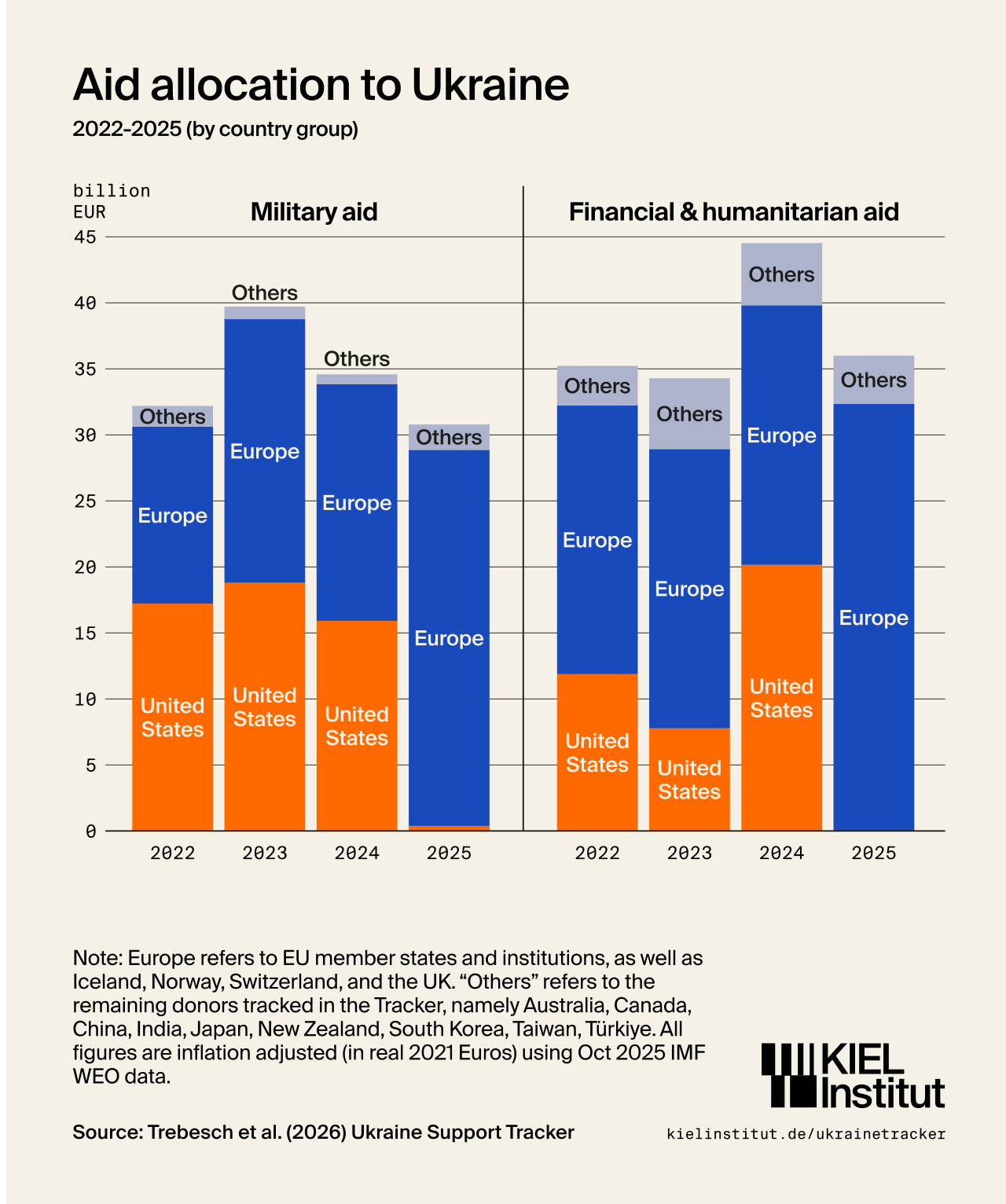
The idea that Russia is fighting the entire collective might of NATO is a popular and a convenient excuse in Russia to explain its failures, but that's very far from the truth. The most powerful member of NATO, the United States, accounts for about 60-65% of the combined military spending of all NATO members, but its support for Ukraine since the end of 2024 barely registers on charts: https://www.kielinstitut.de/fileadmin/_processed_/1/5/csm_mi...
In other words, 2/3 of NATO (by expenditure) is not participating in supporting Ukraine. The ten largest supporters of Ukraine (by contributions as a share of national GDP) are in fact all countries that share a border with Russia and prefer to help Ukrainians kick Russians on an already established battlefield instead of waiting until their borders get violated too.
> Otherwise, why is Zelensky worried that the US might cutoff intelligence access to it?
Cutoff from US sources is very painful, because the US has the best early warning system for detecting ballistic missile launches and loss of access leaves Ukrainian civilians without a chance to seek shelter before the missiles hit. Military value of such revenge attacks is near-zero. It is just pure terror against the civilian population like Hitler's V2 raids against London, and it's deeply shameful of the US to contribute to the terror by withholding information.
> While most Europeans might be ignorant about it, the rest of the world recognizes the simple fact that this is actually a proxy war between western superpowers and Russia (+ China), where neither side actually cares much about Ukraine and sees it as a pawn.
Trump's temper tantrums over his inability to force Ukraine to do what he wants clearly disprove the "proxy war" narrative, another popular Russian propaganda trope. As to the rest of the world, here's how the vote went on a UN resolution that condemned the Russian invasion of Ukraine as a violation of UN's charter and demanded a full and unconditional withdrawal of Russian forces: https://en.wikipedia.org/wiki/United_Nations_General_Assembl...
Likewise, popular opinion of Russia has also sharply fallen. South America saw an especially sharp drop, scroll down to "Changes in Disapproval of Russia's Leadership Between 2021 and 2022" chart: https://news.gallup.com/poll/474596/russia-suffers-global-re... Researchers summarised: "Despite significant Russian efforts to spread disinformation about the conflict, the massive shift in attitudes toward Russian leadership demonstrates that the geopolitical significance of Putin’s invasion of Ukraine is not lost on most of the world’s population."
> It is common knowledge that Ukraine moved most of their Air Force assets to other countries, to prevent its destruction. It was the right move, but also makes them less useful as it isn't immediately available when needed.
Interesting way to gloss over the fact that the Ukrainian Air Force never had the 674 airplanes and 284 helicopters that the Russian Ministry of Defence claims to have destroyed. Not even close. Do the fantasies about the destruction of Ukraine's drone manufacturing industry come from the same sources?
> All these battle tactics, and some battle victories, doesn't change the basic maths of warfare though - even with the limited support from allies, Ukrainian military is outnumbered and outgunned by the more powerful Russian military and thus cannot defeat it alone. That is why they are losing - they have lost soldiers, territory, their citizens, their economic infrastructure and economy incapacitated to the point of no return.
Almost all of that was true of Finland as well when Russians invaded in 1939, but the Winter War is considered a Finnish victory, because Finland retained its independence, government and armed forces, and Russians failed to conquer and absorb the country, despite enormous numerical and material superiority. The Finnish term for the outcome is torjuntavoitto, literally translated as "repelling victory".
> Comparing Putin to Hitler is laughable.
Why? Putin brings him up quite often in his long pseudohistoric rants and has said that it was Poland's fault that Germany invaded. In the interview given to Tucker Carlson, he said that Hitler was effectively forced into the invasion after Poland refused to give in to Hitler's ultimatums. "Great" minds think alike, it seems.
Well, yes, the deal was supposed un-block its own food and fertilizer exports, but they were still sanctioned. It was idiotic to agree to that deal without first getting the sanctions removed. The UN "committed to help facilitate and remove obstacles to unimpeded global exports of Russian food and fertilizers" - something which never materialized.
Completely irrelevant as well as ridiculous. Russia is 100% responsible for any ships being sunk in the Black Sea. Making silly demands when things don’t work out the way they hoped does not shift the blame in any way whatsoever.
Russia can stop the war (and thus sanctions) whenever they choose to. Ukraine does not have that option.
How is it "irrelevant" when there was a deal struck but its terms were violated ? Are all Western deals this way ? No wonder Minsk broke down. How is Russia 100% responsible for any ships being sunk in the Black Sea when Ukraine has sunk >100 vessels in the black sea? Try and separate basic logic from partisan emotion please.
First, this thread is about refuting GPs claim about how this is in response to Ukraine attacking Russian vessels first, which is obviously bullshit.
Second, EU and US were not signatories to any deal between Russia and Ukraine, so any sanction relief was never on the table as part of the grain deal. Russia may have asked for it, but it was not offered or implied in any way by anybody. And yes, this is typically how deals work everywhere.
Third, any ship that Ukraine sinks is 100% on Russia because they’re the reason any ships need to be sunk in the first place. Again, Russia could stop the war today and no further violence would be necessary.
Ukraine started attacks against Russian shipping in the Sea of Azov and Black Sea on 6th July 2026, as part of the 40 days day sinking over 100 commercial ships.
Who cares? Russia's been targeting Ukrainian vessels and shipping infrastructure since 2022, as we've established above. Just because Ukraine has chosen to respond in kind (or at a larger scale more recently) is irrelevant, the responsibility lies squarely with Russia. You should probably consume less Russian propaganda.
If I open something like a stadium, and whenever there's a big game I need a load of security to deal with traffic, drunk fans, and fights - arguably most of the security should be paid for from ticket sales, rather than the taxpayer, although the taxpayer should be there as the final backstop.
Likewise, if I have a bank with a vault full of valuables and I think it needs 3 armed guards present 24/7 - probably that's going to be at my expense, not that of the taxpayer. Although any bank should get a police presence in a reasonably timely manner, once they raise the alarm about a robbery.
>"you're responsible for securing your own property, security guards are a thing everywhere."
Maybe Bulgaria differs from most countries, but security guards seem to be mostly theatre. Private actors are generally very limited in what they can do to secure property, and they're usually required to basically call the police and hope the police show up in time to do something, which is often unlikely in either the countryside or industrial areas.
I think the point would be that it's the private company's responsibility to provide a minimum level of security, even if their job is just for deterrence, documentation, and notifying police in a timely manner. Even if it's mostly "theatre" it still serves a purpose.
Even more in this case: The business Starlink is operating is classified as critical infrastructure (in both EU and US)
As providers in the business of critical infrastructure they need to comply to the HIGHEST physical and digital security requirements, which includes taking preventive measures against acts of terrorism.
Not much is known about this case yet though, it's possible that their preventive procedures failed but their resilience procedures worked (was Starlink down?), and they reported the incident in compliance to EU CER and NIS2.
Either way, I'm sure they'll get an audit for EU CER compliance now, which will create a list of mandated immediate actions...
Is deployment of surface-to-air missiles, flak cannons, Gatling guns, and anti-air radars going to become a standard requirement? Unfortunately, Starlink can't go the easy route and just dig itself 100ft underground, they need satellite comms.
Aren't datacenters being targeted with missiles in this conflict? A single incident for a single Starlink datacenter might not have been the result of a missile, but it seems that full-on missile and drone attacks are now a very real part of the threat profile for datacenters.
As resentment towards datacenters grows in the US you might even see increasingly creative acts of vandalism and other attacks in places that are not considered war zones. A pipe bomb tossed it the vents of AC units ups the game of "basic physical security". And you don't have to get that crazy. A $100 drone can drop a bag of BBs.
Basic physical security is already way above basic at ordinary datacenters in seemingly safe locations.
In Europe, the airspace above a property is not owned by the company owning the land.
It's owned, monitored and guarded by the local government. Missiles aiming at a data center would first penetrate the national airspace of the country, as well as unlicensed drones do. This is a violation of national airspace and a crime against the country.
Drones are still a weak spot of national security though, as we keep seeing all around the world. But governments in Europe have no doubt that it is their responsibility to secure their airspace, and there are EU-wide activities to fix that.
> "Basic physical security is already way above basic at ordinary datacenters in seemingly safe locations."
From all that is known, this incident is about vetted access control and having a sufficient secure perimeter around your facilities.
In both US and Europe, a data center is considered a critical infrastructure and needs to adhere to the maximum physical and digital security requirements, which is much more substantial than this.
In this case, again, two people apparently penetrated security and put equipment on fire.
This might as well be the warehouse of a supermarket. It's a gap in their security that this happened, not a lapse of the government.
The responsibility to do their best to protect is still with the owner, it doesn't mean they must succeed at any cost. They must only do their best. Did they do their best?
I read the statement as the government introduced additional security measures "even though responsibility for their protection rested with their owners". These measures weren't "surface-to-air missiles, flak cannons, Gatling guns, and anti-air radars". Clearly more could have been done before digging into the bag of silly options. The owners just didn't do it.
There's a fine line between hyperbola to make a point, and hyperbola as a silly attempt to blur the issue. You comment is on the wrong side.
It really depends on the site being secured and who's acting as a guard. Try to storm a major US airbase and you'll learn very quickly that not all guards are created equal. Do the same as your local strip mall and yeah... that guy is only there to break up fights between kids and call the cops.
You install gates, raise walls, limit access, hire personnel, etc.
The more you need to secure whatever it is, the more layers you have.
In general, any respectable warehouse would have an external wall with a single entrance to the parking, and then a second entrance to the building itself.
In Bulgaria the security guards used to be just protection rackets. Then EU happened and the country normalized but even the previous prime minister used to be a bodyguard.
When those people aren’t around Bulgaria is incredibly peaceful country.
This. Police are just the clean-up crew who come 20 minutes after, and fill in the paperwork proving that something bad did indeed happen to you, that you can then use for your lawsuit or insurance claim, nothing more.
Unless you're a politician or the billionaire owner of an island, they're not gonna do much more to actually prevent or solve your problem.
In this case they even might come in and check if you didn't take sufficient actions to prevent this bad event.
An individual will be informed how not having a lock on the door was a failure in individual responsibility to prevent harm against yourself/others.
But an operator of digital infrastructure might get audited for compliance of the critical infrastructure directive/act. In the EU fines for such violations can be as high as €10 million or 2% of global turnover.
The people who started the fire are not going to be FSB employees, they're useful idiots that got paid for some vandalism who won't even know who hired them. Plausible deniability.
Not that different, perhaps, from Russia making businesses responsible for defending their sites against drones. Even threatening to nationalize the businesses that fail to establish adequate defenses. How a business can get ahold of military-grade anti-air defense systems is left mostly unanswered.
>If this sort of issue is not the responsibility of local police and federal agencies, I am not sure what is.
It's the Balkans mate. You pay next to no taxes, and so you also get next to no services back from the government.
The Police, education, healthcare, courts, etc. that exist, is just a skeleton crew in minimum load bearing role, not to actually solve your problem when you need it. For that you gotta pay private and costs extra.
Can you tell some example please, because I see fellow balkans thrive wherever they go. It’s the opposite in my experience when you come to balkan from strict regulatory environment then there are problems.
Why would Balkan tax payers pay to secure foreign corporation? Especially if that corporation is involved in a war they don't care which makes it a legitimate military target.
>Why would Balkan tax payers pay to secure foreign corporation?
Because foreign corporations operating in the Balkans pay taxes in the balkans, own property/real estate on Balkan soil on which their business operates, and employ workers in the balkans.
> Because foreign corporations operating in the Balkans pay taxes in the balkans
Ahaha, as if.
Foreign corporations with presence but no local entity pay no taxes. Foreign corporations with local entities somehow manage pay zero taxes because all profits are transferred to their Ireland parent entities.
Domestic corporations have far less options to not pay taxes, so they mostly do.
Bulgaria is not a war party, Starlink is. Whatever taxes they pay, it doesn't cover special military protection or war involvement, just regular protection from theft, trespass and similar, like any other company not involved in war.
>Bulgaria is not a war party, Starlink is [...] it doesn't cover special military protection or war involvement
Huh? So by your logic, if Russian soldiers in fatigues are shooting up a Ukrainian Roshen candy shop in Sofia Bulgaria, it's no the job of the Bulgarian state to intervene and fire back at those Russian soldiers on Bulgarian soil or arrest them, because according to you it's just a war dispute between Russia and Ukraine that doesn't concern Bulgaria and it's government law enforcement?
In the end it'll be up to the courts to decide if the incident on Starlink is an act of war not covered by insurance and law enforcement, or vandalism that falls under the responsibility of the Bulgarian state law enforcement, but you're logic is pure comedic FUBAR.
> if Russian agents assassinated a local industrialist
Funny you mention that - Russia has tried at least once going back as far as 2024[1]. State security services intervened.
> US intelligence discovered earlier this year that the Russian government planned to assassinate the chief executive of a powerful German arms manufacturer that has been producing artillery shells and military vehicles for Ukraine, according to five US and western officials familiar with the episode.
> When the Americans learned of the effort, they informed Germany, whose security services were then able to protect Papperger and foil the plot. A high-level German government official confirmed that Berlin was warned about the plot by the US.
Because that foreign corporation presumedly purchased the local property, pays local taxes on it, and probably employs some local people. Or are you claiming that the property of anyone foreign anywhere is up for grabs because they're foreign?
They should rather seize the property of a company trying to make a country involved in war and endangering its population by operating military actions from that country soil.
And by your own argument, Bulgaria would also be at war with Russia then, since Bulgaria has been supporting Ukraine with weapons and material in this war.
I don't know why it should be the governments job to secure private properties of corporations against vandalism/arson. It sounds much more absurd to me.
Starlink providing services to a customer (which made them a target in this case) is not a matter the local government of that site needs to protect them against.
--> Is it a local governments' job to secure the local properties of e.g. Lockheed, or the job of Lockheed as a for-profit supplier to the military?
--
Edit, as I expected this to be much more widely known: If you are operating in the business of critical infrastructure (for which Starlink qualifies, explicitly "digital infrastructure"), you have obligations to protect your facilities against physical and cyber attacks and have resilience and business continuity processes in place.
If you decide to operate in a business segment for critical infrastructure, it is not the governments job to secure your business, YOU have to comply to the requirements of operating in this field, and the government can audit and shut down your business if you're not in compliance.
In the EU, where this incident took place, this is well-defined under the CER-directive, and further extended for IT under NIS2 and CRE.
In the US, it's covered by CISA and CIRCIA (Cyber Incident Reporting for Critical Infrastructure Act)
It's absolutely the role of the security agencies to protect against foreign attack. Are Oil tankers and Cargo ships supposed to have air defense? What about the World Trade Centers? Otherwise there is no purpose to having a military if you won't defend your sovereignty.
That doesn't absolve the orgs responsibility, but the questions should be directed at both.
I'm certain there will be investigations from the government, not only due to the suspicion of a foreign state attack but also on the grounds of Starlink not sufficiently securing their premises.
It's not the responsibility of security agencies to prevent two guys from entering the premises of a critical infrastructure provider with gasoline.
They may have prior intelligence to act on this, but it is the operator of that facility who has the responsibility to ensure a certain level of security and resilience of his own premises, and this is strictly defined.
-
> "Are Oil tankers and Cargo ships supposed to have air defense?"
No, this would turn a civilian into a combatant ship, causing it to lose the civilian protections of the UN (The Ocean is governed by conventions of the United Nations, it's a different jurisdiction)
And still, oil tankers and cargo ships have requirements to secure themselves against piracy, terrorism and even warfare, mandated by the international maritime organization.
>I don't know why it should be the governments job to secure private properties of corporations against vandalism/arson.
because this isn't 'vandalism', this is an act of war by a foreign adversary that is now happening on European and NATO soil on a daily basis, and instead of responding accordingly we talk about this as if a drunk kid laid a fire somewhere
> "because this isn't 'vandalism', this is an act of war by a foreign adversary that is now happening on European and NATO soil on a daily basis"
Agree, the government should step in and (finally!!) take actions against those foreign adversaries.
But this doesn't change the fact that it is not the governments role to protect the facilities of a infrastructure provider against sabotage (or even acts of terror), a company providing such services in the EU has to comply to the CER directive and secure its operations.
There is a very basic reason for that: I could undercut every provider on the market by not investing in security and resilience. while everything works well I will beat all my established competitors and gain a significant share of the market.
This creates a risk of critical infrastructure stability for the citizens of that country. So if inevitable issues in resilience arise.....I demand the government to step in and take over my operations...?
It's the government's job to protect both individuals and corporations against foreign attack. It's even the government's job to protect against crime.
> "It's even the government's job to protect against crime"
It's the government's job to protect against crime, but the duty of an individual to take proactive measures against becoming a victim of crime ("Individual Responsibility").
--> They won't put a policeman in front of my house just because I decided to not have a door on my house.
-
Equally, (and MUCH more explicitly), it's the legal duty of corporations to protect themsselves against crime, especially if they provide critical infrastructure.
--> They won't put police all over my facilities just because I didn't invest in access-control.
--> In this case, I am not in compliance with the law and considered to invite(!) crime
It's both/and, not either/or. Yes, I have individual responsibility to have a door on my house, and to be careful about walking in sketchy places. And the government has a responsibility to combat crime. Both.
A critical infrastructure company has an obligation to keep their facilities secure. And the government has a responsibility to prevent attacks by foreign actors on critical infrastructure.
> "And the government has a responsibility to prevent attacks by foreign actors on critical infrastructure."
I replied explicitly to "crime", not "foreign actors", let's not conflate those just for a straw-man argument.
Preventing attacks by foreign actors is part of National intelligence and military, this is an entirely different matter. Both are entities facing outwards of a country, not inwards.
But more importantly, their job is not to fulfill the required security duties of a critical infrastructure company to prevent physical/digital attacks against the operation and resilience of its infrastructure.
And even IF they protect such a company in case of an imminent external threat, this is not a replacement for the legally required security compliance.
The critical infrastructure act (US) and directive (EU) mandate strategic measures to take explicitly against terrorist attacks, even natural disasters.
The government won't come to your company and do this job FOR you, they will lock you up and, in the EU, charge you up to xx% of your global annual revenue if they find out you're not doing it.
This is not how this works, corporations are not people.
As a provider for digital infrastructure, Starlink is required to comply with the EU Critical Entities Resilience (CER) Directive, which mandates strict physical and digital security as well as business continuity in case of crisis.
The nature of this incident indicates a security issue on the site of Starlink, which is their duty, not the governments.
They may have not been in compliance with this directive, which puts local infrastructure and citizens and risk.
Because internet is a major resource for the population. Its like water or electricity.
Most of those could be easily targeted and taken out by a large organized group but people are generally good and dont do that. If a country's military attacked though you wouldn't blame the water company for someone cutting the locks and destroying the water pumps. Or blowing up an electric facility.
Its not like this is just some random companies headquarters where they have some vehicles and someone broke the gates to spray paint the trucks.
This is an attack on the people of the country as a whole. The attackers are not vandalizing the internet because they dislike starlink they are attacking its people by destroying infrastructure. there is a major difference between the two.
> "Because internet is a major resource for the population. Its like water or electricity."
Yep, the EU classifies this as "critical infrastructure". Operators of such services (including water, electricity and digital infrastructure) have to comply to the highest level of the EU CER-directive for Physical and Cyber Security. This includes physical shielding, strict access controls and resilience against physical sabotage/terrorism as well as natural disasters or severe climate changes
I agree that the government should step up on against the military adversary on a country/regional level, but even then it is not their job to step in and do the job of Starlink as a provider of critical digital infrastructure.
A player in these markets has an obligation to secure his own facilities, otherwise every new market-entrant can undercut all competitors by not investing in security at all, until it's big enough to become a national risk and the government steps in to secure its business.
Both need to act in compliance with local laws and mandates, it's not the job of the government to fill the gaps.
Corporations have more duties of different scale than individuals.
Starlink is a provider of Digital Infrastructure, and is already classified as "Essential Entity" under the EU CER-directive.
As such, it needs to comply with so-called "Physical-Cyber Convergence Requirements", which entails
1. Perimeter and Access Defense
2. All-Hazards Mitigation: Designing infrastructure to resist natural disasters, severe climate changes, or physical sabotage/terrorism.
3. Vetted Personnel: Utilizing mandatory background checks and security clearances for operators working in sensitive zones
Not much is known about this incident at this stage, and I'm sure the government will conduct own investigations. But regardless of the outcome, it will be the duty of Starlink to secure its facilities.
Depends on the infra, and the level of anxiety generally and specifically.
Petty vandalism no, but I’ve worked at a few and know more completely non-military business premises that absolutely have “military barricade” or the like quietly in their contingency plans.
Funny thing is, a bit of arson is kind of normal on their estates. But usually it’s just stolen cars.
The EU already classifies digital services like those provided by Starlink as "critical infrastructure".
Operators of such services have to comply to the highest level of the EU CER-directive for Physical and Cyber Security. This includes physical shielding, strict access controls and resilience against physical sabotage/terrorism as well as natural disasters or severe climate changes. This is the duty of every player in this business.
The government has a job to stand up against a potential adversary of the country (be it other countries or local terrorists), and in case of an attack on critical infrastructure the government will also step in to protect it, I agree on that.
But it doesn't have the job to take over Starlink's (or whoever's) business operations and make it secure. That is the job of the company, long before it even appears on any map of a potential adversary...
> "It seems absurd that the government is blaming SpaceX for not securing its property against trespass and vandalism/arson, especially when it seems likely that the violations are by foreign-state-sponsored actors"
I think neither private companies nor tax-payers would appreciate if the POLICE would run security for a for-profit corporation, as it means that all corporate access-permissions would de-facto be managed by the government administration (which would be financed by the taxes of citizens and other corporations...)
Also: Would be even more ironic for Starlink to now demand big-BIG-government after their CEO keeps pushing for small-government for years now. But it fits the typical "Privatize profits, socialize costs" view...
> If this sort of issue is not the responsibility of local police and federal agencies,
... it means those properties are own sovereign nations, or at least autonomous zones! woo hoo, time to declare independence of People's Republic of Mars.
Local here. The new prime minister is a spineless russian rag and everyone around him is from the former communist party. You won't find in them anything approaching self-respect or actual will desire to defend against any russian provocation.
It is not absurd at all. You can't arrest somebody for a sabotage without letting him to execute the deed. Because if he won't execute there's nothing to arrest him for...
So to prevent a sabotage is to have several layers of security (i.e multiple fences) so you will force the saboteur to commit minor crimes like trespassing first and also slow the saboteur significantly so you can arrest him for these minor crimes.
> It is not absurd at all. You can't arrest somebody for a sabotage without letting him to execute the deed. Because if he won't execute there's nothing to arrest him for...
You can very well arrest someone for the intention of sabotaging.
How else would you like to discover a conspiracy if the saboteur is a tourist coming from abroad? Or of a saboteur is a child who got promised 1000eur for it?
> How else would you like to discover a conspiracy if the saboteur is a tourist coming from abroad?
Tips? Mistakes? Customs officers getting a funny feeling about something in their bags? Google searches? Purchases of stuff to make explosives with? Surveillance? The child tells their parents some creepy guy offered them a thousand Euros? Do you think intelligence agencies don't already look for this sort of thing?
https://en.wikipedia.org/wiki/Operation_Pastorius has a nice example of how this works that doesn't even rely on modern surveillance tech. They accomplished zero sabotage, and six were put to death for it.
> Even before the mission began, it was in danger of being compromised, as George Dasch, commander of the team, left confidential documents on a train, and one of the agents, while drunk, announced to patrons in a Paris tavern that he was a secret agent.
> Immediately upon reaching the beach, at around 30 minutes past midnight the saboteurs were discovered amidst the dunes by unarmed Coast Guard Seaman John C. Cullen, who was accosted by Dasch and offered a bribe of $300. (Cullen had been shortchanged, the money only amounted to $260.) Cullen feigned cooperation but reported the encounter.
> Additional breaches of secrecy occurred; Kerling had boasted to a colleague about their mission, and in Chicago, Herbert Haupt had asked his father to buy him a sports car claiming he needed it while traveling on business for the German government.
Any operation involving humans has opportunities for fuckups.
99% of saboteurs won't do string of such stupid mistakes. So it is a vanishing chance bordering on luck that intelligence will prevent anything and it will be possible to apply conspiracy charges.
> After the war, it was discovered that all the agents Germany sent to Britain had given themselves up or had been captured, with the possible exception of one who committed suicide.
Not a single successful agent in five years of war.
So you agree "taxpayers should be on the hook for everything"?
Every place SpaceX decides to operate, regardless of what taxpayers want, the taxpayers should foot the entire security bill for their private facilities?
So where’s the line drawn? How much should taxpayers be primarily responsible for if a private company doesn’t meet established security standards?
The comments in this thread you’ve joined seem to imply a private company should be held to no standards, and that this specific company’s security should primarily be the responsibility of other taxpayers.
I’m not subject to NIS2 or CRE standards, unlike the willing operator of this facility.
I still have a gun and cameras, because I’m not a welfare queen dependent on the government to do every single thing for me. With the billions of taxpayer dollars SpaceX has, maybe they should invest in some security.
> It seems absurd that the government is blaming SpaceX for not securing its property against trespass and vandalism/arson, especially when it seems likely that the violations are by foreign-state-sponsored actors.
SpaceX is actively meddling in foreign-state wars picking whichever side they choose to support on which day. They made their bed.
> SpaceX is actively meddling in foreign-state wars
Starlink is banned, by the US government, from operating in a military context, and cannot be used for military purposes. Do you have a reference/examples for them meddling/supporting wars, or a hint at what you're referring to for someone out of the loop? This is not allowed by very many laws and policies that have been in place since the company started operating.
I suspect you're making a logical leap that them stopping means they're now supporting some opposition?
"Motives" section being the important bits, for why it had to go to the government StarShield system.
Maybe this is the recent disruption referenced?
> On 14 October 2026, Musk said the Ukrainian military was using the US government owned and controlled Starshield system, not Starlink, and the recent change to restrict operational user terminals to those travelling at less than 100 mph (160 km/h) was a US government decision and not his decision.[87]
Not exactly - Starlink is civilian. Starshield is their service for the US military. According to what Musk said recently, it is apparently under the control of the US military (he said he didn't know anything about service being disrupted for the Ukrainian military recently because the US military fully controls it). But yes, I can understand why it could still be considered a potential target. War is ugly, and associating with it in any manner is bound to tarnish one's reputation.
The relevant framework is US federal defence procurement law, particularly the FAR and DFARS. Starshield is a military system that Musk says is under US government operational control. Much like other defence systems supplied by private contractors, the supplier doesn’t necessarily retain authority over military deployment or usage. The distinction is that no law forced these specific restrictions; the law and contracts provide the framework for the US government to make those decisions.
and yes its ai slop, its about as much effort as you put into asking this question so we are even.
In the most corrupt administration of all time, American law doesnt really get considered at these levels. There are many things Musk and his companies should legally not be doing but not much really happening there. Especially after DOGE killed most the groups looking into these things and the AG is run by Trumps personal attorneys.
Sorry, I wasn’t clear. The grandparent comment mentioned Saudi and I was saying that there is no one anyone condemns Saudi even if ‘must be alive’ rule didn’t exist.
The problem is the ‘fraud safety’. Your ‘safety’ is likely to be some else’s inconvenience (or vice-versa), and credit cards are all about ease-of-use. Fraud-related costs are also one of, if not the largest single contributor(s) to payment processing fees.
That really is the greatest achievement of card issuers and networks: Taking a huge cut on every payment and throwing scraps to cardholders while making them feel like they're landing a great deal (whether in the form of points or the ability to do chargebacks, which is actually a legal right, not industry goodwill!) or even "tricking the system".
> Fraud-related costs are also one of, if not the largest single contributor(s) to payment processing fees.
Every level of my government has been defrauded of a significant amount of money (relative to their budget,) in the last five years; I do not support their losing more of my money to fraud.
Certainly, once you have a world government. Are you sure that a world government will be aligned with your interests in other areas than payment processing?
I mean really, we do know what a solution to this is; the EU caps interchange fees, without much harm to the fraud settlement part of the network. Just the crazy points programs like Amex Platinum go away.
This doesn't help with payments which take place without a card present, such as online and phone payments, which make up a large (and growing) proportion of transactions.
We should replace payments only requiring the number. Make it so they have to use some kind of on device verification like the banks app or Apple Pay. Keep providing the old system for legacy customers but charge a “fraud fee” while the more secure payments become cheaper.
It seems like many of these prosecutors/plaintiffs just want to go after the largest organizations in a given industry, almost irrespective of their culpability. It seems to me that most 'consumer protection' lawsuits seem to be more focused on obtaining publicity for the lawyers than actually doing anything useful, but getting a few settlements from larger organizations is a lot easier than actually going after wrong-doers, so it is a somewhat sensible strategy if the goal is to 'win' as much money as possible.
The Vertical Assembly Building was used for both the Apollo Program and the Space Shuttle, though it had much more ‘headroom’ for the latter. From what I’ve read the rumors of clouds forming inside of it are actually a myth, though there are condensation and airflow issues. I don’t have citations handy as it’s been a while (decade) since I’ve read this.



reply