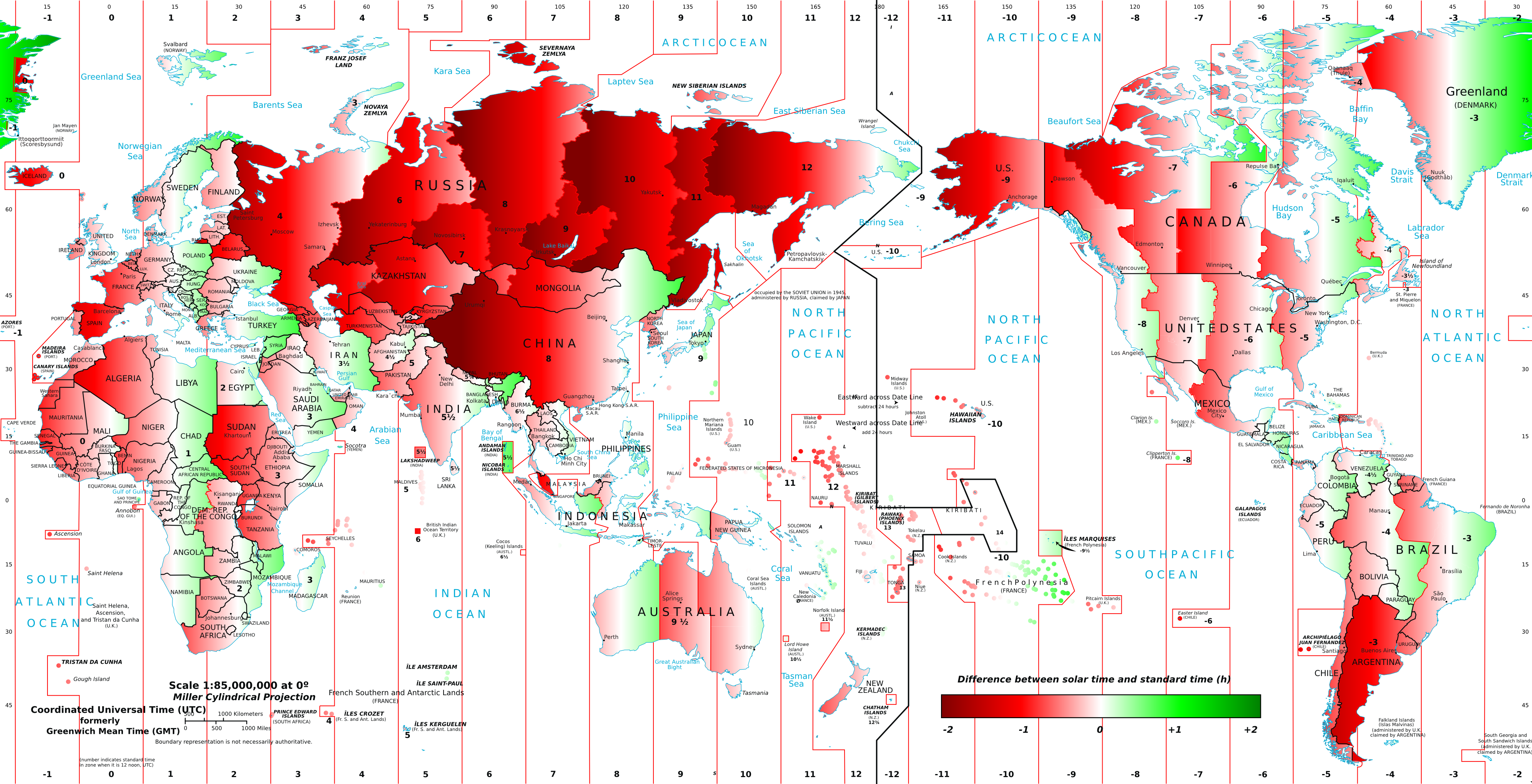
Thankfully, this is a situation we don't need to speculate about without evidence. Spain is on de facto permanent DST, serving as a natural experiment. I bet the results support you.
That's partly because it's in the same timezone as Poland. Madrid is further west that London, but London is an hour behind. Moving Spain to permanent DST puts it on the same effective timezone as London.
The clocks should show 4:45PM in Spain if the TZ was right (same as UK), and even so it would still be mostly red-white with barely any green. Poland appears white-green in the map, to have a bit of red it should be in a 1/2 TZ like India.
Minimum daylight (winter) in Warsaw is 7h 42m [0] and in Madrid 9h 17m [1]. Maximum (summer) is 16h 47m and 15h 4m. That is due to latitude and unavoidable. The exact numbers for sunset and sunrise are pushed around by the TZ choices.
Most of the world tends to prefer to not be too far from the center of the timezone (where solar noon matches solar time in standard time). Geographic and political boundaries make it so that often it's more red. The extremes of north and south tend not to care as much because it doesn't matter as much.
I don't think that explains it. The "red" offenders are basically Russia, China?, Sudan, Argentina and Alaska. The only "green" offender is Greenland, which is still large enough to enough red to justify it. I get China, it aligns with the population density. Sudan likely wants to have the same time as Somalia and Ethiopia. Why Argentina? Why Alaska? And why does Russia basically have zones that range from +2 to the +1 offset? They don't even have the excuse of avoiding 2 hour jumps like between Alaska and Canada, because they still have that.
Argentina is https://en.wikipedia.org/wiki/Time_in_Argentina - My speculation would be that Argentina (the east coast especially) wanted to be economically synchronized with the coastal cities of eastern Brazil. Buenos Aires and São Paulo being on the same timezone makes it easier for the two of them to do business.
Alaska used to have four timezones. In 1983, they were consolidated into two timezones - Aleutian and Alaska. Being in -9 rather than -10 brings Anchorage closer to the Pacific west coast in its business day with the note that it doesn't matter too much when solar noon is if sun is up for 22 hours or 5 hours.
Spaniards are a lazy bunch of party animals, waking up late and going to sleep late too...
Or the clocks are wrong. Once you realize noon is 13h in winter and 14h in summer, never 12h, things start to make sense. Late lunch? Not really, Sun at same height than Italy, but clocks off by 1.
For the "public image" part of the experiment, the conclusion is easy: bad. Time to change clocks so waking up happens at "3h" in the morning, and become a country of hard workers with no nightlife, because everyone retires "early". Even if discos are full as in the past.
It's crazy to me that we want to force age verification on every service across the Internet before we ban phones in school. I could understand being in favor of both, or neither, but implementing the policy that impacts everybody's privacy before the one that specifically applies within government-run institutions is just so disappointingly backwards it's tempting to consider conspiracy-like explanations.
The advantage, I think, of age verification by private companies over cellphone bans in public schools is that cellphone bans appear as a line-item on the government balance sheet, whereas the costs of age verification are diffuse and difficult to calculate. It's actually quite common for governments to prefer imposing costs in ways that make it easier for the legislators to throw up their hands and whistle innocently about why everything just got more expensive and difficult.
And the argument over age verification for merely viewing websites, which is technically difficult and invasive, muddles the waters over the question of age verification for social media profiles, where underage users are more likely to get caught and banned by simple observation. The latter system has already existed for decades -- I remember kids getting banned for admitting they were under 13 on videogame forums in the '00s all the time. It seems like technology has caused people to believe that the law has to be perfectly enforceable in order to be any good, but that isn't historically how the law has worked -- it is possible for most crimes to go unsolved and yet most criminals get caught. If we are going to preserve individual privacy and due process, we need to be willing to design imperfect systems.
The argument about luminance ranges is wrong. I measure the brightness of monitors regularly as part of my job, and typical maximum luminance values are in the range of 100-500 lux. That puts you right in the steep range of the visual response (especially if you are turning it down and near a max of 100), which is natural — maximizing the slope of the neuronal response to light means that more information will be available to the brain. In fact a good monitor will be tuned according to the just-noticeable difference which aims precisely to maximize the information available according to this characteristic curve. See e.g. the DICOM standard:
The author's basic problem is that he knows too much about the brain and not enough about monitors.
The author goes on to argue that you should be turning your brightness down, but most people already are turning their brightness down; the blue light filter is more comfortable. He does make a reasonable case that you should be reducing green light similarly, but people prefer the incandescent effect of the flux filter to a straightforward color filter — indeed a primary design goal of these filters has been to be pleasant to look at which is why people use them.
It's a propaganda maneuver. And it's obviously just as critical of China as it is of Europe. The State Department's public voices may be immersed in the culture war but there are probably a few cooler heads left who have learned to keep out of the spotlight.
>Adding to this: Even back when I was in college (not that long ago) it became known that registering as having ADHD qualified you for extra time on exams.
In sixth grade I was frustrated focusing on exams because I'm easily irritated by noise (misophonia). So, I asked for a separate room, or, as I remember putting it, a closet. They sent me to a different room and offered me four hours. I couldn't seem to explain that I don't need more time, I just want it to be quiet. I never asked again.
Possibly the solution would be to have some kind of soundproofing backing material on the converse side of the drywall panels. Including this could be required by regulation which would be easier to enforce than some kind of abstract acoustic property. One of the interesting arguments that Brian Potter made is that you're usually better off trying to move the issue from construction to manufacturing.
This is basically similar to how leaded drywall is used to shield X-rays. Of course, there are additional costs associated with the hazards of lead.
>One of the biggest mistakes I see artists make is painting things that don't resonate with people. Once you have an aesthetic that works, the market rewards you for exploring adjacent aesthetic territory. You might not make a living right away — it took me over two years from when I painted that first Honey Bear until I took my art full time — but it is totally necessary if you are to make a living off your own art (as opposed to teaching or commercial art). Until then, if what you're doing isn't resonating, you just need to just paint something else. Experiment with different concepts and directions until you find something that works.
He doesn't spend a whole lot of time deliberating on the literature versus television question, but it's easy to see what he's chosen.
There's a related idea in mathematics, the proof that the real numbers are a vector space over the rational numbers. If you scramble the basis vectors, you obtain an isomorphic vector space, but it is effectively a "permutation" of |R. Of course, vector spaces don't even have multiplication, but one interesting thing is that the proof requires the axiom of choice.
I think that actually constructing a "nontrivial" model of C using the field conception might require choosing a member from each of an infinite family of sets, i.e. it requires applying the axiom of choice, similar to the way you construct R as a vector space.
Tracking device might be the wrong thing to focus on. The US has other ways of messing with foreigners who depend on services provided by US companies, like suddenly cutting off those services in the case of ICC judges.
IIRC, ICC judges lost access to their O365 work email accounts. Worst the US can do to me is turn off my Steam, and Gmail but I can easily live without those.
Now imagine being debanked by your own government because they don't like what you're saying and becoming unemployed, homeless and dead. I don't think they're remotely comparable.
For example, a few years ago, a power tripping gov bureaucrat turned off my unemployment payments over a technicality. Luckily, I had enough money to pay a lawyer to sue them and won, but it was tight. What if I hadn't had the money to hire a lawyer? Since I was in a foreign country, with no family or close friends to fall back on. I was exclusively relying on the welfare state I paid into for years, that then turn its back on me for shits and giggles.
So I don't think you understand just how bad it can be for you if your government decides to turn on you and fuck with you, if you're comparing this to losing access to your work email account.
See the famous case of UK postal workers that got fucked by their government trying to hide their mistakes.
Of course in this judge's case there might still be some banks who are willing to work with him even at the risk of getting sanctioned as there weren't language in the news that he was completely debanked which I assume they would highlight if it was the case.
The main problem IMHO that a bank access not seen as a right. Even Russia which is neither powerful (unlike the US) nor an EU ally can de-bank Russian critics living in the EU (and other places) by reporting them to FATF. AML is ripe for abuse.
> Now imagine being debanked by your own government because they don't like what you're saying and becoming unemployed, homeless and dead. I don't think they're remotely comparable.
You don't have to imagine it.
Alina Lipp, Thomas Röper, Xavier Moreau, Col Jacques Baud, Nathalie Yamb. The last two are Swiss nationals. The Baud case is interesting because he's a Belgian resident who now can not even buy food or pay his bills while living in his own home.
> IIRC, ICC judges lost access to their O365 work email accounts. Worst the US can do to me is turn off my Steam, and Gmail but I can easily live without those.
They lost access to everything american, including Visa and Mastercard.
It's in french and maybe not the best source but it's not paywalled :
> "Payments are mostly cancelled," he continued, "as almost all cards issued by banking institutions in Europe are either Visa or Mastercard, which are American companies."
They are not completely debanked since they can go to the bank and withdraw cash, but it's a crippling situation to be in.
You most likely use a Windows PC and an Android phone. If Uncle Sam viewed you as a threat actor, he could ask both companies to send you a signed and verified update to either your OS or apps they control, running whatever he wants.
It's all the same. How is suing Google any different, if you instead get debanked by Google for violating their "terms"? The only solution is untraceable, permissionless money, like Monero. Why do you think governments try so hard to ban it?
Being de-Googled is a hardship, though there are replacements for virtually all its services. I acknowledge you are well informed on this topic.
It is not unreasonable for governments to pursue avenues for laundering money. I recognize that you likely don't believe governments should prosecute money laundering, but that view is not aligned with the majority of citizens in your country.
Ah money laundering, the government's 2nd favorite excuse to bypass due process, remove freedom, and impose arbitrary punishments, after "emergency" and before "think of the children".
The government can prosecute money laundering and all the other crimes, but it's not an excuse to impose extrajudicial punishment. Until they stop, having some cash and crypto is your only means of defense.
I understand your threat model is centered around the risk of a government persecuting you. This will naturally conflict with incentives of people whose threat model centers around a lower severity but higher frequency event of systematic violence performed by criminal enterprises, with a necessary condition being ease of moving money. Both representative and totalitarian governments seek to aid investigation of criminal activity by following the movement of money.
I'm unsure about your reference to extrajudicial punishment, is it referring to de-banking associated with AML and KYC regimes in the US? If so, I agree that unjust things are unjust. I believe we should seek to fix those injustices directly through lobbying lawmakers, rather than rejecting an entire system that has significant security benefits.
I am sympathetic to people who have a fatalistic attitude when it comes to political reforms. Having other financial instruments as a backup is a good practice.
I'm not necessarily opposed to KYC or even government being able to audit transactions in general. But there is too few legal protections both from the bank and the from the government itself for this to be acceptable in a free society.
It's not entirely hopeless I guess. For what it's worth, the US government recently issued an EO that purportedly stops banks from debanking you for political reasons. Hopefully a future administration would take care of the other part.
Because financial sanctions are one of our main tools to pressure enemy countries into calming the fuck down in hopes of avoiding an actual kinetic conflict.
In 2025, North Korea managed to steal from the world over 10% of its GDP worth in cryptocurrency.
Your bank (like most European ones) requires you to pass attestation to use their services. If you don't accept Google/Apple's terms, you can't access it without extreme difficulty.
I can always access my bank via a web browser or even in person at the teller at a branch somewhere, or as a last resort via snail mail from attorney, but most importantly even if I get locked out somehow by google, the account still runs and I won't be homeless as my salary and rent auto-payments keep going regardless if you can access it or not.
How is this comparable to your government debanking you meaning that no bank, landlord, layer or job will touch you?
I... don't think you understand debanked. There is no movement OUT of your account. Deposits will be processed all day long. The intent is to tie up access to as many of your assets as possible. If you think anything of yours will just keep on going if you end up debanked, you're sadly mistaken. In addition, based on the U.S. Bank Secrecy Act as amended by the PATRIOT act, covered entities are forbidden from disclosing to you anything about why your account is frozen.
It's as close as you get to a complete shunning from modern society. You're reset to the cash you hold on you and keep custody of. And yes. In the U.S., the list that manages who can and cannot transact is centralized under OFAC. So it is at the whims of Executive whether or not any financial activity can be done with you.
The premise here is that you lose access to a European bank's mobile app because the US government compels Apple or Google to disable your app store accounts. Not that your relationship with the bank is frozen.
the account still runs and I won't be homeless as my salary and rent auto-payments
Luckily in most European countries renters are protected and they cannot just kick you out of your home for missing one rent payment (IANAL, but in NL it requires 3 months of no pay and a judge has to approve). Most likely they wouldn't approve if you missed a payment because you were locked out of your banking account.



reply