“As someone familiar with the aviation industry” you should know people “skiplagging” won’t check bags, which destroys your whole argument since that’s where all the inefficiencies lie.
Now you just have a no-show at the gate (P>50% ? something they’re surely used to handle efficiently) giving them some slack to fly their overbook flight without having to bump anyone. Truly a win-win
>you should know people “skiplagging” won’t check bags
The point is that a no-show still causes hassle, and in this case hassle that didn't have to happen.
Shit happens, if you turn into a no-show due to factors outside your control nobody's gonna be angry. But if you are a deliberate no-show? All because you wanted to shave some cost? Sincerely fuck you.
Airlines choose these ticketing policies and customers react to them rationally. If the airlines allowed customers to notify them that they won't be taking the final flight without any extra costs, then they wouldn't have to worry about no-shows like this (they could even resell the seat).
The airlines are choosing their pricing mechanisms and can live with the consequences.
There is nothing rational about maliciously misleading someone in a business transaction.
>If the airlines allowed customers to notify them that they won't be taking the final flight without any extra costs,
You absolutely can: Just walk up to the nearest ticketing counter on your way out the airport and let them know you won't be flying. Simple, done. You might still get blacklisted, but you are presumably okay with the consequences.
> There is nothing rational about maliciously misleading someone in a business transaction.
Honestly at this point I think you're just being purposefully obtuse. Of course it's rational for customers to but a ticket A -> B -> C if they want to fly A -> B and the ticket A -> B -> C is cheaper than the ticket A -> B. What's irrational is for airlines to price their tickets that way.
> You absolutely can: Just walk up to the nearest ticketing counter on your way out the airport and let them know you won't be flying. Simple, done. You might still get blacklisted, but you are presumably okay with the consequences.
Once again you seem to just be willfully obtuse here. Being blacklisted is quite obviously a cost. Passengers being blacklisted means that _rational_ customers doing this won't tell the airline. If the airline didn't want passengers to skip the final leg of their flight without telling them, they could simply allow the customer to notify them without extra costs. They choose blacklisting (or charging to to "change" your ticket to not take the final flight) and this is the result.
I mean I get that you work in the airline industry and hence align your arguments to those that profit the airlines, but you really should accept that the airlines are knowingly creating this environment and that customers are just reacting exactly as you'd expect.
Merchants can price their products however they want, and they have no obligation to sell to you. Customers can purchase a product if it suits them, including the price, and they have no obligation to buy from them.
The rational thing to do if buying a ticket from A to B is too expensive is to not buy it, let alone buy a ticket that flies to C.
>Being blacklisted is quite obviously a cost.
Don't break contracts you've signed if you don't want to get penalized.
>Passengers being blacklisted means that _rational_ customers doing this won't tell the airline.
Rational customers will tell the airline that their plans need changing/cancelling. This is just common decency as a human being, my dude.
>If the airline didn't want passengers to skip the final leg of their flight without telling them, they could simply allow the customer to notify them without extra costs. They choose blacklisting (or charging to to "change" your ticket to not take the final flight) and this is the result.
Sure, because airlines (and merchants overall) don't like it when customers try to change the deal on short or no notice. That said, if it's due to outside factors most airlines will try to accomodate you.
If you want to change the deal for unjustifiable personal reasons, of course you will get penalized.
>I mean I get that you work in the airline industry and hence align your arguments to those that profit the airlines,
I'm not, and I'm not sure where you drew that conclusion from. I am familiar with the aviation industry because I have family and friends who work(ed) in it (pilots, ATC, etc.) and I am a very frequent flyer myself.
>you really should accept that the airlines are knowingly creating this environment and that customers are just reacting exactly as you'd expect.
Most customers by and large are reasonable, they buy tickets that take them to their desired destination and the airline honors it. It's not a super power to be a decent human and conduct yourself professionally.
They PAID for their tickets. They are under no obligation to consume the service they PAID for.
What you are not willing to admit that the decent three don't do this stupid shit(Southwest, Alaska, Jetblue).
The fucked up three are the ones pushing it: Delta, AA, United. I truly hope they go bankrupt.
Read a book on tech entrepreneurship. The “goal” of most startups is to get purchased by a big tech company. That’s utterly fucked, and tacitly demonstrates the problem.
Because a lot of those business are only possible through monumental amounts of work and/or investment and selling is way easier than being an owner-operator for years under very probable risk of failure?
Yes I can see the dystopian consequences of google’s search monopoly profits, which they have used to do such horrible things as:
- Providing a free alternative to Microsoft’s monopolized office suite and desktop OS
- Provide a free alternative to Apple’s mobile OS, spurring a revolution in access to the internet for the world’s poor
- Provide free global maps with streetview sights
- Provide a free to access video platform with invaluable educational resources that allows millions of creators to make a living and that likely wouldn’t exist save for Google’s monumental investments and ability to sustain years of losses
- Research given away for free that ignited the current AI revolution
- Research given away for free that is revolutionizing medicine and drug development
So you’re telling me the evil monopolist that charges nothing has a competitor, and that competitor is free? Which is why we must break up the evil monopolist?
The case against Google surely is that they shouldn't be allowed to use their dominant position in ad sales to price dump unrelated businesses until all competitors are gone.
Like for example having youtube be free until they're the only game in town then start charging 14 dollars monthly to avoid 30% ads. Or targeting ads to gmail users so you can artificially provide a cheaper mail service than anyone else.
There's an actual law saying you can't do stuff like that.
This illustrates why breaking up google is a good idea given their egregious charges (free) for things people used to/still spend money on, such as:
- An office software suite
- Global maps and GPS, City Guides
- Video entertainment
- Mobile and Desktop OS
- Web Browsers
Also, pay no mind to their competitors in all of those markets AND in their core business of search, being feeble multi-trillion and multi-billion global corporations
Those things aren't free, they're supported by ad revenue and the sale of personal or aggregated user information. I'm not saying there isn't a place for that type of software, but imo it's wrong and somewhat dangerous to equate that with things that are actually free. And even so, to the extent that any of Google's software is actually free, it's mostly a loss leader for the sake of vendor lock-in, which is intrinsically anticompetitive.
“But my data”
Have your ever sold your data? Would the value you could ever possibly receive for your data ever equate to the value you get from the free services?
Likely No and No.
Is the free ad supported city newspaper free? Yes it is in fact free, just like FM radio is free, and broadcast television is free, and sidewalks next to billboards are free
Someone creating something appealing and giving it away for free in order to make up for it through ads in front of eyeballs does not in any way mean that the free thing isn’t free
All of these examples are probably in part or fully paid for with some sort of taxes. So it is less "no payments" and more "deferred payments".
I would argue that the question of "Is it free?" should not be restricted to monetary payments. If I offer you dinner for an hour of yardwork - are you receiving the food for free? If I would offer you that same dinner in exchange for letting me watch you use your computer for a while, is it free?
I think ads do incur a cost on you: In usability of a service, in your attention span / desensitization and your ability to focus, in the money you would not have spent were it not for ads.
Googles services are free in the sense, that you don't spend cold hard cash on them, but I would still argue, that you pay for them. That 2 Trillion Dollar valuation has to come from somewhere... :(
#1. Would I have used the computer at the same time/place/duration? Then yes it is free. It literally cost me nothing.
#2. You can pay? Also is the argument somehow that the free thing isn’t free because the ad in it makes the UX worse?
Also curious to know how many ads exactly do you get while using google workspace? drive? android? maps?
Finally: You can literally use Chrome, Workspace, Drive, Android and Maps without seeing a single ad, without an ad blocker, without EVER using google search, for free.
There are costs other than monetary associated with doing things. Just because you are not giving someone cash directly does not mean it is "free".
Those semantics aside:
- Maps has ads in the form of sponsored results all over the map.
- Android is only a decently functional platform with Play services installed, which includes ads. I don't have an Android phone handy but I'm pretty sure there's up-sells included in quite a few places, I just can't name any right now.
- Chrome is a browser you cannot use for its primary purpose without seeing ads.
- Workspace is a directly paid-for product.
Google is an ad company. Essentially all of its products are supported by advertising, and it's slightly odd to suggest they are not.
You're describing the difference between highly diffuse costs (taxes -> sidewalks) and transactional costs (price of a hamburger -> hamburger).
I would like private businesses to offer transactional costs. I do not want businesses leveraging diffuse costs; I'd prefer that only my governments use diffuse costs and that private businesses have limited ability to use diffuse costs. At least with government I get a vote.
If I build a movie theater and give away the tickets knowing that I can make money on ads before a movie that does not mean that 5 minutes of your eyesight is now worth something
> that does not mean that 5 minutes of your eyesight is now worth something
The advertisers paying to get their ads placed in front of those eyes disagree.
And ye, since another comment questions this, data or "eye-time are similar - they can be broken down to the individual.
The advertisers pay some price expecting a certain number of people to see the ad, and even if data about people is sold in bulk (too) there is a price per individual. It's a simple division to see the price they pay per person to view that cinema ad, or for one person's data, even if they always purchase those in bulk.
After all, they get to the bulk price by multiplying how much they are willing to pay for one individual with the expected (or in the case of data packages known) number of individuals.
You can literally use Chrome, Workspace, Drive, Android and Maps without seeing a single ad, without an ad blocker, without EVER using google search, for free.
Do you realise that as soon as you go to any of those websites, your details are scraped and sold? The second you put any data in drive or worksdpace, that is scraped into LLMs and sold?
Theres a reason that you have to log into a Google account to use those services, which means agreeing to their rather large TOS.
Buying something doesnt necessarily mean you have to pay money for it. Your time and information is worth something too.
Uhmm.... I have to admit that I fail to see any connection whatsoever between your original comment that I replied to (included in the reply) and your reply...
Movie theater is an interesting analogy because they make zero money on ticket sales. Usually ticket revenue pays for the cost of the movie (theaters pay the studio for the movie). The way the theaters make money is on concessions, hence why they're crazy expensive.
You, the theater owner, are selling the time people are sitting in your theater in view of a large screen to advertisers. That time is literally worth something.
If there were no people in the theater, the advertisers wouldn’t pay for the time.
You just really don’t understand how advertising works.
You’re effectively saying something like “just because people would pay for something, doesn’t mean it has any value”
I have to believe that you’re an extremely skilled troll, because otherwise idk what’s going on in your head.
There are companies like Nielsen that will pay you directly for you to provide personal data. But regardless of that, there are plenty of things that we do for free, like babysitting our own kids or answering our own phones, that if provided to someone else we would get paid for. So if your data is worthless to you, that doesn't mean it's not valuable to someone else. And we know for a fact that data is valuable, so why are you even raising this point, except to be argumentative for its own sake?
It’s really hard for me to take you seriously. You’re just poorly playing semantics to white knight for Google.
Very weird.
It’s a good deal for the individual, that’s why Gmail is popular.
Trading something of low value for something of moderate value is not what “free” means…
Say the data from me or any of my peers was worth 1/100th of a cent and we give that away… that means I am trading something of minor value for something else…
if you aren't considering the fact that your data is what enabled these companies to become such massive giants in the first place, you may be living outside of the EU.
My concern is that breaking up Google without breaking up Microsoft will basically just be giving MS a huge advantage in the multitude of categories in which they compete with each other, so we'll be left in an even worse situation than before.
Microsoft is categorically incompetently run at this point. They chose to cede both the web and mobile platforms entirely to Google for free. They couple some of their most impressively engineered OS releases with things like preinstalling Candy Crush to ensure that any gain of respect their engineering deserves is immediately burnt goodwill from shoddy behavior.
Apple is mostly too dependent on vertical integration to truly take over a market. If they allowed their OS on other hardware or something, they could pull Google power but they are entirely built around being their own unique bubble.
If Google finally gets broken up, you'll probably see hardware manufacturers like Samsung and LG truly start doing interesting things again.
Giving Microsoft the market despite their incompetence is exactly what I'm worried about. They seem to have taken the "pay Washington and slowly become mandatory on every computer" strategy over "make a product people want to use" strategy, and it's paying off.
Eh, I don't think Microsoft is leading in a long-term success direction. In the enterprise IT space, the shift to largely cloud services has totally undermined their monopoly: While many are on Azure, yes, the need for users to be on Windows desktops is nearly gone, and Azure is a commodity that can be easily replaced by competitors' services without end users even noticing.
Google will even with a break up, continue to control search and probably the web as a whole. Microsoft would be starting from scratch trying to build a mobile ecosystem again to compete with whatever's left of Android. And largely outside of the Windows ecosystem, Microsoft has repeatedly failed to buy control over the developer ecosystem. (All they need is one dumb PM to tick off the average GitHub user, and they're sunk there too.)
Yeah. Google is far less locked in than Microsoft. Gaming across Windows and Xbox vs Sony/Nintendo. Office is used by almost every org in the world. Azure locked in via clickops IT staff always wanting to pick it; you have to make a big case to use GCP or AWS in a lot of companies vs "just" using Azure.
Google's search advantage could be taken away with another website that's better. There's no installed base or corporate lockin to contend with. Same with email. Same with maps. While Google uses data from each of these services to better target ads at you, the services are not very tied into each other, and you could easily grab one of those services away from Google if you just provided a better standalone service.
To me, that's not a good case for breaking up Google.
Is Microsoft gaming relevant that much these days ? Admittedly I'm not gaming that much but I own PS5 and Mac and I don't really feel I'm missing out on any titles I'd want to play. Big stuff comes out on PS5 and Steam - I did see Microsoft buying a bunch of studios but the impact of that feels irrelevant in grand scheme of things.
Office/GCloud does feel like the two big players but I'm sure competition would creep up here if GSuite went away (and I doubt it would, even as a standalone company).
Working for big corps these days I see that supporting Apple devices is pretty standard.
I'd say Microsoft is way less entrenched than it was 10-15 years ago technically - but they do a great job of selling Azure to enterprises. And even there AWS is a huge competitor without Google.
From a platform perspective, Microsoft's Xbox has been playing third fiddle to Nintendo and Sony for nearly a decade now. They are likely to phase out the hardware division.
Windows, on the other hand, is a very strong platform, but Valve has been chipping away at it recently by supporting efforts like Proton to play Windows games natively on Linux. Shipping a game on PC is synonymous with shipping on Windows, Mac is an afterthought, and Linux is a pipedream. Microsoft doesn't directly profit off gaming on Windows by charging a platform fee at the moment, but they have tried in the past and could in the future at the drop of a hat.
Windows's hold on gamers at this point is less about playing the games themselves and more about secondary applications, like Discord, having subpar Linux support.
On the publishing side of things, Microsoft just recently became the third largest gaming publisher in the world by buying the fourth largest gaming publisher in the world. Microsoft owns World of Warcraft, Overwatch, Call of Duty, and (for a while now) Minecraft. They own an absurdly large portion of the gaming market despite creating not a single successful franchise in-house.
> Is Microsoft gaming relevant that much these days ?
Hyper relevant I'd say, although the Microsoft corporate touch seems to kill every studio they buy.
> Office/GCloud does feel like the two big players but I'm sure competition would creep up here if GSuite went away (and I doubt it would, even as a standalone company).
Office is orders of magnitude bigger than GSuite. It is gigantic. Governments release documents in Word format instead of OpenOffice. It's so big. GSuite is still a minnow in comparison.
Sorry to repeat the "if you're not paying, you're the product, not the consumer" adage, but I think that's critically important when evaluating Google. These things aren't free, they're paid for by billions in advertising, and it's not like Google was the first to figure out this business model - radio and TV was "free" in the same manner for decades prior.
I honestly would love it we would ditch surveillance capitalism and went back to a simpler option of paying for products and services. I think that essentially all of the complaints you here about Google (their lack of any responsiveness/customer support, their constant spying on users, the constant "Google graveyard" of discontinued products, their current corporate ossification, etc.) can be directly linked to the fact that users don't pay for their products.
Like I said in my comment. All of those things are things you can PAY FOR, today! To multi-trillion dollar corporations! The time you can go back to giving away your money for things google gives away for free is… now!
Excellent criticism too that the evil monopolist that devilishly gives away extremely useful and value-add products and services in order to expand its evil monopoly is also famously criticized by the victims of those free data-mining products for sometimes discontinuing them without giving them proper notice! Surely Google can’t just stop mistreating them without adequate prior notice!
I find it curious that people generally applaud Costco for paying good wages to their workers yet don't extend that consideration to those who build the stores.
Is it latent classism? Disdain for tradespeople? Is outsourcing bad when it comes for office jobs, but good when it shaves a few percent off of the final $/ft2?
A hack that has worked for me is having another person set up the code for screen time settings, in a way that there is just enough friction for the often unconscious reflex to open XYZ app and proceed to get sucked in.
In my case I both set a daily time limit and block certain apps to only certain hours of the day
To me the best argument for UBI is that it would obliterate a bunch of economic disincentives that are dragging down on societal progress.
To be clear I’m working from two assumptions:
1) I have no issue with people being completely dependent on government support.
2) I have no issue nor do I partake in our glorification of work for work’s sake.
Having said that, the most important economic aberration UBI would do away with is the need for government and most public policy in general being run as de-facto job programs for the otherwise unemployable. If UBI were a reality there would be no rationale for bloated agencies, over-staffed infrastructure projects, tax schemes for factories, you name it. In that world, we could potentially turbocharge governance, as well as governmental and policy efficiency and efficacy.
A secondary, yet also important benefit of UBI is that it would unleash a ton of capable people who are otherwise bound to jobs or arrangements far below their capacity, for the simple fact that the fear of starvation or homelessness is too great. Think of all the human potential we could release if capable people felt safe enough to get an education or start a business.
Ultimately a bunch of people would just rely on UBI from birth to death. I don’t think that is a bad outcome. We live in a society advanced enough to be horrified by just letting people die/starve. However we struggle with the idea of some people just doing nothing when in fact the best possible outcome is for them to do just that. Some people are just not capable enough to do stuff at the level required in an advanced society, and saddling some institutions with employing them for charity does more harm than good.
> Ultimately a bunch of people would just rely on UBI from birth to death. I don’t think that is a bad outcome. We live in a society advanced enough to be horrified by just letting people die/starve.
Or they could just work and do all those things that only interest them but can't earn money in their free time like everyone else?
But there are already people who earn money in their free time like land owners and people must work and give up some of their income so that the landowner gets paid for something that was already there and whose biggest benefits are provided by the community surrounding the land.
The free loaders that you seem to criticize already exist and nobody seems to have the desire to stop them.
Honestly I am so pissed off by people like you. If it was as easy as just working then we wouldn't have any problems whatsoever in our economies. The fact that there is structural unemployment due to how money works and that full employment reveals that there are rent seeking entities in the form of accelerating inflation should already tell you that the current system isn't working.
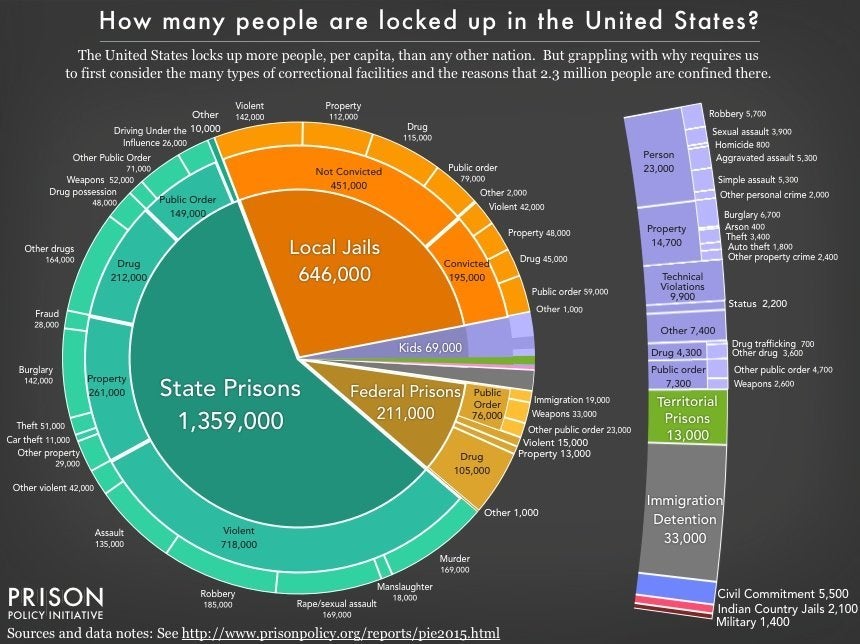
A prisoner costs the same in funding ($150k/year) as 10 school children ($15k/year). The two million inmates in america cost the same as educating 20 million kids -or increasing funding foe x number of kids who need it most-. Further questions: is the work mandatory? Or is it optional for those looking to shorten their sentence?
Is there any data on how much these prisons are making from such labor?
Also, this term "for profit" is thrown around a lot, suggesting there are perverse incentives. That seems true, but I imagine government-run prisons are prone to corruption as well.
If we want such private prisons to improve is it possible to pass legislation for what the minimum standards should be and regulations for ensuring they are met?
So yet another example of the state subsidizing corporations - pay 150k/year for an inmate, and force them to work for a company who gets to keep the profits.
> The ACLU also found that more than 76 percent of incarcerated workers surveyed by the Bureau of Justice Statistics say that “they are required to work or face additional punishments such as solitary confinement, denial of opportunities to reduce their sentence, and loss of family visitation.”
> A prisoner costs the same in funding ($150k/year) as 10 school children ($15k/year). The two million inmates in america cost the same as educating 20 million kids -or increasing funding foe x number of kids who need it most-.
But there is no evidence that increasing educational funding for children will have any positive effect. The correlation between educational funding and educational outcomes in the US is already negative.
So let me make sure we are clear on your position on this — you think 150k per prisoner sounds like a reasonable number? To me that number seems to be about a magnitude of order wrong. I bet you could do some back of the napkin math, multiply that number by 5, and it would still be way under that number.
To me, when I see 150k, I don’t see a cost — I see a facade.
So you choose one prisoner for 168 hours a week instead of 10 children for 35 hours?
Homicide is not insignificant for state prisons (around 15%). Violent crime is over 50%. And mental illness is a huge problem in prisons. Would you care to take the chance of who you get in this?
Right, but that's not how that choice is framed in reality. The people watching prisoners in fact don't make anywhere near that much, because a lot more goes into the cost than wages of a single person watching a single prisoner 1 on 1. People still do the job. Teachers don't make $15,000/yr/student, either, for similar reasons. Your whole line of inquiry (I guess that's what it is?) doesn't make much sense to me.
[EDIT] and that's beside the fact that it's irrelevant if you're looking at "what could we have bought for this instead". No bearing whatsoever.
So, you're aware that when I as this question, all the costs associated with the job are in the number. You only take home what you get after costs. Facilities, staff, legal liability, etc. I'm not offering you a job, I'm offering you a contract to fulfill. You can do it at larger scale if you please (say 100 prisoners vs 1000 children for $15mm), go ahead. I guarantee that you could do neither profitably.
The original claim was that we spend far too much on prisoners, and the rationale is that it costs 10x more per prisoner than per student without any regard to the actual costs and complications of doing each job. The fact is that prisoners are fundamentally that much more expensive to manage. And if society requires some violent and antisocial subset of the population to be removed from the rest of society, then this 10x cost is justified as far as I can tell. I'm offering the geniuses of Hacker News an opportunity to show that they can do it for less, since they seem to know better on this topic.
The original post just highlighted the very high cost of imprisoning people relative to other things one might do with the same money. I see no suggestion in it that it ought to be cheaper, though there's perhaps an implicit suggestion that the US might want to reconsider having the highest per-capita prison population on the planet, since it's so expensive.
> I see no suggestion in it that it ought to be cheaper
So, it's both "so expensive" and there was "no suggestion that it ought to be cheaper?" Cool. So, what in his inkblot of a post did you read as the solution to keeping violent criminals from subjecting society to their violence?