Implying they don't have like 3 or 4 "models" (different quants, post training, plain renaming) on the back burner at any point in time to do exactly that
I ran a battery of tests against a couple of simple prompts to check on thoroughness and verbosity of every available Opus, and 5.5 is a lot closer to 5 than people are letting on. 4.6 remains the best in terms of getting to the point and just doing what you ask. I had switched from 4.7 to 5.5 as my main claude model, but started running into the telltale over-interpretation issues of the 5 series, and have switched back. Something in their RL pipeline has made these models consistently worse IMO.
I see. One of the biggest issues I had with 5 is that it constantly made mistakes calling tools and making API calls that even lesser models didn't struggle with. Mistakes were crazy high.
My main grievance is that any gap in specificity in my statement of a task would lead Opus 5 to invent an interpretation to fill the gap, frequently creating lots of extra work for itself in the process, and often deviating from my intent. This would happen even for very simple things. I once asked Opus 5 to fix a failing unit test in CI (something pretty simple), and it went off on a 45 minute expedition (all in one turn), read a boatload of unnecessary files, massively overcomplicated the assignment, etc. It fixed the test but previous models would have handled this much more straightforwardly.
A common form of this failure is the model picking up on random wordings from earlier in the session (e.g. some comment it made to me in the middle of a response, that I never explicitly endorsed) and then treating these as hard commitments. Or over-interpreting a specific word choice or clumsy phrasing as if it were a "load-bearing" constraint on the task.
None of this clumsiness would be so problematic if the model didn't have such a strong drive toward autonomy. It's much like with people: there's no shame in not understanding what you're being asked to do, provided you ask clarifying questions. There's no shame in ignorance if it's wedded to curiosity. Benchmaxing has RLVRed curiosity and clarification straight out of these models. It sucks.
Pet theory: 70% of what we're busy with brings no value outside of keeping people busy/employed, which means automating it and making it 100x faster also brings no value in the end, no matter how much "intelligence" you can deploy
An economist might counter that any such business would loose market share. But, in actuality, a lot busineses are not competing for survival or even for market share but have it due to entrenchment. examples include: ISPs, healthcare, etc
On the one hand this leads to the mediocre world we live in but on the other hand, thank goodness that these businesses exist. Imagine if every company were run like Tesla/SpaceX. You thought the horrendous birth rate in China was bad...it would be nothing compared to this theoretical world everybody is always in dog eat dog jungle survival mode.
I was reminded about how delusional people are when I was hanging out with some MAGA supporters in the south this weekend. These people adore Elon Musk and what he's done and the way that he runs his companies. They get this mentality because they work in government where their jobs are very cushy, but there is a lot of incompetence and bureaucracy going on, and they hate it. I honestly believe they wouldn't enjoy living in a world where Elon Musk mentality is running everything, including their jobs. That delusion makes them think that a world where Elon Musk is running everyone else's job is better for them.
I'd argue that of the people that Elon hires, many of them probably grew up in an environment where they had the support, love, and care that they need to become great because their predecessors worked in occupation that are not competing for survival. Else you end up with situations like China where the youths just don't have the ability (due to time, money and energy) to put down roots and build up the next generation. Their predecessors planted the seeds and nurtured them to grow value that is then extracted by Elon working the people into the ground and tossing them aside when they are no longer useful.
You can have cutthroat competition between companies and good working conditions, in fact more competition raises demand for labor so workers get more bargaining power. If employers are in survival mode they hold on to experienced workers at all costs and desperately try to attract new ones.
The problem in China comes from a concentrating economy and corrupt government that barely enforces labor laws. Demand for labor is not low but the number of employers is, so if you want better conditions and get rejected or fired you have nowhere else to go. America is on the same path.
>If employers are in survival mode they hold on to experienced workers at all costs and desperately try to attract new ones.
Can you give some examples? A company in survival mode can just as easily freeze hiring, cut benefits, and squeeze the people it already has. Needing experienced workers doesn’t mean it can afford to keep them.
Spirit is the example that bothers me. I’m biased because I loved flying with them, but former employees often describe good pay and working conditions alongside those cheap fares. How do you sustain that when costs rise and there’s barely any cushion for something going wrong? The big airlines have their credit card and loyalty businesses to lean on. What happens to a company trying to compete mainly on affordable flights?
My concern is that treating workers well costs money, and customers generally choose the cheaper or better product. What keeps a company that cuts corners from undercutting one that takes care of its employees?
I asked something similar at a HOPE talk recently about a worker owned software consultancy. Their answer was basically that everyone shares the pain when business gets rough. That sounds reasonable, and I want that model to work. I’m just not sure how well it scales.
>Demand for labor is not low but the number of employers is.
I also don’t think “too few employers” explains China very well. Look at the brutal competition among Chinese car companies, or in coffee, restaurants, and consumer goods. There can be plenty of competing businesses without workers having much leverage, especially when applicants outnumber the jobs available.
Weak labor law enforcement absolutely matters. But I don’t see why fierce competition and bad working conditions couldn’t reinforce each other. “We have to survive” can become the excuse for demanding more from everyone.
I want companies to improve their products while paying people well and treating them decently. I’m questioning whether competition alone gets us there. What makes employers compete for workers by improving conditions, instead of competing for customers by squeezing workers harder?
Some sectors are less productive, but the reality is more mundane: only about 30% of the global workforce are knowledge workers. Adopting AI in real workflows takes time, and that time saved might not be used productively. Also solving Millennium problems is an amazing feat of engineering and mathematics, but doesn't change people's lives that much.
If you look at computer chess it improved steadily, there was a bit of a fuss when it beat Kasparov, then it kept going. People still play each other at chess much as before.
I figure it'll be like that with general intelligence - bit of as fuss as AI overtakes but humans will keep on humaning, making things, competing for status. Maybe like Jeeves and Wooster with us as Wooster and the AI as Jeeves. Most of their activities didn't bring much value apart from keeping people busy. AI will probably keep improving a few IQ points a year, not exploding but gradually getting pretty good.
For me the more interesting sci-fi is the merge / immortality stuff, curious how that goes.
There is a name for this phenomena. It is called bullshit jobs[1]. The author David Graeber who coined the term argued that over half of jobs were bullshit jobs, so your 70% estimate is not far from what some actual scholars in the field also estimate.
Always a good read, most cancers are environmental, and most of these are caused by obesity, bad diet and smoking/drinking, fix these four things in your life and you reduce your chances of getting cancer by 50%+
I don't think that anything you said is wrong, but I also think it's important to note that on a long enough timeline your odds of getting cancer are 100% regardless of the way you live.Most people just don't live that long.
The things you mention here make it happen sooner, but no amount of healthy living lowers your risk to zero and I think that's important to note when you say things like "cancer is caused by".
Cancer is caused by math. This stuff just steepens the slope.
I hear you, but I also think it is this kind of attitude that leads a lot of otherwise intelligent people to not even try. I've talked to people who listened to the Maintenance Phase episode on the complexities of calories in/calories out take the information as an excuse for not even attempting to try to improve their weight problem.
I think this is one of those areas where the translation from research to the public ends up too precise on the details, beyond the cognitive load most people are willing to commit to it day to day.
In the same spirit of upāya from Buddhism, I like to compress this type of topic into a simpler model, even if imperfect.
Here's how I model cancer, and how I judge whether something is likely to give me cancer, without trying (and failing) to memorize a million risk factors individually:
You are a collective of cooperating cells. When cells rebel, the order that holds your body together collapses, and you get cancer. Cells generally don't want to rebel. They're content as long as they get their energy, their paycheck.
But what about activities that cause frequent cell death? A sunburn, smoke in your lungs, alcohol in your bloodstream, radiation (essentially atomic shrapnel flying through your tissue). Anything that causes inflammation, especially chronically. When cells die before their expiration date, the survivors have to keep dividing to replace them, and they start to get pretty mad about it. Maybe even rebellious.
With every round of division, they are in essence "evolving" away from their cooperative nature to cope with a hostile environment. A cell doesn't care whether the collective lives or dies, and it doesn't have the capacity to reason about that in the first place.
So the question becomes: are you keeping your cells safe? Are your activities hurting them? If they're not happy, they'll rebel, and you'll die.
This is where the model earns its keep. Take obesity. It's on every risk list, but excess fat isn't what makes cells rebel. The real culprits are the conditions obesity creates: chronic inflammation, more cells that need to be maintained and replaced, a body that is generally harder to live in.
Weight loss is on the list because it's the easiest way to fix those conditions, not because thinness is protective in itself. Once you see that, you don't need the list. Anything that makes your cells' lives harder, day after day, is raising your odds, whether or not anyone has published a paper on it yet.
The math is real, but a model like this tells you which variables you actually control.
> Couldn't your odds of developing a cancer be sloped to effectively zero if the odds are such that you are very likely to die of something else?
Are you sure that people should try? Will they live longer, or happier lives if they do?
From 1900 to 1950 the average US life expectancy went from about 47 to roughly 68. Penicillin and sanitation did most of that.
From 1950 through present day we added another 10 years. What most folks don't realize is that:
- 70% of those gains, or 7 out of the 10 extra years, came from cardiovascular health. Mostly because we got better at surviving heart attacks, and people smoked less.
- 19% came from infant mortaility gains (2 of the remaining 3 years of gain).
- 11% came from EVERYTHING ELSE that people did to become "healthier." So 1 year.
The US spends $5.3 trillion per year on healthcare, give or take. That's about $15.5k per capita every year. It's roughly 20% of the total GDP of the United States. That's 2 out of every 10 productive dollars going towards healthcare.
In exchange for 20% of every hour you work for your entire adult life you get 1 extra year at the end of your life.
In exchange for constantly worrying, exercising, staying up to date, eating right, etc you buy yourself one year more of life, and it's not even going to be a GOOD year. It's going to be one more year of being 80+ years old with everything hurting and constant medical needs.
Is it really worth 20% of the money you make every year for you entire life to live one extra, shitty, year?
I just don't think people have done the math on this one.
This I can get behind. Quality of life is worth something. Is it worth 20% of the GDP? No, but it's not where we spend those healthcare dollars anyhow. We spend them on trying to extend the lifespan by one miserable year via end of life care, mostly.
There are a lot of medical problems that can make life miserable that won't kill you that are excluded from your simple objective of "how many years am I breathing."
> It's roughly 20% of the total GDP of the United States.
As of 2025, it is more like 18%. For other highly developed nations, the average is about 12.5%. I think a lot of that difference can be explained by the very high salaries paid to medical workers compared to those other highly developed nations.
> In exchange for 20% of every hour you work for your entire adult life you get 1 extra year at the end of your life.
This isn't a very apt comparison. Think about it a different way: How much can I keep if I give up that single year of life?
Not only is this utilitarian nonsense, the "math" here is full logical nonsense.
It shocks me how anyone could string this pile words together and think they sound like anything at all.
> "2 out of every 10 productive dollars"
As if those dollars have anything to do with the time people work, or that they would get those dollars and time back by not caring about health.
As if the tiny portion of those dollars that actually gets spent on patient healthcare isn't dominated by end of life care.
The US healthcare system spend is so far divorced from whatever idea of "productive dollars" anyone has when it's 60-80% admin cost.
The US should not even be mentioned in any conversation about the ROI of health spend.
> The US should not even be mentioned in any conversation about the ROI of health spend.
I would agree with at least this part, if I didn't live here. I'm reminded of the MRI post from a few days back. I think the stat was that Boston had more MRI's than all of Canada combined.
How much healthier are people the United States than Canada - for all that extra spend? I'm fairly certain the number is negative.
EDIT - I googled it. The Canadian life span is four years higher than the average American and they're healthier than the average American when they get there. So, yes, the number is negative.
    > Canada has a total of 432 MRI machines according to the latest official national survey.
    > Per capita: An average of 10.8 units per million people, which is well below the Organisation for Economic Co-operation and Development (OECD) average of 19.4.
And Massachusetts (specifically Boston and Cambridge) has an insanely high concentration due to multiple medical schools and several very large hospital systems.
Real question and no trolling to Canada: How does Canada have such good healthcare, but so few MRIs? My point: Canada is certainly rich enough to buy and operate more. Do they not need them? Does the US just have way too many? (That is my guess.)
A few things.
1) Canada is not as wealthy, per capita, as the USA. Per Google:
> The GDP per capita in the United States is roughly $94,400 USD, compared to Canada's roughly $60,300 USD (as of 2026 estimates), creating a significant and widening economic gap.
2) Canadian healthcare spends less per capita. Per Google:
> The United States spends roughly double per capita on healthcare compared to Canada.
Cost Comparison Per Capita
• United States: Approximately $14,885 USD per person.
• Canada: Approximately $7,301 USD per person (varies by estimates, with public-only spending around $5,000 USD).
• Percentage of GDP: The U.S. spends about 17.2% of its GDP on healthcare, while Canada spends about 11.3%.
3) The USA believes in diagnostic testing at a higher level than Canada. Per Google:
> Utilization and Intensity: The U.S. tends to utilize higher volumes of intensive diagnostic testing and specialized medical interventions.
4) Related: hospitals are private in the USA, and they buy MRI machines to bill for high-margin diagnostic tests. As you noted, the Boston CMA is a world leader in healthcare and education, and thus has a higher concentration of MRI machines.
5) Canadian healthcare simply is not as sophisticated as the health care in the USA. There have been multiple episodes of high profile / wealthier Canadians going to the US to skip waiting for treatment and getting procedures that are just not available in Canada at the present time.
So it's great, it's saved my life a couple times, but it's not a 1-1 drop in for American healthcare. Every system has trade offs, that's the lesson of engineering.
I am not wholly convinced by your reply. If Canadian medical staff are paid proportionally less that US medical staff, then difference in PPP matters little.
> Canadian healthcare spends less per capita.
Due to FX rates and PPP, probably Japan spends the least in G7, yet their public healthcare system is globally outstanding. It has superb quality in the largest cities and surrounding areas (Tokyo, Yokohama, Osaka, Nagoya, Fukuoka, Sapporo), on par with UK's NHS, which the global "gold standard" for cost effectiveness. The key: Don't let medical staff income get out of control. Ignoring truly exceptional medical staff (brain surgeons, etc.), most people in medicine should earn slightly more than middle class. If you can maintain it, then you can really control medical costs. The US is wildly out of control if compared to G7 (and close relatives, like Netherlands, Belgium, Denmark, Norway, Sweden, Finland, Korea, etc.).
1) Worrying about your health is mostly useless and probably won't move the needle much unless you have obvious problems.
2) The United States spends 20% of it's GDP to accomplish nothing. That 1 year of life expectancy gain is probably within the margin of error. Certainly modern healthcare can help at the individual level, but the society is so sick that any gains are washed away by the noise and we spend a truly enormous amount of money to get nowhere.
Our worry costs us a fortune, and generally just doesn't accomplish anything worthwhile.
"unless you have obvious problems" is doing a _ton_ of work. Most people _do_ have _obvious_ problems. Their weight, their cholesterol, their alcohol use, and on and on.
Saying "if you're healthy you shouldn't worry about your health" is a meaningless thing to say. The point is that most people _do_ have obvious room for some kind of health improvement, and as other commenters have pointed out, if it's not in the clear "this will help me live an additional N years" way, then very likely it is in the "this will make my life suck less as I age" way. Eg; Being able to walk up a flight of stairs without getting deeply winded.
You can see my reply to a sibling, but: no, of course not.
However, would I regret not being fit enough to go for a hike in my 60s? That's another story, and it is one which many do have the ability to intervene on.
Treadmill time as an enabler of other experiences may well be worth keeping, even if the time spent on it doesn't satisfy some imagined "will I think of it on my deathbed as time well spent?" bar. I imagine there are a great many things I won't think about on my deathbed which on their own are unremarkable or even gasp not very fun, but that is of course not a reliable measure of whether something is worth doing.
It's also important to note that getting a random cancer at 80+ sucks orders of magnitude less than going out at 45 from colon or throat cancer in every measurable metrics you can come up.
I would heavily disagree with this - it depends entirely on the cancer you get. If it's something slow growing that would take a decade plus to kill you, sure - just trying to treat it would be worse than letting it ride.
But my father died of cancer nearing age 80, (most likely mesothelioma, though we didn't do heavy tests as it was discovered late), and it was incredibly painful and miserable for him. He had fast growing tumors in his ribs, forcing bone to spike out and hit his lungs, the tumors that grew in his lungs caused constant pneumonia and kept leaving him unable to get enough oxygen to his brain to communicate for hours at a time.
I feel your pain, I really do, but I think you missed the point. In almost any metric, if you have to die, it is better to die after having lived a full life than it is to die young.
I used to believe this without a shadow of a doubt, but without the choice to go out on your own accord, I don't know if I do any more after what I saw.
I think the original point was that cancer 80+ is better than cancer at 45, so you should still try to avoid habits that make it more likely earlier, even if the chances remain 100% at sufficient time scales
I don't understand what you think this conversation is about. It's not "die quick and painless at 45 or excruciatingly painfully at 80" it's just 45 or 80. Nobody said anything about excruciating pain except you.
Do you think your dad would prefer to die exactly the same way at 45 instead? No? Great, conversation over.
What an absolutely obnoxious way to respond to someone who was willing to share his experience about a subject as personal and painful as losing his father to cancer.
I don't think it's obnoxious at all to point out that forgoing nearly half your lifespan in order to avoid a painful death implies that you don't value your life much
Maybe it’s that I have young kids, but even knowing my death at 80 would be horrible, I’d choose that over a painless death at 45 in a heartbeat. I’d beg and pray for that outcome.
Unfortunately a lot of us will die in comparable ways if we are lucky enough to get that old. My grandmother was healthy & mentally with it until stroking out in her garden one day at the age of 90. That is the best any of us can hope for and the reality will almost certainly be far more painful and prolonged.
It depends on mechanism, but many cancer patients do deal with a great deal of pain, especially near the end of the disease process. I am sorry for your experience. It is not uncommon.
It is unfortunately a complicated situation that often doesn't have a perfect solution. Without trying to cover every possibl nuance, I'll just say that many end-stage patients have pain so refractory that sufficient doses of pain medication are effectively lethal. This is usually offered, but obviously not everyone accepts.
The truly sad cases are those in which the patient no longer has decision-making capacity and it falls on a family member to make such decisions. When you aren't the one experiencing the pain, it's much harder to weigh that decision rationally. This is why so many providers push patients to establish legal documentation of their end-of-life wishes.
> it's important to note that on a long enough timeline your odds of getting cancer are 100% regardless of the way you live. Most people just don't live that long.
Hmm, that actually parses for me as "it is not important to note" since the 100% assertion doesn't apply to most of us as we won't live that long.
What applies to most of us is that certain behaviors can dramatically increase your chances of getting cancer.
Couldn't your odds of developing a cancer be sloped to effectively zero if the odds are such that you are very likely to die of something else?
A person drunk driving at twice the speed limit in moderate traffic on a dark and rainy night without their lights on in an old vehicle with shoddy breaks and no traction control while not wearing a seatbelt and texting their ex probably has a near zero chance of developing a cancer given their near 100% chance of dieing in the next few moments.
When we talk about factors that reduce cancer rates we normally talk about like-for-like, adjusted for age.
Discussing lifetime risk of cancer without accounting for years lived is not useful.
I don't think it's helpful to point out that everyone gets cancer on a long enough timeframe, because that wasn't what the conversation was ever about.
> I don't think that anything you said is wrong, but I also think it's important to note that on a long enough timeline your odds of getting cancer are 100% regardless of the way you live.Most people just don't live that long.
“Most people just don’t live that long” is doing a lot of heavy lifting there. If you have a healthy lifestyle you would need to live for multiple centuries to reach 100% likelihood.
> If you have a healthy lifestyle you would need to live for multiple centuries to reach 100% likelihood.
Well, 100% likelihood is a bit silly, but the point of the person you were responding to is true -- we will all eventually die of something, and if it's not heart disease or dementia, it will almost certainly be cancer.
The question shouldn't be "will I get cancer?"; it should be, "how long do I want to live a happy, healthy, active, independent lifestyle for?" If you exercise, eat a healthy diet, don't become overweight and keep your blood pressure low, you'll maximise your changes for living well, for as long as possible.
That paper links a random blog post as source for these statistics (reference 9). That's a huge red flag for me and not what I'd expect in a scientific paper. I find the numbers wildly implausible in any case since they only have two categories: hereditary and environmental/lifestyle.
Cancer is caused by random chance. Accumulate enough mutations of the right kind and you get it. Of course you can dramatically affect that chance through genetic factors and environmental ones.
Unless you can demonstrate supernatural causes these are the only two broad categories you need. It's either coming from inside (genes) or outside (diet, random neutrino bit flipping your shit, smoking, x-rays, etc.).
Stress can spike BP due to the higher cortisol level that narrows arteries.
But baseline BP is all about diet, exercise, good sleep routine and avoiding smoking.
Some foods like licorice can elevate BP; the glycyrrhizic acid inhibits an enzyme that deactivates cortisol.
I personally drink hibiscus tea a few times a week which is an ACE inhibitor and is shown to reduce systolic blood pressure by 5-7mmHg. Also the occasional beetroot juice (+ apple and carrot) or magnesium bisglycinate for a 2-5mmHh systolic reduction due to the nitric oxide.
What's interesting is how low alcohol ranks compared to obesity and diet. It makes the recent moral panic following loose interpretations of the Lancet study seem hypocritical, if not misguided. If anything deserves a "may cause cancer" sticker, it's nitrate-ridden processed meat.
Nitrate ridden processed meat already has a “may cause cancer” sticker on it (unless you mean a literal sticker warning when you buy meat from stores?):
I like to drink. With that being said, there are a lot of downsides to alcohol other than an increased risk of cancer. Also, alcohol can lead to obesity and a bad diet. Is it ever healthy to drink? I do not know. I am going to do it anyway though.
No. But drinking every now and then makes so little difference it's not a huge concern. Drinking a lot, though -- that's more problematic.
Like most of my friends around my age, I've cut out almost all alcohol in the last few years. None of us miss it. But it's still nice to drink occasionally, and I'm not going to stop entirely.
There's downsides to heavy or frequent drinking, sure. But since the cancer risk is minimal, what's the downside of a glass of wine or beer a couple of times a week?
I'm less convinced of the negatives of this than I used to be. Humans are quite well adapted to alcohol.
If it's something you enjoy, I'd say go for it, in moderation. It's probably less unhealthy than e.g. living in a city, eating processed meat, or working an office job.
Its all fun and games until you get cancer. I had cancer (and a few drinks) myself, it sucked. Can you ever be certain it was caused by an unhealthy lifestyle? No. Probability and causality is weird tbh.
How sure we are that something causes cancer and how often it causes cancer are not the same. Those WHO classifications are about the former. Usually the two are pretty much entwined, because you can more easily find larger effects. The effect of meats is a counterexample though: because it causes specific types of cancers that are otherwise rare you can be pretty sure it causes cancer even though the effect is not as big as e.g. smoking.
Is there really a moral panic? Apart from a few viral Twitter posts, I don't see a major sobriety push by my colleagues.
Profits of main alcohol suppliers has certainly taken a hit over the last 5 years but this is arguably far more because of rise of remote working, inflation (drinking at pubs have become much more costly than before) and people in general just addicted to their phone rather than going out (similar to the impact on almost all social activities no just going to pubs)
Recent demographic shifts have given rise to a vocally anti-alcohol contingent in large parts of the Western world. There's substantial motivated reasoning.
In the US, there is a large demographic shift on alcohol drinking. What I've seen is not an explicitly vocal anti-alcohol stance. But younger generations just aren't as interested in it. At the very least what they consume is different.
My personal theory is that they are scared of ending up on the Internet when they don't have control.
People are broke. They can't afford the bottle or the place you go to to drink a glass. Or the Uber back/costs associated with a DUI. There's no reason to waste any of that money when you can just stay home and goon.
Of course, there are still people who go out and have a good time, or who grab a bottle on the way home from work. But as with most things these days, there's been a socioeconomic bifurcation that has split the fertile consumerist middle into haves and (mostly) have-nots. And the have-nots aren't bothering.
That's my theory too. When I was in college (late 1980s) the bars had dime beers. It was bottom-end lager and served in an 8 oz cup but still, going to the bars for a night could be done cheaply. Now a drink is $10 and you pay a cover charge even if there isn't a band performing.
What I'm talking about is slightly different than that.
This is more like alcohol apathy - not drinking, but also not explicitly anti-alcohol. That the more generational shift in Gen Z that I've seen. But, those sentiments can certainly change over time.
1. health concerns mean moderate drinkers drink less, but heavy drinkers have not changed their habits
2. young people seem to go more to extremes: either drink a lot or be teetotal.
A common consequence of taking GLP-1 receptor agonists is losing interest in alcohol.
Now, I agree that’s not the only factor — there’s something else going on reducing alcohol consumption even in people who’ve never taken GLP-1RAs — but when you have >10% of the population taking them, that’s another significant factor contributing to falling drinking rates.
> Additionally, all these environmental factors such as X-rays, gamma rays, the radiation emitted from radioactive materials, aniline type dyes, cigarette, free radicals, asbestos, silica dust, air pollution, food additives, various drugs, some of the chemicals used in perfumes, oncogenic viruses and bacteria are playing an important role in cancer formation and contribute the increase of incidence of cancer.
Do the four you cited really cover 50% ?
E.g. moving to a place with less air pollution or better building materials could have a lot more effect than fixing your diet if you're in the average.
Replacing the misnomer class .black-text{color:25% grey} with just {color:black} instantly makes that article so much more readable
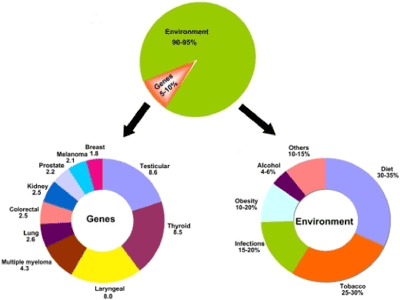
The image is blurred beyond readability, but via tineye.com I found what seems to be the original: https://cdn.ncbi.nlm.nih.gov/pmc/blobs/4f68/2515569/99b99587... It splits out what environmental factors cause cancer. Unsurprisingly, your chance is already 25% lower if you don't smoke, but the rest of the pie chart is also interesting
And gentics. Some people/families are just more prone to cancer than others.
A long while ago i read about this and a link to wealth. Of those families with know genetic problems, the poor ones seems to have actively dealt with the issue internally after realizing the problem. They adopt, have fewer children, or use surrogacy. They cannot afford sickly kids. But wealthy families did not, the best examples being those royal families with known problems.
Personally, my cancer risks went way up when my heavy-smoker uncle died of throat cancer. Going from zero cancer in related family to "some" moved me up the charts.
There is an easy line to draw between the two. "Family history", which includes eating/smoking/drinking habits, follows habitation. Genetics follows blood. So differences between bloodlines easily stand apart from family trends.
Really no, not that many, 5-10% estimated. And I'd not be surprised if a lot of the "everyone in the family get cancers" aren't environmental either (factory next door, working in a field using chemicals, etc.)
No. This is 5-10% are from inherited genetic issues, not environment. And that is the canadian cancer society saying so, not a random website or drug company. 5-10% is a monumental number of cancers. If someone came out with a drug to reduce cancers across the board by 5-10% there would be talk at the Nobel commitee.
I deeply dislike that answer. Its religous tainted by that utopian pseudo-religion ("Glutony punishes the sinners with infinite growth") and a template for the "soft authoritarianism" that is prevalent in the european union. As in: "We know better then you, we will reduce the size of the dice and nudge you to be better with acrylamids in baked and roasted goods- everywhere except coffee "
Synthetic rational religion even replicated hypocrisy in its own way. Cancer is just life going wrong. Its not avoided by being dead while alive.
On sleep I'm not actually sure if they've parsed out whether it's little sleep itself that affects you or if it's little sleep making you not exercise or eat well
I'm wayyyy less likely to exercise if I've only slept 5 hours
Chronic low-grade inflammation is the link between obesity and cancer incidence, so yes, those are not good. Better to be fat and chill (and active) than thin and stressed-out.
I always get a kick out of YouTube and other social media people proclaiming what is "healthy" or not, when we all pretty much know. Eat fruits and vegetables and not too much junk food. Eating too much consistently isn't good for you. Drinking and smoking are bad for you. We've mostly known smoking is bad as a society for a good while now and outside of the old myth that a glass of wine with dinner was good, we know drinking isn't a positive for your health.
And you don't even have to be hard and fast with any of that. Drink on occasion and eat stuff that isn't good for you on occasion and you're probably still getting 95% of the benefits. Not sure about smoking though.
It's very simple at the end of the day. Simple != easy to do. Drinking is fun. People enjoy smoking. Junk food is appealing because it's relatively cheap and tastes good.
The best biohack is to eat like your doctor recommends while we all nod along and silently ignore. Just eat what is widely accepted as good for you and you'll have a good chance at living a happy, healthy life.
In practice for whatever reason I find Luna surprisingly less capable, though. I keep trying, and it keeps failing in seriously odd ways for the coding tasks I'm using it for, in a way that GLM 5.3 Flash doesn't.
I go for weeks without topping up my Deepseek balance, and have to top up my OpenAI balance at least every week.
GPT 6 Luna closed the gap significantly for sure (it seems to be about twice as expensive as DS v4.1 Flash), but Deepseek v4.1 Flash is still the best value model and capable enough for almost everything I need to do. Sometimes if it's babbling or can't nail down a solution I switch to Sol for one prompt, get the solution, then switch back to DS. I use 4.1 Flash almost exclusively though for both planning and implementation these days.
I was a heavy Kimi k2.5/2.6 user but since 2.7 Kimi has gone way downhill -- even the previous models. I think they got under heavy load and had to quantise their models to avoid going broke.
> American AI lost the game already, people just can't see it.
Microsoft has been releasing dog shit insanely overpriced software with decent alternatives for decades and is still used in every single company I work for or with.
Your take is the "current year is the year of the linux desktop" meme of "ai"
You're a decent sized company and wants to manage the SW + security on all your employee's PCs. They need to be able to update/remote SW on your machine remotely, see your settings, etc.
I don't think anything comes close to Microsoft's offerings. Macs suck. Ditto Linux.
It could be a Linux vs Mac/Win situation though. Sure the HN crowd will build their own harnesses and hook up cheaper models but the average Joe Sixpack wants something that "just works" out of box and the frontier labs seems well positioned to give that to them.
The difference is that Microsoft did that while relying on the extremely load bearing windows ecosystem. These AI companies have no equivalent lock in, nothing even close to it honestly.
I can guarantee you 80% of people will call any llm "a chatgpt", most have never heard of claude, even less of opus, or sonnet, "deepseek" probably reminds them of a brand of toothpaste or something like that, "GLM" might make them think of the new mercedes SUV perhaps. 99.9% will never self host, nor send a single sent to a chinese model provider.
I don't know a single company using deepseek internally in any capacity, and I have friends in a lot of tech/tech heavy companies, virtually all of them use claude, the lucky ones get cursor with claude/chatgpt/grok.
Once again, just like your other reply, you are mixing things up- a logical fallacy called the straw man; look it up. Your responses usually use this type of misdirection. Coding agent =/= API.
AI does not mean coders coding with agents all day long. AI integration is mostly for data processing, which is the promise and use of the APIs.
Most people I know working in banks etc are using Co-pilot. Not because it is any good, because it integrates with the entire MS ecosystem - management pushes it. I would suspect that is the main driver of MS's AI penetration numbers for desktop-level non-API usage.
When Microsoft did that there wasn't really any competition and they were also the cheap option. I don't think they would survive if there was a sufficiently good chinese OS at the time.
People use them, if for no other reason, because they are cheap, or are part of the Chromebook generation and have gotten used to it
Of their suite, Presentation and Sheets are the only ones people really have gripes about, Sheets by power users because it isn't Excel and it can never be, and Presentations because it's the ugly duckling of the suite
Huh. I’ve never worked at a company that doesn’t primarily/exclusively use Google Docs/Sheets/Slides. Guess that goes to show we’re really all in our own little bubble.
There’s some weirdness with the UFC’s struggle at the time.
The Fertitta brothers are who actually bought it. Before owning the UFC, Lorenzo Fertitta was on (maybe the head?) of the Nevada State Athletic Commission- the very body who were refusing to sanction UFC events at the time, and the most important governing body in the combat sports world.
Obviously the UFC was hurting bad at that time since they couldn’t be sanctioned, were getting booted from arenas they booked, and were getting dropped by Pay Per View carriers. This decimated their value and the Fertittas scooped up the company for a song.
All of a sudden, now that they owned it, the sanctioning bodies agreed on a set of unified MMA rules, the UFC was re-sanctioned, and they started selling PPVs again.
It was actually quite a success from the very beginning. Their troubles were likely imposed on them by their prospective buyers in order to get the sale done, and all they and Dana White did really were take their foot off the company’s neck.
Agree with most of this but they do deserve credit for the lift off that the UFC saw after the Ultimate Fighter. That was a legit cultural phenomenon for certain demos at the time. Without that, things could have have gone very, very differently.
You may wish to read the thread more carefully, because you are mistaken. If after carefully rereading the thread you still believe you are correct, please explain exactly what part of this sentence:
> “And Zuck’s sudden interest in MMA/boxing/Jiu Jitsu as part of his “alpha male” rebranding”
equates general interest in fitness with being an “alpha male”. Because to me it is pretty clearly referring to the interest in combat sports, not fitness.
That was part of it, back in the early 2000s when people considered MMA "human cockfighting" (but bizarrely, boxing was OK) Trump let the events go on at his venues, however Dana is a pretty formidable businessman regardless of the connection to Trump.
No one has actually said that Dana White is a bad business man. It's just very difficult to believe that's the reason he was appointed to the board of a social media company on the same day that Donald Trump was inaugurated. If he was so consequential why wasn't he named to the board on Jan 7th 2021? I think we know why.
There's been a rightward shift in tech and culture (eg, children identify much less as transger and bisexual than a few years ago), it's likely Facebook is aligning with that.
Zuck spends billions on funding for left aligned causes while spending basically nothing on the reverse. He's a chameleon that merely takes the appearance of a centrist when need be. The money doesn't lie though.
Trump and Dana are close, and when Trump got re-elected, Dana was suddenly added to the Meta board as I think he was seen as a way to influence the Trump administration.
Same as how Clegg was brought in when the EU were on meta's case.