Yeah, it was quite a trip to read this article as a former Etsian (for context to unaware readers: Etsy was a somewhat frequent target of the blog in question here, along with obviously eBay).
I'm not going to pretend we didn't roll our eyes from time-to-time when a new article came out that seemed exaggerated, but the thought of retaliation never crossed anyone's mind.
I'm pretty sure we would've been summarily fired if we had even made contact with Ina, let alone any of the psycho shit outlined here.
I read an interesting explanation on reddit somewhere that posited this is the result of a small group of devoted enthusiasts basically wash trading: They sell the games to each other back and forth for extremely high prices to make it seem like there's an insane amount of demand for them, in order to make that a self-fulling prophecy.
Whether that's true or not I have no idea, but it's certainly plausible.
They don’t even necessarily have to be coordinated.
If you’re operating a business that profits from selling collector items, you benefit from headlines about high sale prices. Spending $1.5 million to juice the market and generate excitement could manufacture enough demand and trade volume through follow-on buying frenzies that you come out ahead in volume sales of cheaper items.
Then you’re still sitting on an asset “worth” $1.5m that you can use to play games with taxes (depreciation?) and also use as collateral to secure cheap loans.
These game prices are no more absurd than a Mickey Mantle card being worth $20-$30 million (1952 Topps Mantle #311 PSA 9 sold for $5 million not long ago; there are three superior PSA 10 copies which in theory should be worth a lot more, two of which are owned by a billionaire).
Consider the global scale and love of video games, Mario, Zelda, etc. Versus the localized scale of Major League Baseball (even if it's in the largest economy) and particularly Mickey Mantle.
So why not Mario if Mantle? It makes just as much sense (however much sense that is, granted).
Check out what new prospects go for in the baseball card world. A Wander Franco card went for $200,000. This is a 20 year old that has barely played any professional baseball, recently got called up with the Tampa Rays, and hasn't hit well so far (and may just end up as a flop, as these guys sometimes do).
So Wander Franco cards make sense, and Mario doesn't? Obviously all of it seems crazy. And yet there it is.
You know what else is really crazy? Tesla's valuation. Shopify's valuation. Snowflake's valuation. DocuSign's valuation. And so on.
Yeah, I know, those are real companies that have products and services. Ok. I posit that many of those valuations are less sustainable than a 1952 Mickey Mantle card at $5m. And we're not talking a million dollars, we're talking trillions of dollars of laughably over-inflated valuations in the stock market. Mario at $1.5m is not crazier than Tesla at $600-$800 billion.
It's all part of the same asset speculation mania.
Millions of people out there are paying obscene prices for stocks and it won't end well. And with stocks it's not just some rich person with a toy hobby (because who really cares what that person burns their money on), it's retirement funds, pensions. All loaded up on Coca Cola at 33 times earnings, for a company that hasn't seen any growth in five years, has mediocre prospects for growth, and deserves half their present valuation at best (now repeat that scenario for most of the garbage-valuation blue chips, like McDonald's or Starbucks; check out the valuation on WD-40 (WDFC), an old slow-growth degreaser/lubricant spray company sporting a 40-45 PE; the entire market is like that now, out of its collective mind).
These are the consequences of perpetually low interest rates, it has bred a rabid culture of speculation and desperation for any yield or return.
I think the reason for the speculation it’s wash trading is that unlike the 1952 Mickey Mantle card, there are presumably a lot more Mario 64 cartridges in circulation and thus the auction price seems out of line for the supply available.
Doing a cursory google search, I can see most used cartridges going for ~$25-40. Is an unopened cartridge worth many more orders of magnitude? Possibly, but it at least raises a lot of eyebrows that there’s something else at play.
EDIT: An analogous collectible is probably more something like a black lotus card, which as far as I can tell has “only” procured 500K at auction for a flawless one, and as far as I can tell inferior versions cost an order of magnitude less (10K or so) but nothing near to the spread here.
> I can see most used cartridges going for ~$25-40. Is an unopened cartridge worth many more orders of magnitude? Possibly, but it at least raises a lot of eyebrows that there’s something else at play.
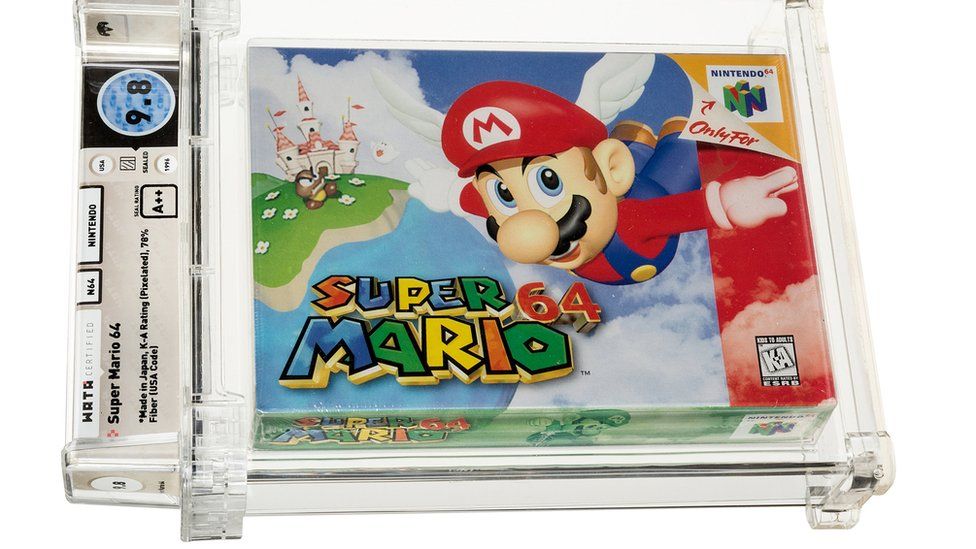
Yes, that's exactly how it works. The unopened package in near perfect condition is considered extraordinarily scarce.
It's the scarcity factor via grading that is being applied. That's obviously a graded Mario 64 package, not just a stray cartridge (of which there are zillions of copies as you note).
The supply, in the collectible world, is thus considered to be exceptionally low. You're talking about a sealed box, top notch grade. There are only a small number of those still in existence.
It's a 9.8, which is a very high grade for a vintage video game box. As far as the collectors are concerned, that's a very scarce item. The value is in the condition of the box and that it's sealed. Without that, you could just buy the item on eBay for ~$30-$50.
You see the exact same outcome in the comics world, for graded comics. And it's identical to the quality + grading = scarcity aspect in baseball / basketball / pokemon cards.
1969 is Mickey Mantle's last year for Topps baseball cards. There are a lot of copies of that card in existence, relatively speaking. You can buy it ungraded for $100-$1,000 depending on the condition you want. If you want a PSA 10 of that card (there are only two)? Be ready to pay $500,000+. That's the same exact scarcity by grading mechanism in action as with the 9.8 graded Mario cartridge, it's because there are not very many of them in that condition.
> These are the consequences of perpetually low interest rates, it has bred a rabid culture of speculation and desperation for any yield or return.
If and when the Fed starts raising rates, valuation on growth stocks (and others too) will come back down to earth. 0% FFR and virtually unlimited Fed support almost do justify some of the current valuations, at this specific moment in time. The Fed could change that though.
It's been awhile since I've taken stats, but people semi-frequently overestimate the necessary sample size needed for even a 99% confidence level.
Depends on the standard deviation for sure, but some quick napkin math suggests that a sample size of ~700 people is more than enough to draw inferences about the entire western hemisphere at a 99% confidence level.
> The competitors to RTSes, games like League of Legends, Fortnite, Rocket League, and Hearthstone... are enjoyable to play across the full spectrum of skill levels.
<citation needed>
I'm mostly kidding, but I do think it's worth pointing out that most (if not all) of those games have been accused of being extremely unfriendly to new players and generally being miserable experiences until you acquire a baseline level of knowledge.
I think the more important part of those games you listed is that they're designed around team play (and thus friend groups), with the obvious exception of Hearthstone (which compensates for the burden of knowledge by having a lot of randomness and a VERY forgiving ladder at the low end).
Getting destroyed in League is fun if you're playing with friends; with strangers it usually just results in a lot of angry messages.
> it is a pretty terrible game to play if you just want to unwind after work.
I think this is really the crux of why games that encourage team play will always win out: It's fun to play with friends, win or lose. SC2 tried this a bit, but at least when I used to play it was very clear that the game was completely unbalanced around team play.
Most of these games, if you want to really succeed, are mentally taxing. You have to pay attention to a minimap, you have to constantly be on the lookout for other people, you have to remember exactly what cards they've played so far.
If you can't counterbalance that with at least some socialization and lightheartedness, it's just work.
Team play is definitely something I missed in my comment which is a big part of the picture. There’s a bit more nuance to it though. Solo queuing a team game can be miserable at any skill level simply due to a lack of accountability for team members. Playing with a group of friends, as you pointed out, can be fun at any skill level.
For competitive games that are inherently one on one, I don’t think it’s necessarily the case that they feel like work. Yes, StarCraft definitely falls into that stressful category. Hearthstone would seem to not do so.
Chess is a pretty interesting example. It’s one where you can have fun games even at very low rating, provided you’re appropriately matched. Low rated games may even be more “interesting” due to volatility in the evaluation, where high level games might be much more likely to result in a draw. Of course, high level players online tend to play a lot more at fast time controls, bringing blunders back into the picture.
I think StarCraft (2)'s pacing and focus on fast 1v1s is its downfall here. Personally, I find both Chess and Hearthstone very stressful because of how much thinking ahead is required. It's analysis paralysis, amplified and gamified. In an RTS, you're generally not working at that level of strategy and have a much smaller state space to search through at the tactical level.
Fortnite, Hearthstone are much more fun/chill compared to starcraft even at lower levels.
I think part of it is does has to do with how real time rts you have practically zero downtime. It's always improve economy, then improve army micro, then do builds. Even with league of legends there's some downtime when you're at the shop or just killing minions.
It's interesting you say that. I don't know if it's still the case, but Hearthstone used to have a decent amount of random effects (other than just basic card draw RNG). A big complaint at the time was that the randomness felt really awful if you were on the receiving end of an opponent's good luck.
Sometimes it felt like a chess match where you had executed your strategy perfectly, but randomly three of your opponents pawns turned into queens.
I get that you're talking about something more subtle than that (and maybe more akin to just, well, card draw RNG) but it's a delicate balance because it can also feel really bad for players being on the receiving end of randomness.
I'm not a fan of the randomised experience really, but it's one way to balance the game a bit.
The best equaliser I've experienced was the handicap in Quake 3. I can have a great balanced match with people both better and worse than me, having lots of fun. Even if without the handicap the matches would end with scores like 30:1. I'm not sure how that would work for RTSes though - handicap on movement speed? amount of gained resources?
Eh, I'd say the campaign of WC3 was a pretty big focus, or at least Blizzard clearly considered it one since it formed the basis for a lot of WoW's storyline.
Hmm, I think the idea is a bit reductionist but given that his definitions stem from those characters I don't think you've chosen great examples.
Ryan, Jan, and later Kelly are definitely "sociopaths" by the article's definition (if not by, well, psychological standards).
Jo (Kathy Bates) straight up says her primary reason for getting married was to attain wealth and power.
David Wallace is seemingly very nice, but the articles explain how he repeatedly sets up "heads i win (and you get a kudos), tails you lose" scenarios. Robert California does this as well, and often in a much more obvious manner.
Michael Scott is his epitome of "clueless", who will never advance past middle management (and we see this play out several times). You can call it the Peter Principle too, if you want. You can throw Andy and Dwight in there too. None of them has the stomach to truly put themselves above everyone else (not even Dwight).
I'm not sure if there are other episodes, but there's a big hint in an episode in season 4 that Michael is much more astute than he lets on:
During the episode where Michael goes out to do a "survival show" in the woods (ala Bear Grylls). Jim is the temporary manager while Michael is gone, and he tries to combine several staff birthdays which are close together into one big celebration. It backfires terribly.
When Michael returns and Jim expresses his relief, Michael explains that he made the same mistake Jim did once and explains that the decision to celebrate the close birthdays separately is a very deliberate one. He also implies that Jim is very much on the same trajectory as him.
He then makes a "That's what she said" joke randomly, and Jim basically replies "Uh, what?" and Michael explains that he makes dumb jokes often to just break the tension.
It's a pretty lucid moment for an otherwise often opaque character, but does imply that Michael's quirks are a result of his staff and not in spite of them.
That shows he's learned from a few mistakes, and it's well established in show that he was always pretty good at being a bullshitting salesman to close deals for mundane purchases like corporate paper (perhaps before his mind went a bit foggier with age). It doesn't outweigh the 10 times per season his bad choices did damage to the company, morale, or someone's life.
Honestly, that’s pretty out of character for Michael Scott. For a character who otherwise repeatedly makes the same mistakes over and over again, to show even that tiny bit of insight is a pretty big plot twist that maybe he’s not completely the bumbling oaf he lets on.
I’m not saying he’s secretly a Machiavellian genius, but his stupid antics belie what seems to be a pretty high emotional IQ at times (in sales and management, at least).
Yeah, I mean of course that’s a possibility. I looked it up, and apparently Steve Carrell wrote the episode in question. It’s not too wild to imagine that he used the opportunity to present his own character as more than just a bumbling oaf.
But then again, Michael having an inconsistently high emotional IQ is a recurring theme. When he’s in “sales mode”, he’s really good at making an emotional connection with people and making them feel like they’re buying from a friend.
I dunno. It’s an interesting conundrum the series presents and obviously doesn’t dig into too deeply since it’s a sitcom. Michael is sometimes unnaturally attuned to someone’s feelings and other times extremely oblivious to them.
Yes? Companies do this all the time with codes of conduct and nobody really thinks twice about it.
Nobody would think it's bizarre that (hypothetically, I don't know what their actual rules are) Coca-Cola has a rule barring employees from wearing a "Pepsi > Coke" shirt to client meetings.
> where we try to legislate for things that are in many cases subjective?
We do this all the time, even in our actual legal system.
"Disturbing the Peace" is one example off the top of my head of something that's incredibly subjective that we consider the purview of the legal system.
>"Disturbing the Peace" is one example off the top of my head of something that's incredibly subjective that we consider the purview of the legal system.
That doesn't mean it's a good thing. Good laws (especially criminal laws) should be normative, i.e. it should be deducible for anyone which behavior is punishable. Laws not adhering to this principle are ripe for selective enforcement and have no place in a rule-of-law society.
This is going off on a tangent obviously compared to the OP's point (that the legal system doesn't try to control for subjective behavior, which is incorrect), but sure, I'll indulge.
> That doesn't mean it's a good thing.
I don't think this is a popular position, or even a necessarily logical one. There are a great deal of "I'm not touching you" type behaviors that society collectively despises and often falls under these catch-all categories.
Legal doctrine is rife with "reasonable person" standards as a result that would be impossible to codify thoroughly and properly. Obviously, the mythical "reasonable person" doesn't exist and is often a judge or jury left to subjectively decide.
For example, harassment laws sometimes rely on a "credible threat of violence" based on something that would "make a reasonable person afraid for their safety". Good luck enumerating all the possible definitions of that.


I'm not going to pretend we didn't roll our eyes from time-to-time when a new article came out that seemed exaggerated, but the thought of retaliation never crossed anyone's mind.
I'm pretty sure we would've been summarily fired if we had even made contact with Ina, let alone any of the psycho shit outlined here.