That’s true, but Zen1 TDP is a lot higher than an RPi. Hitting that level of performance in a power and heat envelope that works for a Pi probably demands a smaller process node, unfortunately.
It's a balance, many of these cars can accelerate and decelerate very hard so the time to get back to the full speed for the next section is fairly short reducing the effect of slowing down. The effect of taking a too wide racing line though means a large multiple in the distance travelled.
In ideal scenarios without having to account for other racers yes generally. In reality it's a difficult to talk about mix of driver skill, mechanical car performance and race strategy that determines the actual best line at any given moment though there is still one fastest theoretical line through a corner.
On race strategy it's rare for drivers to be pushing their cars to the limits for entire races because tire wear and the stops required to replace them is a major time sink because you can only drive so fast in pit lane so even the 1-2 second stops F1 cars go through today lose drivers position that then has to be regained using the extra performance fresh tires provides.
Then driver skill can put the better driver in the correct position to take the correct line more often when you include other cars in the mix and they also know better how to deal with suboptimal routes (eg being force to take an inside route by traffic so you have to know how much harder you need to break to not wreck into another car).
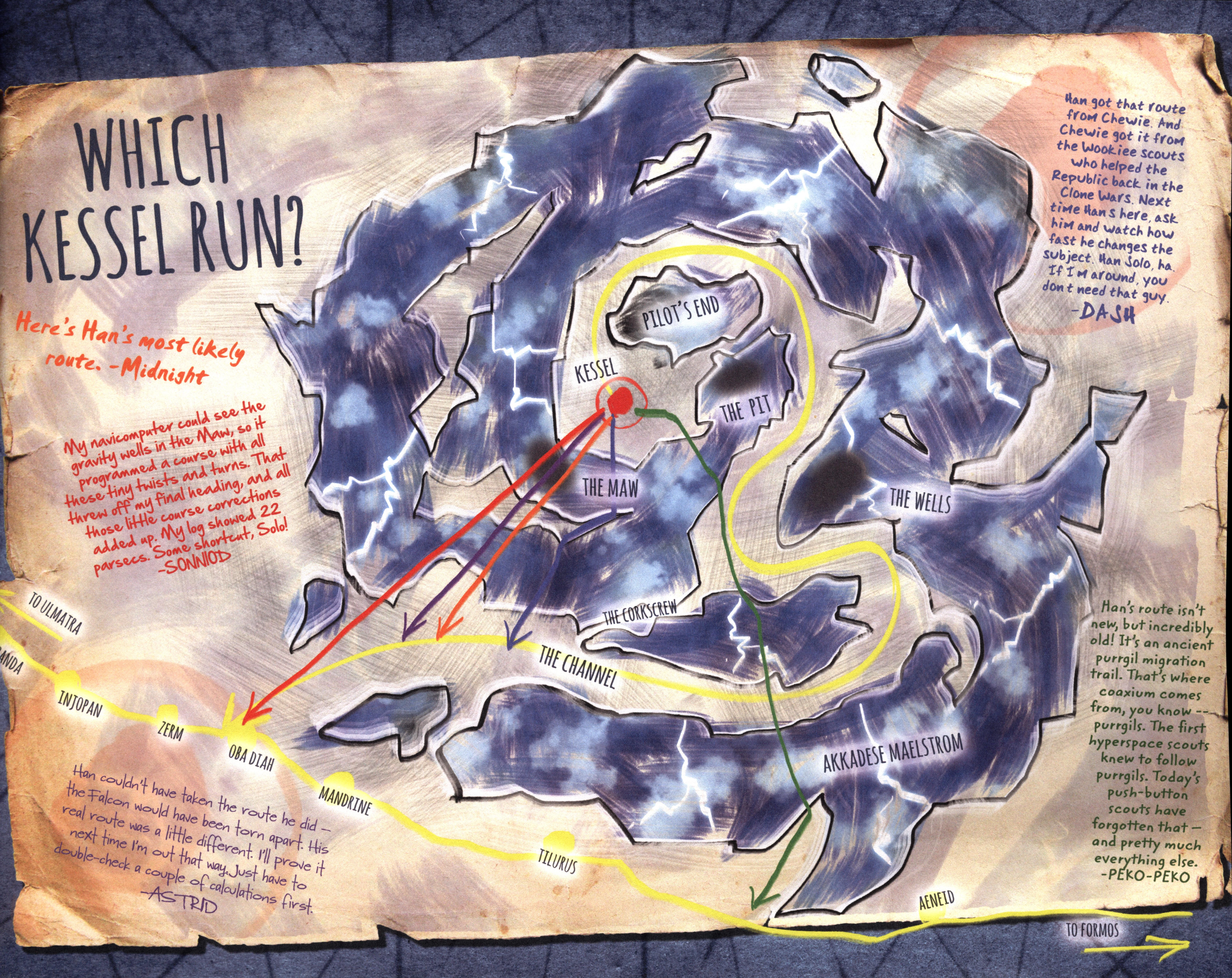
On an unrelated side note because I'm just personally annoyed by the 12 pArSecS!? misunderstanding. The 12 parsec run is impressive because Kessel is in a part of space ridiculously dense with hazards so the usual route to it loops through a narrow region where it's relatively safe to travel through. Han's 12 parsec run cut through the dangerous parts through either luck, superior navigation, or he was just lying the commentary is mixed. [0]
They call that the geometric racing line and it might minimize the amount of time that it takes you to navigate one specific corner but if the corner is a hard braking zone followed by a long straight, your exit speed will likely be lower which will cost you time all the way to the next braking zone.
Many states allow a state tax deduction for 529 contributions, which could net you up to an 8ish% discount if you’re in a high tax locality (e.g. NYC).
Yeah, I just did a project at work with an RP2040 and was really impressed with the Pico SDK. It hits a sweet spot in between ST’s insanity and Arduino’s easy-but-not-powerful tradeoff.
No crazy code generation, going from 0 to blinky is quick, but also going from blinky to DMA’s and interrupts is also a breeze.
I will say that I think the hardware peripherals in STM32’s are miles ahead, and PIO’s don’t necessarily make up the difference.
Yep the STM32 has certain advantages, even if they are usually complicated to program. With the Flipper Zero I programmed a low level timer interrupt and had to setup don't know how many registers... And the documentation is lacking. Also I love the fact that the STM32 comes in 5v variants that are great to interface it directly with things like a Commodore 64 or a Spectrum.
There are two completely distinct differences that jump out to me initially that I think may help justify your feelings:
1: Reading a long book demands focus on a longer timespan than scrolling TikTok, and with focusing on a single thing for a long time, we get a sense of accomplishment. I don’t know how to justify this as valuable, but for some reason I feel that it is.
2: The Song of Ice and Fire (and GoT) were consumed by a huge proportion of people, and you now have this in common with them. This act of consuming entertainment also grants you a way to connect with other humans - you have so much to talk about. Contrast that with an algorithmic feed, which is unique just for you - no one else sees your exact feed. Of course, there are tons of people that see some of the same snippets of content, if their interests overlap with yours, but it’s not nearly as universal as having read the same series of books (and there’s much less to talk about when you’ve seen the same 17-second short form video than when you’ve both invested dozens of hours in reading the same series of books).
I don’t think these thoughts fully justify your belief, but hopefully they provide some support to it.
I think the point 2 will rub many people the wrong way (me included) though. That would make reading Fourth Wing or Twilight a more connecting experience than most classics. (Nothing inherently wrong with that, but... you know...)
The classics were classic because they were the most available and the most popular stories of their time, and they meant more in an era where creating and disseminating media was difficult. I love to romanticize a world where we go back to the classics to connect with our past and present better, even if just for the sake of efficiency. For better or for worse media is more ephemeral which means getting to a common vocabulary is one step removed. It's really a fun time to be alive.
The thing is that literature, and art in general, should be more than just entertainment. It should edify the reader, communicate some concept, moral lesson or keen insight about the world.
Remember when you were taught to extract the "moral of the story" in school? That was the whole point. That form of communication is what makes art valuable and it definitely is what makes some art more valuable than others.
I've been watching these videos for about an hour now.
I really want to call this the "Suno moment" for AI video.
Prior to Sora 2, you had to prompt a lot of clips which you then edited together. You had to create a starting frame, maybe do some editing. Roll the dice a lot.
Veo 3 gave us the first glimpse of a complex ensemble clip with multiple actors talking in a typically social media or standup comedy fashion. But it was still just an ingredient for some larger composition, and it was missing a lot of the soul that a story with a beginning-middle-end structure has.
Sora 2 has some internal storytelling mechanic. I'm not sure what they did, but it understands narrative structure and puts videos into an arc. You see the characters change over the course of the video. They're not just animated Harry Potter portraits. They're alive. And they do things that change the world they're in.
Furthermore, Sora 2 has really good "taste" and "aesthetic", if that makes sense. It has good understanding of shot types, good compositions, good editing, good audio. It does music. It brings together so much complexity in choice and arranges them into a very good final output.
I'm actually quite blown away by this.
Just like Suno made AI music simple and easy - it handled lyrics, chorus, beat, medley, etc. - this model handles all of the ingredients of a 10 second video. It's stunning.
Sora 2 isn't the highest quality video model. It doesn't have the best animation. But it's the best content machine I've ever seen.
I can see this, it's extremely impressive from a technological standpoint, and I've already been caught by the first convincing fakes on Reddit (an army person giving an anti-Trump speech). But I'm also worried, as it's a super easy channel to create convincing fakes, mass produced 'content' for mass consumption, etc.
Now these things aren't new, fake videos / images go back decades if not a century. But they took some effort to make, whereas this technology makes it possible for it to take less effort than it took for me to write this comment.
Of course, it's always my choice; if I stop visiting Reddit and touch grass instead it really won't affect me directly.
Maybe some MAY end up in compiliations in ten years, much like Vines do today. But there will be a million times more tiktoks and a billion times more AI generated videos than there were vines, so if 0.01% of vines became memetic, the amount of AI generated ones will be infintesimal.
Content is all ephemeral on some time scale, but you can cache the near-term content to maximize the views and cut back on compute costs. Some model or human made it (the cost), it's trending (the value), so keep it around for a bit.
Everything has a relevancy and penetration decay curve.
The funny thing is, I think this law applied in the classical era (1950's, 1990's, etc.), we just weren't creating at scale to realize it.
Maybe it's just one dominant variable: novelty. I'd be curious to see how we might model this.
I think that short film is AI generated. I only watched like 30 seconds of an office scene in the middle but it spontaneously changed from daytime to nighttime with zero explanation.
He says it's not: https:/x.com/jasonjoyride/status/1973164183798816773
>> How do you get HD renders? im getting like super low res shit
>It's because this isn't AI
I haven't watched the film, but the premise is something about an orbiting space station. I could easily imagine scenes featuring rapid day/night cycles like astronauts experience on the ISS.
If you've read the classics, then you will likely find a circle you can connect too. I've gone through "The Malazan Book of the Fallen" and it's a signal to know who are truly in epic military fantasy.
I know, I live in such an European country, but I still know (and use) "." as the decimal point. Most people I know here do, too, and they are not in IT. I think it often depends on context, too, and I would like to think people just know.
I just checked, my bank uses "." as the decimal point, too, instead of the official ",".
I get that people can be flexible about understanding that `.` and `,` do not have a stable definition especially in an international world, but I would have thought that 50.000 EUR in context would clearly be 50 thousand. Who specifies cents with 3 digits?
I have seen it in many different places. At some I had to figure out what they really meant.
My bank is inconsistent, by the way. It uses "1234.00" where the last "00" is the cents. It was "1.234" in the same SMS. In another message (same bank) it uses "12,34". Weird. Although in the last case it might be because it is EUR, not HUF, but they are still very inconsistent.
If you turn on localization on your PC, it will use "," instead of "." (in MS Word, definitely) for decimal points though, but as I was saying, in practice (and in real life), "." seems to be the common standard still for the decimal point, it seems, even though officially it is not.
> Hungary uses a comma (",") as the decimal separator, not a period ("."). In Hungarian, a comma is used to separate the fractional part of a number from the whole part, while a period or space is used to group digits in thousands. For example, "one and a half" would be written as 1,5 in Hungarian.
Real life would beg to differ, however. My bank uses "." instead of ",", and I have had the same experience elsewhere, too. In IT, it has always been ".", too.
It is all over the place (pretty inconsistent), but I just checked my appointments to physiotherapy (printed on paper). The format is "YYYY.MM.DD", close enough. :D
From what I recall, I see this format a lot. That, and "%Y. %B|%b. %d". The latter may be the most common? I am not entirely sure. I do not mind these two formats. I have an issue with formats like 2025/05/09 and the like. Is it May, or September? It is ambiguous. Thankfully they are not common here, AFAIK.