You're obviously correct in the de jure sense, here. But there is also a matter of relationship expectation.
An unstated assumption of using any "free" product is that it's not actually free. Canonical screwed up, to be sure, but I do think many of us just expect getting harassed by salespeople to be the cost of using a "free" product.
Microsoft, on the other hand, charges me by the hour for using Azure. They've taken their pound of flesh, so my business expectation is that I'm going to be left the hell alone for anything other than billing matters. Them sharing the data in the first place, for something I've paid money for, FEELS like the bigger violation to me.
For a linux distro, my expectations are that it's "free" but support will cost you money. My expectation is not that it's "free" and the OS will spy on you and report back to HQ so sales can make more sales.
If I don't give personal information on installation my expectation is the product is not harvesting or forwarding that information (For example, I expect that with Facebook, I don't expect that with GIMP).
Both are certainly wrong IMO. MS for giving personal info to a 3rd party and Canonical for bundling spyware with their OS. Both are super icky.
Well, in the case it's not from the OS, but purely from Azure.
And you're selling the information in order to get tech support from Canonical, otherwise you can get it without selling your info (but won't really receive tech support).
As an aside, "pound of flesh" doesn't mean "payment", it means "something that is one's legal right but is an unreasonable demand (esp in the phrase to have one's pound of flesh)", both in Shakespeare and in current usage.
Unless you feel Microsoft's price is unreasonable and you have no other option, "pound of flesh" isn't the right expression.
Something like "they've taken their cut" is more accurate.
Maybe I'm too old, and stuck in the mud with the pre-ICANN intention of the original TLDs, but does it seem odd to anyone else that they host their network services on .com and their corporate information on .net?
Your comment sent me down a research hole. Turns out, stock ticker symbols can be reused but I can find no evidence that NET was used before, which seems impossible.
Cloudflare.net is behind Cloudflare, but the actual site is hosted by Q4. They provide hosted investor relations portals for a bunch of publicly traded companies.
Putting it on a non-cloudflare.com domain puts it outside the security context of the main site and they don't have to worry if it gets hacked. Google does something similar by hosting third-party stuff on withgoogle.com and a handful of other domains.
I've read some non-mainstream theories that economies based on cash accounts and equity-only investments are possible. Some would argue that equity-only investment arrangements are better for society, as they align interests between capital and production in a way that recourse interest lending cannot.
You can already see some fintech startups attempting equity-based home "loans", in which the "lender"'s lien is on a percentage of the future sale value of the home, not a fixed dollar amount. It will be interesting to see how this develops.
I'm not sure how financing on consumer debt like credit cards and non-commercial vehicles would work, though. Perhaps discouraging consumer profligacy would be a feature, however, not necessarily a bug.
IANAL, but my understanding is that obstruction of justice via spoliation, tampering, or destruction of evidence is a charge that requires your investigation to have already begun, the raid to have already started, or the arrest to have been made, and that you are free to destroy any of your own property prior to these events.
Specifically, you need to knowingly be the subject of an investigation. I'd assume destroying the phone when you see the cops coming but before you've seen the warrant would be a grey area. Please, lawyers, clarify.
I suspect that a judge/jury would not be sympathetic to a complaint along the lines of:
"I had no idea I would be under investigation when I saw the cops arriving at the door. I just decided it'd be fun to beat the shit out of my laptop with a hammer at that exact moment."
Yes, but retail is going to get destroyed in the end.
The power elite always get what they want. Right now there appear to be curbs on GME and AMC buy orders for TD Ameritrade and Schwab customers.
If you have to pull strings with your drinking buddy from Dartmouth to blow up a bunch of propertyless zoomers in order to prevent a margin call on the account you've leveraged to buy your house in the Hamptons, then that's what you're going to do.
This is absolutely fucking ridiculous. Someone is getting fucked by their own leverage, they got caught, isn't that what the market is supposed to do? Kill the overleveraged non-sense to redistribute wealth to more efficient investments?
It isn't a bank run to be blocked for the sake of society, this is just a bunch of rich people paying the price for risking too much... Boils my blood so deeply.
The hardest part of gambling is not coming up with the big winning bet -- it's getting whatever counterparty to pay you once you've won. It's always been this way, in sports, in horses, and on Wall Street. People come up with all sorts of reasons to not pay you and you have to shape your strategy around this.
Aaron Brown talks about how being a successful gambler is not about a few high-stakes wins, or a super-consistent record. It's about winning the right fraction of bets, so that nobody suspects you're a winner.
The Big Short talks about this too— people trying to figure out how to bet against subprime mortgages in a way that the entity on the other side of it will actually be in a position to pay out (and be able to be compelled to do so).
>The hardest part of gambling is not coming up with the big winning bet -- it's getting whatever counterparty to pay you once you've won.
Isn't that the truth. I know crypto is hated on here but just as an anecdote, I've traded on a lot of exchanges in the last few years and I almost wince whenever I make a really great trade that 5 or 10x's because as sure as the day is long inside of an hour my account will get frozen and I'll have to submit documentation, answer a bunch of questions, or whatever else to get my account unfrozen and access to the funds. It's almost like they're saying thanks for your business and we don't mind you getting lucky but don't get too lucky.
Business Adventures has the tale of the Piggly Wiggly short squeeze of 1923. The old boys of the NYSE changed the rules to help the shorts and undo trades after the fact.
So you think GameStop shares are genuinely worth $375? GameStop traded around $20 a share for the past couple of years. You think that right now the company is worth almost 20 times what it was worth two years ago?
Remember you can file a dispute for things like this. Gather as much evidence as you can that you attempted to exercise. If you win the dispute they have to exercise at whatever the price was during your attempt (IANAL, this is just my understanding).
Are you trying to do an early exercise, or do you mean that they won't let you sell your calls? If you are trying to exercise, do you have the cash to cover, or are you trying to use margin to do it?
Also they apparently have the "biden economic team" looking into the situation so it does go to show that lobbying dollars allows you to get your concerns addressed rather quickly.
Same stuff goes down on 4chan and several other sites. Not to mention the fact that the SEC has neglected to investigate insider trading for years now.
IMHO why the fuck is shorting legal to begin with. Short insurance should be mandatory for short trading.
Scale dictates enforcement priorities, obviously. Like a lot of people, they don't deal with issues until they are large and impact the market. They are ABSOLUTELY going to intervene here. First with some immediate action, and later they'll craft a new rule to guide social media on stock advice being not allowed on their platforms (IMO).
> why the f** is shorting legal
Short selling rewards investors who believe that certain stocks are overvalued or that the company is covering up fraud. They helped bring Lehman Brothers down, as well as Enron, Wirecard, etc... In those instances, the shorts were instrumental in reverting stocks down to correct (sometimes zero) prices. Without them, bubbles would rise higher and poop much bigger. That sort of volatility destroys liquidity and confidence in the market.
> Short insurance should be mandatory for short trading.
There are naked short limits already, but yeah, this issue with GameStop should have those rules re-evaluated, because they obviously didn't work in this case.
> "First with some immediate action, and later they'll craft a new rule to guide social media on stock advice being not allowed on their platforms (IMO)."
Well, the IRS doesn't go after rich people because they don't have the funding[1]; they only go after the people they can afford to go after[2].
I know the IRS is different from the SEC, Apples to Oranges. But like you said, they've neglected insider trading; it's probably for very similar reasons, because those being investigated just have too much power to take down. I'm sure the SEC will hammer these easy targets on WSB well before they even dare touch the Big Boys.
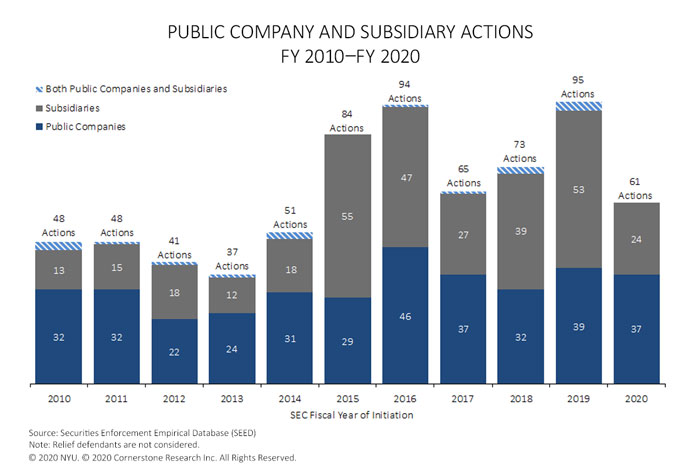
You are correct that they cherry picked information. However you are still incorrect on the original assertion that SEC is not in fact neutered. There have been more enforcement actions but insider trading enforcement has been the lowest in decades:
Could you note any major cases the previous administration pursued that didn't involve some lone scapegoat trader and/or a minority everyone could agree to dislike? Were there any actual cases after the 2008 mortgage/cdo/cds crisis, for example?
I don't know why you're being voted down here. These are legitimate articles in major publications that are broadly accepted by experts in the field. Sad!
Pretty much this. I highly suspect this is just a matter of advertising chasing ROI.
Firearms, ammunition (if you can even find it), plate carriers, plates, optics, NVGs, holsters - all of it is selling for at least 200% what it was one year ago right now. Everyone running ad campaigns is seeing ROI > 3 and dramatically increasing spend.
Once bids rise to the point that ROI is normalized, we'll see less of this.
Exactly. It would be a bit of a gamble, as it may undercut their x86 lines, but as a hedge against the success of ARM/M[1,2,...], they may do themselves a favor to attempt a project to implement RISC-V.
They don't have much to lose, as AMD is already killing their x86 lines anyway.
I've been hoping Intel or AMD would try RISC-V. If the ISA is inherently more efficient (not saying it is) they should be able to prove it by having already optimized so much core and cache hardware.
And do what, shoot both x86 feet they're standing on? If they wanted to optimize technical/engineering success, it's absolutely the best move. But to optimize shareholder value or anything like it, it's impossible.


An unstated assumption of using any "free" product is that it's not actually free. Canonical screwed up, to be sure, but I do think many of us just expect getting harassed by salespeople to be the cost of using a "free" product.
Microsoft, on the other hand, charges me by the hour for using Azure. They've taken their pound of flesh, so my business expectation is that I'm going to be left the hell alone for anything other than billing matters. Them sharing the data in the first place, for something I've paid money for, FEELS like the bigger violation to me.