Didn't the people at Los Alamos think that the atomic bomb's chain reaction might keep going and set the entire atmosphere on fire? And I seem to remember the large hadron collider failing to collapse into a black hole.
Sure, AI might destroy civilization and/or upend the primacy of humankind. But if history has taught us anything, it's that we're gonna go ahead and do it anyways if it's possible.
Shortly before the first field test (you realize that no small scale experiment can be done—either you have a critical mass or you do not), a man asked me to check some arithmetic he had done, and I agreed, thinking to fob it off on some subordinate. When I asked what it was, he said, "It is the probability that the test bomb will ignite the whole atmosphere." I decided I would check it myself! The next day when he came for the answers I remarked to him, "The arithmetic was apparently correct but I do not know about the formulas for the capture cross sections for oxygen and nitrogen—after all, there could be no experiments at the needed energy levels." He replied, like a physicist talking to a mathematician, that he wanted me to check the arithmetic not the physics, and left. I said to myself, "What have you done, Hamming, you are involved in risking all of life that is known in the Universe, and you do not know much of an essential part?" I was pacing up and down the corridor when a friend asked me what was bothering me. I told him. His reply was, "Never mind, Hamming, no one will ever blame you.
>>Didn't the people at Los Alamos think that the atomic bomb's chain reaction might keep going and set the entire atmosphere on fire? And I seem to remember the large hadron collider failing to collapse into a black hole.
Devil's advocate: Give it time. I wouldn't take it lightly how easy it is for us to destroy ourselves. We just obtained the means to destroy our entire civilization less than one hundred years ago, that length of time is nothing compared to the entire human history.
No one at Los Alamos ever thought that would happen. Someone did wonder if it could happen, suggested it should be checked and that is what they did. It turned out to be as impossible as creating a black hole at CERN. They didn't just go ahead without checking.
But don't you ever wonder why after 14 billion years and with a hundred million star systems in the Milky Way, we still haven't heard a peep from anyone out there?
The longer I live, the closer I get to concluding that sentience is an inherently unstable condition.
I don't wonder about why we haven't heard from alien civilizations because it's statistically unlikely for us to ever perceive them (putting aside the assumption that we'd recognize their form of life or language in the first place). In a continually expanding universe, the likelihood of us ever interacting with an alien species technically diminishes all the time. For all we know, there could be a stable civilization of aliens so far away it's beyond our observable universe.
I don't think it's logical to use alien species (or the lack thereof) as an instructive point about sentience in general. There's simply not enough information.
even if we could 'perceive' them... how many are stupid enough to broadcast their location... I mean what if there IS some sort of galactic predatory species that beat everyone else in the timeline? What if they're just waiting for signs of life - to squash the competition.
I think it was Carl Sagan who once said something like: it doesn't matter how 'well-meaning' an alien civilization is... it usually doesn't end well for the less advanced one... case in point: American Indians. (paraphrasing)
> But don't you ever wonder why after 14 billion years and with a hundred million star systems in the Milky Way, we still haven't heard a peep from anyone out there?
I'd say it's unlikely to be AI, just because the AI could wipe us out and then go on to eat the universe. It's not a valid Great Filter candidate.
They thought the high temperatures of fission could ignite fusion in the surrounding nitrogen. That could start a chain reaction that eats the whole atmosphere. Basically turning the surface of the Earth into a star. Turns out that the math showed that this was highly unlikely. Perhaps the designers of the hydrogen bomb drew some inspiration from this fear.
Yes it did. But remember Mutual Funds? "Past investment returns are no guarantee of....". You should either read "The Black Swan" or read it again.
Also: "The threshold necessary for small groups to conduct global warfare has finally been breached, and we are only starting to feel its effects. Over time, in as little as perhaps twenty years and as the leverage of technology increases, this threshold will finally reach its culmination -- with the ability of one man to declare war on the world and win."
As far as we know. Who's to say that there wasn't an advanced civilization of humans hundreds of millions of years ago that wiped themselves out, and now we're re-inventing everything they did up to the point of the apocalypse, where the cycle will begin again?
We probably would have found remnants of their society. Also if there was, they would have consumed all of the easy to reach resources, and we could have not have made it this far.
If organic matter can survive (bones and even sometimes tissues), we can be very assured that hardened structures would.
Furthermore, there's nothing in the fossil record suggesting humans were around very^very long ago, so it'd have to have been a different intelligent species.
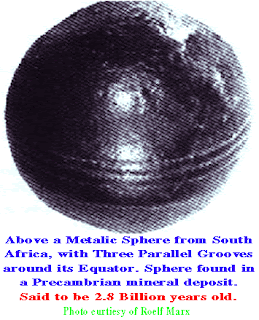
That's a bold statement. Read Forbidden Archeology, and you'll see quite a few oddities in the archeological realm. Such as metal spheres with odd, precise features, that are very very old ( http://4.bp.blogspot.com/-oiiiI75kDic/TdRv4ZsspWI/AAAAAAAAAC... )
(Yes, you can now give me the defaults:
"if this was true we would have heard of it"
"if he says something that is unconventional, he's probably a retard/arbitrarily biased"
etc. etc.
yes, go ahead)
> As proposed by Cairncross, the grooves represent fine-grained laminations within which the concretions grew. The growth of the concretions within the plane of the finer-grained laminations was inhibited because of the lesser permeability and porosity of finer-grained sediments relative to the surrounding sediments. Faint internal lamina, which corresponds to exterior groove, can be seen in cut specimens. A similar process in coarser-grained sediments created the latitudinal ridges and grooves exhibited by innumerable iron oxide concretions found within the Navajo Sandstone of southern Utah called "Moqui marbles".
> Similarly, the claims that these objects consist of metal, i.e. "...a nickel-steel alloy which does not occur naturally..." according to Jochmans are definitely false as discovered by Cairncross and Heinrich. The fact that many of the web pages that make this claim also incorrectly identify the pyrophyllite quarries, from which these objects came, as the "Wonderstone Silver Mine" is evidence that these authors have not verified the validity of, in this case, misinformation taken from other sources since these quarries are neither known as silver mines nor has silver ever been mined in them in the decades in which they have been in operation.


Sure, AI might destroy civilization and/or upend the primacy of humankind. But if history has taught us anything, it's that we're gonna go ahead and do it anyways if it's possible.
It's worked so far.