The best combustion cars are still ahead of us, just like the best mechanical keyboards, vinyl turntables, and mechanical watches have turned out to be.
The truth is that most of us are commuting around in econoboxes already, desperately searching for some form of distraction in the form of music or podcast. We're not forming some spiritual connection with a machine and the road, we're yelling at the bozo who can't commit to a lane.
There will be better econoboxes for when those are appropriate, and there will be more vehicles that are a better expression of our personality. I'm looking forward to both.
Shall we insert Robert Heinlein's rant about the automobile[1]?
> Despite the name “automobile” these vehicles had no autocontrol circuits; control, such as it was, was exercised second by second for hours on end by a human being peering out through a small pane of dirty silica glass, and judging unassisted and often disastrously his own motion and those of other objects. In almost all cases the operator had no notion of the kinetic energy stored in his missile and could not have written the basic equation. Newton’s Laws of Motion were to him mysteries as profound as the meaning of the universe. Nevertheless millions of these mechanical jokes swarmed over our home planet, dodging each other by inches or failing to dodge.
It's a little off topic, but I was thinking about this while playing a space-fighter simulator; how ridiculous it was that far enough into the future that there'd be combat in space, I'd still be manually controlling the targeting system.
A lot of tv shows and movies have this same problem. It seems no one has accepted the idea that the computers will win out here.
Master storyteller. Unfortunately his work has dated because of the advance of technology: he set his wonderful characters and clever plots in "future" worlds that, for example, have no computers -- let alone ubiquitous, wireless communication. So it is sometimes hard to get immersed in his worlds.
The thing about autonomous cars that concerns me is that, if they do become mandatory, your ability to travel at all will be mediated by whatever corporation wrote the software and runs the servers. What if they're all hosted with AWS and there's an outage?
Even if you still own your own car, if that's a Google car, you won't go anywhere without Google knowing. And what happens if your account gets shut down?
Wow. This is Bob Lutz saying this. The car guy. Exec at GM, Ford, Chrysler, BMW. Into performance and car styling. If he thinks cars are over, the auto industry will listen.
It kind of reeks of FUD from a cranky old person though. America has an extremely strong car culture. I don't see the constituency supporting measures that outlaw human-driven vehicles within 20 years. Forcing people to turn in their cars? It's just not gonna happen. It will probably take 40+ years after they've stopped producing vehicles with steering wheels before that even becomes feasible. And then there will be exemptions, the date will get pushed back a few times, etc etc.
Another thing that he and a lot of comments about self-driving cars seem to miss is the roughly 20% of the population that live in rural areas. Penetration in these areas will lag far behind city centers, and the large area to cover would make enforcement of a human-driving ban impractical.
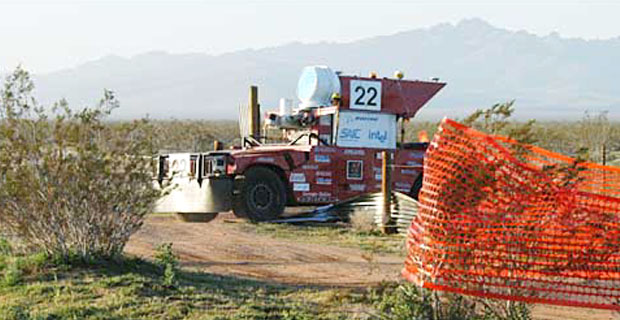
Having had an entry in the DARPA Grand Challenge in 2005, I can say that rural is easier than urban. Most of the really hard problems in self-driving involve other road users. Driving on an empty road isn't that tough. You need full ground profiling, which many of the urban vehicles now don't have.
(When we did our vehicle, we had way too much of the wrong stuff. We were worrying about having to navigate a field of boulders. Getting high-centered on rugged roads. Nah. In 2005, all you had to do was stay on the road. The 2004 course was actually harder, and nobody made it past 7 miles. CMU's team tried to do 2004 by manual mapping. They had people with workstations and aerial photographs manually plotting a precise route. The vehicle itself was almost blind. This was the result.[1] "At mile 7.4, on switchbacks in a mountainous section, vehicle went off course, got caught on a berm and rubber on the front wheels caught fire, which was quickly extinguished. Vehicle was command-disabled." -- DARPA" They plowed right into a sheet metal fence, a clearly visible obstacle.
Why hadn't the planners, who had paid for custom aerial photos, known about the fence? Because DARPA didn't want a dumb vehicle that ran on a preplanned track. The officer in charge of the event, a USMC Colonel, had some men out the night before the event placing obstacles, just so that trick wouldn't work.
Anyway, off-road self-driving on bad roads is a solved problem now. Oskosh sells a system to the military for that. They were thinking that the solution to guerrilla IED attacks on convoys was one armored vehicle controlling a convoy of self-driving soft-skinned vehicles. Works, but too much trouble to set up in a combat zone.)
The reason shared cars will suck is the same reason shared everything else sucks: nobody respects public/rental property. Your autonomous taxi might have been pissed in by the guy before you. And while I like driving, I don't think it's possible to be happy about this aspect of human behavior.
Infrastructure can change quickly. In Boston it looks like it took us about 40 years to move from a streetcar dominated system to an auto dominated one. And that was with two intervening world wars.
More appalling to me is if they can shut down the "modules" (as the article calls autonomous vehicles) to quell protests, contain undesirables, or otherwise limit freedom of movement.
All of this is hyper-focused on cars. The amount of investment still needed in this space for SEMIs, RVs, extra-wide SEMIs, etc...
I don't think we'll have complete autonomous driving until we have true AI. Sure we'll continue to innovate the standard car, but most everything else will wait.
One of the things I do is drive on roads that have 3-4 inch rocks everywhere (I drive my truck camper to places far away from humans). How do I tell my truck to drive 3 inches forward onto a leveling block so that my RV is more level without a steering wheel, breaks or gas it forward.
RVs specifically have a lifespan of anywhere from 20-40 years - and I'm pretty sure the owners are not going to suddenly stop driving them.
Oddly enough I was watching Minority Report earlier and thinking about this. Automatic control with cars that all look alike - with a manual mode for when you are far off the beaten path.
Still, the author is on to something here. There will be no need to own your own car (and plenty of reasons not to) once ubiquitous on demand automatic cars are a thing.
Is it bad that I look forward to this time? Driving is one of my least favorite tasks. Literal years of my life wasted behind the wheel trying to make sure I don’t accidentally kill someone when I could be doing other more productive things.
>A minority of individuals may elect to have personalized modules sitting at home so they can leave their vacation stuff and the kids' soccer gear in them. They'll still want that convenience.
I think Bob owns a car. I don't right now, but I've owned a car, motorcycle, and bicycle. The storage ability is incredibly undervalued.
Out of curiosity, how many years was the transition between horse and automobile? I would bet this will be the same. I don't think it's driven by technology, I think it's driven by human sociocultural inertia or whatever the right term is to describe when we irrationally latch on to things.
The 5-year headline is hyperbole. You can't just take the average persons' second-most-valuable asset, declare that it is worthless, then require an additional fee for them to use your fancy new podmobiles to get to work (on top of still having to pay off the auto loan.) The Economy (tm) won't be able to take it.
Therefore, I think the fancy new railcars cannot become dominant faster than (1 average car-loan period) after becoming available. The only way to make it happen faster is if the AI-tomobiles are free for people who still have car loans or the car companies offer to buy back existing cars for $(exactly what's left on the consumer's loan.)
So the more reasonable estimate is more like:
5-10 years to availability in (those few special cities)
10 years after that to widespread availability
~5-10 years after that to completely eliminate "the automobile as we know it."
Total: 20-30 years. Which includes Bob's "20-years to total conversion" estimate.
Let's remember that the first 4G phone came out circa 2008, and now nearly 10 years later, we still don't have anything close to nationwide 4G coverage.
But it is already then and most probably with ever connected world that will be the solution. I don't think he is aware of NFC or any form of "Pay" applications out there right now.
Whenever this issue comes up, your type of retort predictably comes up. I think first you have to consider where and how cars are used in the majority and rural areas while important don't come close to matching the typical car usage pattern.
I am sure when this world comes to pass many exceptions will be added to accommodate rural areas but rural areas are not going to be the reason we won't get to this future.
Man, I feel like I'd found a nation just to have the risky and inefficient wonder of the automobile. The one form of rapid transport which represents freedom and not tyranny.
I hope this guy is wrong, and people collectively decide that the automobile is worth human lives and tremendous waste, for my own selfish vision of the world to remain true.
For most of us that is the experience without exception...I live in the DC metro area (Baltimore to be specific), I dread even the slightest need to get into my car because I know it will easily eat up all my time. A 5 minute errand can easily become a 2 hour ordeal because of traffic.
Go anywhere around the beltway and see cars in every side street and back alley (never mind actual roads)..you literally cannot leave your driveway on some of these streets during rush hour.
ah yes, the freedom of imposing immense inefficiencies and externalities (read: pollution, congestion, industry lobbying against any sort of mass transit) upon everyone else around you, in exchange for feeling good.
I've been pondering your comment for about 5 minutes and I still how the flippin heck does Gamergate fit into a comment about an article on self-driving cars.
I'm downvoting for off-topic, but if you can explain the connection, I'll gladly remove it.
People have had their email accounts from Google locked and years' worth of email and contacts about to be deleted based on unrelated social media postings.
E.g. Jordan Peterson, a Canadian university professor, as well as an Indian American statistics professor whose name escapes me, but whose account was only reinstated after complaining on HN and other sites.
I'm pointing out that the ability to control people's transportation is a way to exercise control over them. In am extreme case, one could prohibit travel to any but approved locations or even cities.
In USSR for instance, internal passports were needed to travel between cities and in some cases, you couldn't travel to certain cities without official approval.
Think of how a rich gated community could have only a small whitelist of approved people, with no one else even being able to input that destination.
Also, it is important to consider the ownership of these things now. This scheme that Lutz envisions must be state-owned and controlled. We cannot trust Uber and Lyft, or any other monopolist with it.