I'm always curious how a bug like this ships. I mean QA & Testing should catch it, sure. But even before then. Some engineer wrote code for FaceTime that has it open the microphone before the call is accepted. And transmit the audio over the network before the call is accepted. Who did that? And why? I'm not suggesting malice but I do wonder at the lack of defensive programming.
My guess is that it’s an unfortunate combination of several problems:
- audio and video capture has to start going before call is actually established at signaling level, in order to minimize call establishment delay. Audio maybe going through Bluetooth, for example, and waking up Handsfree mode of BT may take 1-2 sec
- most of the group calling functionality was developed by a separate team, and group calling signaling may be loosely integrated at UI level, where, once UI triggers a switch to a group call - internally, the whole new library may kick in and get the current 1-1 call state transferred to it.
- when this “transfer” happens, the state of the first 1-1 call gets affected (at either local or remote side (due to signaling), which leads to either remote side think that the call was answered (a lack of protection in the call signaling state machine to ensure it was users UI action) or local side thinks it’s ok that remote users answers the call (in this case FT must have streamed audio even during 1-1 call establishment phase)
- lack of a check for your own phone number added to a call. This, due to having the same IDs/tokens twice in a group call, may lead to unexpected call signaling state machine switch
- lack of manual testing with focus on edge cases (like the described flow to repro the bug may not be the main flow for how users start group calls on FT)
I never worked at Apple, but I built VoIP stuff for the past 20 years.
latency of local hardware is much lower then cellphone/internet latency... so even if you bring local hardware latency to 0, you still have major network lag... I know you are kidding but this is ridiculous
They supposedly have these chips that make your phone much more secure and they can't get stupid stuff like this right? LOL ... GO APPLE. My trust level was already close to zero before this...
> leads to either remote side think that the call was answered
Maybe that's triggered by adding your own number? Since you're clearly on the call already, your own number is obviously going to answer immediately and that kicks the whole call into "active" (since you presumably want a call to become active when more than one person has answered) without considering that you've actually got A+A+B instead of A+B+C.
maybe - it's hard to tell, and I did bring up that other option as well. It's just that when a 1-1 call upgrades to a multiparty call, there should a be a lot of new stuff going on at signaling level to convert that 1-1 call to multiparty - and a chance is that it's a combination that leads to this bug - a call gets upgraded to a multiparty AND a number being added is already part of the call...
> audio and video capture has to start going before call is actually established at signaling level, in order to minimize call establishment delay. Audio maybe going through Bluetooth, for example, and waking up Handsfree mode of BT may take 1-2 sec
As a user, while I can accept capture starting before I answer, I cannot accept sending. I understand how it helps the speed of establishing calls.
But it means the only thing needed to spy on me from that is a software change ON THE OTHER SIDE. No way to know from my side if I'm good or not.
But your comment it missing the point. Parent commenter said it needs to start recording audio and video earlier, and a combination of other circumstances cause the device to send the data. Nobody argues this is acceptable.
I am not saying whether sending happens at the establishment phase or not - it's just that when your AV capturing is started and even encoding goes on - it's a matter of dropping the actual AV packets or sending them at the network stack/jitter buffer level. By the way, if not for privacy/security, it's actually very useful to start sending AV stream over the network, to pre-heat the network & test its throughput. For example, cellular data bitrate ramps up only when you actually send data, and it takes some delay to ramp up at more power-hungry levels and for cellular to even test what's possible. Also, estimating network bandwidth for the application layer requires measuring the round-trip time for a few seconds...
It reminds me of this MacOS bug from last year, where simply hitting the login box over and over with no password would eventually bypass the security entirely:
This bug only applied to grub authentication, which isn't a widely used feature. And you could achieve the same result with boot from disk/USB if that is enabled.
The vuln doesn't give you access to the actual accounts on the computer.
Yes - from what I recall there was not even a pretense of security. Everything was just unencrypted FAT (VFAT rather than FAT32) and if you logged in as one user all other user's data was clearly visible - it was just a means to have your own user workspace and customisations applied. Windows 95 and everything up to (not including) XP was a toy OS for home users ... If you wanted "grown up" features you had to go for NT.
I believe that was by design: the dialog was an opportunity to authenticate with the domain. If you just wanted local access you could hit cancel. Remember Win9x was not a secure OS itself.
Pretty sure I've seen a similar trick on XP or later as well. (I learned it from someone I didn't meet until long after I last saw a 95/98/2000 machine.)
I remember an article somewhere about these kinds of bugs. A lot of medical hardware/software combos are/can be compromised. And here comes the problem: do you disclose the vulnerabilities since it means potentially killing people? How long do you wait before manufacturers acknowledge and fix the problem (and they often don't)?
So yeah, these types of vulnerabilities are very very scary.
Honestly, I wouldn’t but that in the same class if bugs as those that preceded it because if the attacker he removed the HDD he will have access to your contents anyway (unless the HDD is encrypted) and it’s not a quick and convenient process either (unlike tapping backspace multiple times).
That said, I also don’t agree that this bug should never get fixed either.
This is a very naive estimation of what might happen when someone has access to all your running software. Since it is linux, it loads executables into memory and is able to run them even when they are deleted along with runtime dependencies.
Anything that caches anything to anywhere other than disk will be accessible. Your memcache, your redis, some databases, keychains, your non-userdata browser sessions.
I'm aware of that but it's a moot point because you'd be popping the storage device back in anyway. Which is why I didn't address that in my previous comment.
In any case, half the examples you've provided there are server specific and you really shouldn't be allowing untrusted physical access to your servers (nor running Xorg to be honest).
It's actually the opposite situation. Slackware's policy is to stick to the original software as distributed by the author with only minimal patching where necessary, so if a particular program (say, KDE) has a big support community, Slackware benefits from all those eyes on the code. This leads to a very mature and stable system at the expense of running older versions of software (though there's always the -current branch for those wishing to live on the edge).
Beyond this, the small but dedicated Slackware team is working daily to find and patch bugs when they do appear. You can look at the changelogs for examples of that workflow[1].
There's no such thing as a software project without bugs, but Slackware is consistently one of the most stable and robust OSes out there.
I remember turning on my iPhone and briefly seeing a picture of myself from a time when I had not taken any photos of myself. In fact I had not been using the front facing camera at all.
I think user ‘sixothree’ was stating that a picture would show after unlocking the phone, not after a call. I myself, have had it happen to me several times couple months ago and thought it was really creepy. It almost seemed as if someone was using the front camera without my knowledge. Thought it to be glitch or something at that time.
I remember some people discovered that you could kill the xscreensaver lock screen on Debian with Alt+SysRq+F some years back. Well, a decade back actually — 2009.
A fee years ago, I discovered that if someone was running dual monitors and using XScreenlock, you could unplug one of the monitors and it would bypass the lock screen. I have no idea if this is still possible, I've not used XScreenlock since then.
On Windows 10, if you have dual screens and unplug one while the screen is locked, it will reconfigure the displays and give you a flash of what was under the lock screen. Hope you didn't leave anything sensitive on your screen!
I find those bugs less puzzling because the timeline makes sense. You're not logged in, there's a prompt, you're logged in. Obvious bug in the prompt, but the A happens before B happens before C order is there. Call comes in, audio is recorded, call is accepted is not the expected order. I could imagine a bug where declining the call still accepts the call, because that still obeys the proper ordering, but this bug does not.
I don’t use face time often, but isn’t there a "preview" of the camera feed during the prompt? I guess so that the user can check if he’s looking decent before engaging the call.
The bug could then be that the feed is sent over the call too early instead of being used solely for this local feedback.
From the details, it sounds like "adding" the caller to the call before the call recipient accepts probably puts it in a weird state. Could be some kind of off-by-one error, where for some purposes Participant 2 is the caller and for some it's the recipient.
Yes, I experience this routinely. As do many other people at my company.
In particular it happens when attaching external monitors while the screen is locked. There's a flash of the unlocked desktop.
I am guessing this is because the screen lock is an application drawing over top of the monitor, like XScreensaver on Linux does. A more secure-by-default architecture would have screen locking built into the display server at some lower level: If the screen is not unlocked, it will not allow the data to be passed to the GPU. It's easy for me to arm-chair architect though.
There was one guy on reddit who had a scare when his computer flashed a picture of a dead person when shutting down, and he thought his computer was haunted. It turned out to be a frame from a youtube video he was watching earlier. It may be that macOS is not that good at clearing out GPU memory sometimes.
I have the exact opposite problem. When I reboot after system updates, half a dozen YouTube videos in Chrome tabs start playing over each other on the password screen. They get through about 20 seconds before I can stop the last of them.
Audio only on the password screen, but all audible.
I’ve long had a similar problem on iOS. Whenever I return to an app, I briefly see an image from a few minutes ago. Which can be bad if I’m showing the phone to someone that old state was exposing sensitive data.
I used to see this regularly but haven't noticed it in a long while. I always assumed they were doing something like a double-buffering type trick and switching framebuffers before wiping stale content from the destination.
Possibly a product owner trying out the latest build, receiving a call, accepting it, and then waiting for the call initiator to receive the message that the call has been accepted, and then start sending data and asking:
"Why doesn't it take X seconds before I can start talking".
To which the engineers possibly explained the reasons and the product owner saying:
"But I want it instant, let's bypass all this extra stuff and get a proof of concept instant answer working"
To which the engineer said:
"But we'd technically be sending data before the call has even been accepted"
To which the product owner said:
"That's okay, the user can't actually see that data, let us just get this in for now, we can worry about the security/privacy side later".
To which the engineer said "but, but, but" saw the product owners eyes glaze over and just made the commit:
Commit 1279: Remove very important security/privacy feature of ensuring no data is transmitted until the call has been accepted. This is again my best judgement, do not come to me when this blows up, please speak to the product owner.
You hear this excuse all the time, don't FAANG employ the world's very best developers?
Maybe their code is a mess for orthogonal reasons - management, profit-motive?
Aside: I thought I'd heard devs have automated analysers that step through and find all possible code paths, allowing complex code to be audited for security issues and such? Presumably that's how these sorts of bugs should be found in testing.
Since they have an impeccable interview process that only selects the brightests.. They may be all too busy implementing linked lists and inverting binary trees instead of actually delivering a working product.
> don't FAANG employ the world's very best developers?
People have to stop putting these types on a pedestal. Some of the least intelligent people I've known have worked for some very big names. You shouldn't trust someone based on who they work for or what name is attached.
And some of the world's very worst. There are not 10s of thousands of world-class developers to hire in the first place and they would be focused on much higher-level details than implementing basic features and maintenance.
That gruntwork requires solid reliable workers with experience but the current screening processes do more harm more than help in getting that talent.
I think this is very close to spot on, though the version I've heard from developers involved with mobile involves VP's using the app/feature once it's been deployed: "Why is my group call taking 20 seconds to connect, this is unacceptable!". Fire drill ensues.
It generally happens because you don’t follow a defined state machine. An example of how this might happen is when starting the call the microphone isn’t opened. Then you add someone else to the Group FaceTime, the event handler for they didn’t stop to consider if the call is active (just assumed it is) and now the code for that handler opens a new port to the microphone so that it can encrypt the audio stream differently for that recipient.
Super easy and not remotely malicious. It’s a failed state check.
The actual bug here might be different but that’s an easy example. But it may also effectively be the bug since all the examples mention adding yourself to the call.
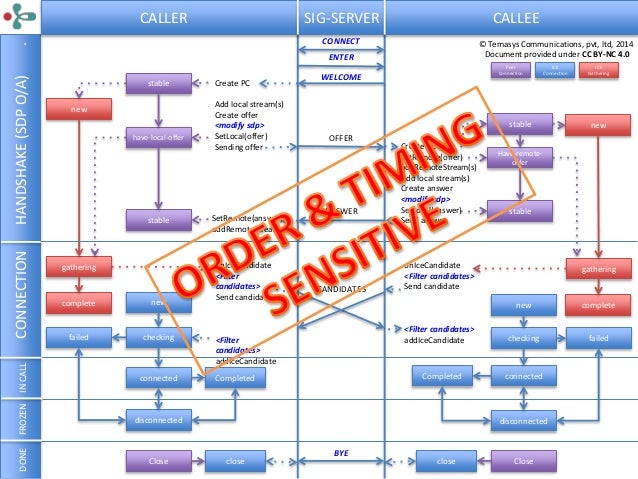
I did a bit of WebRTC development for video chat, and the state machine for that is one of the most complicated I've ever dealt with. Even household name-brand commercial providers don't handle all of the edge cases. It took me about a week to get it right. Session negotiation gone wrong can easily cause audio to be heard before the call is established (and this will certainly happen with the naive implementation -- even Google's own reference implementation had issues).
If you're curious, check out this flowchart slide from a Google I/O WebRTC talk:
I always wondered why FaceTime Audio has almost zero call establishment time on iOS, as opposed to WhatsApp or FB Messenger where you need to wait half a second before the audio feed kicks in after answering. Guess this is the reason!
This sound horrifying. If I use a hacked/modified FaceTime client, does this mean I'll be able to hear and see the other end before they pick up, even after the fix?
I wouldn't call it E2E encryption if only one party in the world has the key. E2E generally means both sides have the encryption key. But lolc points out the real problem with that scheme.
I think it is fair to say all applications must be written to assume the source code is opensource / can be modified / recompiled. A recompiled app should, in theory, only sacrifice the security of the person who did it, not the remote.
If FaceTime is implemented the way the parent comment mentions (which it very well may not) I don't see why you could make a client that performs a proper key exchange to set up an end-to-end call and simply pretend grab the video instead of hiding it behind the "dailing" screen?
"The initial FaceTime connection is made through Apple server infrastructure that relays data packets between the users’ registered devices. Using APNs notifications and Session Traversal Utilities for NAT (STUN) messages over the relayed connection, the devices verify their identity certificates and establish a shared secret for each session. The shared secret is used to derive session keys for media channels streamed via the Secure Real-time Transport Protocol (SRTP). SRTP packets are encrypted using AES-256 in Counter Mode and HMAC-SHA1. Subsequent to the initial connection and security setup, FaceTime uses STUN and Internet Connectivity Establishment (ICE) to establish a peer-to-peer connection between devices, if possible."
I'm not doubting whether FaceTime is end-to-end encrypted, I'm not sure whether FaceTime sends data before the call is accepted for speculation reasons.
Yeah, if you have a hacked iMessage client you probably could retire from bug bounties. At any rate the bug in question would pale in comparison to a rogue iMessage client.
Modified clients are definitely possible - review the recent Project Zero research into webRTC vulnerabilities, which included a look at FaceTime and discovered several exploitable bugs
> Similar to how Nextels cellular "push to talk" fake walkie talkies worked.
Not really. The reason the PTT was virtually instant connect has nothing to do with optimization tricks, but rather is a purpose built design of the network tech it was using.
Nextel PTT didn't go over a normal cellular network, it went over something called iDEN[0]. iDEN provides a trunked radio service[1] which has a similarish feature to a conventional two-way radio. Sprint acquired Nextel and as iDEN wasn't as relevant anymore with the advances in cellular networks (despite those who actually used the PTT functionality), in 2013 Sprint shutdown the network to use it for additional LTE bandwidth in the 800mhz band[2].
No, PTT would send audio from the caller without the receiver accepting anything, but it wouldn't send anything from the receiver without action on the receiver end.
It was obnoxious at times, but very different than the kind of privacy invasion that the receiver's sending data without active involvement is.
If you consider what happens when you add a third person to a call:
You start sending them everyone's audio!
That's the desired behavior and exactly what happened here.
Except the client should have probably checked if the call had been accepted first. That's why I say it's a state machine bug: The "Send audio" function should have never been activated in state "waiting to accept".
Most likely 2 different teams worked on it. One worked on accepting calls, the other worked on transmitting audio, another probably worked on video. Then it got integrated and complete e2e testing wasn't done.
How would an e2e test catch this though? What would the test condition be? Wouldn’t I have to be checking for audio from the other party during all seemingly random events like adding a person to the call group?
Apologies in advance for my ignorance, I haven’t written code for a long time.
I doubt there would be a specific test (or maybe there would, real testers are better than me at thinking of this stuff), but there should be logs for events like "microphone turned on" and "user joined group chat" and the testers should be monitoring those logs.
Not sending any audio or video until a call gets accepted seems like a clearcut test case. They probably have a few tests like that, too, but forgot to add weird edge cases.
> I'm not suggesting malice but I do wonder at the lack of defensive programming.
I've never worked at Apple but neither have I in 10 years seen people truly appreciate any attempts I did in defensive programming. On the contrary, usually I hear - sometimes loud - complaints about that. Usually from fellow engineers when they see it but on occasions also from non technical people.
It's a joke that everybody is so sad about bad application security but at the same time virtually nobody cares about it at all when involved in an actual development project.
Classical case of NIMBY. FWIW Apple's security is far over average compared to other companies. But I guess they cannot isolate themselves 100%.
I believe they have been working on FaceTime Group for 5+ years now.
In 2015, Modern Family had an episode where the entire plot focused around the family using FaceTime on their iPhones --- but they had the Group feature[1]! I remember being blown away when I saw that, figured it'd be coming in the next iOS update. It didn't. 4 years later, they finally released it..then recalled it immediately
I'm wondering if it's something really simple, like comparing the unique number of callers versus the total number who have accepted the call.
Imagine a method for group calling that returns whether or not the call should be considered active or not by seeing if the number of callers is equal to the number who have accepted the call. But now imagine the method that tallies up the number of callers does a unique count by phone number, while the method that tallies how many people have accepted the call does not.
Since adding your own number is adding a caller who has already accepted a call, you end up with unique_callers (2, you and them) == total_accepted (2, you and you).
This could be tested by adding a third person to a group call twice (if iOS will let you do that) instead of adding yourself to the call.
Furthermore, if the interface on the recipient's phone only looks at whether or not they've accepted the call, that would explain why the call doesn't auto-accept on their end and go into the call before they've accepted or rejected the call.
They can aim it at who they want. When it's invite-only they'll only get what they're looking for. I'm certain that just having open bug hunters looking would have at least brought this up. I remember noticing this bug myself but also remember it not being worth my while to report it.
I agree this should have been caught in QA/dev testing. However, I would bet a dollar this wasn't "Some Engineer" deciding to do it this way. This design was the culmination of some back and forth discussions and it is this way for a sound (no pun) reason.
The code involved is a lot more complicated, involving a lot more pieces written by different teams working in concert with each other. There's not a single routine that takes the steps you describe that got a few lines out of order or something.
If the implementation is complicated enough, the code that opens the mic and the code that accepts the call are so far away from each other that its impossible to see. That's why keeping things simple is the greatest art in programming.
Our company's phone system, or our provider, had a problem with outgoing calls once: you couldn't call users of a certain mobile provider, but only if they were currently using GSM. Anything newer would make it work. The symptom was that even when the cell user picked up, you'd still here the sound like their phone is still ringing. That alone was already mindboggling to me, but the crazy part was that with certain phone models (at our company), the cell user would be able to hear you while you still thought their phone was ringing.
Agreed - looks like something very simple to add as a test-case. If not manual, an automated QA process could've easily caught this if it was even remotely robust enough.
Lack of formal methods in the design phase. It would be trivial to express a rule that you cannot hear audio from the called person before they accept it with it.
Abstraction. I can tell you with 100% confidence that any of these logic bugs are created by unecessary abstraction.
Anybody working in security will tell you the same. Piles of abstractions make it impossible to find out these bugs. You need a month of work to understand these codebases, often only the main developer has the architecture in its head.
Apple's application programming has fallen off a cliff in the last 4 years. I blame Swift. There's nothing wrong with the language itself, but its outward similarities to.... other dynamic languages I feel has led to a rot in the core of what was once a rock solid culture of embedded C/C++/Objective-C programmers building robust, well architected applications. The average Apple app today is just as buggy and disjointed as anything else on the App Store, and that never used to be the case.
I actually liked some of the versions of iTunes for Windows back when I had to use it with an iPod Touch around 2008 to 2012 or so. For just playing music from my music library, the interface wasn't bad. You just had to turn off the option to automatically convert everything into Apple's format.
>Most of iOS is still written using Objective-C, including FaceTime. Swift has nothing to do with this.
Most of iOS is still great. The problem is all the cruft that has developed since around 7.0. It just seems like an endless march of features at all expense.
What? Objective C is a lot more dynamic than Swift - which was the whole point of making a new language, albeit Swift itself is not quite as well-developed, highly-performing or safe as, e.g. Rust.
I think it's programming practices themselves that have fallen off a cliff, at least in the non-FLOSS world, and nothing specific to Apple. You can even see this in the dumpster-fire that's popularly known as "Windows 10", as well as in the latest versions of Mac OS X which are a lot slower and less user-friendly than their predecessors.
>What? Objective C is a lot more dynamic than Swift
Sure, that could be argued. But with Objective-C, you still had exposure to the "metal". You had to understand what a pointer is, and why you would want to use it. You had to understand memory management, even though ARC does the job (mostly). It was firmly entrenched in the world of memory efficient embedded programming that mobile started out as, but now that developers coming from Javascript/Python land see a familiar syntax they've brought their patterns with them as well.
>So… your theory is that if people understood pointers this wouldn’t have happened?
Yes. But it has nothing to do with pointers specifically, just the mindset and training of the average developer who has had experience with them, vs. the average developer who has not.
There's an entire generation of developers now graduating from CS programs, hiring into Apple, and getting dumped on these application teams with zero real world experience and their only language being Python or Swift. The result is you have tons of brilliant people who can quickly whip up a DFS algorithm, but don't understand that using 4MB of RAM for a JPEG is unnacceptable, or that whatever dynamic thing they are asking the runtime to do might not always work as intended. That's why we get these massive feature lists nobody asked for with every iOS release, and zero emphasis on performance.
I think you over-simplify — engineers slot into different roles/disciplines within large companies.
There are going to be engineers that have to deal with driver-level code that know full well the limitations of memory constraints, thread overhead, etc.
No doubt you're describing the other half — the app engineers that use the API/SPI's. It might even be argued though that, given a well defined API, they should not have to worry about how much memory a JPEG requires ... the API decompressing the image only when rendering to the destination or what-have-you. Pointers, memory management should be managed by the low-level parts of the language or OS/kernel.
I happen to like the bit-banging, pointer walking, free-wheeling world of straight C but I don't begrudge higher level languages that are designed to tackle the more modern pressures of concurrency and "asynchronicity".
> The result is you have tons of brilliant people who can quickly whip up a DFS algorithm, but don't understand that using 4MB of RAM for a JPEG is unnacceptable, or that whatever dynamic thing they are asking the runtime to do might not always work as intended.
I’m not sure where you’re getting this anecdote from, because I have not found it to be at all true in practice.
I’m not sure about the situation at Apple, but this is 100% true in the web development world today; with the exception that many of the new programmers hired straight out of General Assembly and the like can’t implement a DFS algorithm either.
It’s a nightmare for security and performance - the number of obvious, blatant security issues I’ve spotted and fixed just through luck alone is horrifying.
I'm sorry, but I don't know what "General Assembly" is. I live in the US, so is this some part of a degree program in your country (if you live somewhere else) that I'm not aware of?
But coming back to your point, there have always been new engineers with weak skills, just like there have always been smart engineers as well. I don't think the choice of programming language changes this fact significantly, although certain languages may have a slightly higher proportion of inexperienced programmers than others.
General Assembly is one of the popular US 3 month coding bootcamps. There are others in the US, but I’m not familiar with their carriculums.
As programming gets easier to learn, people spend less time learning programming. This has a number of negative knock-on effects, eg less understanding & focus on correctness, performance, security, etc. Obviously there’s lots of wider benefits too - but I suspect that the average person writing objective-c today spent more time studying programming than the average person writing swift today.
It sounds like we generally agree on that - but my claim is that this effect size is big enough to dominate almost all other considerations. I suspect the average C program is more secure than the average JavaScript web app, despite how the absurd difficulty in writing correct C, just because of the ratio of new and old programmers in both communities.
Then, how do you explain that the last update improved performance a lot on older devices ? Last time I've checked there was no hardware upgrades in the downloaded update...