To be fair, country living also subsidizes the population centers, in that New York and San Francisco are not self-sustaining in terms of food production, not to mention the strategic value (to both the coastal cities involved and the country as a whole) in not having undeveloped wilderness in between major population centers. It seems unfair to say that there is some immoral wealth transfer from urban to rural.
The definition of subsidy is "a sum of money granted by the government or a public body to assist an industry or business so that the price of a commodity or service may remain low or competitive."
How does that fit in this context?
The fact that farmers get paid little is due to supply vs demand. Agriculture has been optimized to a great level but food transportation is expensive.
1) The so-called "Farm Bill" provides hundreds of billions of dollars in what is essentially farmer socialism, incredible sums of money to protect farmers livelihoods from the free market. Prices too low? Government will pay you to not grow anything to inflate prices. (This doesn't include Trumps tens of billions in more farmer socialism to help protect them from his trade wars)
2) Welfare in general, generally speaking blue/liberal states and cities pay astronomically more into welfare programs (food stamps, unemployment, social security) than they draw, while red states/conservative states draw astronomically more in benefits from the federal gov than they pay.
So in two hundred-billion-plus ways, the liberal cities subsidize the rural farmers and their farms.
And then we buy our produce from central and south america anyway...
All of those farms are just one season away from producing food no matter who we pay transfer payments to. Considering many of those fields are left without any crops anyway, I think you overstate how reliant we are on them
Australia mostly leaves food to the market, in the sense that it has some of the lowest agricultural subsidies in the developed world, and it's a net exporter of food with no famine and no civil unrest.
I'm not sure that subsidies are the best government intervention, either. Strategic grain reserves are probably more useful and less distortionary.
You might be right that strategic reserves would be a better policy. I'm definitely not a fan of what corn subsidies have done to the food supply.
Interesting re: Australia. I was mostly looking at the history of the US before the subsidies. There were a few extremely tough times for farmers. And in other countries' history, most revolutions seem to start with a bad year or two for crops.
> most revolutions seem to start with a bad year or two for crops.
This is the main thing. The farm subsidy can be considered an exorbitant, market distorting subsidy. But food is too important to the very fabric of society, that it has to be available at reasonable prices at all times.
Many are, and many of those who are not are working to support them. Farmers need things like gas, clothing, housing goods and raw materials, foods they dont grow, mechanical services and other goods and services too.
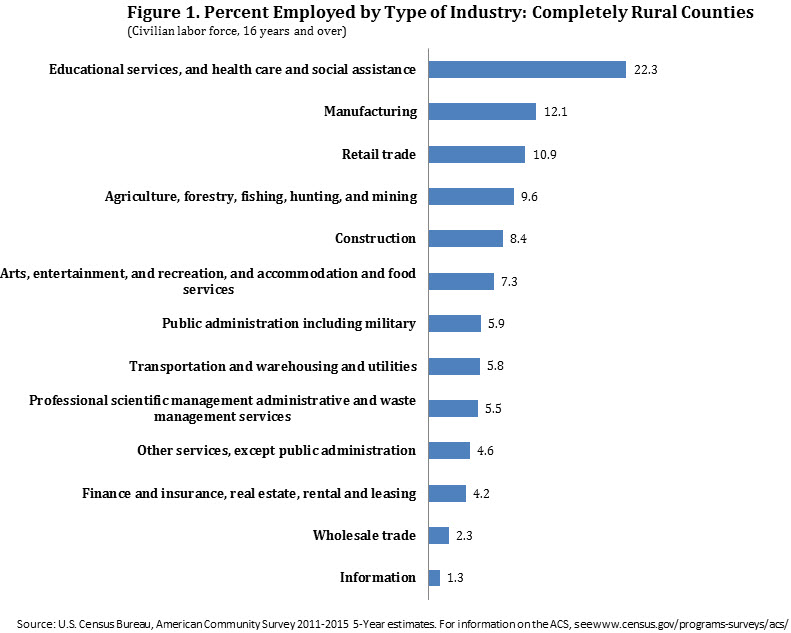
Less than 10% of people living in rural areas are engaged in agriculture.
It seems like a ridiculous way to spend money, when good education and health facilities can be provided at much less expense near or in dense urban centers.
Although we actually have quite a bit. Federal land is about 28% of the area of the US. Some of that is military but a lot is National Forest etc. and that also doesn't include state and local parks and conservation lands. (And private land owned by logging companies, etc. that allow various recreational use.)
Don't disagree with the general point that having wilderness areas is good (especially areas that are particularly useful for wildlife and/or recreation) but there's a lot that is not particularly constrained by people living in less populated areas.