My rule of thumb when it comes to all breathless headlines around battery technology is that "I'll believe it when I see it". It's one thing to achieve these specs for batteries when n = (small number), but can they be affordably built at scale?
2021 starts in less than 5 months. I think a lot of people are still so used to seeing 202x dates as "far future" that it's really easy right now to lose perspective that that future is already here.
Unless it’s actually the year 2525, and we are all just trying to stay alive, but we are in a virtual reality meant to hide the truth from our eyes. Oh what a time to be alive
When I'm president of the world I'll keep the weekend at two days but shorten the work week from 5 to 4. This feels sort of like a 20% reduction in work but actually you'd only need ~7% more time-efficiency to make up the productivity gap. A lot of industries would recoup that for free just due to having a less exhausted work force.
Would be easier to ask the people living in the 3-day simulation, but I don't know how to reach them...
I suppose it depends on whether everyone is gone for the weekend on the day they are supposed to spot the asteroid that would destroy life on Earth in 2431
I love that Zager and Evans song [0]!! Honestly don't understand why this reference is the only thing downvoted in a chain of off topic comments (not that I care).
All technology cost and performance forecasts should be indexed by their TRL.
This should also be applied to all stories about new fission reactor technologies. Comparing a cost that's been validated across many units over decades with the "should cost" for a design that hasn't even had gone critical in a prototype is almost meaningless.
There's no magic required here, people. Batteries, engines, just tiny changes on existing Teslas. This car is dooable by Tesla and by third parties like Lucid Air just replicating some of the things Tesla has done and making small improvements.
1. Battery capacity: Tesla had 100kw cars 4 years ago. 13% increase - easy, even within Tesla's grasp, they just have not bothered.
2. Efficiency and range - this is just a small improvement on what the Tesla model S has, add more batteries. The Lucid Air is bigger than a model 3 and closer to an S. The S already has 400 miles. Tesla improved on the original 2012 (yes, those are 8 years old!) model S' range by using the more efficient model 3 engines on the S. The S has 100kwh currently.
3. The model 3 has different batteries than the S, apparently they have a bit higher capacity in the 3 than in the S. All Tesla has to do to give the S another boost is switch to using the model 3 batteries, add a few more. The one downside of the 3 batteries is supposed to be they have less max power, so less acceleration? Tesla is going to have 'battery day' soon when they will talk about their next generation batteries, and perhaps talk about S improvements.
4. Manufacturing, and especially getting enough batteries - this is where Tesla is likely really ahead. It's hard to make cars in volume, even expensive ones. But getting enough batteries for a large fleet of cars is the early 21st century unobtanium. Every other car company that ones to make large volume EVs can't do it. Where everyone is at least Japan and Europe and the US. China might be able to pull this off, too soon to say.
Nobody is saying Tesla can't match this, and given Elon's personality, I guarantee Tesla will have a Taycan style reaction and seek to reclaim the crown in short order.
However, that competitors are nipping at Tesla's heels is an absolute sea change compared to a few short years ago. They used to not only be ahead in every metric, but also improving faster than their competition further solidifying the lead.
Tesla sets a very high bar, but genuine effort is being made now to compete. It's fantastic, and great news for the EV movement. Reading EV news is finally fun again.
Yup, 4 is the key. Lucid Air is being marketed as high end luxury car, so 113kwh is totally believable. But Tesla's first-mover advantage in this case is having locked down the battery supply chain necessary to scale. It seems that most of Tesla's competition is stalling for time while they wait for their battery suppliers/partners to catch up. I don't doubt at least some of them will get there eventually, but it should take a few years.
Then why does every company say that they have production limitations based on availability? VW was saying that just a few months ago, and so was porsche. That's give as the reason why Audi and Jaguar have low volumes.
> Comparing a cost that's been validated across many units over decades with the "should cost" for a design that hasn't even had gone critical in a prototype is almost meaningless.
The poster is likely talking about new fission concepts like TerraPower [0] and other Gen IV types. See the Generation IV fast reactors section of [1].
Lucid's led by the Lead Engineer from the Tesla Model S. The range is from official EPA testing (pre-production). They have already produced a fleet of ~40.
There is nothing to indicate that they won't be able to achieve this in production of their low volume luxury vehicle.
The Lucid Air is an expensive luxury car. It's affordable in the same way that all luxury cars are affordable: not very. It's not a high volume vehicle.
They will be selling a smaller battery version eventually which will be cheaper but still at luxury car prices.
Are they achieving the additional range by just using a bigger battery? Or new tech/chemistry? Removing weight from the rest of the car? Better aerodynamics?
If it’s just a bigger battery, it’s not all that interesting. I’m sure Elon could build a prototype S with 1000 miles range if he felt like it. It wouldn’t make sense though.
This is the best interview I have seen with Peter Rawlinson which will address most of your questions. He was a chief engineer at Lotus and also at Tesla for the Model S and he is now CEO of Lucid. He is the real deal.
I feel bad even making the comparison, but interestingly, the disastrous Faraday Future was cofounded by Nick Sampson, who was also a chief engineer at Lotus and then Director Vehicle & Chassis Engineering at Tesla for the Model S.
The sheer storage capacity of the battery is less interesting than the cost. Getting below $100/KWh will reduce EV price to FAR below ICE vehicles; while BEV's are already at parity with ICE on total cost of ownership, BEV's are going to continue the long descent to MUCH cheaper, and $100 is going to be an important milestone.
I think new ICE vehicles are going to be banned in most major economies by 2030, so really, ICE is having its last decade of relevance in new vehicles. Given vehicle replacement cycle is around ~20 years, by 2050 the ICE vehicle stock will be reduced to 99% specialty machines like classic cars, motorcycles, and various heavy equipment for industry.
2035 in the UK. That's when the current (conservative) government wants to ban sales of ICE cars. I'd say the economic value proposition of ICE is going to collapse long before that. And few companies will be buying ICE vehicles if they can avoid it long before then.
100$/kwh probably has already happened. It's hard to confirm this but I suspect that Tesla is making a nice profit on their cars at this point mainly due to them pushing hard to get production cost down. At this point, they are supply limited so they have little reasons to eat up their profit margins. Competition will fix that.
I'd say the next benchmarks here are going to be 400wh/kg (3-4 years out according to Musk) and energy prices for clean energy bids dropping below 1 $ cent per kwh. Basically, we are talking about reductions in sales price and operational cost for most vehicles. At some point the math stops being interesting because we're merely debating by how many of orders of magnitude ICE is more expensive. The cross over point for some forms of commercial transport was probably a few years go; judging from how hot the market for e.g. electrical deliver vans or city buses are.
Well, the UK government said that they want to do that, and yet proposed no actual plan on how to do it. Previously at least you could still buy a hybrid - under this new plan it's only going to be electric vehicles, no hybrids allowed. Which is great, except that the government hasn't answered how all of these electric cars are going to be charged? I have a house with my own driveway so it's not a problem, but what if you live in a terraced house? Apartment? Rent a place? The subsidies and grants for both cars and chargers are being cut left and right, so who is going to build the infrastructure? Private sector? Like ionity is, where they charge £0.69/kWh, making it cheaper to drive a diesel than charging with them(and also charging 6x more than average UK kWh price for the privilege). I've heard an argument that places of work will provide charging points - but why would they? At my own work they said the parking lot is owned by an external company that is not interested in doing any improvements whatsoever so that's not happening, after a massive deal of effort they finally managed to install....2 charging points for a building of 1500 people, you can book the charging session in half-day slots and they are never free. You'd think the "free market" would just solve this problem, but it seems incredibly slow to do so.
> I've heard an argument that places of work will provide charging points - but why would they?
For the same reason why they provide (in one way or another) parking spots - because otherwise people can't get to the work place, and because it'll be another way to earn some money.
But even if not, shopping centers have a strong motivation to provide charging ports - if you don't have another good option, are you going to shop at the cheap mall, or at the slightly more expensive one where you can also spend some more money to charge your car? Assuming today's top technology will be common by then, you can expect to get hundreds of kilometers of range range during a 30 minute shopping trip.
Cities could also start adding charging stations to light posts, or install dedicated chargers, in the 15 years until then.
With the relatively small size of the place and the mild weather the UK as a whole could probably switch over to 60kWh EVs tomorrow and nobody would bat an eyelash. Things will take longer in places with greater distances and more extreme climates.
I have been a TSLA investor for a few years, I believe in electric vehicles. At 100$/KWh we're talking 5000$ for a 50KWh battery back, which is plenty enough for most people. This could allow us to see $15K-20K electric cars in just a few years, maybe before 2025, which is awesome. Very soon buying a gasoline vehicle, in a modern economy, will have people giving you weird looks.
What does have me a little worried though is that most of the world doesn't live in a wealthy city. As electric cars rise, gasoline prices will come down, which will keep gasoline attractive for a while, particularly in poorer countries. Failing ICE vehicle companies will try to sell their gas vehicles to these poor countries as well, and our used cars might end up there too. In other words, poorer countries could keep gasoline cars going for another 30 years after they've been banned here. What are we going to do about that? We're all breathing the same air.
I really wish people would stop with accepting lower range BEVs. To truly replace petrol vehicles we should not compromise or suggest drivers do so. Hence hit the three hundred mile mark and go from there with luxury and higher priced models pushing far beyond those numbers; as in 500+
People need to remember, the range is best case range and full charge. This is subject to driving conditions and especially the effect of weather. Lower pack sizes do not charge nearly as quick and this too will hinder acceptance as some will see charge times as a detriment. Wide spread acceptance means more people with a BEV and no home to charge at which means charge times are a real concern
So, don't let manufacturers off the hook. Telsa set a bar for range in 2013 that most are barely crossing in range and upped it with the TM3 and TMY. Mercedes and BMW both have offerings coming in with more than 300 miles range. Let us count this low 200 club as we did the sub 100 range, a good first EV for the manufacturer but not what is expected from true BEVs; remember many of the sub 300 club were petrol platforms adapted to electric.
I tend to agree. I have a Model 3 and while it ostensibly has 300 miles of range, as a practical matter it's more reasonable to expect about 200. And There are definitely areas within my state (Oregon) that I don't choose to take my car because it's too easy to end up in a "gotta hang out an extra few hours at a destination charger" or "drive 100 miles out of our way to hit a supercharger" situation.
I massively disagree - we have ordered(and subsequently cancelled due to covid, but that's not important) an MG ZS EV for my wife, with a range of about 160 miles from its 40kWh battery. That's absolutely good enough for pretty much everything she does with a car, and I see no reason to pay more just for the sake of having a larger battery. At £25k it would have been an absolute steal too.
Embodied energy is a significant fraction of total emissions in a vehicle. It's unclear whether early retirement of existing ICE vehicles is a win; I'm sure someone has done the analysis, and I'm kind of hoping someone will jump in and provide a link to it.
Economics is an imperfect proxy for this, but not uncorrelated: if it makes sense in dollar accounting to sell the ICE fleet to developing nations to be used up, that suggests (but does not prove) that it makes sense in carbon accounting as well.
it's 20k-40k miles depending on the sizes of the vehicles and the size of the battery. ~40 kWh, compact/subcompact on the lower end, and 100 kWh luxury sedan/SUV on the higher end. Phase to google is "cradle to grave" or EOL
Local power grid makes a difference but not by much. The worst case for an EV is still better than the best hybrids.
Bigger problem: More than half of Americans do not have a garage to park their car in to charge. Fast charging is great for road trips but it's got nothing on gas fill ups..yet.
Street level charging is very possible (and growing quickly in Europe). Any street with lamps or parking meters already has easy opportunities for chargers to be added.
Not really? We have electricity at the streets. We want additional plugs on the streets, and maybe a credit card reader on those plugs (even that's not a given, really; cars themselves can transmit their payment information these days, or costs could be rolled into existing city taxes/parking fees). This isn't rocket science, this is infrastructure America has been building since the early 1900s.
> Not really? We have electricity at the streets. We want additional plugs on the streets, and maybe a credit card reader on those plugs
Your parent was not saying that it'd be difficult to have a few charging stations on streets, but rather that it would be difficult to add a lot of densely packed chargers on the street.
Today, there just isn't that much use for electricity on the street: traffic lights and the occasional parking meter are pretty much it from what I can tell.
What you're proposing is adding 100's if not 1000's of amps of electricity to the sidewalk. For many, many streets.
The situation is even more dire in the north: while it's not too bad to charge in a garage, particularly if it's insulated, EVs on the street will have to expend a substantial amount of energy keeping their batteries warm during the winter months, meaning that the minimum charging rate for those areas will have to be solidly in the Level 2 range.
All of this work isn't impossible or even conceptually difficult. But it is a lot of work, and it's not as simple as just setting up charging stations and hooking them into the already existing infrastructure.
Most American street lamps are already "Level 2 range" for historic reasons that many of them are high powered sodium lamps or extremely early fluorescents.
In most major US cities the combined density of traffic lights, street lamps, and parking meters (especially parking meters!) is extremely high; much higher than average in Europe from what I've seen. Plus, most US cities don't have historic preservation laws that apply to "street furniture" like street lamps and parking meters, as opposed to European cities that have already done a lot of work into shaping EV plugs to look more like historic street furniture and fit within preservation law limits. Europe has a slight advantage that their default plug output is closer to "Level 2" than America's paltry "Level 1" wall outlets, but even that advantage isn't as huge as it seems to some of these discussions. (Especially, again, given America wired most streets and parking lots for "Level 2" in the first place because those styles of street lamps were more convenient for more decades.)
It is just as simple as adding plugs to the streets. People keep acting like car chargers are some sort of futuristic new electricity component, but at the end of the day it is a slightly smarter US dryer plug and maybe a meter. Maybe we need to beef up those circuits to support future demands, but just starting with the demand we have today we don't need to worry so much, the capacity is already there, and we know how to scale the infrastructure for demand as we add it, because scaling electricity infrastructure is a well solved problem. So what if it is a "lot of work"? That's not a "huge high-level rework", as suggested above, that's an "expand what's already there, eventually as needed/demanded". We're not moving to some foreign concept of a new energy grid, we are taking the energy grid we have and expanding it as demand happens (again, nowhere conceptually any different than what cities have done since the very first electric street lamp rollouts in the 1910s).
Allow me to place this in the form of reality: We would have to drill/ replace/ rip up thousands of sidewalks to add chargers to every parking spot (or even most).
But the issue isn't about tech.
I'm saying the infrastructure problem is that it's a chicken and Egg problem. You need street charging to have affordable EVs happen, you need affordable EVs to have the political pressure to drive city governments to spend millions on chargers. Europe does not have the conservative issue in the way that America does, most political parties dont think that 'global warming' is a hoax too. Even to have a company show up and do it you need those cars to exist..but then America isn't Europe, it's vastly different. There are good reasons why City Cars are successful in Europe and nobody buys them in the US: We have large, long highways, people do not live 'in' metro cities, generally and for those who do, owning a car is a net negative. Much of America is tight suburban housing, so you need large batteries, higher watt charging, and more stations all over. America won't do it for a long time because our country is so vastly different.
> We would have to drill/ replace/ rip up thousands of sidewalks to add chargers to every parking spot (or even most).
We do all of that every day as a matter of "natural" maintenance cycles, most roads last only a few years between necessary resurfacing, normal activities like construction/reconstruction, utility maintenance, etc continually shift/replace/rip up sidewalks as just the organic life cycle of a city.
Of course it sounds daunting to think about doing it all at once in a major upgrade. But we already have continual processes happening that would benefit from adding electric requirements, and in which adding electric requirements isn't much different from existing zoning laws and regulations (modest modifications to existing street lamp requirements and parking space requirements).
> so you need large batteries, higher watt charging, and more stations all over
No, so you/we think you/we need those things. I don't think America's issue is even that political at this point, it's (a sad) mixture of a failure of imagination, the resistive momentum of the status quo, and the love of outliers/passion for the tales of "Spiders McGee" equivalents.
The old weird anecdote that the average person each 3 spiders a year turning out that that mean was hugely biased by a single "Spiders McGee" that supposedly ate 10,000 spiders a year. The median and mode were both zero. The average person, by two of the three average forms ate zero spiders. Whenever we define "average" we need to remember how exactly we count those averages and stop falling in love with excusing weirdos like "Spiders McGee" at the expense of the median/mode.
Right now the EVs sold in America have the battery size to more than meet the median/mode of American travel even taking into account America's love affairs with suburbs and long, high speed highways. The existing distribution of stations can already handle the median/mode of American long distance travel. (In terms of raw highway coverage at least, if not yet some weird idea of theoretical "full capacity", and yes that will only get scaled out as people start to use them.) Even the the current "low watt charging" ("trickle") in most homes can easily meet the median/mode of day-to-day/week-to-week driving of the "average" American.
We're letting visions of some "perfect" EV that can travel 500 miles on a charge, recharge in 3 minutes, in any random American neighborhood gas station cloud the reality that statistically no one needs 500 miles on a charge, recharging a full 500 miles in anything less than 30 minutes, or recharging "everywhere" that traditional gas is sold. The vast majority of American trips are 40 miles or less. Trips of 300 miles or more in a single run are already suggested to take half-hour breaks every so often to stretch/eat/relieve bladders and avoid driving problems such as driving when too tired, driving without enough human fuel, driving while damaging bladders and important muscle groups. Even just trickle charging at boring American wall outlet power at home or at work or at anywhere else our car is parked for long stretches of time (and by far most cars spend a lot more time parked than driving) greatly changes the economic game versus traditional much more "centralized" models of gas stations.
Sure, nearly every American we all have our tales of those 12 hour straight drives with nothing but the wind to our backs, the snacks in packs, the bottles we eventually grossly pee in, but those trips as oddly romanticly as we recall them are outliers. We shouldn't be using such visions as such big forces in our cost analysis of what constitutes a viable EV today, shouldn't just keep relying on "well I might want to do that once or twice a year" as some sort of resolute line in a sand driving us to large batteries with capacity rarely used, higher watt charging for charge times rarely needed, and more stations "all over" for trips rarely taken.
If America "won't do it for a long time", it isn't because the country is vastly "different", it's because the country is so vastly and weirdly disillusioned, drastically underestimating the economic distinction/difference of trickle/at home charging, and in love with its own weird stories of being "different" over practical reality where it isn't as different as it thinks it is statistically or that cannot be improved.
(America once had the greatest passenger rail network in the world. That was a story that Americans told ourselves made us great. It was told just as romanticly as we culturally give to our tellings of those 12 hour highway trips in cars. A lot of the suburbs that "require owning a car" were still planned and started being built when it was expected they'd be served by rail/light rail/trolley. We've forgotten, but the bones are still there.)
Citation? I'm very curious about if this literally means "garage" as opposed to "any kind of off-street parking".
Our tesla charges in.. our driveway. Our garage is too small to hold a car. When we remodel, I hope to convert our single into a tandem with a lift, holding 3 cars.
Hence we need to develop public charging infrastructure, like has been already happening in Europe. Not a big deal. Installing chargers in apartment parking lots is even easier.
Everyone has to park their car somewhere, and most people who don't have a garage (indeed, most people) have to park their car somewhere during work hours as well.
This is a problem which solves itself during the buildout phase: BEVs are less attractive to people without a garage, but for people with a garage, it's a no-brainer once they're cheaper than ICE.
Those people will want to charge during the day as well, and legislate for charge points in the downtown areas. Malls and other outlying work areas will want to add charge points as well: Malls in particular, anything which induces customers to spend longer at the mall is attractive.
A bit of government funding to induce cheapskate office parks to put in electric chargers isn't out of the question.
By the time we need them on city streets, it will happen.
>>Those people will want to charge during the day as well,
Why would they though? In my experience owners of electric cars who can charge at home don't bother charging during the day while out and about, because....why would they? They start the day, every day, every morning, with a fresh 300 mile range car. Charging while out at work or in town is a faff, and usually a lot more expensive so....they just charge at home. It's people who can't charge at home who mostly rely on public chargers and charger at their place of work. They have to have a solid and consistent place to charge their vehicles, just like we have petrol stations now.
Main reason would be the relentless progress of solar power.
Granted, they might not care as much. But we might want them to care, and I would expect the overnight price of power to climb steadily as our production mix shifts toward solar power.
More than half of the US live in parts of the country where solar is high-performance, and it only gets cheaper from here.
Changing building codes to require retrofits to existing parking garages and dedicated covered parking to include EV charging would be a good medium term fix.
THe problem is how do you charge people for the power? For dedicated parking stalls, that could be covered by a blanket fee or giving the owner a key to the charger. For public shared parking that's more going to look like ChargePoint etc.
2) as far as I know, there's only a handful of these 200kW chargers in all of UK, nearly every motorway and public rapid charger are "only" 50kW, so it will take about an hour to get your battery to 80%
We have plenty of distribution infrastructure that moves that much energy during the day to big industrial facilities. A lot EV charging would help "fill in the bathtub" where night-time demand for energy hugely drops in demand graphs. EVs also add other possibilities for smoothing the energy demand curve in vehicle-to-grid "smart grid" capabilities that would let (known) dormant vehicles contribute back to the grid during high demand periods as a new and somewhat uniquely new distributed mobile storage infrastructure.
I don't think using cars for grid storage makes sense since you do want to limit cycles. Giving those batteries a second live as grid storage when they're down to X% of capacity might be worth it though. Also yes shifting charging to low demand times will be a thing.
I think we are going to learn a lot about the cycle capabilities of car batteries in the next few years. Overall, battery degradation has been much less of a problem in real world EV statistics, at least for actively temperature managed batteries, than many pessimistic models feared.
One thing we seem to have growing evidence for is that battery cells resting at full charge for long periods of time may have more of an impact on battery lifetime than cycle counts, and so partial cycles of an active vehicle-to-grid system may actually be a smart plan for extending the expected life of EV batteries, given that evidence.
Such systems are still in very early testing/planning, so we'll see as we learn. The fact that it is a possibility, though, greatly changes a lot of the "doomsday predictions" about electricity demand in an all EV tomorrow, so it is worth pointing out as a possibility, even if we aren't certain it is a probability that it will be used widespread.
Fully charged state is bad for battery but it not means return to grid is smart. If there's no reword, car owner would hope just charge 60%, rather than full charge and return.
If the oil price drops, at least shale oil production won't be profitable anymore, reducing CO2 emissions and eliminating the pollution resulting from shale oil mining.
Is this actually true when taking into consideration the current production process of EVs? Certainly operationally EVs are less polluting, but I'm not sure where things are at considering the entire pipeline. (I'm not intending to bash EVs at all here, I have a PHEV myself and I'd love to get a BEV when the range/cost suits my needs.)
Many people seem very keen on looking at the entire pipeline of EV, including mining the lithium and any other material, purifying the brine, etc, and also accounting how electricity is produced, making worst case assumption and so on. Which is a clearly acceptable viewpoint, to which I subscribe.
A few of those people, though, do not look at the ICE pipeline nearly as closely, and promptly forget how oil is extracted, refined and transported around the world.
The comparison should be fair.
Spoiler alert: Oil doesn't end up looking so nice.
There are embedded emissions in manufacturing, and yes, embedded emissions are higher for EV's because of battery manufacturing complexity.
But, most of a car's lifetime emissions are in the operation, not the manufacturing. And that's where EV's shine. Plus, this has only been getting more true as the grid has been getting greener -- in the last two years, most new generating capacity that has come online has been renewable.
Longevity of the finished product and/or reusability of components should be taken into account as well. We haven't really had them long enough to know this for sure, but signs are that EVs have a longer service life, which means their embodied energy is amortized over more time.
I don't have all the numbers but I assume it's already a clear yes. Lithium batteries are already highly recycled in some areas. Cobalt is on the way out. What else is left ? coolant ? motor is basically 99% metals.
Not exactly comparable, if the electricity comes from burning fuel then those losses are at the power plant + transmission losses + losses in the car and drivetrain.
power plants are generally more efficient than small combustion engines but all other things in chain must apply. Mix in nuclear and solar and things change of course.
However comparing the efficiency of the controller / motor to engine / transmission is apple to oranges, the battery / controller / motor in a EV is just the last part of a long transmission stretching from the engine in the power plant:
Yes it's difficult to compare. Many people like to take into account the efficiency of the electricity production when talking about EV, which is an important thing to do, but forget that gaz does not appear magically in a gaz tank. The efficiency of having gaz in a gaz tank is shit.
I don't have the numbers because I'm lazy, but I remember reading that it takes more energy to bring one liter of gaz in a car tank, if you consider the full chain, than the energy required to drive a EV on the same distance. So even before you start to turn on the cars, an EV has used less energy.
Right, but I'm saying I've heard some claim that the environmental impact of efficiency gains are largely offset by the waste produced in the production and disposal of EVs and batteries. I haven't seen a great analysis supporting or refuting this claim. However, I also think that if true, perhaps this is part of the "growing pains" of the EV market. Certainly as the scale of the market grows, we can expect more efficient manufacturing processes and longer lasting technology.
> Cheapest EVs in developed countries have passed the $20k barrier, but I don't see everybody falling for EVs.
Not sure what you mean here, EVs are easily the fastest growing auto-segment.
Massive EV sales growth is why all the auto makers are pushing hard on their EV efforts. EVs aren't matching ICE vehicles in volume yet, but they are grabbing big market share where they offer competitive products.
Look how quickly manufacturers jumped on making electric truck announcements once Tesla made it clear the Cybertruck was coming. From the looks of it, electric trucks are going to be big.
I like to compare the growth rates to iPhone. Apple had never to consecutive full production years of iPhone with triple digit growth rates. And by all measures iPhone growth was explosive in the smartphone market.
Given how much more difficult it is to scale car production than phone production, it is quite obvious that double digit growth is as high as it is going to get. But with even that growth rate, the market for new cars is going to look very different in ten years time.
In the US—where Tesla has been established for over a decade—EV sales are the strongest growth segment in the auto industry. On top of Tesla's growth, Chevy has had tremendous success with the Bolt.
Tesla is aiming for $100/KWh at the assembled battery pack level rather than just at the battery cell level, so that's a bit of a different milestone, but we're definitely getting there.
> Cheapest EVs in developed countries have passed the $20k barrier, but I don't see everybody falling for EVs.
AFAIK most of the EVs with a 200+ mile range are above 30K, even after incentives. Some of them are not that amazing either. It will take some time for the prices to come down more and for the offerings to improve. I rode in an VW E-Golf when I ordered an Uber the other day. The acceleration was great and it was a nice looking vehicle, but the base model is 32K and the range is just 125 miles.
E-Golf is a really bad example as it's an old, ICE-based platform that is replaced by the ID 3.
The current Leaf, Bolt, or ID 3 are much better examples.
But you are right about the $30K line.
I don't think Tesla will touch sub $30k for a LONG time, they are way too addicted to 'best'. Even the Model 3 price has increasingly became more expensive with hard efforts to backtrack the original price with an intent to up-sell aggressively and to hide the $35K model.
I mean...not really. The Bolt has more than twice the range and the Chassis was clearly developed further for the Bolt.
I'm not saying it's fantastic, I'm just saying that it's definitely closer than the E-Golf.
This surprises me as I know some very happy Volt owners and I assumed the Bolt would not be terribly different. I see a fair number of them at the charging stations at my workplace.
LFP has poor energy density compared to LiIon. It's great for static installations (powerwalls etc) but putting in cars, phones, drones etc is a fools errand.
1. 170wh/kg cells were on the market for a few years (held them in my own hands,) and, allegedly, 200wh/kg cells are to come.
2. The lower gravimetric cell energy density is compensated by lower cooling requirements, higher volumetric density, and bigger maximum cell sizes.
3. LFP survive fast charging, and deep charge/discharge much better, and have more much better cycle life than anything else. This reduces the need in overprovisioning dramatically.
All of this translate in quite good battery pack specs, and much lower cost.
Anywhere I can buy these cells? (No, seriously). I haven't found anything despite a fair bit of searching.
In comparison, I can order 18650 LiIons with 50% higher energy density right now, in pretty much any quantity or balance of discharge rate vs. capacity I want. BMCs are cheap and easily available. No supply chain worries. If I need to export I just buy in the destination country and build packs there.
There are different versions, and the price of each range level isn't yet announced. Noone knows what the $60k will have, but it isn't expected to be anywhere close to 500 miles.
The title should be updated as it is misleading in a critical way.
The word "big" suggests the size and weight of the battery is bigger, which is not the case. That would be entirely unremarkable. Their quote directly states this: "It's relatively easy to achieve more range by adding progressively more batteries, but gaining 'dumb range' that way increases weight and cost, and reduces interior space." He continued, "Lucid Air has achieved its remarkable range whilst also reducing battery size"
A better title: "Lucid Air's EV 113.0 KWh Battery Is More Powerful, Efficient, and Lighter-weight Than Tesla's"
The battery is not more efficient - TFA doesn't mention anything about charging efficiency at all. TFA also doesn't mention anything about the weight of the battery.
The vehicle has a coefficient of drag of 0.21 (versus the Model S Cd of 0.24). Curb weight of the vehicle is apprarently 4630 lbs, lower than Tesla Model S (4,880) perhaps due to reduced weight of the drive-train or other components.
The right way to describe the battery is that it is higher capacity. It may also have a higher charge/discharge rate, or a higher energy density, but they have not made any specific claims here, just rather generic boasting.
Let’s not jump the gun though. We still don’t know enough about Tesla’s 2021 and later batteries. Your suggested headline is built around a comparison to missing information.
Also Tesla’s best battery will be 200kw, not 113kw... I guess they missed that. And Cybrtrk may be higher than that.
But yes reducing size and weight and improving efficiency are all great things! Kudos to them if they can get it into a shipping car at volume.
> The vehicle is more efficient than the Model S Long Range Plus, which has a 100.0-kWh capacity and 402 miles of range.
It always makes me cringe when I see headlines which compare potential products to a shipping product. It shouldn't be surprising that a future product is better than a currently shipping one.
A year ago Lucid was bragging that they would have a 400 mile range. Now Telsa is shipping a car with a 400 mile range. So Lucid has to up their game.
Whats interesting is that they are focusing on the current Model S and zero mention of the 3, which has a significantly better efficiency due (in addition to the smaller size, admit-ably) to the fact that the newer 3 design, powertrain, and chassis was a rework that is far superior to the, basically, 9 year old, Startup-developed, Model S. Next-Gen Model S will bring not just larger packs but Model 3 lessons in weight and their claims probably wont pan out, even if true.
The current Model S is actually on par with the model 3 in terms of battery and drivetrain. They continuously update it.
They stuck the Model 3 motor type into the front of the Model S and primarily uses that for driving. You get to use the less efficient induction motor in the back for high accelerations. The chemistry in the battery is also the same but in a slightly different format.
I have a Model X and it's also updated in this fashion. They have come a long way since the 2012 Model S.
I suspect they will come out with a 100 kWh Model 3/Y though and it seems that the efficiency/range should be compared to these as you say instead of the big cars.
>After surprising many with the Air's 517 miles of EPA-estimated range...
A few paragraphs later in the article:
>During a real-world ride along with Lucid in one of the company's prototypes traveling at 70 miles per hour on the highway, the Air achieved 458 miles before depleting its battery. The automaker still needs to deliver a production vehicle to the EPA before it has an official EPA number. It expects to do so in early 2021 when the Air goes into production.
Isn't that opening incredibly misleading? The car does in fact not have 517 miles of EPA-estimated range. The company is projecting 517 miles of range once the EPA tests it, which has not happened yet. So why are they calling the 517 number "EPA-estimated"?
Even 458 miles (737 kms) of highway EV driving at 70mph (112 km/h) is phenomenal. If this is coupled with a relatively fast charger infrastructure (150KW+) this means game over for fossil cars. When you can drive for 6 hours or more on a single charge there is absolutely no inconvenience factor in owning an EV at that point.
A lot of countries are still interested in fossil cars because they can slap their bullshit taxes on them and the gas, so I wouldn’t expect an instant transition, as it’s going to severely impact lobby-backed revenue streams
Most countries once EV's are cheaper than gasoline and diesel cars are going to outright ban gasoline and diesel cars so they don't have to import oil and pay for it in dollars.
The EPA is a government agency not a test. Calling it "EPA-estimated" implies the EPA is the one who did the estimating and not that it is a projection of what the car will get on the EPA's test.
The EPA doesn't even do the range testing themselves. Manufacturers do the test based on EPA specifications and report the results.
And FWIW, BEV's rarely get the "EPA-estimated" results except in ideal conditions. 55 mph, windows up, warm day (cold temperatures = denser air = more wind resistance), climate controls off.
My Model 3 Performance is rated for 299 miles. Based on a 150 mile trip in 35F weather at 75 mph with the heater running I took last year, my "real world" range is as low as 240 miles.
Cold conditions reduce range mainly due to use of cabin heat and battery temperature (which may even require wasting power on battery heating), not denser air. But the general point still stands.
Does the 70mph have an effect? In ICE, there is an MPH window where the engine is most efficient. Driving outside of that window will lower the miles per gallon and the total miles per tank. Is there a similar sweet spot for EVs?
The "most efficient" speed is pretty shockingly low, like 25mph to 45mph low depending on if you have "overhead" loads like AC/heat/lights/etc... (for a Tesla Model 3 at least)
And the 70mph does have a MASSIVE difference. Anecdotally, going from 65mph to 75mph in my Tesla absolutely destroys my range (last time I checked, the extra 10mph there would reduce my range by about 60 miles).
But that can be misleading in the real world. If you care about "time efficiency" as in "what speed should I drive to complete a long distance trip in the least amount of time", the most efficient speed for Teslas is something like 90mph! That's because the Tesla superchargers are so fast that they make up for the loss in efficiency from going much faster.
This is a good video on someone that actually did the testing to figure that out:
Interesting bit of "for science" this guy did. I've never looked into buying a Tesla. Just out of my price range. When you buy a Tesla, does it come with a charger for the home, or do you have to buy it separately? 190kph is absolutely insane, even on open highway.
It comes with a home charger, and it's charge speed differs quite a lot depending on where you live and what kind of power source you can give it. In the US it comes by default with an attachment for our normal wall plugs, but at 120v and 12A the charge rate is pretty slow, about 6 miles per hour. With a higher power wall plug you can get it to about 30 miles per hour of charging with just a $15 adapter.
If you buy a separate standalone charger, you can get that to around 45mph of charge speed, but I tell everyone considering it to wait a bit before getting it because the vast majority of people won't need the extra charging speed.
EDIT: I was VERY wrong about the charge rate of the default plug.
3 miles per hour of charging. so for the stock 250miles per full charge would take 3.5 days to get a full charge? why do we not hear more about this in the discussion?
Whoops, I was WAY off, it's 6 miles per hour with a "standard" wall plug. You can see charging speeds for the different models and power at [1].
But even still most owners get a higher power plug installed as in the US our standard plugs are pretty low power and limited. We need higher power outlets for all kinds of things like water heaters, dryers, ovens, and EVs.
Also keep in mind that it's extremely rare to need a "full charge", you only need to charge what you used from the last time you drove, so unless you routinely drive 100+ miles a day, the standard outlet will probably be enough.
A "standard" wall plug (i.e. 120V, 15A, which is actually 12A continuous) charges at 5-6 miles of range per hour for a Model 3.
You don't get 11mph of charge unless you use a 240V-15A outlet. The 11mph you quoted assumes a 240V outlet.
In practice, as you state, even with 5mph of range, taking multiple days to charge isn't actually an issue since you aren't fully filling up your car from empty every day.
what's so insane there? Even my very old ICE powered conbustion car drives 180km/h nicely with 70kW. And now tell me, why Tesla the Model S needs a 700hp setup?
The number of kWh of a pack is kind of a meaningless number for comparisons. A larger pack may actually be worse as it adds weight.
They key numbers I want to see are volumetric density (wh/l), gravimetric density (wh/kg), and cost ($/kwh) at the pack level and the cell level. Other key numbers are operating temperature ranges, max charge rate, maximum charging curves, idle energy loss or leakage, and overall efficiency of the vehicle (wh/mi) in many specific testing regimens (different speeds/air resistance, temperatures, and weather conditions.
There are EVs with inferior cell gravimetric power density, who in the end manage to have superior pack gravimetric density, and superior mass fraction (cell weight/car weight) than Model S.
Yes exactly. Going further than that they may even choose a lower density for cost reasons. Elon responded to me about this when I tweeted him about LFP which have worse density but a lower cost, better thermals and safety. In China they are going to use LFP on the low cost SR+ Model 3.
As a fellow TSLA retail investor up about 50x on an average cost basis, not 10x, I don't really put much weight in those credentials unfortunately. We could easily get owned here shortly.
At a constant 70mph, that is over 7 hours continuous driving (...although I wonder how much range decreases at that speed?)
I do wonder what the magic numbe needs to be before people stop complaining that x00 miles is not enough and that they reguarly drive 19000 mile a day etc.
A brand new Model 3 will do 310 miles of range. Only you're not supposed to use the top 10% or bottom 10% unless you absolutely have to, to avoid damaging the battery. So now it's 248 miles of range. Unless it's extremely cold or hot, or you have a heavy foot, or you have a roof rack, or it's uphill... Where 200 miles might be more accurate.
My 18-month old Model 3 will do 301 miles, which means best-case 240 miles reality unless I want to damage the pack (more).
I actually love my Tesla, and the pack degradation is fine, and there are lots of other benefits....
But when someone says "500 miles range" I'm going to read that as "probably ~350 miles real range after a year of ownership and if it's cold or something".
> A brand new Model 3 will do 310 miles of range. Only you're not supposed to use the top 10% or bottom 10% unless you absolutely have to, to avoid damaging the battery. So now it's 248 miles of range. Unless it's extremely cold or hot, or you have a heavy foot, or you have a roof rack, or it's uphill... Where 200 miles might be more accurate.
This isn't much different from ICE cars mileage estimates. Getting the actual mileage out of my Subaru is possible if I'm very careful with the gas-pedal, don't have a bike on the back of the car, etc etc. If I drive at 70 miles an hour for the whole tank, my range drops by 15-20%.
You’re overthinking it. Just drive the car as the range reports. There is a battery degradation warranty if the pack does truly get damaged.
I know Chevy bolts have extra capacity so you aren’t causing permanent conditioning at low capacity. Never heard of not driving when at full. Only not to fast charge above 80%, which the car and charging stations manage for you.
And as for cold weather, yes you do lose some range, but in warm weather you gain range. I get close to 280 on my bolt (rated 238) in the summers.
IME, 300 miles is enough. The problem is charging infrastructure. Tesla got it right building out their own as everything else is a crapshoot.
At least 50% of the time i've tried to DC fast charge, stations just don't work. In fact, there is a station near me that has 2 of 4 chargers not working for the past 2 months. (I've called and used the phone app to report problems)
The FUD is real. When I bought a model 3, it was trying to decide whether I wanted to spend half as much on a commuter-only, or pony up for the Tesla and have a "nice" car I could also take a roadtrip in.
For the "same price as Tesla" EV competitors, you get an admittedly slightly nicer car, with the massive downside of charging infra. And it's just too much money for me to spend to not be able to be confident on a roadtrip.
I assume you mean 300 miles is enough "if there is sufficient charging infrastructure." If so, I think that I would agree that would be sufficient for most. Having to stop for a non-trivial amount of time to charge is one of the main disadvantages right now of EVs vs ICE.
I wish we had a standardized test for range at continuous 70/80/90 mph instead of the EPA and WLTP tests. Those are designed for overall efficiency testing when what people really want to know about EV range is how long they can go on road trips. For everything else charging at home every night makes pretty much any EV range enough for the commute and the efficiency is always great compared to gas.
This isn't a given. Money-efficiency in the UK at least is only good if you charge at home. If you pay on-street prices for electricity, you can easily spending more per mile than a gas car.
Eg. An electric car might do 330 Wh/mile. A recharge on the road would cost £3 (connection fee) + £0.30 per kWh. That means if you top up 25 kWh, you'll end up paying £10.50, and able to travel 76 miles, or £0.138 per mile. A typical 2018 gas car gets 50.8 imperial mpg costing £0.108 per mile at todays gas prices in London.
Overall, unless you can charge at home, an electric car will cost you more per mile for fuel/electricity alone.
The efficiency is still great in your example. You're just paying outrageous prices for electricity. That's not an efficiency problem, it's a price problem. EPA/WLTP also doesn't help you measure if your electricity prices are reasonable or not compared to your gas prices.
Depends on the car. Model 3 is rated for around 250 Wh/mile in the US. For the UK on the WLTP cycle it's rated for a range of 348 miles, and is actually better than 245 Wh/mile, but I don't think WLTP is realistic so let's use the US numbers.
Tesla charges around £0.24 per kWh in the UK, and there is no connection fee. In that case for 25 kWh you'd be paying £6, which would get you 100 miles of range. Or £6 / 100 = £0.06 per mile.
£0.06 per mile vs £0.108 per mile. That's way cheaper for the Tesla.
Some of the other fast charging networks are indeed more expensive than Tesla, but they are also getting cheaper. Plus if you charge at the L2 chargers, like a lot of people generally do for charging at work, it's even cheaper.
How are fuel taxes there and do EVs have an equivalent tax?
Ideally we'd just move to a carbon tax, to punish EVs a little bit and ICEs a ton, but I suspect that governments are going to aggressively pursue taxing EV miles in the near future once penetration hits double digits.
Most people only own their cars for ~3 years. It's unlikley such a policy change will be proposed and implemented in under 3 years, so it shouldn't really factor into anyones decision making much.
Right, it's not going to be a factor in parent's decision making process, I'm just saying that EV charging being such a good deal (taking parent's numbers on faith) may well be short lived.
Governments are currently attempting to incentivize EVs, but as soon as the shift is happening rapidly and looks inevitable, they absolutely will start to see the money left on the table that they once took.
Of course this is more a European thing (and Australian where I'm from). US gas taxes are famously low.
To go even further I think you want to have tests or simulations with specific air resistance as the drag is actually what causes range loss at higher speeds more than anything else. As an example driving 45mph into a strong headwind is also going to be bad for efficiency. I’d actually like to see some tests/simulations that isolate speed (different speeds in a vaccum) and air resistance (constant speed but different air resistance).
Agree. It’s an ok way to convey an intuitive feel for the distance, but as the expression goes ymmv. In real road tripping, what matters is having a fantastic charger network with redundancy on major routes and good coverage on minor routes.
Hence the need for a test cycle with a standard set of hills/wind/cold to get you a good estimate of what range to count on from adverse to optimal conditions.
That would be enough range for me if it weren't for the temperature sensitivity of current batteries. I live in the northern US and pre-COVID I regularly drove trips ~300 miles to visit family. 500 miles range would work great for most of the year, but at least in my current vehicle, battery capacity drops quickly in the cold. This is the main reason why I drive a PHEV and haven't gone fully electric. (That and the fact that my family lives in rural Ontario where public charging infrastructure is very limited.)
I wonder if this will become the new high end luxury EV, at least until Tesla does a refresh of the S. My impression is that right now the current Model S isn't really that popular because the 3 is functionally similar at a much lower price point, but clearly that segment of the market willing to pay 120k+ for a top tier vehicle exists because they paid it when the S was the only game in town.
I have a Model S and a Model 3, and I actually prefer the 3 (though I generally prefer sportier cars to luxury cars). The smaller size makes it more nimble, the lack of air suspension gives better road feel, the horizontal orientation of the central screen seems more effective, and I don't miss the dash at all. The only things I do miss from the Model S are the much more comfortable steering wheel, AM radio (weirdly missing on the Model 3), and a hatchback. If I were looking for a new EV today, I'd probably be looking at a Model Y.
The Model S steering wheel has a nicer surface texture, a rounder cross-section that feels more comfortable in my hand, and is (slightly) padded. The Model 3 steering wheel is hard plastic, and the cross-section is a narrow ellipse that creates a hard edge.
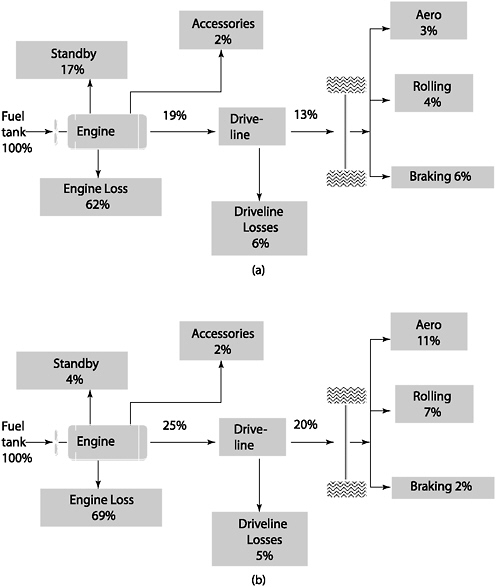
I'll just run the math for an electric car with a 95% efficient electric motor, assuming 0% driveline losses with direct drive and no transmission, with no standby losses:
City:
  Engine + driveline + standby: 5%
  Aero: 3%
  Rolling: 4%
  Braking: 2%
  Accessories: 2%
  ---
  16% (already 6.25 times more efficient by going electric)
Highway:
  Engine + driveline + standby: 5%
  Aero: 11%
  Rolling: 7%
  Braking: 1%
  Accessories: 2%
  ---
  26% (already 3.85 times more efficient by going electric)
Rescaled to 100% by multiplying each term by (100/total):
City:
  Engine + driveline + standby: 31%
  Aero: 19%
  Rolling: 25%
  Braking: 13%
  Accessories: 12% (rounded down to make 100% total)
  ---
  100%
So we can see that city driving is dominated by engine efficiency and highway driving is dominated by aerodynamic efficiency. But both lose about 25% (1/4 of the energy!) to rolling resistance.
Googling "mileage loss percentage due to drag coefficient" and "mileage loss percentage due to rolling resistance":
For passenger cars this means that aerodynamics is responsible for a much higher proportion of the fuel used in the highway cycle than the city cycle: 50% for highway; versus 20% for city. This means that if you make a 10% reduction in aerodynamic drag your highway fuel economy will improve by approximately 5%, and your city fuel economy by approximately 2%.
A 10 percent decrease in tire rolling resistance resulted in an approximately 1.1-percent increase in fuel economy for the vehicle. This result was within the range predicted by technical literature.
Converting these for electric in city and highway by multiplying by 6.25 and 3.85 respectively:
City:
  Each 10% reduction in aerodynamic drag increases mileage by 13%
  Each 10% reduction in rolling resistance increases mileage by 7%
Highway:
  Each 10% reduction in aerodynamic drag increases mileage by 31%
  Each 10% reduction in rolling resistance increases mileage by 4%
  Lucid Air: 0.21
  Tesla Roadster: 0.35
  Tesla Model S: 0.24
  Tesla Model 3: 0.23
  Tesla Model X: 0.25
So the Lucid Air has about a 10% better drag coefficient than the Tesla model 3, which gives it (at most) 13-31% better range city-highway. I think this is a liberal estimate, and that drag coefficients will never be below about 0.20, so improvements here will probably be marginal from here on out.
It seems to me that a better return on investment might be to fix tires. Someone needs to think outside the box on this and create a tire that acts stiff at high speed, but still grips while cornering and braking. Eliminating this resistance would add 100 miles to electric car range.
I ran this math from a first order perspective, to give an idea of relative costs. I'm sure it's off (since drag is nonlinear), but it helps visualize where the energy goes. Seeing that accessories use as much or more energy than regenerative braking was eye-opening for me.
Oh and you don't even want to know about bicycles. The upright position is the worst possible, and wastes most of the rider's energy. I wish recumbants were safer and more affordable, although this matters less each year with improvements in electric assist, mostly from reduced cost and better batteries.
I do remember reading an interview with a guy in charge of the electric Clio development, and he basically said something along the lines of "we could have easily put 2x as large battery in the Clio, but then your average driver would need to drive it for at least 10 years before the car became a net benefit for the environment". These massive batteries have an environmental cost is what he was saying.
I agree that massive batteries have an environmental cost that has nowhere near been researched thoroughly. I too think that they are not advanced enough to be easily be called a "green" option.
That said, Lucid is not improving range through battery pack addition, but rather through increased efficiency which reduces the size of the pack, which is promising.
From their press release: "Lucid’s (efficiency) breakthrough is not merely just a few percent; we are talking about a significant improvement, which I shall cover further on September 9th."
And yet the Zoe (the electric Clio) has gained battery size instead of going lower in price over the years. I wish they'd actually go all in on the ~150km range city focused EVs. Cheaper lower-range cars would fit well a lot of second cars at least in Europe and I suspect in a lot of other places.
Given the number of job openings (491) for the company, who actually works there now? By that I mean, how can they already have a car, or know these kinds of specs, when there are that many positions to be filled...
Most EV conversions start with a manual transmission car and leave the transmission in, only because it's easier that way. (Just need an adapter plate to replace the ICE rather than replacing the whole gear box, etc.)
So in those cases, people do sometimes fiddle with gears while driving, mainly for fun I guess; but most often they just leave it in 3rd and drive that way.
Because they aren’t necessary for electric motors at anything other than the most extreme applications. They add weight, complexity and expense for no good reason.
(A dual motor design could simulate the benefits of two gears by having different final drive ratios for each axle.)
To be pedantic, EV do use gears. Most of them have differentials and some gears with a fixed ratio.
What most don't have is gearboxes to change the ratio. The exception is the Porsche Taycan with 2 gears in gearboxes, the second gear slightly improves the acceleration at high speeds and improves the efficiency at high speeds. Accelerating super fast when you are already above the speed limit is not very useful for most people so most electric cars have no gearboxes, despite the slightly better efficiency. It's too complex and expensive. An electric engine has a lot of torque, you need a really good and expensive gearbox to handle it. It makes sense on a Porsche, but not on a Zoé.
Tesla has another alternative on the cars with two motors. They don't have the same gear ratios. The rear motor is used more at low speeds and the front one is used more at high speeds. It's a bit less fast than the Porsche solution but much simpler and cheaper.
In both cases, having different gears indeed improve the efficiency. I think the Tesla solution is very clever but requires two motors, so it's not perfect either. Most eletric cars have a single motor.
It's not 13% larger. They purport to be making batteries that are more efficient, so they get 13% more power than Tesla's batter pack with a smaller pack.


My rule of thumb when it comes to all breathless headlines around battery technology is that "I'll believe it when I see it". It's one thing to achieve these specs for batteries when n = (small number), but can they be affordably built at scale?