What a great computer. Way ahead of its time. Still usable today. It is one of the last computers produced where all the components are well documented.
The legacy it left behind is huge. Whenever I meet another dev and find out that we have similar background it is like meeting an old friend.
The computer might be discontinued but it's legacy will live on forever.
If ever the modern open source community needed a Manhattan project / holy grail, it is this:
> “... [a computer] where all the components are well documented.”
I am convinced that the appeal of the Amiga, and retro-computing in general, isn’t just nostalgia - it’s making a stand against the bottomless complexity and disempowerment of modern computing.
>I am convinced that the appeal of the Amiga, and retro-computing in general, isn’t just nostalgia - it’s making a stand against the bottomless complexity and disempowerment of modern computing.
Agreed 100%. I was born well after the original home computer movement was over and the idea of doing things like graphics and audio simply by writing to registers seems nothing short of magical.
It is this for me - since it's so heavily documented and we have the schematics it's super easy to troubleshoot these machines and to build new expansions for them today.
I think the Commander X16 intends to be that computer where all the components are well documented and simple enough for a single person to fully (or almost fully) understand.
The custom chips achieved a lot of functionality with a low transistor count due to clever design[0].
AmigaOS[1] achieved a lot of functionality (preemptive multitasking with priorities, fast interrupt response, elegant APIs[2]) and low overhead despite.
Links are Amiga as of ~1991 (ECS and AmigaOS 2.0).
Totally agree. That entire team was ahead of their time, and arguably produced more efficient and elegant technology than many in the industry do today.
Also if I remember correctly, Jay's dog helped. Cannot forget the pooch...
Very good point. The combination of technical excellence and easily available, open documentation for all system components is also what I find most compelling about that whole ecosystem, and I haven't seen it replicated since. Hopefully we'll see something like that in the not-too-far future, as newer open architectures become available.
In many ways it is still ahead of its time today. All electrical signals coming from user input devices are causing interrupts in the CPU resulting in a jmp directly into the interrupt routine which gives you the unmatched I/O latency and responsiveness. In a world of USB polling, CPU sleep/wakeup, compositing desktops and slow switching LCD-Displays it is easy to see why people enjoy going back to the Amiga for good old times because some things really were better.
I still know Amiga inside out, even after all these years. I don't have to look up that $dff180 is palette entry 0. Or how to set up BPLCON and bitplane pointers, etc. in a copper list to set up a graphics mode.
Alternatively you could of course do those the "proper" way through exec.library vector at address $4. But the name of the game was to extract all the performance available and that meant bypassing the operating system. :-)
Programming Motorola 68000 was so simple and enjoyable. A very elegant and orthogonal design!
OMG that Epyx joystick [1] in the screenshot brings it all flooding back! I hated that thing so much that I went to my local arcade parts dealer, bought a stick and buttons, built a plexiglass housing and circuit board (designed in Deluxe Paint) in the electronics lab at my high school, and cannibalized that horrible Epyx joystick for its plug. Best decision I ever made! SOTB and Turrican were so much nicer with an arcade stick. I even added toggle switches to reroute one of the buttons to "up" (since many games used up for jump).
I still have the buttons and joystick, though the home-built plexiglas housing didn't fare so well over the years.
I enjoy seeing how people use old tech. I never really understood the appeal of just "getting them working", which seems like fixing up a classic car and not driving it. But seeing how they are still in production is interesting to me. About 15 years ago I was at a cable access station and they were still using an Amiga; I think it was for captioning. HD did it in, I expect, but it was neat to see it getting use in the 21st century.
I totally agree it's the biggest leap I've ever seen in a computer, I just thought everything would be getting better at the same rate for years. The only thing that happened was that PC CPU's got so fast you could have real time 3D graphics at a given point but things would not get dramatically better in terms of colors, resolution or sound anymore.
Especially given the fact most people came from an Apple II, bleep bloop 4 generous colors PC or Commodore 64 the difference was just day and night. Only Mac users had a similarly large improvement but it was still black and white and silent.
>Only Mac users had a similarly large improvement but it was still black and white and silent.
The Mac was a clever marketing feat.
The hardware could be summarized as 68000 + unaccelerated 1bit framebuffer. The OS had an easy to use GUI, but didn't even multitask at first, and had only clunky cooperative multitasking later.
But it sold well. Despite the ask price was insane for what it was.
This isn't even remotely true. Well, the insane price part is, I guess. But speaking as someone who was around then, the Mac was impossibly advanced, compared to the C64, Apple II, IBM PC.
I went from a Commodore 16, Amstrad CPC 464 to Amiga 500. IIRC the Amiga was about £100 more than the CPC in the later eighties. I'm sure many a user could run off a list of their top 10 games. I still play Civ to this day, about the only game I play actually.
It took me a great deal of time to track it down - and I only have it as a PDF, never found a physical copy. Long-running saved eBay search still active for it. :-)


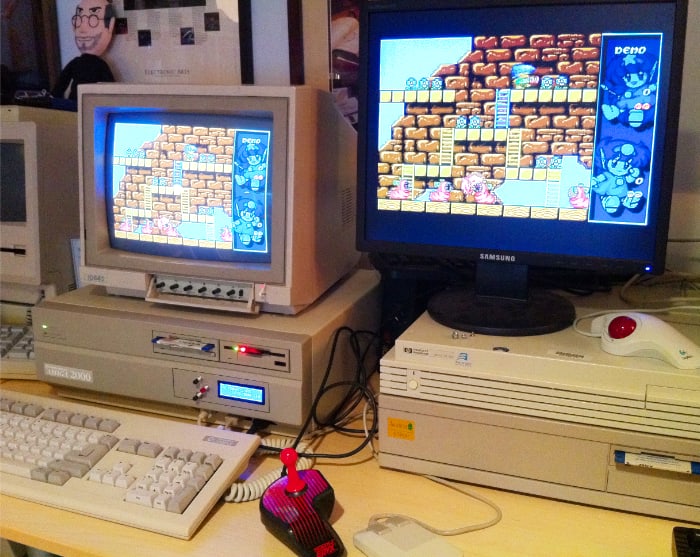
The legacy it left behind is huge. Whenever I meet another dev and find out that we have similar background it is like meeting an old friend.
The computer might be discontinued but it's legacy will live on forever.