> There are a whole bunch of popular interview questions
As a very personal strong opinion, this makes me groan.
I'm not concerned If someone happens to know some esoteric trick that they could Google search (Unless of course you're applying for a position at a company that manufactures very low level devices like microcontrollers or embedded systems and questions like this are _actually relevant_).
I'd rather know whether or not they are a pleasant person, are a team player, whether they have leadership aspirations, and take responsibility.
> pleasant person, are a team player, whether they have leadership aspirations, and take responsibility.
I know the above is a popular opinion, but I've worked as a SWE at a company A that had a "technical interview" process and Company B that didn't have a formalized one.
I would much, much prefer to work at company A (pay differences aside) because of the type of person who passes these interviews. It can be quite difficult to determine someone's capability at interview-time. But company B had lots of competency "false positives" (in my view) whereas company A had very few. That's the value of a technical interview.
That said, of course the XOR solution would never be the only one accepted, but it would probably get you brownie points here.
> company B had lots of competency "false positives"
The thing to note is that, in exchange for this, Company A (probably) had a lot false negatives. So it comes down to whether you'd rather missing out on someone that would have been beneficial for the company (false negative) or have to deal with accidentally hiring someone that is not a good choice (false positive). The best choice to make depends a lot on the situation.
Maybe you feel like you are being inclusive and warmhearted for praising soft skill vs 'teh codez skillz', but please also consider that tech and programming jobs is like the last refuge for people with high technical aptitude and perhaps less social soft skills regarding the meta political and expectation games, eg people somewhere on the autism spectrum.
Perhaps such interviews are overused but if the interview is purely soft, and about "sell yourself to me", you will also be biased towards some people.
I mean of course it's important to be able to work together in a pleasant way, but when someone's main strengths are in the technical aspects, they may like to be able to showcase that too. And yes of course in the age of high level frameworks and glued CRUD pruducts, some programming jobs are more social than technical. But not necessarily all.
And I'm seeing lots of this sentiment nowadays on social media, that all "allegedly" merit based nerdy "gatekeeping" is merely about white male privilege and hence not inclusive.
Nobody complains about puzzles in tech interviews. People care about uncreative "did you read this book about interview questions" questions. If you want to test tech knowledge in tech interviews, ask a question that isn't in any book. That takes a lot more skill as an interviewer to pull off, but if you're a hiring manager, surely you can find someone on your team qualified to design a puzzle.
Google's policy is to extensively discuss interview questions internally, and blacklist any that are leaked. They are still complained about near-constantly on any tangentially related HN thread.
The attitude is often quite strange. Like on Twitter I saw a few days ago that many were riled up about the fact that a prof would ask how to solve Ax=b (linear algebra) for a deep learning / computer vision PhD position. People were calling this unnecessary gatekeeping... I'm like that's just a warm-up question to get comfortable... But apparently the loud online hive mind opinion is that all that should count is soft skills and that everyone is equally able. People are even calling out professors on Twitter (who then engage, for some reason) for saying they are looking for "outstanding" PhD candidates. Because this is apparently too exclusionary language, everyone is equally outstanding or something...
To be fair, you would not actually need to know how numpy.linalg.solve works to use pytorch. Solving linear equations is an extremely deep subject on its own, featuring a lot of difficult and sophisticated issues related to numeric stability. Entire books have been written about how to solve Ax=b with awareness of the nature of floating point arithmetic. Machine learning researchers are generally unconcerned with those topics.
As everything in the world of knowledge, this topic too has a fractal nature. There's a difference between what you just said vs "well, optimize it with gradient descent, yoloswag" or "just invert the matrix A". If you say something something pivot selection, Gauss elimination, iterative algorithms, QR, LU factorization, backslash operator, pseudoinverse, under and overdetermined systems and can roughly handwave your way around roughly explaining what these things are about, it's probably already very good for this job. This prof probably wasn't interested in the tiniest of numerical stability details.
Except solving linear functions has a clear role in any field that makes use of linear algebra. Interviews that require memorizing volumes of pointless trivia unrelated to the work at hand are completely different.
Yes, in practice this interview style now achieves exactly the opposite goal that it was created for. That is, originally people wanted to base hiring on general problem solving skill, mapping out a problem domain with relevant questions, proposing solutions, identifying tradeoffs, reacting to a change in problem statement, etc. based on a pure computer science foundation, independent of ever changing software frameworks, libraries, APIs etc. Precisely because memorizing the specific steps of creating a CRUD mobile app in today's workflow is not useful later on. The problem is, Goodhart's law kicked in and performance in such puzzles became the target to optimize for, so it stopped being a good measure, because now people have to explicitly study for it from books and online courses and practice sites and so now it measures more of the effort you're willing to put in to jump hoops instead of actual problem solving aptitude.
An alternative could be to ask about a recent real-world project of the applicant, but that's also easier to rehearse.
> I'm not concerned If someone happens to know some esoteric trick that they could Google search (Unless of course you're applying for a position at a company that manufactures very low level devices like microcontrollers or embedded systems and questions like this are _actually relevant_).
Erasure correction is a very useful trick for data-engineers. I don't think this is a microcontroller trick, as much as a data-resliliency trick.
The XOR-trick is how you implement RAID5 most efficiently. A proper discussion / interview would probably describe the XOR trick, and then see if the engineer is smart enough to understand the difference between erasure and errors.
--------------
With a blog post describing the XOR trick ahead of us: now I ask you (the audience): what is the difference between an erasure and an error? Why can this XOR-trick protect against an erasure, but NOT an error? And how does this relate to RAID5's known failure cases?
But at that point, I'm interviewing for someone who has passed a data communications class.
> However, I don't see how you would know the locations in this problem?
Well, that's just from the blogpost itself:
> Application 2: Finding the Missing Number
> You are given an array A of n - 1 integers which are in the range between 1 and n. All numbers appear exactly once, except one number, which is missing. Find this missing number.
We can "find the missing number", but we don't know where to "put" the missing number. If you want to put the "missing number" back into the sequence, you still need to know the location to put it into from some other mechanism. (Ex: hard drive #5 failed, so you know to put the number into slot#5).
----------------
Application 4 starts to get into "partitioning", which is getting dangerously close to sparse parity-check matrix and LDPC graphs.
Ah, do you mean that solving the problem described in the blog-post helps actually using erasure coding, since it requires knowing which parts are missing?
> But at that point, I'm interviewing for someone who has passed a data communications class.
This is basic data-communications stuff. But there's a reason why data-communications isn't exactly a commonly taught subject: its niche and not really generally applicable IMO.
My main point is that the XOR-trick is a decent data-communications question. But I don't know how generally applicable it is to other programming fields.
> I'm not concerned If someone happens to know some esoteric trick that they could Google search (Unless of course you're applying for a position at a company that manufactures very low level devices like microcontrollers or embedded systems and questions like this are _actually relevant_).
The "XOR trick" actually nearly sank me on an interview once, I'm assuming because the interviewer shared your opinion. One of the questions they asked me to solve was the "n - 1 numbers in a list" question the article talks about - I promptly came up with the XOR solution because I have more background in low-level work than the high-level finance role I was interviewing for. Turns out, they had never seen it before, didn't really understand how/why it worked, and they took a lot of convincing to accept it as correct.
I think I only still got the job was by then proceeding to also solve the problem the "normal" way.
I think it kind of depends on the type of programmer one wants to hire. There are different roles, solving different types of problems.
There are places for people with technical brilliance, there are places for people with social brilliance, with both, and with neither. That's healthy. You want a diverse economy with different types of positions for different types of folks, and vice-versa.
If I ask a half-dozen questions like the xor trick, I'll have a filter for one type of technical background. Whether you know each of them is pretty random, but whether you know none of them or most of them is not.
Being able to interact well with others is part of being a valuable employee. You can be the best engineer in the company, but if nobody wants to work with you, it's going to negatively impact the value you bring to the company.
Because, as you move up the management chain, understanding how people work and how groups of people work becomes more important than technical brilliance. The job of a manager is to create a healthy working environment where people work effectively, and are well-aligned to a common goal.
That's hard.
You don't just practice that by living.
That's made easier by having people lower down who are helping and not hurting.
Nobody wants to see the XOR solutions. These questions are really basic and only filter out the non-programmers. Any decent programmer should be able to solve all of these without a problem.
I wouldn't say "nobody" wants to see the XOR-trick solution.
Its just that those who DO care about it is asking about the general solution: Reed-Solomon codes, or maybe a more modern (harder to understand) variant: like LDPC or Tornado codes.
Anyone who needs to recover *ONE* symbol from a data-stream with noise actually needs to recover two, three... four... symbols in the general case.
One symbol of erasure recovery is the weakest-of-the-weakest of error correction codes. Its even weaker than the single-error-correction / double-error detection Hamming Code (discovered back in 1950s).
XOR-trick is your "basic parity bit", and is the stuff taught to undergrads to wet your appetite for error correction codes (well... erasure correction in this case. Since XOR isn't strong enough to actually correct an error. Only an erasure).
I don't see how the problem corresponds to erasure coding.
Typically in erasure coding you know the locations of the erasures.
Here, you don't know the location.
Maybe you can elaborate on how it relates to erasure coding?
As long as a^1, a^2, a^3... are distinct, then this matrix is invertible (aka: all rows / columns are linearly independent). In a GF(2^8) field, there are 2^8-1 distinct values (the values 0x01 through 0xFF), making a 255x255 matrix. The polynomial "x" (aka: 0x02) is often chosen to be the value of "a", but it can be any primitive element that loops around all 255 non-zero numbers and still work.
This Vandemonde Matrix has a very simple construction, but it is non-systematic (the data is "mangled" in encoded form, so we need to invert the matrix to decode). However, this non-systematic form is easier to see some patterns. Now lets take the 1st column:
    1
    1
    1
    1
    1
    ...
Hmmm... look familiar? What happens when we multiply the data vector with this column?? It becomes a bit more obvious:
                       1
                       1
                       1
    [d0 d1 d2 d3...] * 1
                       1
                       1
                       1
                       1
                       1
Remember, in Reed-Solomon, you perform operations over GF(2^blah). So all multiplications are GF-multiplications. But these are all multiplications by 1, so we can just ignore the complications of GF-multiplication entirely. (Even in GF(): a multiplication by 1 is just the identity).
To finish the matrix-multiply, we add everything together. But we do GF-addition (not regular addition). A GF-addition is also known as XOR. So the ultimate answer is:
d0 XOR d1 XOR d2 ...
Which so happens to be the first parity bit of the non-systematic Reed Solomon code. As such, we've proven the relationship between the "XOR trick" and Reed Solomon (Vandemonde construction).
------------
The hamming-distance between codes is 1. We can correct floor(1/2) errors (aka 0 errors) and 1 erasure. As such, this "all 1s matrix" is a 1-erasure punctured Reed Solomon code.
I'm familiar with some subset of coding and number theory, so you can assume at least some more knowledge (Galois Fields, or basics of RS codes for example).
Small nitpick: The Vandermonde matrix actually isn't square. It's a (k × n) matrix, (where typically k ≠ n). Therefore, it can't be invertible.
I see that many codes contain a parity bit (for example the extended Golay code), however I don't see how the operation of recovering "the missing number" could be implemented in terms of a code and its encoding/decoding algorithms.
It describes a way to recover the missing number by constructing a Vandermonde matrix using the given numbers. This would correspond to constructing a generator matrix of a specific RS code [1].
However, after this I'm not so sure about the relation between encoding/decoding and recovering the missing number.
In the end they also factor a polynomial (that could be something analogous to the error locator polynomial?).
[1]: although I'm not sure if it's strictly an RS code
Note: Backblaze here uses "vertical data" (G * data) instead of what I did earlier "horizontal data" in the form of (data*G). But otherwise, still a good blogpost.
------------
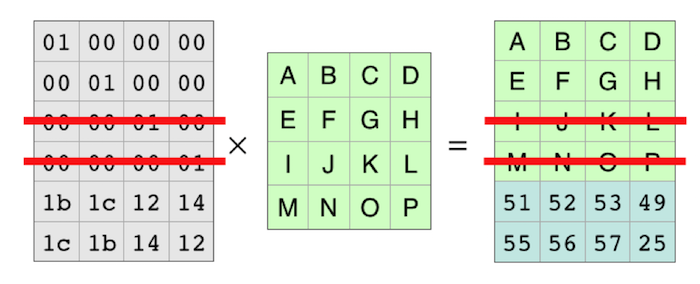
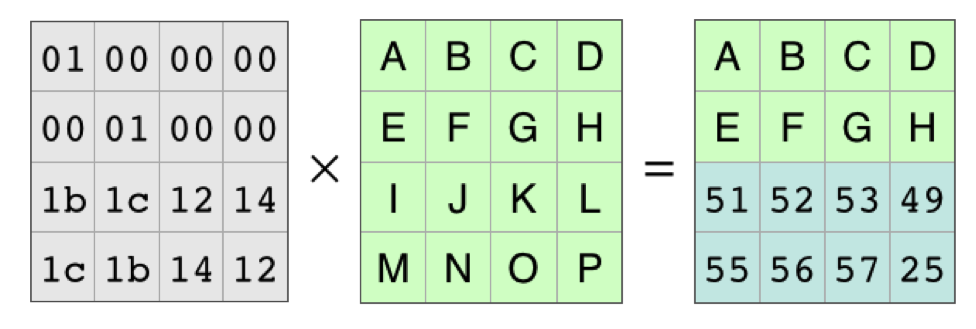
So if you have 5 data + 1 parity, you now have a 5x6 generator matrix, giving you one extra column for erasures.
If one column is erased, you replace the erased column with the parity column, creating a 5x5 matrix.
As long as all columns were linearly independent, the resulting 5x5 matrix remains invertable.
The specific matrix multiplications / inversions / operations are well documented in that blogpost.
-----------
EDIT: Erasure decoding is much easier than error decoding. Error decoding requires figuring out the "locator", and then applying the calculated errors at those locations. Since we already know the locations in an "erasure" situation, we can just manipulate the matrix in an obvious manner.
--------
EDIT2: Ah right, the "systematic form" of the Vandemonde-Reed Solomon construction is to perform Gaussian Elimination on the non-systematic matrix (with the goal of forming an identity-sub-matrix). After gaussian elimination, the "column of ones" (or the simple XOR) disappears. (Erm... row of ones in the Backblaze pictures)
So maybe the Golay code you're thinking of is a better example as a matrix with an explicit parity bit.
I would be interested in a way based on coding theory that solves the problem in the blog-post.
Something of a form similar to this one would be a solution to me:
  def find_missing_number(nums: List[int]):
    # 1. Define some code C (possibly using nums)
    # 2. Encode a message using C (or interpret nums as a word or codeword)
    # 3. Do something with the word
    # 4. Find the locations of the errors in the word
    # 5. The locations of the errors tell us the missing number(s)
The answer on stackoverflow seems to use methods very related to RS decoding, however I can't quite squint enough at it to see, whether it could actually be solved using the exact same methods in RS decoding.
Something in the middle might be useful though. Discussing XOR and it's properties (the first part of the article) with the assumption the interviewee doesn't know them... and then working through what it means you can do with it (the second part) could be a useful exercise. "Given these properties, what can you do with it". To some extent, it still means the person that knows the tricks will do better.. but much less so.


As a very personal strong opinion, this makes me groan.
I'm not concerned If someone happens to know some esoteric trick that they could Google search (Unless of course you're applying for a position at a company that manufactures very low level devices like microcontrollers or embedded systems and questions like this are _actually relevant_).
I'd rather know whether or not they are a pleasant person, are a team player, whether they have leadership aspirations, and take responsibility.