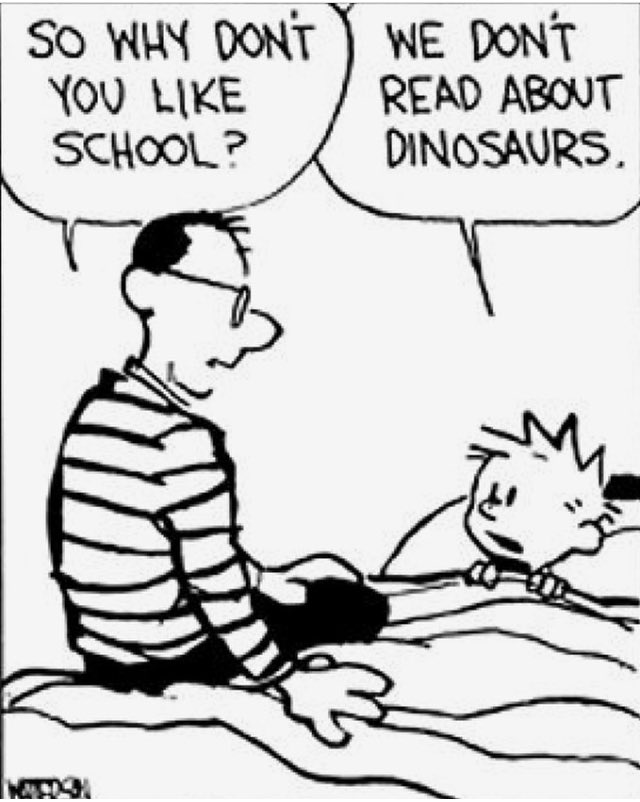
Kudos to this kid. How many of us are getting bored to death by the constant coverage of politics yet suffer silently? At least he had the good initiative to write to NPR to offer feedback on something that was important to him. Nice job, kid!
I complained a couple years ago when all afternoon they were running some completely inane story about trump staff having problems finding light switches in the whitehouse and repeating it multiple times during the day.
Political coverage I can take and I doubt I liked trump any more than the reporters at NPR do, but that's just factionalism. I find it really problematic[1]. If there isn't anything relevant to report on, music (or dinosaurs) would do fine.
But I'm not a cute kid, so I didn't get a response. :D
NPR has a very formulaic editorial/programming approach. They pick a topic and grind it for a month. Personally, I can’t listen to them for more than a week before getting bored.
That's the thing. There almost definitely were much more important things happening around the world, yet they talked about that. Most news organizations do the same thing, which is part of why people call them biased.
I too find light switches in large and unfamiliar houses to be confusing. Of all the things Trump could be criticized for, I agree that this one is not fair.
Kudos to the parents for encouraging / helping that behavior too. Too many people grow up believing it's useless to interact with the world at large because they can't affect it.
I rarely listen to the news now. I swear that I hear “Democrat” or “Republican” within the first few words whenever I turn on the radio to hear NPR. It drives me crazy.
Same here, their bias used to be in the form of leaving out a point of view, or bringing on a moron to represent a point of view as a punching bag. Or the opposing view was presented by someone slightly to the left vs someone on the far left. For the last four years it has been a reflection of fox news. I miss the old subtly biased npr.
I gave up NPR for podcasts a long time ago. There is so much high quality content for different niches now. I wonder if others have made the same switch.
Never got as far as their podcasts. I have given up on their news though — just feels really partisan and stale (and I’m saying that as someone who leans left)
Lots of new people entering political discussions over the past five years, it was the best drama in town. It was likely fantastic for readership, but I suspect everyone will move on now that politics will be boring again. As it should be.
Politics ain't gonna be boring again for a while yet, though I can understand why you might push that narrative. Trump was a mere symptom of political dysfunction that includes both parties. Until our government can actually address the needs of its people we're going to continue swapping back and forth between the two parties.
Eh, I wasn't pushing a narrative. I'm not even from America, so I have no horses in this race. It's just not comically dysfunctional anymore, and back to being real politics. The politics may be controversial still but it's hopefully just policy, not subterfuge, scandals and insurrections. I guess we'll see though!
"Real politics" would involve considerably more aggressive movement from the democrats to shut out the republicans for 2022. I see the republicans gaining the house a the current trajectory, with nothing more than a one-time, means-tested, under-delivering $2000 check, let alone more aggressive policy on the horizon to address economic crisis.
I think that's part of the problem in getting a proper health care system. Some think they will lose what they have, rather than gain quite a lot, in the switch to a modern public health care system.
Buying a few barrels of oil and tracking them from ground to fuel tank and making T-shirts starting from cotton and ending up as a final product are really good journalism.
Then they have the episodes where they try to sell a bunch of christmas trees, you can skip those :D
What I do like about NPR stuff is that they edit their podcasts, I just can't handle a 3 hour meandering chitchat flowing in and out of different subjects.
In the UK we have a rather unimaginative news diet of Covid-19, Brexit, lol-Trump, repeat ad nauseam.
One day our media will have to discover doing proper journalism - I think it will be quite a shock when the news stops writing itself. It's been like this for roughly five years (or 50, depending on how much wine I've drunk.)
I was feeling that I wasn't as informed as I used to be about world affairs compared to the old days of reading the newspapers, mainly because of how UK news are now focused on promoting UK/US news. The stories are there, on the guardian, the times, etc., but it's hard to find them. Whether it's the algos, or that screen space is harder to balance coverage, or whether it was easier to skip to the back in newspapers to read the world news, I'm not sure.
So I've been trying Al Jazeera as an additional source, and I have to say, it's good. I feel it's fairly unbiased, a bit left leaning, the writing quality is high, the occasional piece that's not is because it is written by a foreign, local, journalist that offers real local insight on an issue (e.g. they had a Tunisian journalist writing about the anniversary).
I agree, Al Jazeera is worth a watch, DW News (German) and France 24 are also alternate source of what's happening elsewhere - all English language, BBC is another alternative.
Also what do you expect? COVID-19 is ongoing and is still killing as near as makes no difference 1000 thousand people a day in this country, Brexit has effectively just become "real", Trump is in a major trial. It's in the news because that is what the news currently consists of...
> It's been like this for roughly five years (or 50, depending on how much wine I've drunk.)
Rosé-tinted spectacles.
"Proper journalism" is vacuous at best and a dog-whistle at worst - since you refer to 50 years ago the term "Shabby Journalism" with regard to watergate should ring a bell.
In the age of helicopter parents zealously micromanaging kids' screentime, there are still a lot of kids who functionally aren't in the age of the Internet.
I'm not a parent yet. For the parents out there: is there a way of making sure my future kid will like dinosaurs? I have so much to discuss with that kid!
One of the early realizations I had as a parent (more-so after my second) was that it's wrong to assume that I have the authority to "make sure" my kids like something. They are their own person from day one, will like what they like, and I personally feel that you're setting yourself up for a good, healthy, relationship with your child if you accept this early.
This doesn't mean I can't _encourage_ things; if my daughter displays an interest in dinosaurs, I will be sure to gently fan the spark. If the spark goes out, no big deal. There will be more interests, and my job is to make sure I'm encouraging an exposure to a wide range of them.
My friend's youngest is little miss princess. Everything has to be pink and sparkly, and tiaras are the height of fashion.
My friend was pretty dismayed at first, because she's quite feminist and has been very careful to raise her daughter with gender neutral toys, media, etc. All her family and friends have taken similar precautions, and if anything, this kid has been raised to see "girly girl" things as quite negative.
Ultimately, my friend came to the same conclusion as you--you can only shape your kid so much. For whatever reason, her daughter is just naturally obsessed with being a princess. Genetics probably play a role, plus other far more subtle environmental factors.
My friend has embraced her duaghter's interests--after all, feminism is all about letting women chase whatever interests and life paths they want! But we still chuckle at how unlikely it seems for her, of all people, to have a daughter so obsessed with pink.
Good point – we need not marry careers to color. People always forget "pink" used to be a color reserved for little boys (as a derivative of red) and baby blue for little girls (derivative of indigo).
In reality, the number of astronauts is pretty limited as is the number of princesses so it is just probabilistically unlikely that there is some combination.
In fact, I bet the percentage of princess astronauts vs. non-princess astronauts is pretty close.
Wouldn't surprise me if a princesses are more likely to become astronauts than an average person. If they really want to go to space they have things to offer in return.
Our pediatrician made a quip once about a family that came in and said "Our girl only plays with the dolls and our boy only plays with the trucks" despite the parents doing the whole "gender neutral toys" thing.
And her response was, "Yes, duh, that's what little boys and girls do"
My experience is that it's good not to limit what your children are exposed to or have available, but don't be surprised at all if they fit nearly every stereotype regarding boys vs girls.
So the pediatrician was basically implying that saying that trucks are for boys and dolls for girls is a construct of a part of society trying to reproduce its politically charged gender roles is a construct of a part of society trying to reproduce its politically charged gender roles?
I think the problem here is that some people made the fire burn so bright that it's impossible to even talk about the issue without fanning the flames.
The reason people worry about their daughters' having an affinity for princess stuff is rational.
It is because, however unfair and wrong, as a society we have associated those symbols with disempowerment and subjugation to men, and our culture has echoed and amplified that association, because it sells.
At the end of the day nobody wants their child disempowered, and many would make the terrible choice of suppressing their child's tendencies in order to protect them from that injustice.
I think a handful of ideologues have arbitrarily assigned those symbols negative meanings. There's nothing bad about girls playing with girly toys and to say that a child is subjugating herself to men because she imagines being a princess or a mom is a perverse interpretation of a normal childhood fantasy. It's also illogical - princesses having power over most men.
> I think a handful of ideologues have arbitrarily assigned those symbols negative meanings.
What's more likely, a "handful of ideologues" assigning these symbols, or the combined history of disempowerment of women throughout history assigning the symbols, which only started being disassembled this past century?
> There's nothing bad about girls playing with girly toys
You misunderstood what I wrote. I wholeheartedly agree there is nothing wrong with it at all. But embracing those aesthetic tendencies (which have nothing to do with being a mom) comes with a cost to the individual in society, not the least of which are being slotted as intellectually inferior. You'd have to purposely ignore the historical cultural signaling to deny it.
> It's also illogical - princesses having power over most men.
This is wholly irrelevant to the discussion, since we are talking about figurative princesses, not literal princesses who are daughters of aristocrats.
You're right that I am misunderstanding what you wrote. I continue to not understand what you are writing. I'm not even sure if we are in disagreement or not.
My position is that there are a handful of ideologues who have perverse beliefs that typically feminine things are bad or demeaning. These people are left-wing, academic, modern feminist types. They think things like "Wanting to be a princess is synonymous to wanting to subjugate yourself to men" or "Wanting to be a housewife will make people think you aren't intelligent".
The reality is that women and girls are, on average, predisposed towards "girly" stereotypes. More girls are interested in aesthetics, talking, emotions, etc. In the same way boys are more likely interested in things like fighting, guns, dinosaurs, trucks, etc. I think we should be equally fine with anyone interested in any set of subjects, but I also contend that the people I referenced earlier argue that girls doing typically girly things are undesirable and girls should be encouraged to pursue interests that boys typically do.
My argument is that predisposition (AKA nature) is only one aspect of identity, and that nurture plays a very important role. The nurture side (regardless of what direction you nurture in) has strong connections to cultural power structures that are loosely connected to nature, but far more connected to history.
Survival in society requires a lot of adaptation to cultural power structures and symbols, and that can rationally mean nurturing a child in the direction that might run against their natural disposition. Another example less encumbered by the topic of gender: a parent might rationally make a non-athletically predisposed child play sports because the child can learn useful teamwork skills through their participation.
Lots of men and women prefer to be submissive in some or many contexts, whether personal or professional.
Our overculture highly values the drive to dominate, win, take control, but make no mistake - this is not the inherent imperative of all human beings.
In fact, surveys indicate that at least in the sexual arena, about 75% of women prefer to be submissive. Many men do as well. This is the basis for consensual BDSM.
And lots of people do, as adults, more or less consciously prefer to be submissive in their life to bosses or spouses. There are many wise reasons to choose this path.
It may be true that parents don't want their child disempowered. However, it may also true that, at least as much as a child can want anything, the child wants to be disempowered. I find it really interesting that you and others don't even realize this is a possiblity - that's how much submission has been denigrated in our culture.
That means that the parents are pushing their child to do something against her own preferences and away from her own happiness, just because they don't like it. A rather foolish and selfish thing to do. But it's understandable given how little our culture can even acknowledge the value of honorable and confident submission.
> But it's understandable given how little our culture can even acknowledge the value of honorable and confident submission.
That's because outside of very specific contexts, "honorable and confident submission" doesn't exist.
Yes, respectful power differences in otherwise mutually beneficial relationships naturally exist, whether those relationships are platonic, professional, romantic, or very concretely in the context of activities like BDSM. These are, however, characterized by clear limits and boundaries, and a mutual agreement about the benefit of the relationship, including the power difference.
But social subjugation is not the same thing. It's about being disempowered in situations where there is no trust relationship that puts boundaries on the exercise of that power against the disempowered. For example, it's a job interview where someone's abilities are cast in doubt because their interviewer perceives their "princess" appearance or mannerisms.
That people conflate the two very distinct scenarios is baffling. The difference between them is quite simply a huge gulf of trust.
Moreover, by conflating the two, we delegitimize relationships that do involve respectful power differences, and destroy the mutual benefits that they can create. I also agree that the destruction of trust is central to this process.
I think you have something here, but I also think you have accepted the wrong dichotomy.
I would abandon the vocabulary of "domination" and "submission". And I disagree with the association with BDSM, because it is full of coercive symbolism: whips, striking, restraints.
A much better pair of words, in my opinion, is "to lead" and "to follow". The connotations are better.
Leading is understood to take effort, to be a service to the community, even the community of two. The follower chooses to follow, not because they are compelled by force, but because the leader knows the path. The leader is not giving directions merely to extract pleasure for themselves, but as a service; they are organizing the community for its mutual benefit.
Then, when you follow, it is not because you are being whipped, or choked, or physically restrained, but because you want to go where the leader is directing; they don't have to make you do anything. You are happy to let them make the decisions, because you trust their decisions to be good for you -- and they are.
And when you lead, you do not need to worry about maintaining coercive power, because you know that you can trust your followers to work together with you. Their eyes (and yours) are on your shared objective, not on who gets to be in charge.
I think the key difference between these two dichotomies is this: One is held together by coercion, and the focus is on who is in charge; the other is held together by trust, and yes, someone naturally takes charge, but this is for the purpose of achieving a shared objective, which is where the focus is.
I am saying that legitimate consensual authority exists, and that our society should allow it to exist, rather than tearing it down always by viewing it as violent. It does not need to be violent, or attached to violent symbolism. Instead of "master and slave", think "mother and daughter" or "father and son". Both sides of these relations have obligations, and both have dignity.
> At the end of the day nobody wants their child disempowered
Worth considering that this statement being obviously true and unobjectionable even when applied to daughters is the result of difficult work by generations of women, a part of which has been criticism of which portrayals of women are made available to young girls.
You can argue that that criticism has become less relevant today, but ironically that’s in part thanks to the critics’ success.
"Princess" is a great job to have. It's 100% monarchical privilege and zero responsibility. There's nothing disempowering about it. The shiny "baubles" are symbolic gemstones. A little girl drawn to "being a princess" is like a little boy drawn to "being a rich guy" with a monocle and a top-hat.
(We have even met the man that little boy grows into: Donald Trump.)
Behold I have just set up a totally different complex of associations.
Some days ago I found a comment here in HN talking exactly about that, how siblings want to differentiate from each other. It would be nice if someone finds an actual research paper that delves into this.
My favorite analogy about being a parent is that children are like a tightly furled lotus buds, and our job as parents is to give them the room to unfurl into the unique flowers they are, rather than clay to be molded into whatever form we see fit.
Molding them to follow your passions may seem to work initially - kids naturally want to please their parents - and it certainly could happen to align with their personal excellence, but it can also ultimately rob them from developing their own unique talents.
Sure, but a child often can't or doesn't know how to discover things that aren't in their immediate environment. A parent's job is not to force them to like particular things, but to expose them to things that they may be interested in. A curator if you will. A curator has a very important job, and the things that are left out can be just as important as the things that are included.
I had a colleague who was into cycling. It was his uttermost passion, the biggest thing in his life.
His kid didn't like cycling, he likes wakeboarding. My colleague absolutely hated it, said it wasn't really a sport, said you didn't have the suffering that you have riding a bicycle.
After some weekend on one of his rides (alone), he came across a father and a son. The son was all into cycling, took his dad everywhere. The dad didn't really like cycling, but his son was so passionate that he was willing to ride long distances with his son.
My colleague noted "I wish I had such a son", but in my mind, I thought "Your son probably wishes he had such a dad".
You will have to decide what kind of father you want to be, the one where your kid follows your passion, or where you follow your kids passion. The first option will not result in a close relationship.
And as a father of 4 myself, it seems most kids don't really have an extreme passion. And if they do, it shifts quickly. Plus, when you talk about your passion all the time, they will soon be pretty bored by it, don't want to hear about it anymore.
Just enjoy the time you spend with your kids, do fun stuff that you both like. You can always discuss dinosaur stuff with people who are as passionate as you.
In my observation, pretty much every 5 year old loves dinosaurs. So just wait. Enjoy it while it lasts. Most kids move on... some not.
When my kid was 5, mom arranged for a couple of days of family vacation at a dig run by a museum just on the Colorado side of the Utah border, in dino country. You could pay a few dollars for a day of digging, where you paid them to move their dirt. :) Great fun for the kids. The 2 days we participated there was a herd of 5-6 year old kids, and associated parents, digging under the supervision of a quarry master. Said QM being a paleontology graduate student (one of those kids that never outgrew dinosaurs).
One of my most memorable moments as a parent: during lunch break as we were all munching on bologna sandwiches, chips, and orange drink that were part of the package, the quarry master was surrounded by an adoring crowd of kids. One boy about 6 years old looks at him very seriously and says "I want to be a paleontologist when I grow up." -- the QM looked at him and said with full sincerity and seriousness: "Yeah. Me, too." The kid, of course, took that at face value and drank in the kinship. For us parents, the moment was an "Oh yeah, I feel your graduate student life. Half-done thesis, summer jobs at museums and a diet of ramen noodles. Keep the faith, buddy." I sure hope that guy is a tenured professor somewhere by now.
I sat down to watch Jurassic Park with my son just after he turned three. My wife thought that showed questionable judgement on my part but he absolutely loved it and instantly became thoroughly obsessed with dinosaurs. He’s almost 4 now and shows no sign of slowing down.
That doesn’t dispose of the question of my judgement - there’s some violence in that film so that’s not a universal recommendation.
Parenting is a total mystery.
EDIT: Just to say - kids go absolutely bananas for any of the scenes in either Jurassic World movie that feature a Mosasaurus.
I love this. And yes, parenting is a total mystery.
One thing I found to be true for me personally (not trying to imply universal truth here), is that so many instincts just take over.
Was never one to think I'd be ready for kids (who is?), but here we are and my partner and I are somehow managing. It's exhausting, but I love it so far. There is nothing quite like joining the imaginary world of a young child in their endless creativity.
They’re so great aren’t they. I only wish someone had told me to start younger and have more of them - but I bet I wouldn’t have listened. You can’t tell people anything.
Our first daughter didn't really develop a sense of fear until she was 4. Then it kicked in hard and took about a year for it to go to a more sensible level (she was afraid of almost everything for a period of time). Now, at 6, she likes things that scare her a bit.
We have 3 year old twins, and the boy is still fearless but the girl is not.
My oldest, a three-year old, is obsessed. I have done nothing to cultivate the interest early or specifically, he just gravitated toward them and now all we do is play dinosaurs.
I was cleaning stuff out recently and found a bunch of papers my mom saved from like 1st grade. What I learned about myself is I really, really wanted to be a car mechanic. Also made me realize that I don't really give a hoot about what 6 year old me thought, these days I don't even want to change my own oil!
Have him check out Dino Dana, Dino Trek, Dino Dan on Amazon Prime. My four year old is a big fan and will randomly drop some amazing Dinosaur facts he's picked up from those shows.
I have the theory that if parents push an interest too hard, the kid will actually dislike that interest. So hopefully you can strike that balance / get lucky.
In general observation, the kids are going to like what they're going to like.
While nature has its role, and both of our kids are skilled in math, and comfortable with the geek nature of puzzling over that which is unknown and becoming skilled at it, neither of them are into programming computers, despite both their parents having the background.
Instead, one's a visual artist. The other's a theater geek.
I opened the door to introducing them to programming, but with a light touch, as I knew a hard sell would make them hate it. They weren't interested, though I think one is starting to dabble with MineCraft mods. Fortunately, I half expected it, and they're good at what they like to do, so that will hopefully be a source of contentment for them in the future.
A great deal of that probably comes down to how much you respect/like your parent. I think both my sister and myself resemble our dad far more than our mom, and our mom definitely demonstrated her personal interest onto us. My dad in comparison, while not really engaging with our interests, certainly didn't actively try to get in their way like my mom did.
Also compare https://slatestarcodex.com/Stuff/genius.pdf (by László Polgár, whose three daughters are an International Master, a Grandmaster, and the strongest female chess player in history).
László Polgár has encountered lots of controversy about his view of child-rearing. My understanding is that his daughters have tended to express support for their childhood experiences.
Almost all kids love dinosaurs. I don’t know why but I have a theory:
They’re not allowed violent content of any kind. No horror, no blood, no gore.
But they’re allowed to watch these prehistoric monsters devour others from limb to limb. It’s actually ultra violent but the kids can watch it because it’s real, therefore natural, therefore science.
This is the same reason kids love big cats, sharks and other predators.
Anyway, if you want your future kids to like dinosaurs, just don’t let them watch other forms of violence. (Again, just a theory)
Almost every kid I know got the Nat Geo _Big Book of Dinosaurs_ at a early age and pored over it. My kid couldn't get enough of it, you could have put her on Jeopardy and I'd have given even money that she cleared that column.
There's something inherently fascinating about enormous creatures that used to walk the earth. Kids IME don't need much encouragement.
> is there a way of making sure my future kid will like dinosaurs?
In my experience it's unusual for kids not to be interested in either dinosaurs or fire engines at some point.
I once asked a fire department rep at an open house whether he liked fire engines as a kid. Turns out he loved them--no surprise--and really enjoyed paying it forward with new generations of kids.
Like others have pointed out, do not try to force your interests on your child.
However, “liking” dinosaurs is pretty likely to happen, if only for a time period in their life. All of my kids “like” dinosaurs, but one likes them far more than others.
For a time, we lived close enough to the Field Museum in Chicago to be able to ride bikes there. We got a membership and visited 50-100 times per year (seriously). They have a world-famous dinosaur collection, but it’s located inside a much larger exhibit that takes you through earth’s history and places the dinosaurs in their proper time period (if I’m remembering correctly it’s between the 3rd and 4th mass extinction event). There is so much information and it’s so well presented that you can’t help but enjoy it and learn from it. My kids have never seen Jurassic Park or any other pop culture dinosaur movies, and they didn’t need to.
There's really no way to make anything sure. From an early age they are influenced not only by you but also friends and other people. This will only increase as they get older.
What you can do is create an environment that encourages learning. Take an interest in them, and their interests, even if it's not the same as yours to begin with. Ask lots of questions! Then they will start asking you, too.
If there's one universal truth to parenting, it's that kids don't really do what you say, but what you do.
If you keep musical instruments around and play a little regularly when they are around, sooner or later they will try themselves. If there are books of dinosaurs around, and the parents take an interest in dinosaurs, sooner or later they will be curious to find out what's so fun about them.
My little girl is almost five so I'm not a very experienced parent but I'll tell you what I've learned. She is an individual and she's interested in her own things. Sometimes we share interests and other times, I have to seriously up my own knowledge (and beg for help on Hacker News) to share her interests with her.
For the most part, I just try to build a loving environment where she can feel secure to enjoy the things that she is into. I encourage her to be exactly who she wants to be. Luckily, I'm privileged enough to be able to fill her environment with interesting, somewhat age appropriate things.
Incidentally, here is one of the things that she is really into right now. I don't understand it, but she loves it enough to draw it fairly often. To this day, she refers to _ph_ as a 'really cool dude'. Armagon is another 'really cool dude' as well. I'm still not but I sure love that _ph_ and armagon are!!! :)
Edit - I'll find and link to an ask HN that I asked while she was having one of the biggest, most awful tantrums of her life. She wanted to see the ISS and was the angriest she has ever been when I couldn't remember the link.
"Me no yike you," screamed out at the top of her lungs while we were grocery shopping.....joy! :)
Some kids are simply into dinosaurs, others are into trains or superheroes. I don't think we have much control over it, and we should probably just go with their flow. My 4 year old is obsessed with trains, galaxy railway videos, and has recently discovered drifting trains and trains doing jumps on YouTube (simulations of course). Not much on dinosaurs, unfortunately.
They will be exposed to dinos because it is pervasive in children's culture (TV, toys, clothing) and education (preschool, elementary, museums, science centers, books).
If they like it is up to them. You can't push it. If they aren't interested at some point in time, they may be latter.
Someone on HN mentioned the book 'Titanosaur: Discovering the World's Largest Dinosaur' written by the two paleontologists who led the discovery - José Luis Carballido and Diego Pol. It's illustrated and seems to have very good reviews.
If you are excited about it and gladly read this books, chances are little one will too. You can make kids think X is cool easily. Mostly talk positively about X.
However, with the main hobby, at age of 8, peer pressure does a lot. And so does wish to be individuality. So your kid will like dinosaurs and debates about them with you, but to can't make it super obsessed or something. You can't make kid into copy of you and it would be harmful anyway.
Maybe forbid them to having anything to do with dinosaurs. But, provide a lot of tempting dinosaur information if they can find it. A bit like the parent whose child is "secretly reading under the blankets" and hasn't yet realized their torch has infinite life batteries...
(ours is 28. he still likes dinosaurs. we didn't forbid this, its endogenous in some genotypes apparently)
I recently bought a fairly large fossilized raptor skull mounted on a base for my office. It never fails to get a comment when I have visitors and having a hands-on relic from millions of years ago (even if it's just a cast) is really cool. I suppose my answer would be "tasteful fossil decor". Type in "dinosaur skull" on eBay and see what pops up!
Get some dinosaur kids books. Kids love it when you read with them and tend to latch on to the ones you make really fun. As others have said, nothing is guaranteed, but it will certainly improve the odds. Worked with both my kids, one girl, one boy. They are teenagers now and don't care as much about dinos now, but still think they are cool.
I talk to my kids about how birds are dinosaurs. I've trained them to refer to birds as dinosaurs. "Look at that blue dinosaur!" We get weird looks from other people, but it helps to solidify for them that dinosaurs were and are real.
As others have said, just show them dinosaur cartoons and movies and they are pretty much guaranteed to fall in love. For some reason, kids seem to be predisposed to liking dinosaurs at least a little.
You could adopt a kid that's old enough to already know whether they like dinosaurs. I'm not sure how adoption agencies will feel about this line of questioning.
There’s some great shows on Amazon Prime called Dino Dan, with follow-ups Trek’s Adventures and Dino Dana. All great fun. Live action episodic show for kids probably 3-8.
Facebook recently announced that they are going to modify their feed algo to reduce the % of political posts that show up.
NPR should do this to.
Actually, a better idea would be to focus all political coverage to a day of the week, Tuesday.
If every organization talked about politics only on Tuesday, then it would give citizens an easy way to stay sane by just ignoring that day.
We now know there are huge mental health tolls for getting wrapped up in this stuff, yet we continue to self-flagellate. Would love to see smart ‘leaders’ realize this and respond accordingly.
If people start purposefully ignoring you as a politican, how are you supposed to influence them? I don't think that they'll implement something which gives themselves a disadvantage.
They would still maybe get a date. I think it would work to everyone’s advantage. Then they could work the rest of the week without firefighting every day because of xyz on the media.
That could also be a solution, yeah. Then I guess the question is, how politicians feel about it.
But I'm sure this would be abused instantly. Some media outlets would probably ignore it to get readers who crave political news and some politicians would probably purposefully tweet or post on Facebook for the same reasons.
I wish the media understood it was in their best interest.
Trust in journalism is soooo low because they talk about politics so much.
If they talked about what is happening (there are an unlimited number of things happening, it shouldn’t all be political, e.g. new technology, structures being built, community activities, health procedures, e.g. teach people stuff) they would be appreciated more.
Funny...but, come to think of it, some of those < 300 utterances of the word must have been in this metaphorical sense, making the paltry count an overestimate of paleontological content.
I love how respectful and helpful the paleontologist they connected him with was. I'd imagine it's quite fun to have a career that you can nerd out about, but which also is appreciated by curious 8-year olds.
Id highly suggest listening to an NPR story that covers something you are deeply familiar with.
Of all things where I am an expert, NPR misinforms in the direction of outrage. I can only assume that is their standard practice. It’s shameful that they are tax paper funded.
If somebody has an example of a story that NRP did a good job of accurately informing the consumer, I would love to read it and change my mind.
I listen to NPR, but cringe heavily during news reports that verbally may be roughly unbiased but are delivered with a tone that is either shining with overwhelming approval or dripping with disdain. I don't need my news delivered to me with a patronizing tone, or opposite. I can make up my own mind; just the facts please.
The best thing by far on NPR, for me at least, is Marketplace with Kai Ryssdal. He's amazing, but some of his understudies try too hard to emulate Kai's playfully slick idolect that it comes off as ersatz.
They publish textual articles too. Their tone has gotten a little more slanted in the past ~6 months but they're still better than a lot of what's out there
Any concrete examples rather than slightly vague truisms?
Have you ever watched a programming conference talk on something you're particularly knowledgeable about - surprise, surprise, there are always things that can be improved.
And besides, unless you are an expert in everything you alone cannot be the judge of this without help.
Is it possible you're less of an expert than you think you are, and there is a range of views in these things? Is it possible you are e.g. an autodidact, and NPR is going to academics?
Hmm, I've always felt the opposite about their reporting. I've always thought they went out of their way to be accurate when expert attention to detail is necessitated, in comparison to other news outlets (regardless of whether they're left or right leaning)
I think NPR tries too hard to be "neutral" and tends to report on the chatter of the stories rather than the drivers of them.
The way they report on the Military Industrial Complex, the War on Drugs, and our foreign policy misadventures is maddening, but I don't think it's done to intentionally deceive. It feels more like they're trying to be objective by echoing chatter and headlines without injecting any critical analysis.
If they did the article or podcast would be an order of magnitude longer - also, could you cite some specific passages, because I'm not familiar with the NPR going into some impassioned defence of the War on Drugs for example.
If you want to know what wrong with the world ask an anarchist, whether you stay and listen to the solution is up to you.
> I'm not familiar with the NPR going into some impassioned defence of the War on Drugs for example.
It's not the defense, it's the reporting on it at face value without question. Positions can be challenged by data, and opinions are often offered up by "experts", but this and many other subjects are never implicitly challenged, because "neutral".
If you could save me the effort, I'd be interested in you channeling an anarchist perspective in how to fix things (I'm already reasonably aware of what's broken).
I'm not an anarchist myself I just think they're the best place to go to for a big rant on just how bad things really are e.g. I trust Noam Chomsky immensely to tell me what's wrong but I wouldn't pay that much attention on specific policy issues.
I feel like we all need to be more like this kid and actively seek out more dinosaurs in our lives. I especially enjoy listening to science-related podcasts and shows as part of my wind-down routine. For example I watch a lot of space documentaries to wind down at night to not thing about work and the state of the world by encouraging my curiosity.
I think it is supposed to be a consequence of my decision so perhaps some sort of punishment, given I'm unceremoniously dropped there upon clicking "your choices", but the text only low-bandwidth version of the article is beautiful. Exactly what I want from a news source. News in text, without all the flashy flashy and 3rd party stalking. https://text.npr.org/965953078
I think I ditched NPR around the run-up to Obama's election, amidst the hand-wringing over "Is Obama too black?" and "Is Obama black enough?" That and Iraq, Iraq, Iraq at the time.
They softball people they support, will hardly ever interview people they don't, and are generally pretty dismissive of those of us in "flyover country." The unceremonious dumping of A Prairie Home Companion, which wasn't exactly my schtick but provided a little variety at least, made their coastal preference clear.
Hell, I already disliked NPR for their bullying in Congress of various Class D stations, pretending that they needed a larger clearance for bandwidth than actual engineers would testify to. They're a big dog pretending to be an underdog.
> The unceremonious dumping of A Prairie Home Companion, which wasn't exactly my schtick but provided a little variety at least, made their coastal preference clear.
WHaaa? Garrison Keillor hand picked Chris Thile to be his successor on the show. (A truly inspired choice, IMHO.) Chris gave the show a more musical focus, since that was what he was more comfortable with producing. Finally though since covid made doing live shows impossible, and that was the backbone of what the show was, he decided to shut it down. It was super frustrating to see it go after such a long history, but it was yet another Covid business failure. There are many.
That's strange, I live in flyover land, never thought any of that about NPR... quite the opposite. I always felt like I heard more of a variety of content from all sorts of places on NPR compared to other media outlets.
I am sad that one of the top comments on a feel good story is a feel bad rant. What does "coastal preference" have to do with dinosaurs and 8 year olds?
The gap in quality between "HN talking about technology" and "HN talking about politics" is enormous regardless of which side of said politics you're on.
The cultural dynamics of the vaguely-republican contrarian types you get on hackernews is quite fascinating in some threads (not this one to be clear).
There’s a certain irony to NPR doing a “we talk too much about politics, his something else” story, and all the comments here being about how npr is too liberal. Deep down, everyone wants a politics story
>The unceremonious dumping of A Prairie Home Companion, which wasn't exactly my schtick but provided a little variety at least, made their coastal preference clear.
What in the world are you talking about? Why is your post laden with so much angst and victimhood-language, without any real reasoning at all? Do you really think this type of post contributes to an HN-worthy conversation on any topic?
Maybe it has to do with the creationism - mentioning dinosaurs that are not supposed to exist in creationist reality tunnel, would turn away too many listeners and depress ratings?
8 year olds don't want stories about senators. They want stories about big scary monsters! Please!
And see, 8 year olds drive the narrative we receive! The networks listen to their customers, and when one writes in for a request, they fulfil every request. This is no puff piece - how dare you!
If one regularly listens to NPR, is one likely to be considered a core Democratic voter or far-left-of-Democrats? I had always considered NPR very left wing until I heard Noam Chomsky claim it was far too moderate in a recent interview. I am what you would call a green-socialist by Scandinavian standards, so asking out if pure interest; not to troll.
The news they show and the biases they display are definitely left-of-center, but I would say that they're more neoliberal than far-left. They were pretty biased against Bernie Sanders during the 2016 primaries, yet still bash Trump constantly. They seem to focus much more on social issues like race and gender than economics and actual flows of power.
I'm not sure that's how I would describe it, but they have really narrowed their focus in a way that's becoming tedious.
Their narrow focus on elite media/academic preoccupations has really made their coverage unappealing. I mean I'm interested in that stuff to an extent, but no everything in the world needs to be examined that way.
I had a Facebook memory from four years ago commenting on how I was proud of NPR for covering the beginnings of the Trump presidency in a fair and balanced way.
Could only look back and laugh.
Not sure where they took a wrong turn, but "fair and balanced" or even "well-rounded" are not terms I would use to describe current NPR.
On their national broadcast they have a couple of reporters who do their best to be balanced (Shapiro and Greene), the rest don't try to balance stories (for example on a budget issue they’ll go to a Democrat and not also add an IND or Republican. Or on immigration, or on workers rights, etc. Those two guys though at least make an effort to have multiple sides for a story and also don’t try to spike the story as others do (from the outset frame something with great bias).
Steve Inskeep is the worst offender in my opinion.
I wouldn't say he did it single-handedly, but I went from tripling my monthly donation in the Spring to cancelling my membership and getting rid of my radio in October.
I think the era of single sources for news coverage is over, for better and for worse. On the one hand, it's harder to just dial to one place on the radio/TV/internet and be well-informed; on the other hand, if you do the work, you get way deeper into interesting subjects than was ever possible before. You can get way more info on Covid out of This Week In Virology than even the competent NPR reporters of yore could have ever given you, for example. Esoteric interviewers like Tyler Cowen (on Conversations With Tyler) are vastly smarter and more perceptive than Terry Gross et al. That said, they are not all located on the same place on a radio dial that you can just trust, and you have to sift through the muck to find them.
I don't think that happened in a vacuum, but they have acquitted themselves poorly over the last 4 years.
To a large extent media audiences self segregate and demand certain content, and media companies have responded by tailoring their products. That probably further narrows their appeal.
I have to imagine that some of these news orgs will simply fail once they become too narrow and audience preferences shift again. News operates in a market just like anything else.
What day to day life is and what is political depends on whether you like the current state of affairs or not.
For example, if you think minimum wage should be living wage, then saying it's an undue interference with the market will be perceived as a political statement.
What happens now in the federal government is immensely important and impactful for every American and NPR can't really avoid covering it. It's essentially their job.
I'm absolutely sure NPR would be happy to run a story on racial disparities in paleontology dig crews and the moral challenges and ownership rights when digging up fossils on historically Native American lands.
NPR only has so much content, even if it broadcasts twenty-four hours per day. We can call this total content, TC for short.
Now, if NPR has more and more content about "progressive political ideology" (PPIC), there would therefore be less content about any other topical content (AOTC). If PPIC + AOTC = TC, and NPR increases PPIC as TC is held constant, means that AOTC must decrease.
Basically some people would prefer that (say) LGBT people just shut up and got on with things rather than address any systemic problems in the world around them.
Besides, from an outsider's perspective (not my Tax money!), NPR seems to be a bit like the BBC in that it is continuously mischaracterized as some bastion of the left, when the left usually don't want much of anything to do with it - rather that the correct "ideology" is effectively liberal capitalism (Think Obama, middle of the road type politics) bend over the status quo's knee.
That take is absurd for two reasons, the biggest that NPR doesn't have "programming" (local member stations decide their schedules) and the second that there is very little "progressive political ideology" on display for the national broadcasts - its remarkably neutral. But anything neutral looks liberal to contemporary conservatives, so what do I know.
I’m a daily listener to my local NPR station (WAMU). I can’t speak to all stations, but mine is very heavy on the racial justice/equity/reckoning programming.
One frustrating thing is that this type of programming takes precedence over all other sorts of local news. I’ve begun to tune out NPR and listen to another news radio station, a CBS affiliate, for coverage that has direct and actionable relevance to my daily life. I’m probably not the only one.
It’s not like I’m uninterested in progressive politics, either. What turns me off about NPR’s political programming lately is simply that it’s become boring, predictable, and repetitive.
The local shows on WAMU, such as the Kojo Nnamdi Show, tend to focus on local issues— not news per se, but things like school board decisions and the new Amazon office in Northern Virginia. Lately, these local shows have also shifted more to an equity beat.
> What turns me off about NPR’s political programming lately is simply that it’s become boring, predictable, and repetitive.
I think the focus on "diversity" or "intersectionality" is largely to blame. If you need to check off 6 boxes on your diversity checklist to cover a story, that rules out the vast majority of subjects.