Greetings from Europe. We have all-time record breaking heat wave and dry summer.
Norway has plenty of hydro-power they can sell to the rest of the Europe but their government is setting export controls to maintain water levels.
Normally 70% of electricity generation in France is nuclear. France has been forced shut down nuclear reactors because river water is too warm to cool down nuclear reactors. French government has made exceptions to allow few them to run with hot water in minimum power. Making thins worse is that many reactors are under scheduled or unscheduled maintenance.
Big rivers like Rhine and Danube have water levels so low that it affects logistics. Coal deliveries for example. Road logistics is seeing 5X price hikes. Railways are in full capacity. German government is going to prioritize railway logistics to essential goods first.
Nuclear plant cooling is an interesting point that I've never thought about.
Building more plants is a part of the solution to global warming, but we're nowhere near the warming peak and we are already seeing a crucial part of the solution - the cooling - failing.
Is this something that can be mitigated by building more cooling towers?
The problem is they draw cool water upstream from the river and dump the warm water downstream. There's a limit to how much warm water you can dump because it raises the overall temperature of the water which impacts aquatic life.
Extreme heat and a severe drought do two bad things:
1. Lowers the river level. This threatens to expose the intake pipes drawing in cool water. Those pipes must remain submerged for their pumps to work. They don't rest on the riverbed because they don't want to draw silt from the bottom of the river.
2. Raises the temperature of the water. Lower water levels mean the river has less thermal mass and so the hotter air is warming up the water that much more. That means the cooling water is hotter. This typically isn't a problem as far as cooling the plant itself is concerned but consider that To - Ti (temperature of output - temperature of intake) is constant, so if Ti increases then To must also increase, which as already noted impacts aquatic life. The water may simply be too warm.
Either (1) or (2) is problematic - the two together are a big problem and threaten to shut down the plant. This doesn't just apply to nuclear power units either - coal units, IGCC units and HSRG units face the same issue as do nuclear units. You're right though, this is a big problem getting very little attention. This is one of many reasons why utilities are investing so much into solar and wind - no cooling required.
I'm not talking about dumping the warm water downstream, but using evaporative cooling as an alternative solution.
Cooling towers don't recirculate the drawn water back to the river as far as I'm aware. They only draw the water in the basin depletes. Looking at the sources, 2% of it is lost to evaporation, the rest condenses back on the bottom.
So it doesn't actually draw that much water, and it doesn't dump the warm water downstream.
90% humidity in Hamburg and similar throughout Germany as of writing this. Is it feasible to site plants on the ocean and upgrade HVDC to the interior of the continents?
>The facility evaporates water from the treated sewage of several nearby municipalities to meet its cooling needs. Up to 26 billion US gallons (~100,000,000 m³) of treated water are evaporated each year.
I have no idea how that stacks up to other nuclear plants, but 100,000,000 m³/y sure sounds like it needs a lot of water.
More cooling towers would mean more water needed, since they rely on evaporating water. With river levels already low, I bet they're cautious about using more water.
I wonder if they're considering refrigeration, or if that's even feasible. Conceivably, you could use the power from the nuclear plant to cool itself, since refrigeration has a higher-than-1 coefficient of performance.
It's not an issue of river water levels. It's an issue of permissible river temperatures. They should rethink the impact of heating a river versus increasing fossil fuel emissions that heat the whole world.
Cooling towers don't recirculate the drawn water back to the river as far as I'm aware. They only draw the water in the basin depletes. Looking at the sources, 2% of it is lost to evaporation, the rest condenses back on the bottom.
It seems likely that they simply designed it for a max expected water temp and they're exceeding that max. If you need more water to cool the same amount, you're gonna need some bigger pipes.
It's not an issue of being unable to cool the plant, it's an issue of the plant being prohibited from heating up the river too much. Apparently this is done for ecological reasons, though seeing as it results in more fossil fuel emissions it might be better to hear the river.
I routinely drove across the Hoover Dam in the late 1990's and marveled at the water crashing over the spillways. The rings were present even then, albeit not very wide.
To manage the water level, a release was performed for the first time in the dam's history and it was spectacular. That was only 20+ years ago.
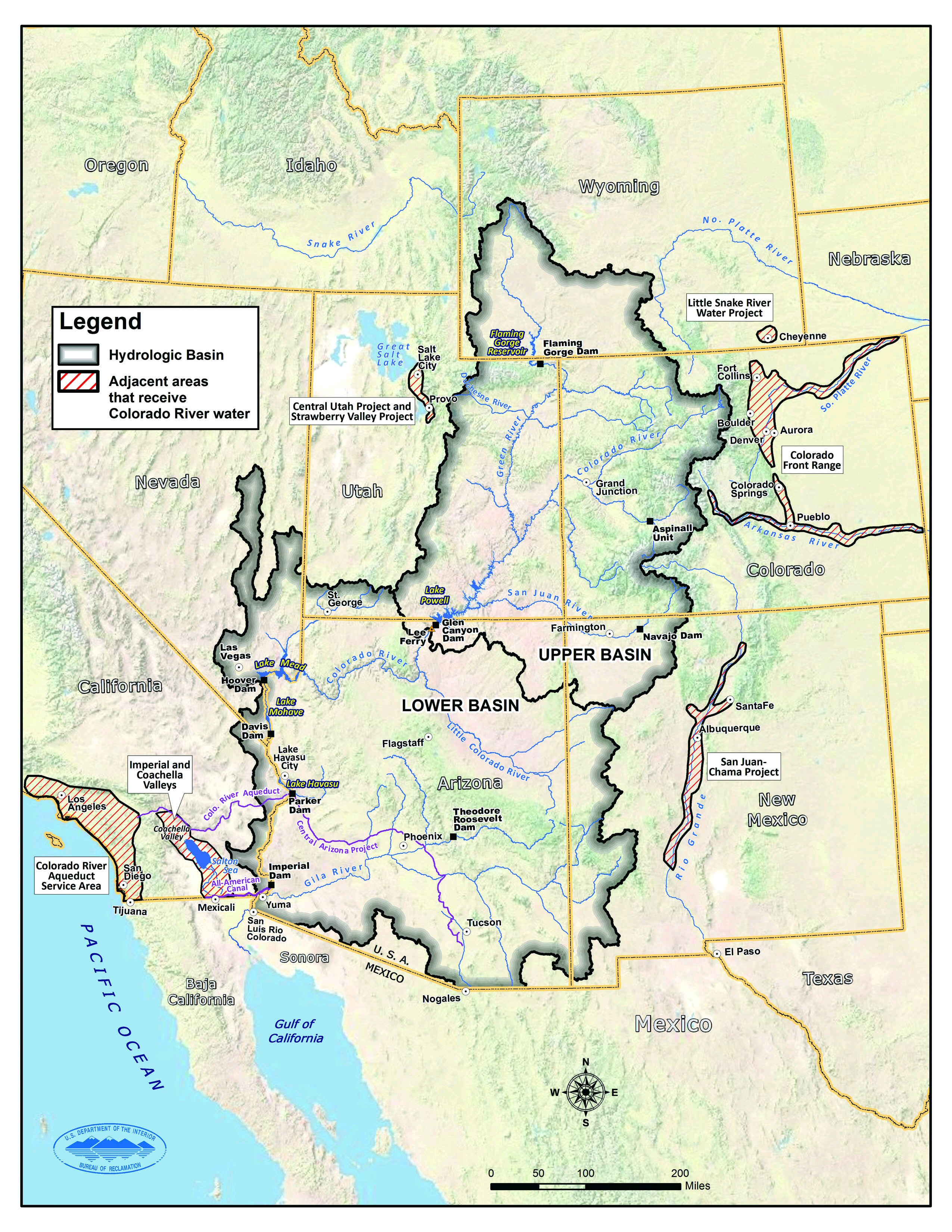
It is my understanding that the U.S. Bureau of Reclamation is having a very difficult time managing the water levels of Mead, Powell, Glen Canyon, and the upper Colorado. Not only due to drought but to the ever-increasing demand being placed on the system from development, agriculture, and inadequate conservation.
The potential inability to produce hydroelectric power is yet another wake-up call that things are changing fast.
Well stated! The drought has intensely exacerbated what is essentially a water mismanagement problem. Even without historic dry conditions, the Colorado river basin system was on its way to losing water anyway without a major reduction in consumption. Granted it would have taken much longer to get to where they are now.
> ever-increasing demand being placed on the system from development
Glad to see recognition that people and industry could help by reducing water usage. Huge consumers such as Denver Water talk about conservation yet new residential and commercial developments still seem to be built as if water is unlimited.
It's also: not my problem, let someone else deal with it, while I make money NOW and they don't even really know the extent of the problem. It's also how we got here, and we continue to let speculators externalize costs to society at large.
Careful study of a park service map for RMNP will show a tunnel. It is a water tunnel serving northern Colorado on east of divide. Fascinating construction history.
Bad policies combined with unchecked growth and inefficient water use is my understanding (John Oliver had a good segment on it). When farmers feel the need to grow alfalfa just to make sure they'll keep their share of water rights - in a drought-prone area - that's effed up. What we should have been doing is efficient drip irrigation and conservation efforts, instead it's the polar opposite that's going on.
Farmers often have very very old contracts with no lifetime. Currently there is no recourse, no way to either start charging them for water or to increase thier rates (as applicable).
Hence the example, growing extremely water inefficient crops like alfalfa.
We seriously need to rethink agriculture in the West. California produces a lot of food for the country and we use 80% of our water to do it, but it's also only 3% of our economy. The other 97% of the economy needs water too, in part to feed and bathe the people who make that part of the economy go.
It seems like it would be wise for California to pay farmers not to use water and pay farm workers who are unemployed since we have plenty of money and not a lot of water.
This would mean that farmers would not go broke, and they would be motivated to find ways to use less water, or charge more for their product, or both. Which would then shift the growing of those things to places where they have water and can build massive greenhouses, which would be supported by the higher prices.
Or at the very least charge farmers the same price for water as the rest of us! In Santa Clara County (aka Silicon Valley), an acre-foot of water costs a farmer $36.85 and everyone else pays $1,724.00! If you go a litter farther south, where the majority of land use is still farming, it's still $36.85 for farmers and $513 for everyone else!
I ran across this channel after their first video about the sinking water levels. It has been interesting and a little scary watching updates over the summer as they return to the same places and show how far the water has dropped. Their channel also helped get a guy get his houseboat unstuck that had grounded after the engine quit (another YouTuber did it but was tipped off by SinCityOutdoors).
Anyone who actually lives in the American West knows this has been a very wet summer. I live in the Colorado Mountains and I bet only we've had around 20 days this whole summer without rain. I think this is an outflow problem rather than an inflow problem. Looks at the historical data here https://www.usbr.gov/rsvrWater/HistoricalApp.html
It's definitely both, poor water management combined with desertification of the region. People studying water management in the American South West have long been aware that there has been more water allocated than actually exists. However this is definitely compounded by climate change.
To your point you can see that in last month lake Mead has been rising quite a bit[0]. Unlike lake Powell, I do not believe this rise is because of redirecting other water sources (please correct me if I am wrong). However you can see this increase is a long way from restoring, and the region is still considered under drought conditions (though less severe that it was earlier in year).
What’s important to understand is water resources are averaged over a multi year period and a few months of normal rain isn’t enough to make things ok.
That said, much of the midwest’s water issues come from assumptions before wells dropped water levels in the region. A stream can gain or lose water based on the local water table so simply getting X rainfall per year doesn't guarantee a dam will continue receiving the same amount of water year after year. Worse models aren’t based on unlimited data, random events can mean you’re basing things in unusually good times, even ignoring climate change.
Year-to-year variability isn't enough to make up for cumulative multi-year effects. See this UC Boulder webinar - here's the timepoint where they discuss multi-year droughts:
Notice the increasing tempo of drought frequency? That's in line with long-term climate model predictions of the drying of the American Southwest, linked to a general trend of rising interior temperatures in midlatitude continental zones (in particular, decreased soil moisture, declining summer snowpack, possibly expanding Hadley cell circulation).
See also the 2000-present graph at the bottom of this page:
It might be true that these reservoirs could be refilled if most outflow was eliminated, but that would mean the end of regional agriculture and severe restrictions on household water use across the entire region.
Essentially the effect is the same, but one reason is reducing conflict. A bidding war over water rights, for example, might mean that some regions don't get enough water to survive while others get enough to keep their golf courses green. Historically in the American West, that kind of thing has led to people dynamiting canals and so on.
A more balanced option might be setting a minimal delivery baseline for everyone in the watershed, with prices rising steeply above that baseline for the remaining water. This would encourage adoption of recycling, aka 'toilet-to-tap'...
Because the people with the most money (golf courses) and the people with the most legitimate need for water (thirst) are not the same people.
Many Americans have this bizarre fixation on the idea that markets are magic and freedom means that whoever has the most money gets whatever they want. Sorry but that is an incredibly cruel and inefficient way to make decisions.
The system of free market pricing has always been a more efficient and effective way to distribute scarce goods to where they are most needed.
The system of rationing has never produced fair or efficient results. If you disagree, present a system where rationing has done otherwise. Certainly, that has never worked for water distribution.
I mean that's the most obvious example. But really, this is a commonplace and standard practice- get out a cake at a birthday party and how are you going to divide it? Richest family gets the most cake?
This is a bad question to be honest, possibly asked in bad faith.
Talk to someone who lived through WW2 rationing (I have). (Sadly, they're pretty much all gone now.)
Let's take WW2 gas rationing. People were allocated gas based on their profession. Note that this had NOTHING to do with their needs. So what happened? Nobody had an allocation that matched their need, it was either too much or too little. So what happened? An illegal black market emerged where those with extra sold it to those with less (at high prices, as illegal markets always carry a price premium).
Let's take your birthday cake example. It has the same assumption built in - that everybody wants exactly the same amount of cake. This is never the reality, and forcing it on people results in inefficient mis-allocation, and people who want more saying "hey, are you going to finish yours? Can I have it?".
> possibly asked in bad faith
You might want to read up on the history of the results of rationing before you draw such conclusions.
This recent spike in has prices left a lot of people without. It distributed gas to the people who could afford it, not to the people who needed it, no?
I would rather accept the wisdom of the cruel and inefficient markets, in which literally the whole world has input in some fashion, over the edicts issued by a local board of the well-connected and appointed.
No, the world's people are not what has the input- the world's money does. Very different. Money does not think or feel, it's just a measure of power. Money is power. If you think money should purely decide this question you are in effect saying "whoever is the most powerful gets what they want", which is anti-civilization. Markets only function at all because powerful governments moderate and regulate them. Otherwise the world would quickly decay into a hobbsian war of all against all. Unregulated markets always self-destruct. Rationing on one level or another is the only reason that markets in limited areas are even possible. Try having markets without "rationing" who can print money, for example.
Bullshit. Outside of temporary supply disruptions (such as in natural disasters), rationing has always been a total failure. Central planners are incapable of efficiently allocating resources, and most of the participants end up cheating through a secondary black market.
And anyone is free to print unlimited quantities of their own private currency. This is completely legal. But no one else is obligated to accept it.
Money deflates so the wealthy need to pursue valuable investments to preserve and grow it. Value is generally produced by doing things that people will pay for. It is this value-seeking behavior by the masses that gives everyone some implicit input on the long horizon. And water is certainly a long horizon thing.
It's going to take overwhelming evidence to overcome the "historic drought" claims we've been hearing for some time now. Not wild "anyone who actually lives in the American West knows" conjecture based on "I bet" and what is happening in your very local backyard this specific year.
FWIW I tried the link and couldn't get it to generate data.
McAuliffe was to be the first teacher they sent to space, and they didn't try again until I think '98. Not sure if you realized that connection, but it was kind of surreal for me when it clicked that this is probably who you're talking about.
A single extreme weather event can refill most dams, what the parent post is missing is it’s actually been a dry year for the watershed and most of the region. https://droughtmonitor.unl.edu/
For those who doubt the mention of a refill from a single weather event, 500 year floods are a thing. It’s more likely the lower the average annual rainfall in a region is, but you get nonliner amounts of flooding with extreme events because a lower percentage is obsorbed into the soil. Large floods can carry more water than the river carries in an average year.
Yep, there a a bunch of rich people enclaves in the desert where they use their leverage to avoid accountability for wasting the most of this and other valuable community resources. In particular too many huge artificial lakes that werent designed to catpure runoff well so only replinishing from Hoover pipes brings them up to level. Water usage restrictions for normals but none enforced on companies and the rich, on top of all the normal problems, build up to a stark conclusion: we cannot sustain population growth in Hoover dependent communities with current societal usage rates.
On a different note, I always appreciated the teaching from the local tribes about how being the source of these waters (multiple headwaters on west side of continental divide) was considered not just a privledge but even more important a responsibilty. Every thing you do upstream impacts tons of peoples downstream.
Pump the breaks. If you live below 8k altitude, it’s been dry.
Also, I’m not sure how you’re missing the very acrimonious Colorado River negotiations b/t upper and lower basin states. Upper basin is refusing to commit to water use quotes in 2023, lower basin states aren’t addressing the root cause at all while asking for cuts (my bias - this how the upper basin probably should act without rational acknowledgement and concessions of why Co/WY/UT should sacrifice water for Almond farms in CA and Arizona suburban sprawl and golf courses in literal deserts).
If you’re not aware of how heated this is getting, you should check in. It’s about to shape a tremendous amount of water policy for us, however it turns out.
Is it really a drought only in the West? How is the rest of the globe handling it? I was under the impression that rainfall has beeen at very low levels everywhere.
It seems likely that hundred-year-long droughts are very common in California. If you've ever seen Lake Tenaya in Yosemite, you may notice some dead trees sticking out the surface... Those trees are from a drought period in the Middle Ages [1] when the lake was much lower and totally fry in some spots - enough for pines to grow. Those deadheads are about 1000 years old! Highly recommend kayaking that lake.
Global warming does not mean everywhere gets hotter.
Global warming means:
Entire planet gets hotter ON AVERAGE,
Some places will get hotter, some will get drier, but some can also get wetter or colder.
In essence, warming will cause weather patterns to change. We will get a period of changing weather and then the system may stabilise with a set of new patterns that are different from current ones.
Whatever happens, it will be very costly to humanity. Our current existence, for example placement of population centers, how we live, how our houses are built, how we produce our food -- it all depends on weather patterns being the way they are now.
In particular, it is possible that Europe will get colder soon. If the Gulfstream collapses, the masses of warm water that bring heat and humidity to north Atlantic will cease. While it is not entirely clear what is going to happen, it is possible we are going to get much more arctic air and possible that European climate gets drier.
Australia's east coast has had insane and unrelenting rainfall all year. This is due to La Nina which causes the moisture to be directed to Australia's east coast.
It's actually interesting I remember people talking a lot about La Nina and El Nino back in the 90's, I didn't understand a lot of it back then because I was younger but it seems like no one talks about that, or the ozone, or any of these other major weather systems, or cycles anymore. Any change in weather is lumped into "climate change" I'm not saying I'm a denier, but I am just wondering how many other weather systems happen on decade long cycles that should also be considered or investigated?
Nobody talks about ozone because global cooperation led by science and public policy fixed the hole. Come to think of it, maybe we should talk about it more.
Can you really have a global drought? It seems like all the airborne water has to land somewhere, and climate change is increasing the water content of the atmosphere.
In total, I suspect that you're right. But it doesn't help us much if the rain falls into the ocean. What we've been seeing in the pacific northwest is long dry spells with short torrential rains, both of which are devastating to crops, but it does tend to balance out to about the same amount of annual rainfall. My very weak understanding is that the more extreme weather tends to kill plants, which contributes to desertification. Hot ground makes for high pressure zones, which prevents moisture-laden air from ever getting there. So, yeah, I'm not a climate scientist and the above is mostly guesswork, but I think you really can have a global drought.
If it lands mainly in the oceans, then effectively yes. (I don't know enough to say if there's a mechanism that would do this everywhere or most places)
There is - it's the el nino / la nina ENSO cycle. I think other people are right that the rain has to go somewhere but that thing can and has caused droughts over effectively the entire populated world. There was a world drought in the 1870s that badly affected brazil, northern africa, india, and northern china.
That doesn't follow because rain fills reservoirs the same as snow. One difference, though, is that snow releases as it melts during the spring/summer.
Snow is localised and melts into captured streams. It gets refilled because high alt + low temp preferentially causes rainfall/fog that replenishes the snowpack.
If fewer rain cloud condense on the peak then it just rains more dispersed which leads to much less efficient capture (some absorbed by the ground, some rains over ocean, evaporation is faster when you have water spread over large area so fraction of time spent in liquid form is smaller, etc).
It makes a big difference. Imagine watering your favourite plant once per month with 4 litres of water, vs watering weekly with 1 litre of water. The snowpack melt cycle allows for gradual watering of the surrounding areas. Not directly answering the question for reservoirs, but the rapid loss of snowpack and glaciers has a massive impact on the environment.
Right. Snowpack is a form of massive reservoir. Snowmelt through the course of the year allows us to constantly release water from human-made reservoirs while their levels stay the same. There is still snow in the Sierra today, and in a typical year snow stops falling in April.
Rainfall is much, much harder to capture, and the release curve is completely different; you can very quickly go from flooding to bone-dry.
But more rain doesn't necessarily equate to more ground level water supply. Rain more easily evaporates, and can then be transported elsewhere. Snowpack historically is critical to water supplies in the West because it slowly melts and provides a steady source of water throughout the dry season. A mega storm with no way to capture the water AND prevent it from evaporating in the dry season can still provide far less water than an equivalent amount of snowpack.
> "The root of the problem is an ongoing, 23-year drought, the worst stretch for the region in more than a millennium. Snowpack in the mountains that feed the 1,450-mile river has been steadily diminishing as the climate warms. Ever-drier soils absorb runoff before it can reach reservoirs, and more frequent extreme heat hastens evaporation."
Hrmm, so having now read some random papers, I learned that relative humidity over land is actually decreasing due to climate change, which isn't what I expected. Guess we're screwed.
Just watched a DW documentary the other day on droughts and climate change, focusing on California for some time without ever mentioning agriculture. Sure, restaurants in Mendocino have to close because they can't operate bathrooms, let's mention that. Let's also mention that it takes a gallon of water to produce a single almond, that 80% of the worldwide supply is grown in California, and such insanely water-intensive farming is still doing just dandy while people elsewhere in the state are keeping track of toilet flushes.
Yes but you have to keep in mind that droughts are really different in the northeast. Our reservoirs are all over 90% full. We like them at 100%, but it really isn’t all that unusual to have dry spells in July and August. People are conserving water right now because it’s the right thing to do, but nobody thinks that this is going to extend too far into the fall
I've lived in Western Mass for 20+ years and this summer has been bone dry. Most of the grass in my yard is dead (which never happens) and our town (feed by wells) has had a water restriction order in place for most of the summer.
I'm hoping this is just an isolated pattern. Two or three years ago (not quite sure) was so wet though that it took two months to stain my deck (waiting for it to dry out after powerwashing it and then waiting for the rains to stop).
Another idea I'm entertaining is a DIY well (thanks to our pretty accessible water table) for watering the lawn. It's not clear how cool the town will be with this but worth exploring. :-)
Northeast US is in a mild to mid level drought depending on where you live. Higher temps are causing more evaporation and consequently more water usage (also rising population).
In the Pacific Northwest we had the rainiest spring in a long time this year. Typically the rain up here is more of a continuous drizzle, but during the spring it started raining hard and didn’t let up like it normally does. Our rivers reached the lower flood stages from too much rain.
In my neck of the Midwest, we've had a dry couple of months, but generally the last few years have seen precipitation levels at or above the yearly average.
That's different than power generation. If the reservoir goes dry, the power plant can't generate energy. That video is about drinking and irrigation water for communities.
I would assume that same thinking can be applied to both, although reduced hydraulic head would lower the power capacity making it not completely linear as is the case with water supply.
The entire video is about how you take an variable supply and turn it into something consistent and the engineering challenges required to do so.
The Hoover Dam's deadpool level is 895 ft, or 272 m. I am not a civil engineer, but why not build the water intakes (apologies if I don't use the correct terminology) at the bottom of the dam, in order to set the deadpool level at 0 ft? Why build the intakes so high?
At 0 feet, you will end up with silt being sucked though or accumulating/clogging. Also, the intakes are likely below the stated level, but you need X number of feet above that for water pressure to turn the turbines. Either way, I'm not sure that a retrofit is a feasible option.
Filters have to be cleaned, a process that is both expensive and dangerous at the bottom of a reservoir that high. Which is why the better solution is to put the intakes up a bit and allow the bottom of the reservoir to serve as a settlement pool.
The measurements given are from sea level. The deadpool height of 895ft (above sea level) is the output level, where the water dumps downstream. The intakes have to be above this height.
TL:DR:
"Head differences of 100 meters or higher are considered high head. In this type of plant, water travelling through the turbine comes from a significantly higher elevation, meaning that the system needs a smaller volume of water to produce an equivalent amount of energy.[1] These systems generally also require smaller turbines since there is less water flowing through the turbine."
The ideal place for a hydroelectric dam is what's called a slot or "gunsight" canyon. Narrow and high, to create the best conditions with the smallest dam. Dams in wide, relatively flat places like along the Columbia River exist, but they are multi-purpose, built for flood control, irrigation, navigation (with channels and locks), and recreation benefits in addition to hydroelectric.
Is there any movement on the political front to doing anything about it?
It looks like there's a bunch of independent and news discussions about the problem, but I haven't heard anything about restricting use enough to keep the lake at its current level.
Hydrological cycles are measured in decades/centuries. Ideally, you’d start siting solar and batteries near Hoover Dam to rely on existing transmission infra. Nameplate capacity is roughly 2GW, so lots of transmission capacity available. Boulder City (to the SW of Hoover Dam) has some solar generation resources already, unsure if that area is close enough though. TLDR Plan for dead pool and inability to generate hydro power.
No one will ever vote for lower living standards explicitly. What can be done about it?
Any solution or lack of solution equates to decline in quality of life, and democratic systems are least efficient at pushing through big changes or unpopular policies.
Theoretically, the Department of Interior can impose cuts if necessary to protect reservoir levels. This would likely be challenged in courts all the way up to SCOTUS, and take years to resolve. It's a huge mess
The 'crisis' is mostly one of pricing, in that farmers get the water for nearly free, so they use 80% of it in inefficient ways to produce low value crops, because hey, it's basically free. Cities pay much higher prices, but it almost never makes sense to pay ~$$$ for desalinated water just so you can keep giving away water for $ to other users.
I’ve heard that the farmers are getting the bulk of the water. I’m curious, could they use desalinated water instead? it would raise the price of food… But I’m just wondering if that is a bad thing given the trade-off.
You could farm with desalinated water, but the economics don't support it so no one would bother (or at least the current farmers with their current crops would not). We're 'running out' of free/extremely-subsidized water supplied by the government for mostly-low-value crops. No one will ever grow alfalfa with desalinated water that then needs to be moved via canal/aquaduct - the beef from the cows you fed with it would cost like $2k/pound.


Norway has plenty of hydro-power they can sell to the rest of the Europe but their government is setting export controls to maintain water levels.
Normally 70% of electricity generation in France is nuclear. France has been forced shut down nuclear reactors because river water is too warm to cool down nuclear reactors. French government has made exceptions to allow few them to run with hot water in minimum power. Making thins worse is that many reactors are under scheduled or unscheduled maintenance.
Big rivers like Rhine and Danube have water levels so low that it affects logistics. Coal deliveries for example. Road logistics is seeing 5X price hikes. Railways are in full capacity. German government is going to prioritize railway logistics to essential goods first.