This is the first time I have seen the Open Infrastructure Map, and I was particularly struck by the global solar distribution: https://openinframap.org/#2/49.5/-53.93/S. Not what I expected, at all.
There are many solar plants not mapped due to lack of high quality, up-to-date aerial/satellite imagery, or volunteers.
Germany is country mapped best, not necessarily having significant share of solar.
Might also be how it’s displayed. Germany has quite a bit of solar but its less concentrated in giant solar parks and the country is smaller than US, China, or India.
So for example US has multiple solar farms over 500MW and several over 200MW but none of Germany’s solar farms are over 200MW and only 4 are over 100MW.
A quick google tells me that as of 2021, the US had ~23GW of installed solar generating capacity, and Germany had ~59GW. As the US has roughly 4x the population of Germany, that means that Germany has roughly 12x the amount of installed solar capacity per capita.
In addition, the US govt says [0] this year should have added 46,100 MW to the total. Electrek, if they are accurate, predicted an additional 5,600 MW on residential rooftops in 2022 [1].
I wonder whether this is due to unreliable data. I am not sure where this is sourced from since tracking all the solar installations seems like a lot of work.
Yeah, given how abruptly the density of the data shifts based on borders, I strongly suspect there is a data quality problem. The available information is interesting, but comparisons pretty meaningless.
I heard yesterday (from someone who works for a place that determines solar capacity from satellite photos) that the UK has between 10 and 16GW solar capacity. That's the official figure. No-one really knows (hence his company)
On the power layer, it seems the national grid is generally 400kV nominal, with regional sub-grids at 132kV and then towns with 33kV & 11kV. Is that 3x 11kV phases = 33kV? And then 33kV = 1/4 tap of the 132kV? '400kV' is actually 396kV?
When I joined a web portal, that was part of Brazil's second largest telco, to manage a couple project teams (in 2008), one thing I got was a nice coffee table book describing that telco's data network in exquisite detail, down to detailed maps of fiber placement, routers, radio towers, and repeaters.
I called it the "modern terrorist handbook" because, with it, anyone so inclined could almost completely cripple Brazil's communications.
Putin's a high tech terrorist with lots of technical expertise, who regularly destroys so much infrastructure and shopping malls and murders a hell of a lot more people every day than you can by driving a car into a crowd.
Christ, seriously? I assumed they'd henceforth be underground everywhere - in Dorset some (Milliken) are being replaced with underground cabling, after a petition based on countryside views I believe, but it benefits/doesn't disrupt farmers' fields & future developments too. Presumably once you have that sort of underground trunking it's easier to add other utilities too (even if they don't share any hardware/boring, there's still the planning and mapping etc.).
Non-superconducting electrical transmission lines don't want to be buried, it's really expensive and harder to handle/deal with when stuff breaks.
You also can't have forest on top of it.
One can hope we get by with the current approach until superconducting lines have been sufficiently figured out (it seems they don't need to run the voltage as high due to current being somewhat easier to deal with than voltage and losses not depending (significantly) on actual current (so thicker cables don't loose as much of their current rating to thermal limits than with traditional cooper/aluminum)).
Underground utilities are usually significantly more expensive to construct. That's why overhead power lines are so common.
The installation cost is tends to be so much higher that the potentially lower maintenance costs due to less weather damage doesn't make underground lines lower cost in the two to five decade maturities of utility bonds used for financing.
Allow me to quote to you from a Punch article by E. V. Knox written in about 1930 (collected in "Things That Annoy Me" of 1932):
  The Pylons
  (Being the transcript of an unwritten radiologue, dated A.D. 2129)

  Once again we are threatened with a historical calamity. It is proposed to uproot the graceful pylons which adorn the line of the Sussex Downs and are the sole relics of the electricity cable which carried light and power to our forefathers along the Southern Coasts...
I don't think so. He died in 1971 so it's still in copyright though I doubt anyone would care much. I don't know exactly which volume of punch the original article is taken from, and it's possible that that's up there somewhere.
Oh, and I just double checked and my copy was published in 1930; the second edition was 1932. So quite likely the original article was in one of the 1929/1930 run.
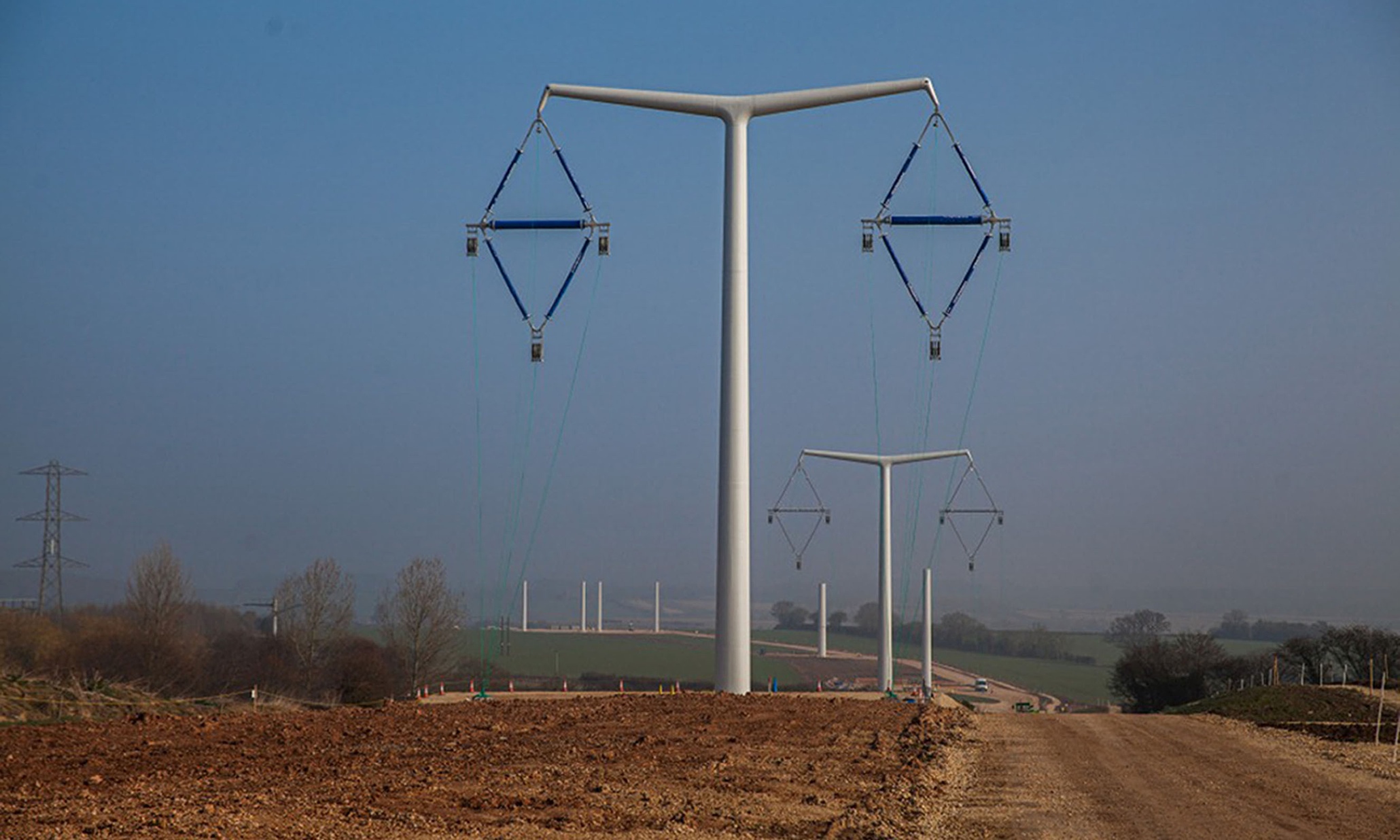
I remember the competition that spawned these - they were, by far, my favoured option.. although the idea of wireframe giant humans and ants oVer the countryside was 'interesting'! :
not sure "making in pretty" and giving in a UI refresh every 5 weeks when the latest version of whatever js framework is released is really in the budget.
The deepest tunnels in London are the electricity grid tunnels. Inner London is served by a whole redundant network of them, and we only hear about it when the power (very occasionally) goes out because one catched fire and they have to wait for it to burn out. The last mile services are all burried too.
It gives the city a very different look from what you get in Asia for instance, and I always ssumed it was because of the lack of earthquakes.
Silly Earthling. The Pylons were built by the ancient Altrusians, who devolved into the Sleestak. Do not tamper with the Light Crystals in the Matrix Table, or that will disrupt the weather and summon the Skylons.
We've got a line of em out between Watford and Rickmansworth along the Colne. (Just outside of Greater London but inside the Orbital.) One is my favorite - it's in a field by itself next to where I walk for exercise, and something about it is weirdly peaceful, like a remnant of a vanished civilization.
I'm not too far from you, there are quite a lot in the Iver area. One comes in and crosses the M25, then there is quite a lot of them between Iver Heath and Uxbridge.
That's a pity about the open infrastructure map not having the boundary for greater London. I'm not sure if it helps in any way but you can download an osm cut-out of greater London from Geofabrik: https://download.geofabrik.de/europe/great-britain/england/g... . You would then need a tool that loads an osm file and visualises the infrastructure components.
The author gave an update at the bottom of the article:
Sunday update: Russ from Open Infrastructure Map has knocked up some code which generates a precise map of Greater London's pylons. Thanks Russ!
I'm surprised the electrical demands of Greater London can be supplied with so few transmission lines. For comparison the city proper of Toronto has slightly less with a fraction of the population.
Surely a significant portion has to be underground?
3. a Protoss building which costs 100 minerals and supplies 8 psi and allows you to warp in other buildings. Protoss executors are frequently reminded to construct more of these, though in my experience the effort might be better spent reminding them to build additional photon cannons instead.
Here in Canada we refer to "traffic cones" as pylons. As someone living in London, Ontario, the first couple paragraphs of the OP was particularly funny to read; some sentences could be changed very minimally and apply all the same - "yet in a few places pylons are an intrinsic part of the landscape, like here along the edge of t̶h̶e̶ ̶R̶o̶y̶a̶l̶ ̶D̶o̶c̶k̶s̶ almost every road, due to construction."
My first reaction to the article was "We don't really use the word 'pylon' to describe these things, at least not here in the southern United States," though the term makes sense and doesn't sound strange to me at all.
But now I'm struggling to thing of what term I personally would use, and honestly, I'm having difficulty. "electrical tower?" "transmission tower?"
"High tension line towers", or...hmm, I guess I don't know what the common usage would be in the U. S., southern or otherwise. And we live a block from a local Redmond, WA trail that follows the line of...high tension towers for miles in either direction.
But between my spouse and me, if we need to refer to them, we just call them "towers". "Pylons" are short little things, such as traffic cones (to borrow an example from another commenter).
This squashes the idea of some Londonites to become an independent city state. Try doing that with no electricity generation of your own, and nowhere to build one.
The most frustrating thing about these pylons and cables pictured in the article is they come ridiculously close to the buildings beside them.
At one point I was looking at renting an apartment in a building right beside them (Hoola), ultimately didn’t, in part because of the power lines. Turns out there is no/little regulation in how far away these lines must be from other buildings.
When I had a computer network/support business, a somewhat competing business (they were mostly Mac, we were mostly Windows) with strong marketing and weak tech decided to move to a new location. The new location was on an upper floor of a converted old mill building near the river, railroad tracks, and high-voltage power transmission lines, which were just outside the windows on that floor (like only a few meters away).
Several months later, they were out of business. The rumor around town was that they'd frequently lost large amounts of data and/or customer's entire drives (floppy and hard).
I'm not sure if this was because they were all marketing and weak technologists and it just caught up with them in higher error rates with more biz, or if it was just one big error of being ignorant of the EM fields from the power lines outside windows (which I did hear second-hand that they'd started having random data loss in the new location, took too long to understand it, and were doomed by the time they figured it out).
I'd also read about when the Tennessee Valley Authority started installing some of the first high-voltage transmission lines in the US, a clever adjacent homeowner buried a long wire in a set of coils under the lines and ran it to his house to supply power. He was eventually caught and argued that he wasn't stealing electricity because he was only collecting ambient power. He lost, as although the device was not mechanically contacting the lines, it was still of course electromagnetically coupled — the phenomena of which he was taking advantage.


https://www.alexchinneck.com/a-bullet-from-a-shooting-star