As a scientist, this is such a dumb take. The incentive structures in science encourage novelty, and there's no shortage of scientists who would love to see their career take off.
Unfortunately, reality does not make the greatest dissident.
Some notable scientists like Freeman Dyson stand in contrast to your statement. He wrote an entire book around the concept -- which is by the way an excellent read.
I've followed the covid lab leak origins saga a bit and the incentive structures definitely do not encourage most scientists to speak out there. They'd probably be shunned and lose funding. One of the only scientist who is outspoken is Richard Ebright and he can get away with it because he has tenure and is high up in his hierarchy but most would have problems.
Exactly. In the words of Mike Stonebraker, "stake out a controversial claim and prove it true" is pretty standard career advice for junior faculty who are trying to get tenure. (At least in Computer Science.)
Larry Summers was forced out of Harvard in part for mentioning the greater male variability hypothesis. James Damore was forced out of Google for similar reasons.
This despite fairly strong evidence for that hypothesis:
"Following the end of Clinton's term, Summers served as the 27th president of Harvard University from 2001 to 2006. Summers resigned as Harvard's president in the wake of a no-confidence vote by Harvard faculty, which resulted in large part from Summers's conflict with Cornel West, financial conflict of interest questions regarding his relationship with Andrei Shleifer, and a 2005 speech in which he offered three reasons for the under-representation of women in science and engineering, including the possibility that there exists a "different availability of aptitude at the high end", in addition to patterns of discrimination and socialization.[8]" https://en.m.wikipedia.org/wiki/Lawrence_Summers
I think we're quite far from "strong evidence" anyway if you want to argue that there's "less aptitude at the high end" of either gender.
I'm more thinking of something falsifiable maybe? You know, strong evidence?
Ps: He's still employed by Harvard, I'm not seeing a ruined career here.
Edit: "The company fired Damore for violation of the company's code of conduct.[2] Damore filed a complaint with the National Labor Relations Board, but later withdrew this complaint. A lawyer with the NLRB wrote that his firing was proper.[3][4][5][6] After withdrawing this complaint, Damore filed a class action lawsuit, retaining the services of attorney Harmeet Dhillon,[7][8] alleging that Google was discriminating against conservatives, whites, Asians, and men.[9][10] Damore withdrew his claims in the lawsuit to pursue arbitration against Google.[11]"
> A 2021 review investigating different hypotheses behind the discrepancy of sexes in STEM jobs summarizes the greater variability research with respect to this question. Given that research finds greater variability in males with in quantitative and nonverbal reasoning,[32] they hold that this can explain some, but not all of the difference seen in STEM occupations.[33] With regard to the question of whether these results are due to societal influences or of biological origins, they hold that the results showing greater variance at a very young age (for instance IQ differences in variability between the sexes is visible from a young age on [34]) lend credence to the theory that biological factors might explain a large part of the observed data.
It's certainly falsifiable. Research could have shown no evidence of the variability. That didn't happen.
What are you looking for? Evidence as strong as the evidence in physics? No one gets that in the social sciences.
IQ tests are not reliable when not heavily weighted on the culture of the person taking them (and even then - the same people taking the same tests get different results). Translating a test induces a bias. Even in the same language, cultural differences can make questions more or less difficult to understand.
The simple fact of being in a "test" environnement is something that will be more comfortable to some than others - based on background.
Meaning if you even believe IQ tests are somewhat valid on an individual basis, it's ludicrous to draw conclusions on comparisons between groups; they have to take the same test to be comparable, but giving the same test to groups of different backgrounds will yield different results, because tests aren't weighted.
That's all separate from the current replication crisis in psychology and the fact that intelligence is not even a clearly defined trait (thus we cant test for it).
You're looking for a level of evidence that doesn't exist in any social science.
So I suppose I have to concede your original claim (now that we've narrowed it down): if someone somehow established a level of evidence that revolutionized social science and rendered all previous work meaningless, then they probably could get away with offending powerful groups.
Until then, scientists are wise to tread carefully.
There are many claims can be proven that aren't social science, you're the one unable to show an example of a scientist that had solid evidence of something and ruined their career and artififially confining it IQ - one of the most contentious subjects you can look for. I'm sure there are falsifiable claims in social sciences too.
Maybe look into something like medecine or physics? Something falsifiable, following the sientific method.
I've already cited examples. You dismissed them because they don't fit your arbitrary narrow criteria.
Want another? Stephen Hsu. Forced to resign for discussing research that found no racial bias in incidents of officer-involved shootings.
Another? After more than a decade at Harvard without complaints, Roland Fryer had several complaints filed against him shortly after he published research showing that Black and Hispanic Americans were no more likely than white Americans to be shot by police in a given interaction with police.
I'm sure you'll find reasons to dismiss these as well.
Edit: As I said, Roland Fryer was at Harvard for more than a decade without incident. It's more than a little suspicious that there was an investigation immediately after he published his research.
And are you just going to ignore Stephen Hsu?
Edit 2: "I gladly will not research your claims further"
I knew you wouldn't in the first place. You've been dismissing any evidence that contradicts your narrow world view.
Edit 3: "Feel free to eat bags friend". I see you've deleted that and all your other unreasonable comments. I'll leave the quotes here though, because you did say these things.
Edit 4: "why keep editing your comment?" Because HN admins don't like long threads like this and have set up a rule that says I'm "posting too fast".
Isn't the whole idea of the scientific method is that you don't prove things true? You just test things enough until you are not able to prove it false?
The specific example (computer science) coincidentally does allow for proofs, because it is mostly math, but I think they actually are just using the word prove informally here.
The incentive structures in science encourage publishing, not novelty, and the ones who are best at bringing fame to their institution (and thus grant money) are not the scientists early in their career.
> The incentive structures in science encourage novelty
I would modify this statement somewhat.
The incentive structure in science today encourages following the money. Very little research these days is done just for the sake of research or discovery. Science is expensive, and scientists who want to have a job, like it or not, have to fish to where the fish are swimming (where the money is being spent), which typically means delivering the narrative sought by those who control the money.
The most salient examples of this today are saving the planet and electric everything (cars, trucks, planes, water heaters, stoves, etc.) --which are usually connected. The first of which is ridiculous beyond description and the latter is so unimaginably far from being attainable it might as well be labelled a fantasy. Yet, these narratives are pushed because they have political power through emotion that results in votes (you can divide people) and the only money being spent in research is in support of these narratives --not research, confirmation propaganda.
> What about working to save the planet from the very much real, devastating effects of climate change do you find “ridiculous beyond description”?
A few things.
First, the planet will be just fine. It has endured much worse than any of the imaginary scenarios being tossed about these days.
Second. It is nothing less than hubris to think we can actually control something at a planetary scale. We are far more likely to kill everything in sight than to save the planet. The whole thing is laughable.
And, BTW, this isn't my opinion, this is a scientific fact that a 15 year old with basic math skills can confirm inside five minutes. Since there's no financial or political power in saying "we are sorry, this is all nonsense" the money keeps flowing in that direction.
Find just a single non-trivial funded program trying to refute the current narratives. You can't. Nobody wants to fund that research. No scientist wants to talk about it that angle because, in todays context, it would end their career instantly. People are making way too much money in an "Emperor has no clothes" utopia relentlessly promoted by industry, government and the media.
Here's a reality check:
Anyone who thinks we can control matters of planetary scale, kindly show how we immediately controlled and stopped the effects of the massive fires in Canada, the fires in Maui, etc.
I mean, seriously, can we have some intellectual honesty around this topic?
Just looking at the Canadian fires [0]. Just this year, over 132,000 square kilometers burned. These fires have already released the equivalent of a full year or Indonesia [1] burning fossil fuels (a country with nearly 300 million people).
And how about these fires [2][3][4]?
Let's show how we can control these events and then, maybe then, we can speak of regional control. Global control is a fantasy.
I mean, they are doing things like throwing billions of dollars at giant air sucking filtering machines. We have gone completely insane.
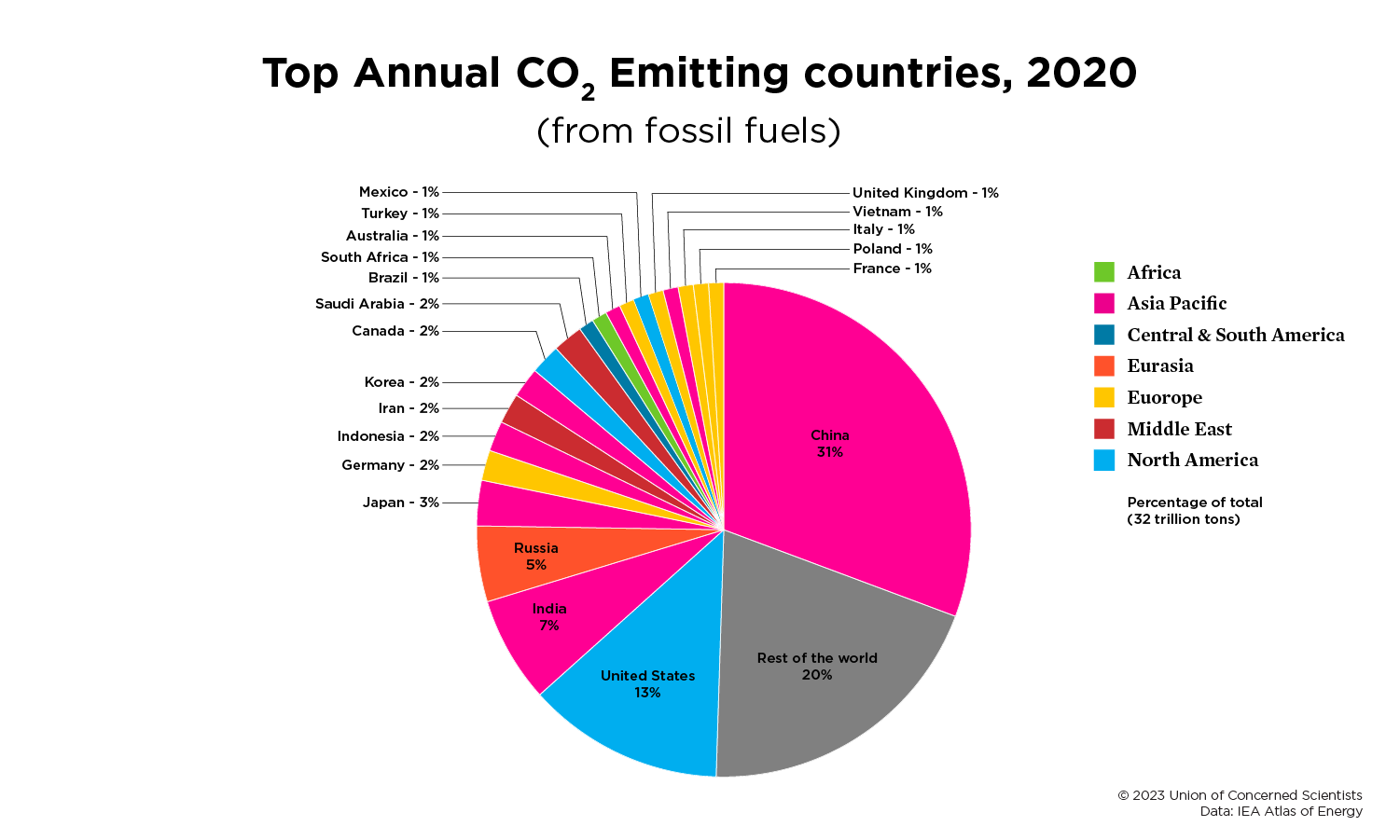
Now, let's magically erase China and USA from the planet. We have Star Trek beam everything on these lands into space, never to be seen on earth again. That removes 44% of CO2 emissions. That isn't even close to being enough. That isn't enough to STOP CO2 accumulation, much less REVERSE it.
If CO2 emissions went to absolute ZERO tomorrow, it would take somewhere between 50K and 100K years for atmospheric CO2 accumulation to come down by 100 ppm (this is a scientifically known fact). That's how ridiculous the "save the planet" narrative has become. It is so far away from attainable reality that anyone pushing it should be laughed off the stage.
I mean, removing all of humanity from the planet means 100K years for a 100ppm drop. And we are talking about fixing it in 50, 100 or 200 years...with electric cars and water heaters? Have we gone mad?
If all research is funded to support the idea that 1 + 1 = 4, where funding, profit and political power are centered around this being found to be true, you are not engaging in research at all. When powerful forces can --and will-- take you from being a funded researcher to being an Uber driver or stacking boxes at the hardware store, well, lots of people will find ways to find justification for 1 + 1 being equal to 4.
This happens in other domains as well. A pyramid sales scheme is one where early participants are aligned with the fraud because they need to both recover their investment and continue making money. My point is: People, under various types of pressures, will do such things.
When it comes to the range of matters generally wrapped around the "if we don't save the planet" fear mongering machinery, 100% of research funding is focused on promoting "1 + 1 = 4" ideas. Again, any researcher sticking their neck too far away from "The answer is 4" knows full-well they will suffer career/professional decapitation. You cannot say "Wait a minute, this stuff isn't right. We are nowhere near 4!". Well, you can. And then you are done.
This is conclusions-by-fear, science-by-fear, financial coercion, etc. Pick a name. They all apply in one sense or another.
Nearly everything being pushed today under the "save the planet" banner are lies. And the things we are being made to do and are planning to do under this manufactured narrative are between futile and down-right dangerous on many fronts.
The problem with the idea of scientific dissidents is that it isn't any different from someone going against a brutal totalitarian regime: Nobody speaks up because they know their life will be over when they do. The relative cost of speaking-up, when compared to praising the invisible clothes, is tremendously high. If you praise the emperor for the invisible clothes you get to keep your head and live whatever life you might be able to live.
Doing science today means expanding on the known body of published work, and progress involves either (a) doing novel work or (b) overturning established work - which is why scientific debates are often contentious. For example, there was one a theory that tidal cycles controlled the climate but technical discoveries in the 1950s and 1960s pointed towards infrared-absorbing gases (mainly CO2) being the main factor, and plate tectonics came along and overturned the orogenic consensus.
It is true that some fields of science have large budgetary demands, like high-energy particle physics, relative to things like cold condensed matter physics, but climate science is hardly a budget-breaker, and much of the data is just archived weather data.
It's been an issue in some fields though - renewable energy development in the USA is lagging far behind China because China invested a lot of money in R & D in the sector, resulting in engineering victories like mastering monocrystalline silicon ingot production at scale.
Also, there are dozens of practical studies pointing to the ability to eliminate fossil fuels from the energy mix while maintaining and expanding overall energy production on a global basis.
> It's been an issue in some fields though - renewable energy development in the USA is lagging far behind China because China invested a lot of money in R & D in the sector, resulting in engineering victories like mastering monocrystalline silicon ingot production at scale.
The US is so busy with two political parties trying to destroy each other that we can't even build a train. And we are going to save the planet? Have we gone insane?
> Also, there are dozens of practical studies pointing to the ability to eliminate fossil fuels from the energy mix while maintaining and expanding overall energy production on a global basis.
Reducing and, on a very long time scale, eliminating fossil fuel usage is a worthy objective. Nothing wrong with that. However, pretending that this is going to save the planet is just fantasy. It isn't. Not even close. We can't control things at a planetary scale (other than make things worse).
Destroying an economy in support of something that is, at best, laughable, isn't good for anyone other than those using it to make money and gain power.
I don't think we could build a train regardless. And the CA HSR program was idiotic from the start, based on basically fraudulent premises of potential ridership.
> I don't think we could build a train regardless. And the CA HSR program was idiotic from the start, based on basically fraudulent premises of potential ridership.
Absolutely true on both points. The math supporting the justification for this train is a complete falsehood. Something that lends further support to what I was saying in my other comment about researchers not daring go outside the politically and economically favored narratives. Imagine someone daring to prove the CA high speed train was stupid beyond any doubt. Their professional life would be over instantly. And for what?
The point I was trying to make is that we actually have people talking about saving the planet in a few decades --a planetary scale problem-- when we can't build a train and we can't even control fires.
Have we actually gone insane or are people so numb to this stuff that they just checkbox everything and let it happen?
Maybe it is a matter of education. When a large number of the population needs an app to calculate tip at the restaurant, how could they possibly be equipped to critically evaluate anything? An uneducated population is far easier to control than one with real critical thinking chops.
If the planet actually needs saving, then inability to do so isn't any sort of comfort.
There are actually plenty of examples of environmental protection that were smashing successes, so I don't see why pessimism is warranted. The Clean Air Act returned value some 40 times its cost. The Montreal Protocol on ozone depleting substances was a huge win. SOx control in the US came in a factor of 6 cheaper than had been warned.
This is very different. I am not being a pessimist at all. Just being brutally realistic.
People are talking about "saving the planet" (in quotes because I think it is a ridiculous statement) in 20, 50 or 100 years.
If humanity ceased to exist on this planet. If we all evaporated tomorrow, it would take 100K years for a 100ppm drop in CO2 levels.
How the hell is installing solar panels or driving electric cars going to make that happen a THOUSAND times faster.
It's like claiming we can safely stop a semi truck in 0.5 feet (roughly the width of your hand) from 65 miles per hour (normal braking distance from that speed is about 500 feet) without killing everything in it, in close proximity, causing massive destruction and using unimaginable amounts of power and energy.
In other words, nice sci-fi fantasy, and that's all it is. Can't be done.
I know of one paper that set out to prove renewables could solve the problem. The researchers were stunned to learn they were wrong. I commend them for printing their conclusion. To paraphrase, they said something like this: Even if we deploy the most optimal forms of renewable energy world wide, forms that have yet to be invented, the best of solar, wind and more, not only is atmospheric CO2 concentration not going to decrease, it will continue to grow.
If you look at a chart of the annual contributions of CO2 by country it is easy to see how this works. I posted a link in a prior comment. You could erase the entire US and China from this planet and atmospheric CO2 concentration will not drop any faster than 100ppm in 100K years. That's reality.
Do you mean ideally? Because obviously modern science and academia is mostly steered by external interests and public opinion. I know many scientists who entertain research projects from companies only because they're fully paid for, meanwhile they struggle with funding and publishing projects they want to do because there's so few opportunities available for funding. To then conclude that companies or government entities may want to do certain research according to what best serves them is not too hard of a stretch to make. It's happened numerous times before, especially within climate science, medicine, and tobacco.
I'm not saying one should distrust science, especially papers published by reputable sources, done by reputable labs, or otherwise have good methods and sensible conclusions. But that's the problem, right? One has to contend with what's "sensible". If someone published a paper tomorrow actually showing a strong causal effect between consuming fluoridated water and the calcification of the pineal gland, not only would it be seen by no one except weird fringe communities, but the scientists involved would be ridiculed. The area has been politicized, and in that case it's hard to see how it couldn't be, it's a ridiculous idea, but it does make a clear example of this politicization if you understand the context. Something similar happened with the origins of SARS-CoV-2, where the assumption is (from my personal experience) that only certain political machinations could convince someone to come to conclusions that SARS-CoV-2 origin could be a lab leak. Now maybe this isn't the case anymore. I haven't thought about this in like... a year, nor looked at public discourse for about that long either. But regardless I feel like public opinion is still largely the same, and judging by the article, the politicization of the topic is still in full swing. Thus, we're not only dealing with reality, but a manufactured reality as well.
It seems quite obvious that this novelty maximizing can be strongly curtailed by political and profit-seeking power, through various incentives and punishments that are then deeply internalized by scientists. Look at how fossil fuel industry scientists long knew about climate change and lead poisoning, or pick a range of examples from pharmaceutical or nutrition sciences. This is by no means unique to science (the influence is arguably much stronger in other domains like journalism) but there is no sense in arguing science operates on an orthogonal plane to power.
My critique of the piece is that half its length is devoted to dissent that turned out to be significantly incorrect or explicitly political or of very weak rigor, that seemingly had no censorship. The other half details some meaningful and concerning censorship and conspiracy to preemptively absolve players like Daszak, etc., and I think that's where the focus should lie, as we have not learned the appropriate lessons.
Yes, incremental novelty of the sort where you go somewhat further down an apriori promising path and show some somewhat stronger results than the previous paper.
But I don't think any community ever has truly rewarded dissent. It's just that sometimes a truly valuable idea will push through in spite of the resistance to it. Case in point - around 2014 I knew CS/AI/ML profs who were very dismissive regarding deep learning and thought it to be a dead end and basically missed the boat and took them very long to get up to speed again. A few years before that, and it was difficult to get papers published that used neural nets. Everyone knew that the modern way was the theoretically well-founded kernel methods and similar techniques.
----
There's no overarching one thing called science. There have been over the last 150 years a few towering results that propelled our understanding of the universe and our technological capabilities forward immensely, on whose wind we are coasting today -- but many of them came before the current professionalized, job-ified massive system we know as "academia" today. Without peer review, in informal letters between gentlemen scientists persistently pursuing topics for their leisure, often with extreme concepts of "work-life-balance". We have no idea what exactly brought about those successes, and so we are building a cargo cult, somehow imitating it, LARPing it. Thousands of papers, salami-slice publishing, citation metric-chasing, quantification and metrification, incentives to hop from place to place, endless grant writing and documentation/administration. This is a very specific system that was mostly created and solidified over the last 50 years. It should not be equated with science itself, which was already a very productive endeavor hundreds of years ago, while being intimately intertwined with mysicism, alchemy, esoteria and theology. This particular utilitarian paper factory of today isn't equal to "science", even if it has taken over the buildings.
> The incentive structures in science encourage novelty
Former academic here. This may be superficially true, but it's always been "novelty within the established orthodoxy". Kuhn documents this quite well, but it's become even more true since the funding motivated push for peer review that started in the 1970s.
Academic publishing today strongly demands conformity for survival. Geoffrey Hinton has a great quote, that I can't seem to dig up, about having any truly ground breaking work dismissed by juniors who have no idea what you're talking about being a major problem in moving science forward.
The bigger issue is that we have very little space for actual dissidenters. For example there is lots to legitimately question about mainstream medicine, but it's hard to walk too far down that path without immediately getting thrown in with "vaccines cause autism!!!".
Yes, science's incentives encourage novelty. That's actually part of the problem. It's how we got climate change denialism funded by Exxon, decades of bunk nutritional advice funded by competing food companies, Koreans faking human cloning, and Andrew Wakefield falsifying evidence of vaccines causing autism by giving small children colonoscopies.
The problem is that science is actually not that great at sorting out the wheat from the chaff. Better than chance, and better than science denialism, but not anywhere close to perfect. Many of the participants in the scientific process are malicious and they have sybils to obscure their identity and ballot-stuff meta-analyses. And scientists are not always willing to call out malicious evidence right away, because this is a community that runs on trust and understanding. So if anything, we have too many fake dissidents perfectly willing to make the entire scientific community chase their own tails.
Furthermore, the entire scientific establishment has an incentive to refute COVID-19 explanations that imply their research is socially harmful[0]. If COVID-19 is a lab leak then the explanation is simple and the preventative fix is a permanent ban on certain kinds of virology research. Nobody in the scientific community wants a repeat of George Bush's stem cell research ban.
But, if COVID-19 came from wet markets, then there's loads of research you can do there. You can sample viruses from sick animals to find precursor mutations for the original COVID-19 strain. You can hypothesize about mutation rates and evolutionary pressures.
Wet markets are novel. Lab leaks are boring - and a threat. And as always, more research is needed.
[0] I don't quite buy the idea that some have that China is deliberately trying to cover up the lab leak hypothesis because it makes China look bad. China looks bad regardless of where the virus came from. If it came from the wet markets, then China needs to shut them down. If it came from the WIV, then China needs to ban gain-of-function research. Either way it's China's fault.
This is a very simplistic statement that doesn't acknowledge the realities of how research funds are distributed in both government-funded and privately-funded research programs, or the other kinds of pressures that can be brought to bear by interested parties with deep pockets and political influence.
For example, research into novel uses of out-of-patent drugs is not incentivized in American academics because universities are eager to license new, patentable drugs to pharmaceutical corporations and thus earn a percentage of the profits from their sale, and this is reflected in NIH grant disbursements.
Similarly, DOE funds for renewable energy research have been miniscule for decades, resulting in few American universities having anything like a robust well-funded renewable energy R & D program - and that is due to pressures applied by politicians in the pay of the fossil fuel lobby. Scientists have to follow the funding, and only if such funding is available is novelty - in that specific area - rewarded by the incentive structure.
Additionally, as the article notes (emphasis added):
> "Sometimes, a scientific consensus is established because vested interests have diligently and purposefully transformed a situation of profound uncertainty into one in which there appears to be overwhelming evidence for what becomes the consensus view."
The most notable 20th century example is probably the plant breeding program controlled by Soviet agronomist Trofim Lysenko, and while it may be normal to suppose 'that could never happen in the open American academic system', there have been some examples of this kind of thing, although people will also make false accusations of this happening as part of their effort to discredit reliable science.
For example, the basic science of CO2 and climate was established by 1980, and since then it's just been a question of fine-tuning estimates of the magnitude of the CO2 effect, but there was a multi-million dollar effort funded by fossil fuel interests for decades to overturn that concensus. In contrast, while there was an effort in the 1980s to claim that HIV (the virus) was not the cause of AIDS (the disease), that never got much traction against the broad consensus that the cause had been discovered.
The Covid origin case is a bit murkier; at first it was natural to assume that the virus had a zoonotic origin, based on previous events, but it does look like leading academics in the US in the virology field came to a deliberately false and misleading consensus on the zoonotic origin story early on for what are pretty clearly political reasons - even though they knew there was at least as much evidence in favor of the engineered lab origin theory. Now, if things were as bad in American academics as they were in Soviet Russia, proponents of the lab leak origin would all be sitting in a Siberian gulag, so I guess it's not as bad as all that.
Science does remain the only real tool we have to coming to a factual understanding of our physical world, but it's also subject to manipulation by government and private entities. Informed skepticism is required when it comes to interpreting and understanding scientific claims - faith and trust are not that advisable.
Like everyone else, scientists are so convinced of what they know that they won't listen to other opinions.
The problem is that scientists think their knowledge is truth because it comes from "the scientific method." They fail to internalize that the whole point of that method is that no knowledge is sacred and everything should be doubted to the degree at which evidence exists to the contrary.
A crackpot conspiracy theory with a single anecdotal source of data is sufficient to create doubt in the soundest of theories. Just not much.
When someone who refers to their monitor as "the CPU", and can't tell the difference between a programming language and an operating system, starts telling you how you should be doing your job because you've got it all wrong...
How much do you listen to their opinion?
(Unless of course that matches your manager to a T).
You smile and say, "I appreciate your input. I value it and consider it a good starting point. I am not certain it alone provides the level of support necessary for me to consider a different path, but I would consider both additional data and reducing the amount of evidence I require with a good reason."
I appreciate your input. I value it and consider it a good starting point. I am not certain it alone provides the level of support necessary for me to consider a different path, but I would consider both additional data and reducing the amount of evidence I require with a good reason.


Unfortunately, reality does not make the greatest dissident.