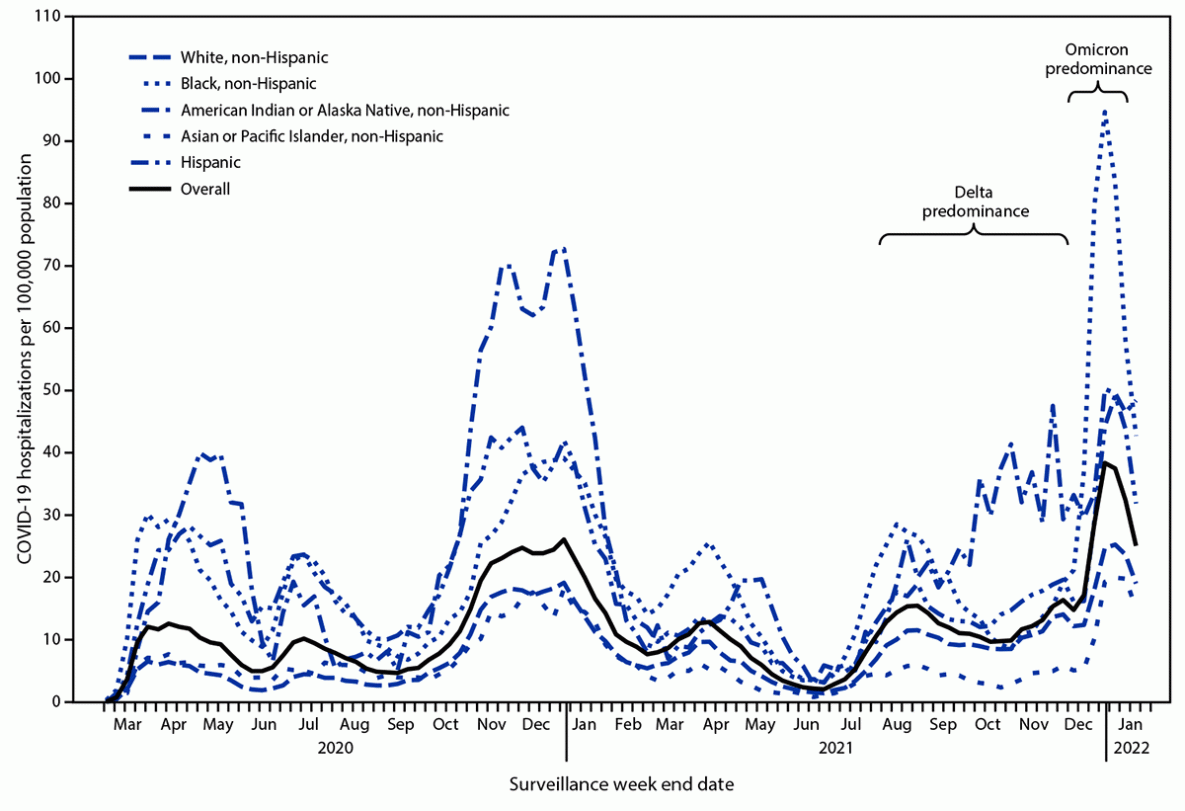
He is making a stink about Covid vaccine requirements during a period where hospitals were overflowing and bodies were being stacked in refrigerated trailers.
There are no stories about this outside the first month. The hospitals were initially ill equipped but were so well equipped after March/April that the giant boat they sent as a backup to New York was barely used.
Almost no healthy people died from COVID, most had co-morbidities and they should have been the only ones forced to vax and stay home.
Vaccines were a miracle. The state medical examiner converted one nearby university’s arena to a temporary morgue at one point in 2020. It’s mind boggling that people were and still are in denial about how bad it got before large parts of the population started getting vaccinated
For real. The sibling comment is flagged now but people seem to have memoryholed the impact of COVID on the healthcare system.
Hospitals were absolutely overwhelmed at many points during parts of the pandemic, outside of the first month. That was a major concern during the "surges" and spread of new variants.
I know this because my state routinely publishes hospital census levels and at many points during the pandemic elective and even non-elective procedures had to be cancelled due to lack of bed and staff capacity. The facility I work at was regularly impacted.
Search hospital related COVID stories during 2021 and 2022 and you'll find plenty.
The people who voluntarily glued themselves to propaganda TV never paid attention to it in the first place. They'll believe whatever they need to because they're mad about lockdowns.
Are we living in the same world? I had a child born about that time which was one of the few ways to actually get into a hospital. When I went in the fucking place was barren. A bunch of medical professionals shaking in their shoes waiting for something that never came. I knew then and there I knew i was being sold a lie and the news was carefully orchestrating snippets of misrepresented footage. And then went about my business as normal.
They were not putting COVID patients anywhere near the maternity ward and you certainly were not allowed to leave the maternity ward so I'm not sure what you were expecting. A busier than usual maternity ward?
Those protocols were apparently not in place yet, or security wasn't aware of them, or no one wanted to stop me. I walked around damn near every hallway of the hospital, which was smallish.
I did a Google search because a wife not being allowed to have her husband present during childbirth sounded too egregious to be true. I found a single Today article about one specific hospital in New York enacting that policiy (NewYork-Presbyterian). That's not nearly widespread enough to apply to any story of a COVID-era childbirth you hear about, FYI.
It varies widely by state/county, etc, but in most of the US, hospitalizations were pretty low still in April. The first peak was around August which was my experience, and the second peak was around January 2021.
So as far as "A bunch of medical professionals shaking in their shoes waiting for something that never came", they were waiting for what was actually coming.
> I knew then and there I knew i was being sold a lie and the news was carefully orchestrating snippets of misrepresented footage. And then went about my business as normal.
It’s extremely poor reasoning to rely on your individual anecdotal experience of your hospital visit to conclude that there is a global conspiracy on a massive scale. Was all the footage of overflowing hospitals and makeshift morgues fabricated?
Fwiw, I went to a Boston hospital in April or May of 2020 to get tested for a Covid exposure and they kept non-covid patients quite separate. They relocated entire offices to different buildings to avoid cross-exposure. They don’t want to put Covid patients near people giving birth or their infants for obvious reasons. Also our emergency department had a million signs up telling people who had certain respiratory symptoms to go to a different location (which I went to and was indeed much busier).
…But I didn’t base my belief on the things I was hearing from literally every source on that experience. I did it because that many people simply can’t coordinate a lie on that scale that convincingly. Skepticism is good, but respectfully and in my opinion, believing it was all a hoax requires a great deal of arrogance and gullibility.
For inexplicable reasons I was about the only one there with free reign of the hospital. They seemed so starved of guests and happy someone was there for good reasons that the hospital didn't stop me from walking around most the hallways, so I did. Small town hospital with few enough security that they all knew who I was.
There was so much bad data and propoganda coming in at the beginning thar ultimately the only thing I could depend on was what I personally investigated. I'm not using it to sign off on a research paper.
And you generalized this to the world as a whole? I admit I don’t have a citation for this, but I’d be shocked if small towns didn’t have markedly slower spread rates than cities. I feel like this was brought up frequently during the pandemic.
> There was so much bad data and propoganda coming in at the beginning thar ultimately the only thing I could depend on was what I personally investigated.
How and which things did you decide were propaganda and bad data?
Perhaps so but I ultimately use data I collected to make my own choices in my own environment, not to force choices upon you. If you had different data I would not judge you for acting differently.
No one exists alone in a society. People who ignored the overwhelming evidence of the pandemic’s severity were more likely to spread the disease to other people because of their poor judgement.
The evidence being peddled by our state health director at the time to justify lock downs was largely computerized projections that were not based on overwhelming evidence and were ultimately wildly wrong even without vaccines.
Sorry, I’m not an expert in the field, but are computerized projections not the norm in disease spread modeling?
I don’t really feel like continuing this argument, so the last thing I’ll say is that I don’t know how else experts are supposed to have made decisions at the time. Makeshift morgues were opening to handle the overflow of bodies. They acted on the evidence they had at the time, and readjusted recommendations as new evidence came to light. This is part of why social distancing protocols changed so much during the first year of the pandemic.
My contention was never so much experts making recommendations based on projections built on weak evidence, but rather experts issuing orders on these wildly false projections that imprisoned and fined people for something as simple as dancing on a sidewalk in protest.
Experts should be free to advise the public. Thankfully the health director issuing the order that jailed and charged this man with a felony had to resign in disgrace.
Look at the timeline of literally any plague, as they all follow a very similar pattern. For instance here [1] is the one for the Spanish Flu. There are a number of peaks and valleys that gradually recess to noise as viruses tend to evolve to less virulent forms while people also simultaneously develop broader immunity. This makes observational data highly unreliable for determining the efficacy of a vaccine during a plague.
The same is true of mortality/severity rates by vaccination status in hospitals. People who opt in to a vaccine are generally going to be more inclined to seek hospital treatment than those who opt out of such. So if somebody unvaccinated went to the hospital for COVID it would naturally be, on average, a much more severe case than a vaccinated person going to the hospital, with worse overall outcomes. And so you skew the results when looking at hospital data.
These biases and trends are facts most people may not be aware of, but big pharma certainly is.
> These biases and trends are facts most people may not be aware of, but big pharma certainly is.
I have a hard time believing that “most people” also means “most epidemiologists” or “most medical organizations” would be unaware of such an obvious problem. It seems like it would be day one of school stuff.
It seems trivially obvious to me, someone whose closest qualification to being able to debate the actual science here is having a bachelor’s in physics and very technically being involved in some academic research. I’m not going to second guess the overwhelming majority of scientists and medical professionals I’ve heard comment on this because of something like that.
I mean laymen. All epidemiologists and the like are certainly aware of such problems. You'll see these biases and many others buried in the discussion/limitations or other such section in any study. Here's [1] a random one from the CDC:
- "confounding might exist because the study did not measure or adjust for behavioral differences between the comparison groups"
- "these results might not be generalizable to nonhospitalized patients who have ... different health care–seeking behaviors"
Along with many more. The problem is that there was no meaningful public debate whatsoever. You were on board with absolutely anything and everything, or you must be an "anti-vaxer" and just wanted everybody's grandmother to die, and probably also thought COVID was caused by 5G.
We also knew perfectly well that allowing it to spread among teenagers would make it impossible to control. When I got vaccinated it was to protect elderly friends and family, not myself.
I'm not surprised when I google the author of that paper, it's a bunch of antivax nonsense because the idea that the mRNA vaccines didn't reduce transmission is one of the dumbest I've heard yet. Here's a slightly (ha) better study investigating the matter from real scientists;
> Full vaccination of household contacts reduced the odds to acquire infection with the SARS-CoV-2 Delta variant in household settings by two thirds for mRNA vaccines and by one third for vector vaccines. For index cases, being fully vaccinated with an mRNA vaccine reduced the odds of onwards transmission by four-fifths compared to unvaccinated index cases.
I'm referring to the medicine deployed against a pandemic whose death count is still entirely unknown.
How many people died because of COVID?
You don't know. No one knows.
Meanwhile, everyone who knows better pretends that the most fundamental data about the subject, on top of which all other data and decsions were built ... is garbage.
Do you think the rough death toll of pandemics are fundamentally unknowable to some approximation? Do you think the massive increase in mortality during the pandemic was a coincidence?
Might some of that be due to long-term medical conditions (such as cancer or dementia) that were treated less effectively during the pandemic, but which didn't cause immediate loss of life?
TLDR: Those comorbidities are often complications caused by Covid in the first place – like pneumonia or respiratory failure. Sometimes they also include risk factors that could never be treated as a direct cause of death on their own, like obesity (which also happens to be extremely widespread in the US so it gets reported on many death certificates for many illnesses, not just Covid).
Pneumonia and respiratory failure are not comorbidities. Those would be the actual cause of death with COVID given the credit for bring them on.
---
Common comorbidities associated with COVID-19 deaths have been well-documented across various studies and data sources, primarily reflecting conditions that increase vulnerability to severe outcomes. Based on extensive data, especially from the U.S. and other heavily impacted regions, the most frequent comorbidities include:
- *Hypertension (High Blood Pressure):* This tops the list in many analyses. In the U.S., CDC data from March to October 2020 showed 56% of adults hospitalized with COVID-19 had hypertension [1], and it’s consistently cited in mortality stats. A New York City study of 5,700 hospitalized patients in early 2020 reported it in 56.6% of cases [2], while globally, a meta-analysis pegged its prevalence at 32% among all COVID-19 patients and 35% in fatal cases [3].
- *Diabetes:* Another major player, often linked to worse outcomes due to impaired immune response and blood sugar control issues. The same NYC study found it in 33.8% of patients [2], and CDC data noted 41% of hospitalized adults had metabolic diseases, including diabetes [4]. Globally, it ranged from 8.2% in China (early 2020 data) to 17.4% across broader reviews, with higher rates (up to 33%) in severe or fatal cases [5].
- *Cardiovascular Disease:* This includes conditions like coronary heart disease and heart failure. It appeared in 11.7% of cases in a 2020 meta-analysis [3] and was notably prevalent in fatal outcomes—26% of 814 COVID-19 deaths in Romania, for instance [6]. In the U.S., myocardial infarction and congestive heart failure were tied to higher mortality odds in a 2020 study of 31,461 patients [7].
- *Obesity:* A significant risk factor, especially in Western populations. The NYC cohort reported it in 41.7% of patients [2], and a 2021 CDC report flagged it as one of the strongest chronic risk factors for COVID-19 death among hospitalized adults, alongside diabetes with complications [8].
- *Chronic Pulmonary Disease:* Conditions like COPD or asthma showed up in 17.5% of U.S. patients in the 2020 Charlson comorbidity study [7] and were linked to higher mortality risk (e.g., HR 2.68 in China’s early data) [9]. Respiratory failure, often a direct result of COVID-19, complicates this category but underscores lung vulnerability.
- *Renal Disease:* Chronic kidney disease was a standout in multiple reviews, with a hazard ratio of 3.48 for death in a UK study [10]. It’s less prevalent overall (0.8% in some global data) but deadly when present, especially in older patients [3].
- *Cancer:* Malignancies, particularly metastatic ones, increased mortality odds (HR 3.50 in China, 2020) [9]. Prevalence was lower (1.5% globally), but the impact was outsized in fatal cases [11].
Other notable mentions include dementia, liver disease (mild to severe), and immunosuppression, though these were less common. Age amplifies these risks—over 65s with comorbidities faced death rates 4 to 10 times higher than those under 40, per UK data from 2021 [12]. Multimorbidity (multiple conditions) was also a game-changer; over half of fatal cases in some studies had two or more comorbidities, with one U.S. analysis noting an average of 2.6 to 4 additional conditions per death [13].
These patterns held steady from 2020 through 2023, with the CDC reporting that 94-95% of U.S. COVID-19 deaths involved comorbidities [14]. The virus didn’t just exploit these conditions—it often triggered acute complications (e.g., pneumonia, ARDS) that were listed alongside chronic issues, muddying the “cause of death” debate. Still, the data’s clear: these comorbidities didn’t just coexist; they stacked the deck against survival.
AFAIK, that number more accurately reflects the number of people who died within two weeks of testing positive using PCR tests at high Ct values (35-45), inflating case counts.
> A COVID-19 death is defined for surveillance purposes as a death resulting from a clinically compatible illness in a probable or confirmed COVID-19 case unless there is a clear alternative cause of death that cannot be related to COVID-19 disease (e.g. trauma). There should be no period of complete recovery between illness and death
It does not include cases like someone dying in a car crash who happened to be COVID-positive.
> It does not include cases like someone dying in a car crash who happened to be COVID-positive.
Maybe not, but it definitely includes millions of elderly or otherwise comorbid subjects who developed pneumonia and never recovered. Sad is it is, that happens year-in and year-out when the initial virus doesn't have a household name.
It also happens with the influenza virus ... except 2020 and 2021, where we had a miraculous reprieve from flu deaths.
Methods used to combat COVID-19 (social distancing, masking, moving indoor events outdoors) really are quite effective at reducing the transmission of respiratory viruses. Big changes can come about from small changes in r.
It's useful when done in good faith. During COVID there were numerous decisions that even if not intended to inflate mortality figures, then they did so inadvertently. In particular the CDC gave extremely broad guidance on what to classify as a death "of" COVID, and the government was giving hospitals additional funding per COVID death. So for the most ridiculous example of what this led to, in Florida some guy died in a motorbike crash and ended up getting counted as a COVID death because he also had COVID at the time. [1] He was eventually removed from their death count, but only because that case went viral.
Even in more arguable cases, preexisting conditions and extreme senescence are ubiquitous in deaths "of" COVID, and at this point there's probably no real chance of ever untangling the mess we created and figuring out what happened. For instance Colin Powell died at 84 with terminal cancer, Parkinson's, and a whole host of other health issues. His eventual death was flagged as 'caused by complications of COVID.' I mean maybe it really was, but I think the asterisk you'd put there is quite important when looking at these stats.
I’m neither an epidemiologist nor a statistician (just a mathematician pretending to be a coder and/or butterfly), but I do not believe there are no mathematical tools to mitigate the statistical impact of comorbidities and accidental misreporting.
To contextualize this: my position is “weak signals are possible even with noisy data”; I read your response as “but the data is really noisy,” which, sure, agreed; the user I was responding to seems closer to the solipsistic position “there is effectively no data at all.”
> I don't remember dissent being tolerated, let alone encouraged.
How many people were jailed or disappeared for their dissent?
Being able to dissent doesn't mean that people accept your opinion, it means that you are allowed to make your point using your own means.
People still get to disagree with you, point out where you are dishonest or mistaken, etc. etc. etc.
The idea that dissent wasn't tolerated is absolute BS. It was tolerated far more than it should have been, far more accommodations were made than necessary, such as in the military, which injects people with all sorts of vaccines but somehow decided that this well-tested one didn't have to be because some people were scared.