The market has been overvalued for decades. Even the biggest corrections only take it down to a reasonable valuation. There is never a rational buying opportunity... except that people have lived their entire working lives without seeing a reasonable price. (Maybe... 1987?)
It's very likely that Tuesday the market will see a buying opportunity and send it right back towards record territory. Which is insane.
I think there is a genuinely new factor at work: so much money flows into the market that it has bought up all of the possible future earnings.
That was all following reasonable advice, but that advice assumed that the market could absorb all of that money. If too much flowed in new capital opportunities would arise. But even before the AI bubble, that had ceased to hold.
If it’s been “overvalued” for decades, wouldn’t there be a point where we can concede that it is actually valued properly, and it’s your valuation model that needs to adjust, not the market?
Surely there is some time horizon at which we can admit that the market is effectively correct. After 100 years of being “overvalued”, can we call that the real value? 1000 years?
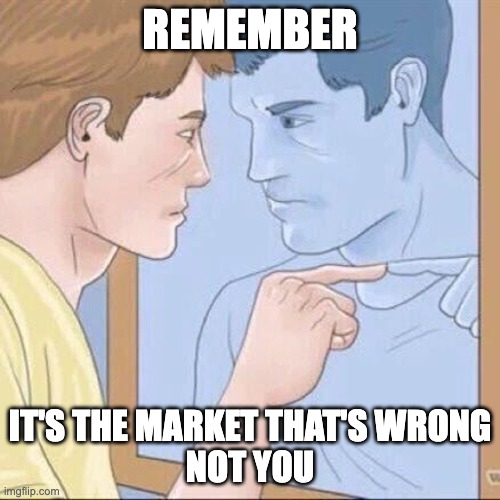
This seems like that meme where the guy is looking in the mirror and telling himself, “you’re not wrong, the market is wrong”[1]
We could concede that, but it would require defining "proper value" in a way that has little relationship to proper or value. We could define it to mean "market price", perhaps, and then we could asset the market price matched the proper value. But then it would only be a meaningless tautology.
The real value is in earnings. Pricing in future revenue requires a crystal ball but it is clear that the market capitalization has grown faster than revenue.
Earnings do not justify the price, for the market as whole. There is only so much earnings to be had. It is overvalued by the metric of dividends or property (retainer earnings).
I agree with you that price is some kind of signal about earnings. However:
> Earnings do not justify the price
… maybe? I’m not sure I believe you conclusively, so you would have to prove this before I accept it.
PE ratios are higher than historical averages (according to Perplexity, S&P PE is 27, which is higher than the median of 18. The top 10 holdings hover between 12 and 80, excluding TSLA which is over 200).
However, I could see reasonable rationalizations for these PEs that could tell me that they’re expensive compared to historical trends, but not “overvalued.”
Maybe investors are assuming technological change will drive accelerating earnings growth (especially true for the top tech stocks) more than we’ve experienced historically. Top tech stocks are more efficient cash generating machines than they’ve ever been before, and the S&P has shifted to high multiple sectors like tech and away from lower multiple sectors like energy and financial services. So it’s possible our understanding of “expensive” stocks is miscalibrated if we just look at historical PE ratios.
I can’t say for sure that equities are priced “reasonably,” but I can say you haven’t convinced me they’re overvalued.
18 is exactly what he number I mean by overvalued. It corresponds to an interest rate of about 4%. You can do better in zero risk bonds. And that's for 18; 27 is just not reasonable.
And the S&P.has been going up much faster than 4%. If there was ever a point where it was properly valued it must be overvalued now.
The S&P index isn't the whole story, especially in an expanding tech economy. But still, I'm looking at it as an absolute, rather than a relative number, and it strongly suggests that earnings cannot justify these pricings, even when we're not at the top of a bubble.
The only “yes, but…” I would add is that it seems to my retail, unsophisticated eye that:
1) while you could do better nominally in bonds, it seems like investors are pricing in a lot of earnings growth, not just static earnings in PE.
2) the market expects inflation, and blue chips can typically raise prices during inflation which protects shareholders, whereas bonds don’t offer this protection, other than TIPS etc
3) it also seems like (for now…) US equities are still a safe haven for international capital, so demand is still there (i.e. there is no alternative)
> wouldn’t there be a point where we can concede that it is actually valued properly, and it’s your valuation model that needs to adjust, not the market?
Requires an alternate proposal about how to value stocks, and in aggregate, the stock market at large.
The only reasonable way to value stocks is in their potential, upon purchase, for the purchase price to be returned via dividends issued on future profits (even stock buybacks ultimately justify their price increase on dividends being divided among fewer shareholders).
> After 100 years of being “overvalued”, can we call that the real value? 1000 years?
Stocks are being priced at levels that will require longer than a full human lifetime to return their share price via dividends. "Overvalue" is subjective; some people will be fine with the idea that only their children (or, someday, only their grandchildren, and so on ad infinitum) will see a profit. People will also pay a premium for the liquidity of the stock market compared to less-liquid investments (e.g. real estate).
There is simply too much cash sloshing around compared to the opportunities for return available.
Complete nonsense. Your understanding of investment is entirely flawed. Dividends are one element of the value of a stock, but there are many, many others. Chiefly, the expectation that the stock will rise in value such that you can later sell it for more than you purchased it for.
A parallel to draw very easily is an investment in commodities. Those will never pay a dividend, so therefore they're worthless? Obviously not, you invest in them because you expect their value to rise. Same with a stock.
An asset is worth what someone is willing to pay for it. That is its value. Intrinsic value is an element, but not the most important one.
You also display either a very basic misunderstanding or willful ignorance. There's no gambling involved - investing is not dumb chance. There are real companies behind these purchases with real expectations of future growth and thus increase in value. Or vice versa.
Everyone loves the "you can't beat the S&P" trope, but that's also just ignorance. There's a reason that proprietary trading firms generate more profit per employee than any other business in the world.
I do personally know people who do invest and it is 100% gambling for a lot of small "investors". The only ignorance is to pretend it is not a thing. This point becomes super clear once you start looking at trading apps targeting this market.
> There's no gambling involved - investing is not dumb chance
First a gambling does not have to be a theoretically pure dumb chance in order to be gambling. Second, in practice it basically the same thing as betting on horses used to be.
There is a reason why small investors loose money on their investments on average despite markets going up. Because what they do is not investing.
> There are real companies behind these purchases with real expectations of future growth and thus increase in value.
Oh common, this relationship is quite broken for exactly the most known companies.
> Everyone loves the "you can't beat the S&P" trope, but that's also just ignorance.
This seems like a willful misinterpretation.
They say “you won’t beat the S&P” because maybe some HFT firm with highly secretive and advanced technology and MIT PhD quants might… but you, Mr. Retail McDumbMoney, don’t stand a chance.
And it’s still nonsense. Many people beat the S&P and this meme needs to die. It’s considerably easier to beat the S&P when you’re not working at the scale of a hedge fund.
> the expectation that the stock will rise in value such that you can later sell it for more than you purchased it for.
If the person who holds the share can never expect to be paid for holding the share, then you're describing a Ponzi scheme. Eventually you cannot find another sucker willing to pay in even more.
> commodities
Are used as manufacturing inputs and thus a commodity investment injects liquidity in exchange for a return, should manufacturing demand (for those inputs) rise. Their intrinsic value derives from their consummability.
Stocks/corporations do not have intrinsic value beyond the sum of the fair market prices of the assets belonging to the corporation, should they be liquidated and dispersed among shareholders... which would be a dividend. At the end of the day the only reasonable means to price a stock is a calculation of expected dividends.
The quote should be updated from "Markets can remain irrational longer than you can remain solvent" to "Markets can remain irrational longer than you can remain alive".
At some point, inevitably, bonds have to appear more attractive. Until those, too, get bid up until their coupon rates become effectively worthless compared to bank deposits or worse, inflation.
At some point, all financial instruments look bad, but non-financial markets remain: it's possible to go out and buy goods and services, and it's possible this leads to a better end result than holding financial instruments as long as possible.
Even when the market isn't bad, it's still a good idea to consider your balance between financial and non-financial assets. The whole point of holding financial assets is to eventually maximize your non-financial assets, after all.


It's very likely that Tuesday the market will see a buying opportunity and send it right back towards record territory. Which is insane.
I think there is a genuinely new factor at work: so much money flows into the market that it has bought up all of the possible future earnings.
That was all following reasonable advice, but that advice assumed that the market could absorb all of that money. If too much flowed in new capital opportunities would arise. But even before the AI bubble, that had ceased to hold.