Valid points by those concerned with taking over the sidewalks.
I will also say, people riding electric scooters shouldn't be zooming along at 20mph (or pedal bikes) on sidewalks either, which are a true safety hazard.
And on the other side, much better for our environment, to have a lighter weight robot delivering a burrito than a 2,000lb vehicle, in terms of net energy consumption/expenditure.
Imagine how much better for the environment it'd be if your delivery was brought to you via a human-powered bicycle. Or as an in-between: e-bikes and e-mopeds.
Using 2,000lb vehicles for last-mile burrito delivery is a "we've tried nothing and we're all out of ideas" scenario. Delivery robots are an improvement because literally anything is.
Why are you assuming that a human would be more efficient and better for the environment than an electrically powered robot? It is very inefficient (approx 25%) to use food as an energy source, and humans are always burning energy. They can't turn off at night or when they are idle. I think it is very likely that the robot would be better for the environment than the person.
> Why are you assuming that a human would be more efficient and better for the environment than an electrically powered robot?
Because bicycles use 5x less energy per mile than electric scooters, which would be a reasonable analogue for slow electric delivery robots [0].
> It is very inefficient (approx 25%) to use food as an energy source,
By comparison, fossil fuel conversions are about 30-45%, depending on the energy source [1].
> and humans are always burning energy. They can't turn off at night or when they are idle. I think it is very likely that the robot would be better for the environment than the person.
That's a really, really weird baseline to use. Turning off a robot when not performing a task is standard procedure. Turning off a human when not performing a task is not standard procedure, and is frowned upon in polite society.
I live in a place with excellent bicycle infrastructure. All the delivery people ride electric bicycles. A robot would be that, minus the human. So probably better in terms of energy expenditure, cost, etc.
What does "good" for the environment even mean? I always assumed it means "good" for human purposes. But if we replace humans with robots, then the goodness of the environment seems somewhat moot.
Oceans filled with plastic would be "good" for something. Just probably not us. Maybe robots?
I think it's a symptom of our work culture and lifestyle. When people are spending anywhere between 1-2 hours a day in a car going to a job that sucks the life out of them, I'm not surprised they don't have the energy to get food for themselves.
Convenience services thrive in America because it's the only way the working class can claw back a teensy bit of time and energy. We could have had hybrid or even remote work, but that dream is dead. Traffic sucks, outside is loud and stinky, and you're in the office minimum 9 hours a day, 5 days a week. Minimum. I actually don't know anyone who works that little.
It’s a vicious cycle. I’m not a big delivery fan myself but you go into some small casual restaurants now and everyone else in there is a delivery driver.
Yeah, depending on the speed of these vehicles, it seems like bike lanes are the appropriate place for them. A smart city could even offer companies an opportunity to fund the buildout of additional bike lanes if there aren’t any existing in the neighborhood in question
The point of infrastructure is to have a common substrate where members of society can provide services to each other. Sure, in some sense there are subsidies but we have to account for the positive externalities. After all, a tennis court has very low utilization of space so that's a "subsidy for rich guys to talk about crypto". And golf courses likewise.
It's just not a meaningful way to think of infrastructure. The point of infrastructure is that it benefits society, and it will benefit some people more than others. Nice sidewalks benefit the rich people who live there more than they do the poor people who have to drive from the suburbs to work there.
And this business about "have to move out of the way" is really a bit much. If they're impeding the disabled then that's of some significance, and ensuring that those who need wheelchair access can still get places is worth it, but any able-bodied person can easily step aside.
I find the online reaction to so much of this stuff hard to fathom. Occasionally, I'll walk by a Lime / Bird scooter that's fallen over and I just pick it up and place it on the side. The net gain to society of having easy-to-access last-mile transportation is probably much greater than this happening occasionally. I really think these things are far overblown. But if you go online, you'd think that sidewalks are completely unwalkable. I principally walk and bike (now e-bike) places and this has never been a problem either in San Francisco or London - both cities where a large contingent has constantly insisted that it is.
I think you’re right that liability concerns are probably what motivated companies to design for sidewalks instead of roads. That being said, I think it’s very unlikely that a robot weighing 100 lbs and moving 15 mph is going to kill anyone. Could certainly cause some property damage or break a bone, but is that worse than blocking a disabled person on a sidewalk or pushing deliveries into full cars?
I think the problem is that if they're in the road their liability and required smarts go up a lot. Right now it sounds like they're at least partially relying on being the largest thing on the "road" and everyone else will naturally get out of their way.
A slow-ass cooler-sized wheely boy filling up the entire bike lane and stopping randomly, that'll be super safe for cyclists, yep. On the bright side maybe some of them will get knocked into traffic by people who don't bother looking for bicycles coming up behind them when they open their car door, never mind low-riding bots that are much harder to see.
Bikes and scooters aren’t legal on sidewalks in Chicago, and these little robots are just clogging up what little pedestrian space still exists. Totally apart from the questionable ethics of gratuitously using tech for tasks that could be a job for someone.
Wait, the first part I get: the robots are basically motor scooters, don't belong on sidewalks, sure. But the last bit, about "taking tasks that could be a job for someone" --- that's the lamplighter fallacy, isn't it?
As someone who has lived in chicago for 30 years I dont mind telling you that laws are not enforced here. Bikes and scooters not being legal on sidewalks has not stopped a single person from biking and scootering on the sidewalk
Atlanta has been an early market for both scooters and various food delivery robots. Both have been a boon for the city.
We've had these delivery robots for about six months now, and they've grown to the point where I see hundreds of delivery robots on the sidewalks each week. Scores of them daily. They're flooding our city, making the long commutes people don't want to.
The reason this is great is that Atlanta's infrastructure is car-centric and spread too far apart to make walking or even biking make sense.
The biking infrastructure we have does no good when it rains and you're twenty minutes from your destination. That same infrastructure also doesn't serve our children or our elderly. Or help when you're sick or tired and need a pick me up.
It's easy to order for a group of people from one of these. To imagine the same group of four people hopping on bikes together to travel twenty minutes to food - that's never once happened in my life. Only certain types of people bike, and you'll invariably find yourself in groups with lots of non-cyclists.
I feel that cyclist culture is bright eyed and idealistic, but not practical. You need a city designed around it, and all the people need to grow up loving it. These delivery robots, Waymo, Lime bikes - they're much more sensible middle grounds for cities like ours. Where people can't bike, or simply don't want to.
The economies of scale of a 2,000 lb (electric) vehicle are probably such that they use far less carbon than an individual delivery robot on a per-delivery basis


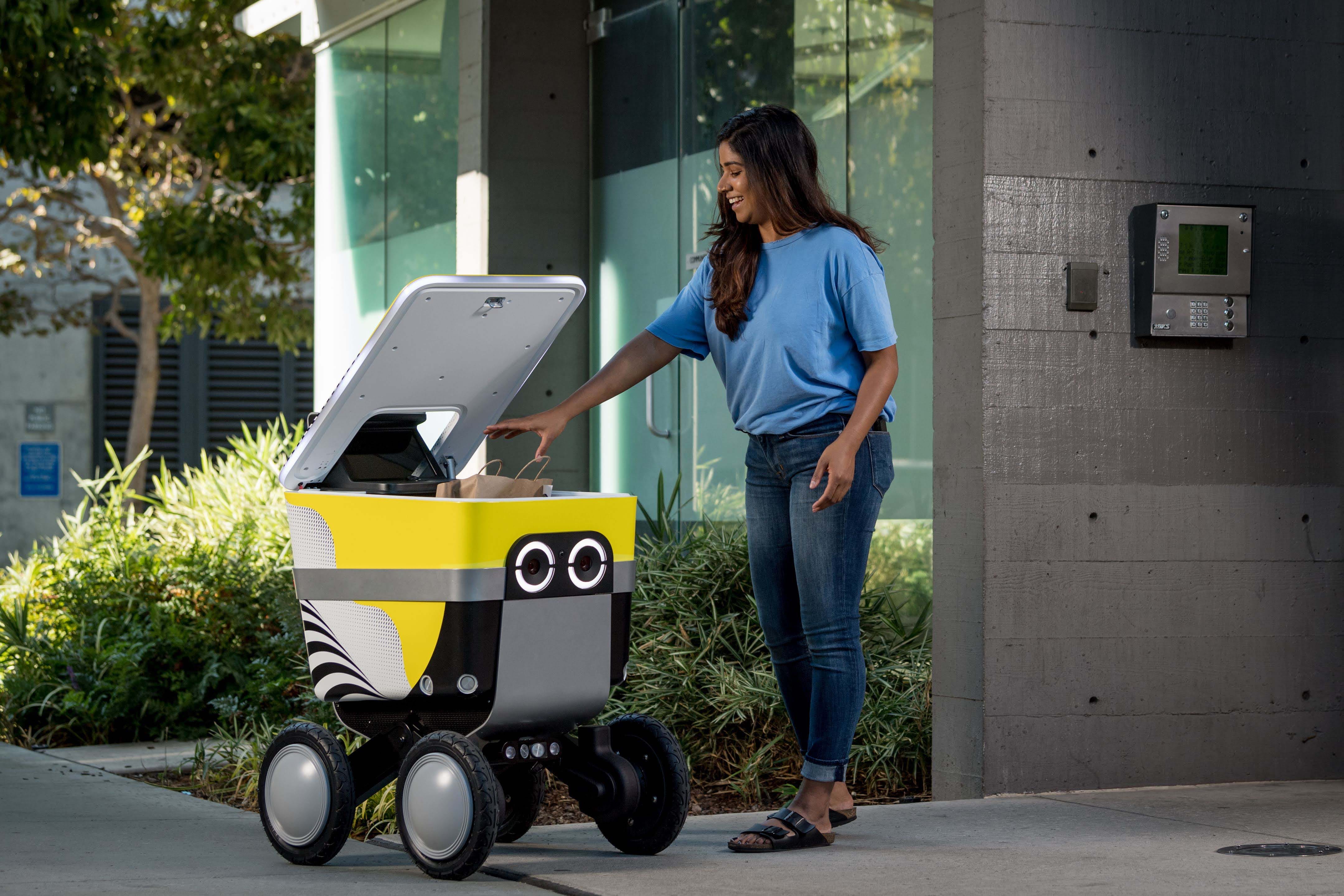
I will also say, people riding electric scooters shouldn't be zooming along at 20mph (or pedal bikes) on sidewalks either, which are a true safety hazard.
And on the other side, much better for our environment, to have a lighter weight robot delivering a burrito than a 2,000lb vehicle, in terms of net energy consumption/expenditure.