This says more about the arbitrary nature of using city boundaries for studying home pricing than anything else. San Francisco certainly has high prices, but it also has one of the smallest footprints of any major city, and has lots of nearly-indistinguishable residential areas that are adjacent but fall outside its boundaries, particularly to the South and East. If you look just at pricing within the city boundary, it's going to be inflated by the fact that such a large percentage of that area is still relatively close to the "city center" and benefitting from the value that creates.
Meanwhile, "New York City" (which ranked lower on median price) includes large residential expanses that are much further away from the city center, including Staten Island. (Not to mention Los Angeles, which is what, 50X the size of SF proper?)
I'd like to see this comparison done for say, Manhattan island vs. San Francisco - that would be a much more apples-to-apples compare.
One of the interesting bits then is the differences between the common meaning of a city and the statutory boundaries.
What people mean when they say "New York City" and what it actually is are more or less the same thing (though most people are surprised at how big and diverse the 5 boroughs actually are). People don't really count the NYC Metro area in the equation. Nobody who visit Trenton or New Haven comes back home and says "I went to New York".
When people say lots of other cities, they really mean the metro area. "Washington D.C." refers colloquially to the 7th largest urban area in the country. People can make regular repeated visits to Arlington, or Fairfax or wherever and still go back home and say "I just went to D.C.".
I suspect SF is the same. People can visit anywhere in the Bay Area and go back home and credibly say "I visited San Francisco" even if they never actually stepped foot in the city proper.
edit I notice everybody who disagrees with this premise lives or is from the Bay Area where these things matter. On the other side of the country, all of California north of Monterrey is basically "San Francisco", most people think Oakland is part of L.A. and nobody could pick out SV on a map if their life depended on it.
>I suspect SF is the same. People can visit anywhere in the Bay Area and go back home and credibly say "I visited San Francisco" even if they never actually stepped foot in the city proper.
No, no they couldn't. Residents of SF are quite prickly about what is and isn't the city. You'd say you visited the bay area or possibly silicon valley not SF.
I've visited that part of the country before. I tell people I visited SF. I have no clue if I was actually inside the city proper. The problem with the "these people are prickly" notion is that THEY'RE NOT WITH ME BACK HOME TO CORRECT ME and thus I don't really have to give a shit if I stepped inside the city boundaries or not.
[nothing personal]
by that logic (no one is around to correct you and also you don't give a shit) you can start making plenty of things up. Oh what a stories you should have about your travels and adventures!
Yes of course, I completely agree. You're 100% right that I can make up any lie I care to and it's even easier if there's nobody to call me out on it. And I don't take it personally, it's not offensive.
My point, though, is that the notion that the residents of SF have any ability to sway the visitors to SF as to what they tell people back home is bogus.
>>I suspect SF is the same. People can visit anywhere in the Bay Area and go back home and credibly say "I visited San Francisco" even if they never actually stepped foot in the city proper.
>No, no they couldn't. Residents of SF are quite prickly about what is and isn't the city. You'd say you visited the bay area or possibly silicon valley not SF.
This second statement one I take issue with, made by coolsunglasses. What mechanism does coolsunglasses have to force me to know the difference between "bay area" and "san francisco" and "silicon valley"? How does he propose to regulate my speech such that I don't offend his (or others) sense of which areas are which?
I get that people who live in SF proper might get upset if someone said that. That is their right. But for the vast majority of the population (think "flyover states" and probably a good bit of the east coast) visiting anywhere in the bay area is just as good as the "real" san francisco. At least from a communicating-the-idea-of-what-happened perspective. And the folks in SF or the bay area not liking it doesn't do anything to make it impossible to say. Inaccurate? Perhaps. But uninformative? Not at all.
Actually I do recall meeting some people in one "tourist's destination" place who answered "we're from San Francisco" to "where are you guys from?" and then later specified they from bay area not far from SF (I myself live in SF). It's a matter of convenience I guess, when you are in the place with plenty of people from different regions it will quickly give an idea what part of US you're from without going into detailed explanations when not necessary.
When people ask me where I'm from I say "DC". I actually grew up in Alexandria, VA. But I'm not lying to those people[1], I'm trying to give them a general idea of where I'm from that they are most likely to know. If they follow up with "what part of DC" then I know they are more familiar with the area and I say something like "well actually, i grew up outside DC in northern virginia".
Now that I live in Oakland I say I live in Oakland, but if I lived in, say, fremont, I'd probably just say the SF Bay Area. People probably know Berkeley, Oakland, SF, Palo Alto, and San Jose as specific places around the bay, so you can safely say those, but if you are from Walnut Creek...no one (generally) outside of the area can actually place that, so defaulting to "SF Bay Area" or even "SF" is simpler and puts the person you are talking to in the right geographical area.
>But for the vast majority of the population (think "flyover states" and probably a good bit of the east coast) visiting anywhere in the bay area is just as good as the "real" san francisco.
Not really, no. If I said I visited SF, my grandfather from Florida would ask me what neighborhoods I visited and restaurants in SF I went to.
I kind of doubt anyone visits Oakland or San Jose (both of which are huge destinations in "the Bay Area" but have their own international airports) and says they "went to SF." I sure hope not. It's pretty clear cut if you went to SF or not, since there's water on 3 sides of the city and not much to visit on the 4th side.
I'm not familiar with housing costs in SF, so I'm not sure how considering surrounding areas would change the data, but I know in DC that the surrounding areas are by-and-large as expensive (and in many cases more expensive) than DC-proper.
The point being that whether you consider DC-proper, or DC/Arlington/Bethesda/Silver Spring/McLean doesn't really change things too drastically. Expensive cities tend to be expensive everywhere. I know that in Atlanta, for example, you can live in the city center in a nice place roughly for what it costs to rent an apartment of comparable quality pretty much anywhere in Northern VA. There is a floor (a very high floor) beneath which you will not find quality housing and really not much of a ceiling.
In SF, some of the immediately adjacent areas (connected by subway) are drastically cheaper, like South SF, Oakland and Alameda. Like 50% of the cost if you look at the median sales prices. There are definitely some expensive suburbs, but they're either to the north in Marin or much further south down the peninsula down by Stanford.
It's worth noting that after New York and Brooklyn merged (I think around 1900), SF considered merging with Oakland.
> Nobody who visit Trenton or New Haven comes back home and says "I went to New York".
You're stretching things. Trenton is 2 hours from Manhattan by car. If you stay in Northern New Jersey, you definitely "went to New York". I can get to Manhattan within 15 minutes from Hoboken or Jersey City. When you're that close, you're definitely part of the city.
No one I know in NYC considers Jersey City to be "part of the city" any more than people consider Oakland to be part of SF. Hell, I know people living in Brooklyn who only consider Manhattan "the city".
Sure - it's like having a stopover at SFO and saying you've "been to San Francisco"... or at CDG and saying you "visited Paris." They're both 15 minutes from the city, too.
> I can get to Manhattan within 15 minutes from Hoboken or Jersey City.
As a figure of speech most people won't consider either of those NYC. Somebody visiting Jersey City went to "New Jersey" colloquially.
Actually, I take it back, people who don't know NYC well "know" that Manhattan, Brooklyn and the Bronx are "places in NYC" even if they aren't quite sure what they are, I'm not sure Queens registers for most people, and Staten Island, even though it's geographically one of the largest parts of the city, may as well not even exist. People picture Manhattan in their heads though and that's about all they ever visit. Some people might confuse the name Yonkers as part of NYC because it's kind of a funny name like Brooklyn or Bronx and they've probably heard it on NYC area TV shows and movies. But nobody outside of the NYC area will visit White Plains, Paterson or Newark and claim "I went to New York City".
Meanwhile, people who visit Palo Alto definitely say "I visited San Francisco". But I do agree with other comments that people don't usually conflate San Jose or Oakland with San Francisco.
It's the colloquial semantics of place names that I'm referring to. It's a little bit like how "Asian" means either East Asian, or East Asian + South Asian depending on your dialect of English, but nobody who ever visited Aermenia or Cyprus ever claimed they "visited Asia". Or people who visit Egypt visited "the middle East" when really they visited Africa.
Part of it is name recognition. If I'm not from the Bay Area, "Belmont" or "Millbrae" doesn't mean anything to me or to the people I'm talking to, even if they're clearly distinct places well outside of SF. The identity of SF has subsumed those other areas, at least in the geographic knowledge base that people from outside the area walk around with.
Most people know Jersey City is obviously not NYC. But most people from outside of the D.C. area couldn't pick out Annandale nor does it have any meaning to them. So people just say "I went to D.C."
This has some embarrassing and sometimes hilarious side-effects for out of towners. Like for example, somebody visiting San Francisco proper, knows that they have a buddy that lives near there (because in a past conversation his buddy said "I live in SF" because it was easier than saying "I live in Emerald Hills" and doesn't understand why it's not immediately convenient for them or their buddy to just hop on a street car and meet up for a quick Coffee.
Or I know a company from the West Coast that set up shop in "D.C." expecting it to be convenient to their Government customers, only to find out that none of their customers would come to their office since it was a 2 hour drive in traffic from the actual customer locations out in the larger Metropolitan area.
I think the exact boundaries to use for comparison are really difficult to pick, and vary on an individual level. For instance, the superb connectivity of the public transportation makes me feel as if Brooklyn, Queens, the Bronx (sorry Staten Island) are very much a part of NYC. I did not feel this way living in Mountain View; SF felt like a major chore to get to and a different world of its own. Plus it helps that the boroughs have the urban amenities I associate with a city that the suburban Bay Area towns like Mountain View lack.
So, while you might personally want to compare SF to Manhattan (which is totally fine based on what you value), when I think of my own quality of life metrics, I consider the NYC boroughs (excluding Staten Island) a cohesive unit that the SF Bay Area is not.
This was the metropolitan area, though. If you look at the chart, the top-left column states "Top 25 metropolitan areas, by population". After all, everywhere in Silicon Valley is expensive, not just SF proper. San Jose is not itself cheap.
SF isn't in Silicon Valley. San Jose is one of 10 largest cities in the county and Oakland's pretty big too. I'm guessing that "San Francisco metro area" probably can't include either of those two larger cities, nor would it include Silicon Valley (which is 15-20 miles from SF and closer to San Jose.)
That's absolutely right, and in the few articles I've seen that break out Manhattan, it's still significantly more expensive than SF. Of course, that's old news, right? And being old news, "Manhattan is the most expensive place to live" doesn't fit into the current tech boom, linkbait narrative that all the blogs and news outlets are exploting.
That's funny, because I often make the opposite point about SF. Living in the Boston area, there are areas of Boston that are as expensive as SF (Back Bay, South End), but I can go a very short distance out of the city (Somerville, Medford) and find considerably cheaper housing.
It's not that different, depending how far north you get in Manhattan. The distribution of housing types might be different, but things get pretty residential in the northern end of Manhattan, and you're as far away from "midtown" than those places are from downtown SF.
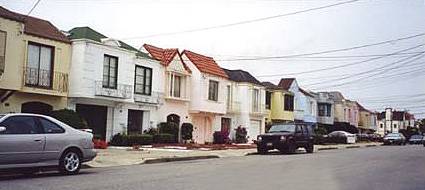
It's as far away geographically (even further for the north in terms of miles), but even if you get to harlem/university heights the types of buildings and the way the streets feel is different from the sunset/outer richmond. There is just some sort of gloom and emptiness because of the density of people & climate in those neighborhoods compared to manhattan. You'd hardly find a street in manhattan that has the feel of this : http://foundsf.org/images/2/23/Photo9Ungaretti.jpg
Maybe the light colors in San Francisco's outlying neighborhood's architecture make them look just even more distant and quiet / abandoned?
Also, the ease of getting into the heart of manhattan (say Union Square for both cities) from north Manhattan just feels different than taking the Muni/Bus in SF. You're inside the subway, enclosed and underground. The neighborhoods that have that distant feeling in NYC are ones like Flushing, Gravesend & Jamaica. Or Canarsie. Canarsie is so far away...
Also, Hi Tom - This is Alex from the first Stuy meetup :)
I feel bad for the people who grew up in the area and feel connected because of family or whatnot. As a software engineer NOT from SF, it's probably the last place in the country I'd move to - we have such a relative abundance of remote opportunities compared to other professions. I don't really see why I'd be willing to pay maybe up to 4x+ my housing cost for perhaps a 15% increase in pay. It's a nice place and all, but geez.
>I feel bad for the people who grew up in the area
The people who grew up there (whose parents owned homes) are doing quite well (at least their parents are) because of the vast appreciation of their homes. Among some of my wealthy friends that have paid ridiculous prices for real estate in SF, I have heard the rather condescending term "thousand dollar millionaires" used to refer to these long-term homeowners that did nothing to create a $1M+ net worth other than pay their mortgage and live in the same place for decades.
Anyway, it's not the people who grew up there that you should feel bad for. It's the people that need to be there for one reason or another and can't afford a living wage with the incredibly inflated prices and taxes associated with living in SF and California in general.
Asset rich, when your asset is your home, is the worst kind of rich. Unless you have something else very very compelling to back it up.
If you sell, then say goodbye to your city. If you don't sell, then you don't have this capital, and you still live in a very expensive place.
You can mortgage it for a lot of capital, but this is a poisoned chalice.
Other means to actually realise any of that wealth is to try your luck and speculate downwards, which is extremely risky if that's your only big asset.
Lots of people are "feeling rich" without being realistically able to realise any of this wealth, since they cannot really move away from their city. This is fictitious wealth that constitutes a massive burden to the city and endangers its competitive place in the future.
It will pop sooner or later and its likely to cause massive social problems. It's causing them already even before that happened.
I work as a real estate analyst in Shanghai, and this same situation is playing out here. Like San Francisco, buying a 2 BR 1,000 sqft apartment in the city proper can cost upwards of US$1M (RMB 6M), though here the GDP per capita is only US$6,000 vs ~$42k in the US. Also, many Chinese feel to own a home before marriage, which is usually accomplished by pooling the savings of parents and grandparents, and assuming one will be in debt until the end of time.
Those that have apartments probably bought them 10-15 years ago, when the price was 10X less. They are, as you mentioned, asset rich, but it doesn't translate into any greater quality of life.
The good news is that the rental market is relatively cheap here. In real estate terms, the cap rate (annual rent / sales price) for buying an apartment is around 1.5-2%, compared to 5%+ even in places like SF.
The market here in China, and the general obsession with real estate, is a deep an interesting topic. The best summary I've found so far is the corresponding section in the book "In Line Behind a Billion People". It's expensive by ebook standards but well worth the time/money for those curious about China.
In fact, it can be even worse with rising property tax valuations. The home you've owned forever might cost you more in taxes a year than a mortgage would be in many places.
My understanding of property tax in SF is that it is based on the price the house was purchased at. This means that the home you've owned forever has had a predictable tax based on that price, and only new owners you sell it to will be paying the higher cost tied to higher property value.
Really, the article left out that HUGE issue. If you grew up in the Bay, you are very very familiar with this. I am surprised how many commenters here claim to live in the Bay, yet don't understand property taxes in California. It's a major issue in the state, not quite as big as water rights, but still major.
This is an interesting perspective. I'm from Marin County (the "classic" cloister of the rich in the bay area). While I was growing up (1985 - 2004), there was already a cultural gulf in the community between the older population (families that had purchased houses before the prices spiked) and yuppies who were buying housing at hugely increased prices. On paper, many people in Marin are very wealthy, but in practice this isn't as common as the stats suggest (An ex-girlfriend's parents weren't well off enough to help her attend college, but her parents were considered too rich due to their house for financial aid).
I've been lucky enough to have parents who could afford to help me with school, and have an interest in a lucrative field (computer science). However, many of my highschool classmates did not have one (or both) of those advantages. They are also squeezed between a high cost of living and the lack of jobs that provide a realistic living wage. However, unlike migrants from other areas, the less fortunate locals do not have another home to go back to. I know families that moved their entire family out of the state while their kids were still in school because it became financially untenable to live in the area.
This situation reminds me of the ongoing situation in SF. There are plenty of stories (anecdotal though they may be) of long-time residents being forced out of communities by the economic climate. It is easy for outsides to look at the Bay Area and see a city made up of tech workers making $100k+ a year, but the reality is very different. The same is true of people who bought their houses in a different economic climate. At least the parents have the "escape value" of their houses, as long as they're willing to sell off 18+ years of their lives.
The people who grew up there don't have any extra wealth. So long as their parents continue to live in the same house, it's all just wealth "on paper".
Now, if they live with their parents, that is certainly a leg up in terms of not paying rent (or paying much less rent), but other than that...
Not in SF proper... I'm a native san franciscan that grew up in the mission in the 90's, and virtually every native san franciscan I've ever met has been a renter. I only had like 1 friend in high school whose parents actually owned a duplex in noe valley, but other than that, pretty much everybody was in small apartments. I think this is the reason why a lot of the "if you wanted a stable living situation, you should've bought a home" type arguments aggravate a lot of the anti-gentrification people in SF...
That same sort of thing happens in Australia, especially for coastal and beachfront properties. Where property was really cheap because it was far from major centres ended up getting really expensive over time. The only difference here is that those people tend to be squeezed out when they can no longer afford to pay the council rates (local taxes based on the value of the property). So they have to sell up, make a lot, pay a lot in income tax, and move somewhere far cheaper.
There is no tax payable on selling your home in Australia, unless it is a second home or investment property, or you purchased it before 1985 (in the case of investments).
Council rates are assessed on unimproved land value - which usually lags well behind actual land market value, and far below actual house & land value. Most people pay more for electricity than they do for council rates.
I live near several old-lady-millionaires who moved into coastal properties on retirement - husbands have passed away and they are still in the homes 30+ years later. But they have no intention of moving and cashing in, and despite presumably modest incomes, have no problems paying the rates, which add up to about $40-50 per week. I also suspect their children aren't keen on them selling up.
Yes, no tax for the primary residence, somehow I forgot that.
But as far as council rates forcing people out, it does do that in some areas, especially when land value goes from something like 100,000 to over 1,500,000 in 30 years.
Sunshine Coast resident here, Demographia's most unaffordable in 2009. The Buderim market was insane during that time. Sold out in 2008 and sat it out until last year.
> It's the people that need to be there for one reason or another and can't afford a living wage with the incredibly inflated prices and taxes associated with living in SF and California in general.
This is more along the lines of what I meant, although I'd wager plenty of people grew up renting and have been slowly pushed out of what feels like their home by skyrocketing housing prices as well.
I grew up in the area, and I no longer want to go back; and neither do most of the friends I grew up with. It has not only gotten more expensive, but the culture has changed significantly.
The intransigent "family farm" that is ingrained in the American psyche is being eroded by a practical reality - and on some level everyone feels it. The newer generations are increasingly less attached to their place of birth. The Bay Area is rapidly changing, and I'm happy for all the people that now live there and call it their home.
It's no longer my cup of tea, but I'll find my place somewhere else. Please don't feel sorry for me =)
Well, that's my family. Grew up in the East Bay and my family has been there for 4 generations. My dad bought the house in '81 for ~60 and now the house next door is in negotiations for about 600. That's a 1000% increase. Compare this to wages, and it's still bad. These are 1 bath, 3 bedroom single story 1.5 acre plots. Basically, Levittown houses. Granted, the elementary is 3 blocks away.
But still, it's insane in the Bay property market again. Anyone from the Bay knows a bubble when we see one by now. When all the hipsters and their credit-cards run out, the market will crash and the locals MIGHT be able to buy something again. There is also the elephant in the room called Prop 13 that is not mentioned here. That, among all other bubble ingredients is the main reason why property in the Bay is the way it is.
It's just as likely to go sideways for a decade or two with devaluation only due to inflation. Japan is the best example but Australia never had a major crash and seems to have rebounded again.
Maybe if there was another DotCom crash it might take the real estate market down with it.
Again, prop 13 distorts things a lot here. Mobility is very restricted for people, as the taxes go sky high for older owners when they sell.
Still, until you can reasonably pay a mortgage on 2 incomes, pay for kids, medical, and insurances, then these bubbles will continue. Rent? Sure, but rent also has to make sense. You can float on credit for a long time, but eventually people have to have a future for your market to exist. Otherwise, they'll just move to Tuscon or Denver. Similar people and climate (not lots of snow for months on end).
The Australian bubble has been largely blamed on two things:
- Restrictive policies on land release for development which is the simple classic supply/demand explanation
- Low credit costs and negative gearing tax concessions which encourage speculation fueled by debt (Keen, Minsky, et al)
The First Home Owners Grant and other schemes also stimulated demand but any value was quickly absorbed by the rising prices. On top of this spruikers pushing get rich quick on property also inflated the market.
Now, everyone's stuck where they are.
A true correction here will require either a normalisation of interest rates or repeal of negative gearing provisions. Neither of which the current Government are likely to allow.
Most likely it will be a long slide and a lost generation who's best bet will be waiting for an inheritance. That is if their baby boomer parents don't reverse mortgage the house to fund their retirement.
In a bubbly, Ponzi scheme way. Last one in is left holding the empty can.
I used to read this blog back when I was watching for the crash that never was. (Doesn't appear to have happened in Canada either) He had an interesting tax story from a few days ago too about inheriting property.
"But still, it's insane in the Bay property market again. Anyone from the Bay knows a bubble when we see one by now. When all the hipsters and their credit-cards run out, the market will crash and the locals MIGHT be able to buy something again"
Just curious, but what happened to property prices in Oakland/SF during the last crash (2008)?
The pay differential for software engineers in the SF Bay Area is much more than 15%. The average adjustment for all jobs in San Francisco is about 40% higher than the national average.
Looking at BLS data, jobs for Software Developers in San Jose-Santa Clara are actually about 15% higher than the next highest municipal area in the US (Seattle-Bellevue). The average Software Developer job in San Jose-Santa Clara makes $28,000 more than the same job in the New York Metropolitan Area.
If we go by the parent comment's "4x+" metric, and if we keep with the traditional personal finance advice of 33% maximum budget allocation to shelter with no other debt and that 33% covers PITI+M, that 33% expands to 1.32x of the budget. In other words, for compensating just shelter costs alone, you need a salary bump of 132%.
This doesn't account for the increased cost of living that should be compensated for, as well as any risk premium for moving in the first place. I don't see how people pencil out the numbers to convince themselves to move into either Silicon Valley or the Bay Area, and I'd honestly like to see how the numbers shake out if someone has made it work. Unless one is Fabrice Bellard-level quality, I don't anticipate most average arrivals to SV or BA ever getting a 200-250% salary increase to just stay in a Red Queen's Race personal-finance-wise.
The landowners of Bay Area are the new store owners of this new gold rush, profiting with much lower risk premiums from the majority of "prospectors"/programmers flocking to the new gold fields while the stories of "hits" keep luring in fresh meat each year.
Still cheaper than Vancouver with a $922K benchmark house price[0] ($847K USD) in Greater Vancouver area, or $2.1M in Vancouver West. Factor in Vancouver's lower salaries and higher mortgage costs, and SF looks particularly cheap in comparison!
Both rent and home prices are driven by supply and demand, that is, what the market can bear.
In both cases supply is the same, but for ownership, the market is global. You can live on the moon and own property in Vancouver. The price of Vancouver property is constrained only by the limits of how much foreign capital is available to be safely parked in Canadian real estate, not by the population of Vancouver. As you can imagine there is considered more of the former than the latter.
However, the market for rentals is constrained by the number and salaries of people who actually live in Vancouver. Nobody rents an apartment in a city in which they don't actually reside. You can't charge $3,000/month for an apartment in Vancouver because no one will be able to afford it. In Vancouver a junior engineer earns $60,000/year.
Vancouver salaries aren't higher than anywhere else in Canada (in fact they're lower than Calgary and Toronto, both of which have cheaper housing, and about on par with Montreal which has MUCH cheaper housing), so despite the crazy property market this keeps rents down.
SF's crazy rents are driven by the tech industry salaries that are much higher than anywhere else in the country (or in the world for that matter).
SF prices are driven by intense demand due to the tech industry. Tech continues to import more and more people but there isn't enough room for everyone.
Vancouver prices are driven by speculation, primarily from international investors. The actual demand for housing in the city is comparatively low, and the typical salary for white collar work in Vancouver also doesn't support sky-high prices.
The large disconnect between sale and rent prices represents the large disconnect between who is buying vs. who is actually living in these homes.
I thought much the same thing. While it is high it is relative to global demand areas for houses (units and apartments are in a different category for a reason). Demand is high in SF and it isn't just because of the tech industry.
Some stats for Australia just to put another perspective into the mix.
This doesn't take into account median salaries. It's possible that the median salary in SF is $200k and everything is OK (it isn't $200k though). While it doesn't really affect the results of this article, it's important to always consider that like-for-like comparisons are being made.
Like I said, the numbers don't change much but if you're curious, here are the results:
  San Francisco-Oakland-Fremont metro area    8.84
  San Diego-Carlsbad-San Marcos metro area    7.52
  Los Angeles metro area 		      6.98
  New York metro area 	                      5.87
  Miami (FL) metro area 		      5.25
  Seattle-Tacoma metro area                   5.11
  Boston metro area                           5.10
  Riverside-San Bernardino-Ontario metro area 4.71
  Washington (DC) metro area                  4.10
  Phoenix-Mesa-Glendale metro area 	      3.57
  Baltimore metro area 	                      3.52
  Philadelphia metro area 	              3.46
  Houston metro area           		      3.17
  Tampa-St. Petersburg-Clearwater metro area  3.06
  Chicago metro area 	                      3.05
  Dallas-Fort Worth metro area                2.99
  Minneapolis-St. Paul metro area             2.95
  Atlanta metro area                          2.48
  St. Louis metro area	                      2.41
  Detroit metro area                          1.29
Interesting numbers (I live in San Diego-Carlsbad-San Marco metro). I make 3x+ the median income of my hometown in Maine, but here I only rent a single bedroom in a larger house. I'd love to own....but I've known for a while that my options are either move or make more.
Would you happen to have a source for the numbers? Thanks!
I pulled the data from Wolfram Alpha (I searched for "median home prices [and median household income] of top 25 metro areas in the US"; I couldn't figure out the correct syntax to get it to compute the numbers for me).
Not SF, but my wife and I are trying to buy a house in Silicon Valley. I can't imagine how this market is sustainable, but all the evidence is that there is no hope for improvement. It's disheartening to say the least.
My wife and I are ~30 years old, have $500k in cash saved, and our combined salary is ~230k. So we are in the upper upper range of earners, and not looking for sympathy. But even with that, we are unable to buy a house or townhouse in mid-range neighborhoods here. The houses all go for 1.3-1.5 M. I don't see that ever being feasible for us.
I don't know that I have a point, other than an anecdote of what this looks like on the ground. I know we could commute or move to a lesser area, but how are there enough people to maintain the volume of ongoing purchases of all these $1.5M houses?
Right, this throwaway account is misnamed. My point is not that I can't buy a house, because I could easily move further away or move somewhere with lousy schools or get a small condo. It's that the majority of houses in the city we live in are out of our reach, despite how well off we are (median price in MV is > $1M). And so it boggles my mind how there are enough people in perpetuity to maintain these prices.
You don't need a 200k a year job to buy a house here. What you do need to do is be practical about where you are buying and have about 10% of the purchase price in your savings account. For someone in the low six figures, it is possible to buy, but it will be in the up and coming parts of town, like Ingleside, Bayview, and Visitation Valley.
There is also a reverse advantage of making too little. The mayor's office of housing offers first time buyers condos below market rate. The cap is about 90k for a single person, depending on the property, and works out to about 33% of that person's pre-tax income for a mortgage payment plus HOA dues. There is a lotto to get in on this deal, and there are some steep re-sell restrictions, but for those who want to own it is a real option. For those who make even less, under 60k, the city will help out with an interest free loan up to 100k.
Owning in SF is very possible for those who are willing to put in the work and deal with the red tape.
Wait, there is really a way to get an interest free home loan to buy in SF? What are the criteria? Do the terms change if your employment status changes? This screams manipulation to me: Take a $59K job no matter what your qualifications. Get the home loan. Buy. Begin applying for better jobs. Even if you can't resell, a below market home and an interest free loan is incredibly valuable, and if it's in an area you don't want to live, just rent it (under the table if need be).
Do you have a link to the details on this? I'm curious.
The chances are higher than you would think. A lot of folks who took the class and apply for a unit fail to meet the application deadlines or fill out their paperwork wrong. Others win a unit that they don't want, and drop out so they can try in another building.
Seems like an easy scam to defer most of your compensation/take high equity at a startup, then do this. I assume the average 200k market rate tech employee remains more capable of successfully completing paperwork even when making 60k than most 60k earning people. Are there people doing this?
Many below-market-rate places take a long time to sell because the salary restrictions make it difficult to get a loan, even with 10% down.
The reality is that you need a large fraction in cash to afford these units. This might be the case if you're selling and moving within San Francisco, but not if you're a new low-income home buyer.
No, not exactly. The buyer will need to be credit worthy, with at least 5% down plus closing costs. Additional cash in the bank actually reduces the income qualification. The rub comes in after a buyer moves in and the HOA fees go up, or there is an assessment, but that is a risk for anyone who buys a condo.
The number of applicants for below market rate, or BMR, far outstrips the number of available properties. If a buyer is diligent and timely with all the required MOH paperwork, they can beat other applicants since the washout rate is high.
If you are interested, I suggest signing up to take the class, they are free.
That's not true. Anecdotally, I had several friends buy nice places in foreclosure in 2009-2010 for roughly 50% of what they were worth at the peak of the housing bubble. On average, housing prices fell by 25%, but (note above), in the lesser known neighborhoods, it was closer to 40%.
I think the really established neighborhoods will be insulated if there is another crash -- Nob Hill, Marina, Pac. Heights, and probably the "new" neighborhoods that have gentrified quite a bit with the tech boom -- Portrero Hill, "Dolores Heights", SOMA, Mission Bay. The parts that are just getting hot now, though, could easily become less desirable and get more than a "tickle" just as they did in '08.
And hence why buying here is extremely smart from a financial perspective. I don't typically advise people to invest in housing for financial means (purchasing a house is largely emotional), but given the situation and the data I've seen, it appears to be a smart move.
Yep. Almost everyone I know who has bought in the Bay Area (including myself) has gotten help from relatives to come up with the down payment.
Nowadays, you pretty much need all cash to have a chance at a decent place; money is flowing in from China and investment firms like Blackrock, who are buying up all the properties they can get and turning them into rentals.
I'd also say that 20% down on a first home is also rare. Interest rates are low enough that PMI isn't a deal breaker, and salaries are high enough to make it easy to qualify with 10%.
Shouldn't you be able to buy a house alone? And shouldn't you be able to work part-time and pay for college? What you're missing is that you used to be able to do these things but inflation has far outpaced income in certain areas of the economy, and now it's much harder.
The water is getting hot slowly and the frogs can't tell that the water is starting to boil.
> The water is getting hot slowly and the frogs can't tell that the water is starting to boil.
In one of the most expensive cities in the world? Hyperbole, apart, irrespective of how amazing the economy does, there will be places which will be expensive as shit.
It's not the expensive as shit part, as much as it is the lack of variation. Once you get realy expensive, the place gets lame. It already happened to (much if not all of) downtown NYC and central london.
You still can buy a house alone, just not in San Francisco.
Florida, for instance, is very cheap. There are plenty of places in California that are still quite cheap - they're just less desirable.
A lot of San Franciscans are just unwilling to extend to others the opportunities they had themselves. Expensive houses are terrible for young people and immigrants, but great for homeowners.
The problem is that in the game of home ownership the situation where every couple buys a home that they can afford on the lower of their two incomes is not a Nash equilibrium. If everybody else is doing that, then you and your spouse can be the exception and use both your incomes to get a mansion. Now everybody else sees how well you're living and they mimic your approach. It doesn't take long until it is no longer possible for families to buy a house on the lesser of their incomes.
Given that something like 60% of US households have two incomes, you'd have to expect that home pricing is at least somewhat tied to what you make on two incomes, not one. (And that's why you usually see these ratios in terms of median home price vs. median household income, but everyone immediately thinks of it in terms of per-capita income, which inflates it.)
Renting in SF comes with its own set of strings and scams/opportunism, for example a lot of condos set out an attractive initial rent, but then either (a) tack on ridiculous extras like paying for water, and/or (b) raise your rent by a ridiculous amount after your first year.
> (a) tack on ridiculous extras like paying for water
Umm..If your lease says you don't pay for water, you don't. We had a lease that said we didn't pay for it.
> b) raise your rent by a ridiculous amount after your first year.
An overwhelming majority of the apartments in San Francisco have stringent rules on how high the rent can go up every year for a tenant who is renewing their lease. Mine was 4% or so IIRC.
Renting in SF is a strong value if you plan to live here for a while, but the property needs to be protected by rent control, otherwise you'll get wiped out during the booms and busts this city has.
Owning is also a strong value over the long term, but it is more complicated between taxes, mortgages, and city ordinances; it also comes with a lot more risk and way more upfront costs.
For people just moving to the city and haven't established any roots, don't rent or own: be a roommate. It is the best deal possible and you'll be own your way to making this place your home, if you want it to be.
"For people just moving to the city and haven't established any roots, don't rent or own: be a roommate. It is the best deal possible and you'll be own your way to making this place your home, if you want it to be."
Solid advise. I have been living in SF for the past six years and this is what I did initially. I now live in a rent controlled aparment and I have no intention of moving.
If you are going to be working in SF another viable option to consider is getting a place near a BART station in Oakland/Berkeley. Both are much cheaper places to live in than SF or the South Bay.
Buying in SF is currently cheaper then Renting[1] not to mention its one of the best investments out there (better then apple stock over the past 2 years) [2]
That's extrapolating based on current conditions. It's a bet that a) nothing meaningful is done about housing supply, b) the overall market doesn't turn south and c) the US cheap-dollar policy of low prime rates doesn't change.
I'd be suspicious about 2&3, though I'd probably agree about (1) - never underestimate municipal incompetence when that incompetence means tax coffers fill faster.
Coming from Austin (high property tax, no state income tax), a decent number of very successful people I spoke to there told me they planned on possibly moving to CA to retire simply because of the flipped property/income tax ratio (and them wanting CA weather over the other low property tax states).
I don't really think throwing away $3k+/month for a small 1 bedroom is a better option. At least have that money go towards a mortgage and get the tax deductions on interest...
If you're buying something comparable it's not $3k/month, it's $5k/month + $900/month in property taxes + all maintenance and expenses + the lost opportunity cost of investing all that money in diversified assets.
I have to call bullshit on that. You're not renting in SF what's equivalent to a $1.5M home (which is roughly what 6k a month in mortgage + taxes + etc will get you) for 3k a month.
This excess for investing doesn't exist. Its in fact cheaper to buy in SF every month then it is to rent.
Trulia has a really cool tool where you can mess with the numbers yourself
You're welcome to call bullshit but it's not and here's why.
First $6k/month will not get you a $1.5MM home unless you had a down payment of $500k and even then it would not cover your taxes and other expenses. A general rule of thumb for someone with good credit is a monthly payment of $3k will let you borrow $500k on a 30-year fixed mortgage. You can check this yourself here: http://www.mortgagecalculator.org/ (or use Trulia's).
The problem with Trulia's "really cool tool" is unless you use the advanced version all the inputs are wrong. For example, its tax assumptions are less than half of real cost for SF. A more sophisticated tool is available from the NY Times (http://www.nytimes.com/interactive/business/buy-rent-calcula...).
Of course getting an apples to apples comparison is pretty hard unless you're talking about buying a condo vs. renting a condo in the same building. Yes, it would be cheaper to buy a 1 bedroom in Bayview then rent a 3 bedroom in Pacific Heights. If you're looking at starter homes in a decent area, say, Noe Valley and compare those costs to renting something similar in the same area renting is generally cheaper.
The "excess for investing" DOES exist, at a minimum in the form of the down payment you did not spend. The good news for home buyers is that you get leverage on that return if the market keeps going up. The bad news is that it's illiquid and we don't know whether that's a better investment than the stock market or one of the companies we see on the front page everyday. In short, if you're never moving again buying is likely cheaper. Otherwise, it's complicated.
TLDR: It's complicated, and most calculations downplay other buyer costs and ignore other renter opportunities.
Rent for my loft at 11th and Folsom was raised in 2012 to $2650. My wife and I moved across the bay to Oakland and now pay $2725 a month all for a house. The loft was then rented for $3300 after we moved out.
1000 sqft loft: $3300
1150 sqft house w/ 40x50 yard and 1 car garage: $2725
But, that isn't in san francisco, but it is within a similar commute distance.
This totally explains why everyone is moving to Oakland but, as you say, not a fair comparison.
Out of curiosity, how much would you estimate it costs to buy the house? Some quick math will let us figure out the rent vs. buy for your neighborhood.
Yeah, that's the kicker for buying. You have to have something for a down payment.
My place was $470k and we paid about $72k in closing costs. Our loan is 3.625% for $417k.
You can still find nice places at that price point, but rates have gone up. So that's another reason why it isn't a fair comparison. But it's an option, and it isn't far away like other east bay places. And like I said, commute times are similar (35 minutes for me).
Questionable - remember that interest over the life of a 30 year loan often dwarfs the principal itself. Depending on how long you live at a place, whether the price goes up or not if you sell and various sales costs, your tax "savings" from deducting mortgage interest might only be a small discount on getting screwed in general.
I'll happily take out a mortgage on an income-generating property, deduct interest from my taxes, and essentially lease-to-own a building on leverage while generating some modest cash flow as part of the deal. That's when a large mortgage makes sense.
On the other hand, taking out an expensive mortgage to buy a residence I couldn't otherwise afford? Much more dicey, even after accounting for the tax deduction, appreciation, etc.
Call me old fashioned, but I only like debt when it works for me, not when I work for it.
The problem of buying in SF is that it is a high-risk earthquake area. If a big earthquake occur, not only you may lose your house, but you STILL have to continue to pay the mortgage... on a house that does not exist anymore.
Even if you have earthquake insurance, insurers typically go out of their way to avoid/reduce claims they have to pay (this is exactly what happened to numerous Hurricane Katrina victims: http://rt.com/usa/katrina-state-farm-insurance-fraud-596/ )
On the other hand, if you are renting and your house gets destroyed, you move to a new house and you don't have the financial liabilities a homeowner would have.
That is not "the problem with buying in SF." Earthquakes big enough to damage houses are very rare, and much of the value of the property is in the land, not the structure.
"There is a 63% probability of at least one magnitude 6.7 or greater quake, capable of causing widespread damage, striking somewhere in the San Francisco Bay region in the next 30 years." Source: http://www.earthquakesafety.com/earthquake-faults.html
And I would say it is not true that most of the value is in the land. Even if it is 50/50 between land/house, losing 50% of your investment when the house is destroyed is still a terrible prospect...
I see a lot of posts about 'incredible' prices in SF and The Bay. But I'm living in Paris and a medium apartment (1400-1600sq ft) here is around €800-1M (±$1-1.3m). And we have 45% taxes ...
... and I did think SF is expensive ... average semidetached house with small garden in a suburb of Munich, Germany (1h commuting): 950k USD, quite an average price here. And the salaries are lower than in SF while cost of living is higher. 770k USD in SF looks like a bargain :-)
A simple and obvious problem is that elementary and high school teachers in SF are making $40k-60k/year. So even if you and your spouse are making >$100k/year and living comfortably in your sf apartment the teachers teaching your kids can barely afford to live in the city.
But if that were the case, then schools would simply be forced to pay higher wages for teachers. That, or teachers would be willing to travel further (perhaps in exchange for slightly higher wages).
In either case, the idea that a city can just "break" because it is too expensive for ordinary workers, ignores basic microeconomics.
The laws of supply and demand imply that wages go up to deal with lack of supply of certain professions. Whether that lack of supply is caused by a nationwide talent shortage, or a local high cost of living, makes no difference.
Name calling is not cool. If you have an issue w/ a comment of mine in history, other that they are not liberal or aligned w/ your POV, ping me offline w/ a reference to it.
This down voting because you disagree is also not cool. Look at how other websites only have 'like'. Plus you only give some people down vote, and you can go and down vote each of my comments.
hth.
Prices of everything should be relative, else it does not work. Someone is buying those homes.
sure, because you obviously want to live in a town where there are nothing but other engineers, and you clearly want to limit your pool of potential partners in life to other people who have the same type of job and make the same amount of money.
On top of that, good luck buying a place with a mortgage/20% down payment. A friend of mine was turned down multiple times trying to buy a condo last year because the sellers were only accepting all-cash offers.
> What difference does it make to the seller if its a all-cash?
A mortgage requires approval by the lender after the terms are settled with regard to the particular property (often including a third-party appraisal by someone approved by the lender to validate that the value of the property, rather than merely the sale price, has the correct relationship to the loan value), which means that an offer contingent on a mortgage can fail, whereas an "I have cash right here to pay now" offer cannot fail.
Zero chance the buyer and/or house will fail to qualify for a mortgage. Also gives the seller more leverage in not having to fix issues not required by law.
Slightly lower risk. Typically, if you are taking a loan, then you have a condition stating that the sale is contingent on the loan getting passed. If it does not, then the seller has to put the house on the market again and loses a few days and possibly value.
as others have mentioned, a deal can fall through.
but more importantly, once a deal falls through and you relist the property, the price can potentially be negatively impacted for a variety of reasons.
I'm assuming he had his loan pre-approved before hitting the market?
I take it those load deals entail some risk to deal completion due to the bank requiring due-diligence and making sure the house isn't an absolute lemon?



Meanwhile, "New York City" (which ranked lower on median price) includes large residential expanses that are much further away from the city center, including Staten Island. (Not to mention Los Angeles, which is what, 50X the size of SF proper?)
I'd like to see this comparison done for say, Manhattan island vs. San Francisco - that would be a much more apples-to-apples compare.