That is almost exactly an increase of 8X, compared to roughly 1.5X for personal income. Do you think an increase of 1.5X over forty years or so counts as "barely increased"?
Of course household income is higher because most households have two wage earners instead of one. But that's still around 3X to around 8X.
And the standard deviation for property prices has increased hugely.
This has nothing to do with supply and demand and everything to do with the difference between an unproductive rent seeking economy which sweats static assets - including the workforce - and a productive creative economy driven by innovation and invention.
For all the rhetoric, the current economy has a lot more of the former than the latter. And this is only good for a small number of incredibly rich individuals - at the expense (literally) of almost everyone else.
I think these graphs mistakenly compare inflation adjusted wages to unadjusted house price. It also fails to account for increases in house size.
Inflation adjusted cost per square foot is $126 in 1978 and $146 in 2020, about a 16% increase. Inflation adjusted wages over the same years went from 24.5K in '78 to 36K in '19, for about a 46% increase.
According to these stats, housing is actually more affordable for the same home size.
I wonder to what extent homes have increased in size to compensate for the higher price of the land they are built on.
In my neighbourhood over the last ten years small-ish 1-floor homes built in the 70s and 80s have been consistently replaced with 3-story McMansion atrocities.
You can't buy a smaller, cheaper, house because they are not being built, and I suspect the reason I'd that their price per square foot would be sky high due to the cost of the land.
What I am saying is that the price of a good (say, a car) is not decided in a vacuum. It is merely an indirect side effect of the supply and demand optimum.
What that means is that if the price of cars increases, it is a consequence of either consumers being willing/able to pay more for a car (demand driven) or cars being more expensive to build (supply driven). As I mentioned, this is not an absolute truth, since the term structure of the supply demand _could_ change due to external factors. I still mention that in the case of these goods, this is very unlikely.
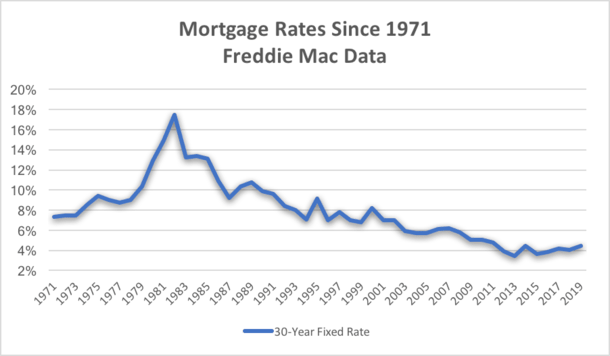
For housing, the main factors are 1) what the investment will yield (rent expectation) 2) what the investment costs (interest rates).
If any of these factors (rent, IR) changes, it will impact the price.
> Here's a graph of median personal income:
> And here's a graph of median house prices:
You are comparing CPI adjusted versus point in time dollars here...


Here's a graph of median personal income:
https://fred.stlouisfed.org/series/MEPAINUSA672N
And here's a graph of median house prices:
https://fred.stlouisfed.org/graph/fredgraph.png?id=MSPUS&nsh...
That is almost exactly an increase of 8X, compared to roughly 1.5X for personal income. Do you think an increase of 1.5X over forty years or so counts as "barely increased"?
Of course household income is higher because most households have two wage earners instead of one. But that's still around 3X to around 8X.
And the standard deviation for property prices has increased hugely.
This has nothing to do with supply and demand and everything to do with the difference between an unproductive rent seeking economy which sweats static assets - including the workforce - and a productive creative economy driven by innovation and invention.
For all the rhetoric, the current economy has a lot more of the former than the latter. And this is only good for a small number of incredibly rich individuals - at the expense (literally) of almost everyone else.