> Your reaction to Riven when approached in “gamer” mode will depend on whether you think this kind of intensive intellectual challenge is fun or not, as well as whether you have the excess intellectual and temporal bandwidth in your current life to go all-in on such a major undertaking.
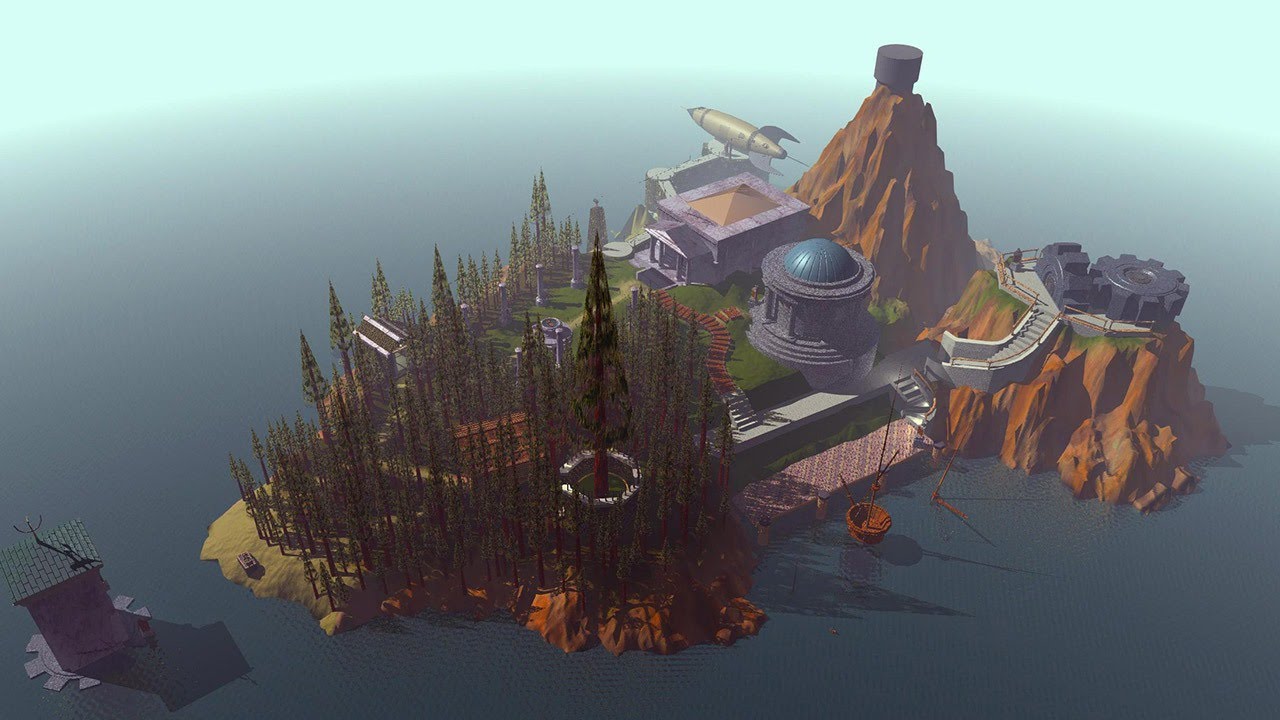
There's a period of time between the nineties and mid 2000s when ubiquitous and fast internet access wasn't easily accessible, and so games like Myst and Riven had the space and time to be digested and savoured. Now it seems this just isn't feasible anymore. There are of course games in the same category, e.g. Outer Wilds and The Witness, but these have much more concessions to the internet age
To me, both Outer Wilds and The Witness were absolutlely savourable, and I made a point of never looking up anything on the Internet while playing these games. That would rob me of the feelings these games were designed to impart.
Tunic is so good. Although I'm yet to complete it, I've gotten like 90% of the way I think after runs of 20-50%. Maybe I'll finally complete it this year because I adore the aesthetic, vibe and that little fox.
Definitely the game opens up and becomes more deep/mysterious than I thought it would get, super cool.
There's definitely games in this category and I do still think they work even in a digital age. It's a relatively niche microgenre though, and I think in a sense that is why it works.
Immortality and The Signifier are both solid games where most of the enjoyment is interpreting the world.
They aren't hypercard-esque puzzle games like Myst and Riven, but what they share in common is that the enjoyment of the game is figuring out the somewhat ambiguous world major beats occur in the negative space of what you are explicitly shown and told.
The former has sort of Lynchian undertones that slowly emerge over the course of the game, and the latter benefits from at least a cursory understanding of Freud and/or semiotics.
Any Daniel Mullins game, Noita and Animal Well are excellent high depth and intellectually stimulating puzzle games. I highly suggest them all if you're looking for a puzzle box to rip apart.
I love the environmental simulation and deep secrets in Noita but it's not quite like Riven. Riven had me filling out pages and pages of a journal with notes and drawings. Many of these notes and drawings were my observations ended up being extraneous details about the visual design and lore of the world, because in Riven it can be very difficult to parse what is and is not relevant to progressing in the game. It's a very unique experience, I love a lot of puzzle games with secrets and meta layers, and I love Outer Wild's knowledge based metroidvania design, but no other game has had me scouring and mulling on every detail of this virtual world like Riven.
I haven't played the latter, but The Witness avoids, as one example, a common problem in games like Riven or many other old adventure games. That is, The Witness understands that huge challenge is completely fine, so long as it's isolated to a specific virtual space, such as a given panel and room. Instead many old games give a strong sense that a solution may be found anywhere in the game so far, or anywhere on any random bitmapped area from a set of 10+ screens. I think the "concession" The Witness makes is to focus itself in order to ask the player to focus. I don't think it's possible to ask the player, like Riven does, to be comfortable living in the world for extended periods. Riven does so by unfocussing and spreading itself out over everything: anything might be interactable, anything might be a clue and important.
Today, people want progress, and if they are stuck, they want to know exactly where. The sense of anxiety created by totally open confusion is not acceptable. For me, personally, that's the moment I open a walkthrough: for example, the moment I feel like I missed something important and I have no idea where.
Totally open confusion is how I would describe Outer Wilds, long periods where I was lost and making no progress, and it was absolutely one of the most amazing games I’ve ever played.
Well first I think that Outer Wilds still does a great job at nudging the player in a direction and making them feel like they are doing important stuff, though sometimes this fails. Ironically I saw how much Jon Blow got lost and hated Outer Wilds. I think an aspect of making the player feel like they're doing something important and not just wasting their time is that for Outer Wilds the game world itself is so interesting and unique that it feels fine to be lost in it.
Riven is a series of paintings, Outer Wilds is a beautiful and serene real time fully simulated solar system. I think that is a concession the poster was referring to: Outer Wilds has to have a wow factor in order to make it okay to be lost and confused. If Outer Wilds was a series of static images, people would not persevere.
One huge benefit Outer Wilds has is that its fans are like "No! Don't watch this spoiler - Play the game" which is definitely the correct advice. If you're not sure, play the game.
I actually only played a few hours of Outer Wilds and decided to watch others (and particularly Thor) finish it instead because I'm bad at flying the ship and I found it too frustrating to die unsure whether I was bad at it or what I was attempting is impossible.
But I know I'm weird, I think the Penn & Teller things where they explain the trick are the best, clearly Penn himself doesn't agree because you won't see too much of that in their newer work. My favourite bit of Portal 2 was playing with commentary on just before "The Part Where He Kills You" where there's a frantic portal fling and in testing they realised it's not fun if the player accidentally flings the wrong portal. Like, sure, if you actually did that you die, but so what? So - if you hit the wrong button you get the correct portal anyway, as a special exception to the game's rules. So yeah, I'm weird, I like to understand how it works.
Outer Wilds (less so the DLC) has a lot of opportunity for you to completely misunderstand and I think it's actually overall nice that the game doesn't finish by insisting on correcting you. You can keep believing whatever it is, and maybe you eventually realise you were wrong or maybe not. Life's like that.
SPOILERS - Stop reading if you haven't played Outer Wilds and think you might
It's very possible to "win" Outer Wilds not understanding why the visitors died. Maybe you never visit the asteroid, maybe you don't understand what's happening there and never go inside, maybe you see what happened but never understand it. This is especially likely if you haven't noticed that they're clearly right in the middle of everything, they actually have just discovered the Sun Station doesn't work at the time!
If you understood why they died, it's even more possible to not see why Hearthians were spared. Video game protagonists are used to miracles that save them, but your whole species is here and yet other species were annihilated in seconds. Was it so long ago? Well, yes and no. It was a long time ago, but your ancestors were amphibians and like radiation the death is abated by water's density so that's why you're here.
It's also really possible to not "get" how the "Quantum" rules work. To "win" you don't need to actually go meet the last "living" alien although ideally you will, and so you don't need to grok the rules well enough to go there. So you can get to the "end" of the game without ever really knowing why the weird rocks move or that there's a coherent explanation for how and why they do that.
Ooh, edited to add the biggest I forgot - it's easy to not realise this game takes place at the End Of The Universe. The stars are dying! Unrealistically quickly, but that's what's happening. You aren't seeing more supernovas just as a hint (although it is a hint) or because of where this happens, but because everywhere the stars are dying.
To be fair to The Witness, I think it does spread itself out across its traversable space in a similar way. In both games, there's often a locked device or closed door or puzzle which you try to solve, but cannot. You explore other places on the island to discover the mechanism which allows you go back to that puzzle and complete it.
Riven manifests these discoveries as changes to world state stored in computer memory, whereas The Witness manifests them as an acquired skill residing in the player's brain.
I don't know if that's a concession so much as an evolved understanding of what is fun in an adventure game.
Pixel hunting and moon logic puzzles where you're more or less expected to brute force the puzzle and groan at the answer (e.g. the infamous monkey wrench); that shit was never fun. It ended up in games because the genre was still immature and game designers didn't know better.
Modern adventure games are much better at ensuring that the key is never far from the lock... for the simple reason that softlocking because you didn't pick up a single pixel that was an important rock 4 hours ago isn't fun, and neither is backtracking across the entire game to talk to the pigeon you missed because it only briefly flies past in the background once every 4 minutes.
> The Witness understands that huge challenge is completely fine, so long as it's isolated to a specific virtual space, such as a given panel and room
What about all of the puzzles that use the environment? There are all sorts of challenges that use the island/features. Really enjoyed that game. Good sense of progression and learning without teaching.
As I said in another comment, those are not necessary and really for people who feel compelled by them. I personally ignored them. You can’t ignore them in Riven
Technically you can skip to the end of the game in the opening scene, so I guess you can ignore all of it. Very weird credits!
I was trying to find all the answers. Afaik, you had some way of knowing how many puzzles were remaining? Eh, both great games. Myst and Riven definitely have more of the "if you can't solve this you're stuck" vibe, I'd agree.
If you haven’t played The Talos Principle 2 (which came out around 6 months ago), I highly recommend it. They put a ton of effort into it, and it shows.
Excellent comparison. I would consider those both Riven-Tier games in terms of awe and wonder. There are a few factors affecting emotional appeal, including phase in life, age, how much you're used to games, and your main point but...
I will say I had nearly as much of a good time with those two games as with Riven. For all three, I had this sinking feeling while playing "I will rarely find works as lovely as these in my life".
I recall the graphics of titles such as Myst and Donkey Kong Country were in itself newsworthy.
There was definitely something appealing in these lower-resolution rendered graphics for the way they hid the imperfections of computer graphics and conveyed more detail than was actually present. In a way our minds filled the gaps.
A good example of this are the trees in Myst in this image (https://i.ytimg.com/vi/E9ZtXtFXE84/maxresdefault.jpg). They're just textured cones with a central cylinder, but as composed they look far more richly detailed.
I've never played Riven nor Myst, because I just can't find a version or remake that wouldn't suck technically, but I just loved Quern, and one or two similar games I found since.
One that stood out to me is "Odyssey - The Story of Science", which is a Myst-like with focus on teaching basics of math and physics through its puzzles.
I've played Quern for several hours but couldn't bring myself to care as much about the puzzles or, more importantly, walking around the world.
It was not too bad, but my memory of Riven is so much stronger. Maybe I should replay it instead, just to walk through this beautiful world again, even without solving all the puzzles (the puzzles are IMO not why you play it). Riven evoked this constant feeling of wonder with the sounds and short cut-scenes adding a lot to the atmosphere.
There was this place where you walk down towards the water with a beast sitting there in the sun, and that scene almost has a smell to it. Or maybe my memory is colouring it all rosy now.
> because I just can't find a version or remake that wouldn't suck technically
the recent myst remake is probably the pinnacle of them... that said the original is well worth playing still and i've played it through a few times now.
I tried it, and it plays atrociously. Extremely inconsistent FPS, sound choppy and cutting off during movement as new assets are loaded, graphical glitches, just horrible. I refunded it pretty quickly.
I totally agree. The thing about Myst and Riven is that they really are full of the kinds of things that players will naturally try to circumvent by looking up solutions: non-obvious interactable objects, branching paths, easy to accidentally backtrack. Basically, full of ways to feel like you are wasting your time. The concessions that Outer Wilds and The Witness make are naturally related to this. Particularly with the latter, Jon Blow stated how much they changed the game to make it clear that the panels were the only thing that needed to be interacted with, and the game makes it very clear from the beginning that each panel can be approached independently. It's only with the game's environmental puzzles that this starts to devolve, but they are not necessary by any means. Outer Wilds also does a great job of making you feel like you are getting something significant from each time loop.
But I must agree with you, the ship has sailed with this kind of game. You can of course go back and enjoy it but you do so with the knowledge that you can be doing other things that feel as meaningful but without the feeling of frustration.
Another similar example are MMOs. When I was a kid, my dad and I were really into Star Wars Galaxies. Well, people made emulation projects to go back and play it, but it's just not the same for various reasons. I feel the same way with World of Warcraft. It is almost more stark than Riven, because you not only miss the word of mouth and lack of easy "cheating" aspects, but you also feel the distinct lack of open socialising in modern online gameplay.
A good example of the opposite would be old Nintendo games. Super Mario Bros 3 is still one of the best 2D Mario games of all time, and in no sense when playing it do you feel compelled towards a modern experience.
I had a similar experience when I bought an iOS remake of legend of Zelda three… Within an hour I found myself circling the border of the accessible area of the game looking for the door or NPC interaction I was missing. Absolutely Not fun. I chalked it up to gameplay of a bygone era and gave the rest a miss.
There's another thing about hyper-prevalent internet: there are wikis and guides documenting every detail, every nook and cranny, detailing every optimally min-maxed strategy. Exploration is dead.
It was one of the first PC titles ever to enjoy that sort of traction with non-gamers. I know a couple of people who actually bought a home PC just to play it on.
Whatever your opinions of the game, it definitely played an important role in opening up gaming to a wider audience. Myst is an important artifact in the history of gaming.
Now... were I not more restrained, I'd hope here that you step on the sourest of your grapes.


There's a period of time between the nineties and mid 2000s when ubiquitous and fast internet access wasn't easily accessible, and so games like Myst and Riven had the space and time to be digested and savoured. Now it seems this just isn't feasible anymore. There are of course games in the same category, e.g. Outer Wilds and The Witness, but these have much more concessions to the internet age