People are super religious about this but I've never been able to tell pre-shredded cheese from cheese I've shredded myself and I don't think anyone else can tell the difference in a blind taste test.
That's actually crazy to me. Like, a sealed, generic brand bag from the cold section of a chain grocery store vs a block purchased from the deli and shredded by hand? The difference is massive! Taste will vary between the two anyways but the texture difference is categorical. The pre shredded has grainy flour like stuff all over it, the manually shredded is completely smooth with no graininess at all. I can 1000% tell the difference in any kind of test you want to do.
Where are you buying cheese that this comparison isn't noticable?
Like...in what way? If I buy a block of Aldi's cheddar and Aldi's pre-shredded cheese it tastes the same once it's mixed into something - except the block saves me like 20p and wastes 10 minutes of my life on grating and cleaning up afterwards.
most of my pre-shreded cheese has no such grainy flour like stuff all over it... Harris Teeter, but Kroger before that... I think I can remember once getting a bag with some noticeable anti-caking agent... in my life.
I think you are generalizing from your own tastes.
Just because you don't notice something doesn't mean that others don't.
I started to notice this when I was hanging out with a very smart friend who worked as a restaurant cook. They just noticed heaps of stuff I didn't if we went out for a meal. I wasn't sure if it was training or natural ability.
Training is massive for our senses. I’ve been learning the piano lately and I’m starting to notice I’m getting more information from listening to music. It’s really weird - like, I’ll play an old piece I’ve listened to a thousand times. But now I can separate out the different parts of the song in my head now. It’s obvious - how could I not have heard it before?
I think foodies are like that. I knew one girl years ago from a foodie family. Anything she ate, she could list out all the ingredients and tell you how it was prepared. It was uncanny. I don’t think she had a special mouth. Just, she came from a family which bonds through cooking. Their family goes on hikes where everyone cooks a fancy gourmet meal one night for the camp. She’s been training her palate since she was a toddler. It shows. The difference is insane.
>I started to notice this when I was hanging out with a very smart friend who worked as a restaurant cook. They just noticed heaps of stuff I didn't if we went out for a meal.
Or they were being pretentious to try and impress you. I suspect even they can't tell if melted cheese within a dish started out pre-shredded or not.
Skill and pretentiousness are independent variables. Assuming that one is correlated with the other is a sign of poor judgement. I know people that fit would fit in each of the four quadrants {skillful-pretentious, unskilled-pretentious, skillful-humble, unskilled-humble}.
Anecdotally cooks are not usually pretentious - perhaps in your circles or in your city things are different? Personally I've got little time for pretentious people.
> I suspect even they can't tell if melted cheese within a dish started out pre-shredded or not.
You can deny the reality of other people all you like. A more open-minded scientific approach is to listen to other people's experiences. People have some weird skills. And they believe some weird things. But yeah, it is hard to truly judge the skills of others.
Just because you're ignorant of something, it doesn't mean that something isn't real, or that others can't perceive it.
And just because someone knowledgeable shows you something you hadn't noticed before (and then you start noticing it all the time), it doesn't mean it's just all in your head. Being discerning about things can be taught. (And sometimes knowing can be a curse!)
Sure, and I also doubt people's ability to tell the difference in a blind taste comparison. People claiming to do so visually see the anti-caking agent, they don't taste it. It doesn't taste grainy. You can taste a bit of corn starch or cellulose directly and tell that it doesn't taste 'grainy' or even have much of a flavor at all.
The point of the anti-caking agent is to prevent the cheese from sticking to itself, which inherently affects the texture of the cheese in your mouth... it doesn't stick to itself the same way freshly shredded cheese does, particularly if the cheese is soft and sticky like processed american cheeses. Although it is likely less noticeable for dryer and harder cheeses.
>The point of the anti-caking agent is to prevent the cheese from sticking to itself, which inherently affects the texture of the cheese in your mouth
It does so by keeping the cheese 'dryer' than it normally would be. Putting it in your mouth basically undoes that. You're only going to notice if you're eating it by the handful, not when you're using it in actual food dishes.
You seem very certain that you know how my mouth works. I promise you, you don’t.
I’m a super taster. I did a test when I was 20. You take a macro photo of your tongue and count the taste buds in a 1cm square spot. From what I read at the time, the average person has 25 taste buds per sq cm. I have 40. Some people have as few as 10. Imagine how different food must taste to all of us!
And flavours don’t just “scale up”. Some flavours are way too strong for me - like, spinach is super strong. If spinach is on pizza, all I taste is spinach. I can’t taste anything else and I may as well be eating a salad. I can’t eat dark chocolate - it tastes like a punch in the mouth with wood ash. And I’ve never been able to drink coffee.
One of my all time favorite meals is plain pasta with butter and grated Parmesan. So simple. So yummy. But pre shredded cheese doesn’t melt the same way on pasta - and the difference is obvious to my mouth. Shredded Parmesan cheese has a much weaker cheese taste - even from the same brand. And the texture is all wrong.
Maybe your mouth can’t tell the difference. But don’t claim to know how my mouth works. I suspect if we could trade mouths for the day, we’d both be shocked.
I wonder if there's a confounding factor here, because that's precisely where I tend to notice it the most. The anticaking agent lends a grainyness to an otherwise smooth foodstuff.
Are you thinking more of a cheese sauce, or cheese that gets melted into e.g. a burrito?
My family eats a lot of shredded cheese, pre and home shredded, I've never noticed in anything melted nor in anything where it's only half melted like tacos. Any graininess that might be present would be far offset by the other ingredients, but honestly I've never tasted any graininess. The anticaking stuff isn't even grainy, so why would the resulting cheese be grainy? You can lick a piece of pre-shredded cheese and the anticaking stuff flavorlessly dissolves in your mouth. I honestly believe most of this "graininess" is imagined after people read about it on the internet or hear about it from cooking shows. People have convinced themselves that cellulose = wood (notice it's mentioned in this thread several times) and somehow lose the ability to critically think about it. While cellulose is an anticaking agent, I don't think I've ever seen it used for cheese. Typically you see cheese using a modified corn starch. The anti-caking agent can cause some issues if you're making cheese sauces specifically, but generally if you're making a cheese sauce you're mixing in other ingredients and then dumping it over macaroni or potatoes or something anyway and it won't matter.
> > While cellulose is an anticaking agent, I don't think I've ever seen it used for cheese.
> parmesan is pretty much the only one i ever see with cellulose
Can you stop, please? You keep contradicting yourself, and I don't really see the purpose in repeating, over and over, the assertion that because you can't perceive a difference in something, no one else can either. That's pretty arrogant, and ignores, well, basically everything about how humans work.
These subtheads here are just noise, and are distracting me from the rest of the interesting conversation.
I was taught to use a little cornstarch sprinkled over freshly grated cheese, and to me it is undetectable (served hot or cold) and works amazingly well. The shreds never clump together and are easy to scatter evenly.
I dont know if I can tell on taste but the difference in mouth feel is huge. The shredded version has wood dust on it to keep it from sticking and you can definitely feel it against the cheese in the mouth vs much more smooth/liable to clump together hand shredded off the block cheese.
>People are super religious about this but I've never been able to tell pre-shredded cheese from cheese I've shredded myself and I don't think anyone else can tell the difference in a blind taste test.
This. In actual dish, I doubt most could taste any difference. You only really notice when it's not melted fully or not melted at all.
Pre-shredded cheese is much, much dryer than cheese you grate yourself. Unless the only cheese you ever eat is already dry, like a parmesan, it should be trivial to notice the difference.
Perhaps the best example is parmesan. You should buy a small brick and shred it, then compare to the Kraft tube we all know -- the difference is massive.
I've had both and I'm going to have to disagree with you here. For the other cheeses, buying a brick is always the right choice. For parmesan, if its going on pasta I'm picking the green plastic tube of presumably mostly filler 100% of the time. Brick parm lacks the proper texture and has too strong of a flavor. Green tube mystery powder I can pour onto my pasta in mounds that then absord the butter making a soft delicious wet sand. Sometimes if I'm looking for a snack I just pour the green tube mystery powder directly into my mouth.
This, I think, is a case of Different Thing Same Name.
The same way that coffee runs the gamut between the gnarliest of instant coffees to 3rd wave single-origin craft brews. Almost every step of the production chain is different, and while they're all technically coffee, they're basically different products, that get enjoyed in different contexts. Weirdly, I enjoy a 80s style black coffee when I'm at the greasy spoon around the corner - it just feels right.
Your Green Tube Mystery Powder is a product sold under a name that is probably technically correct (Parmesan) but the "real thing" is a product that behaves completely differently and doesn't meet your wants or needs.
Huh, that's funny. I love the flavor and texture of parm from a brick. I am usually far too lazy to grate my own though, and do use the pre-grated stuff often. But on the occasion where I do grate my own, or am in a restaurant where it's done for me, I resolve to grate it myself more often.
This is all just a matter of taste, though. Sounds like maybe you grew up with the green tube mystery powder, and developed a liking for it, and that's "parm" for you. You never developed a taste for the "real" stuff, and that's fine! We all like what we like, and no one should tell us that we're liking it wrong. (I, too, grew up with the green tube mystery powder, but my tastes changed. It happens.)
> Sometimes if I'm looking for a snack I just pour the green tube mystery powder directly into my mouth.
This made me chuckle; I used to do the same thing when I was a kid (despite the disapproving look from my mother). I've tried it as an adult though, and now I don't like it (not quite "gross", but not something I enjoy).
> Brick parm lacks the proper texture and has too strong of a flavor.
That's exactly why I use Parmesan from a block of cheese. It has so much more flavor, and I find that far superior. That doesn't make you wrong, of course... taste is subjective. Just thought it was funny that we have opposite views on the stronger flavor.
I'll buy parm wedges if I'm making a sauce or salad dressing, but where/when I grew up, you weren't living unless you dumped at least a half cup of Green Tube Mystery Powder on top of your plate of spaghetti.
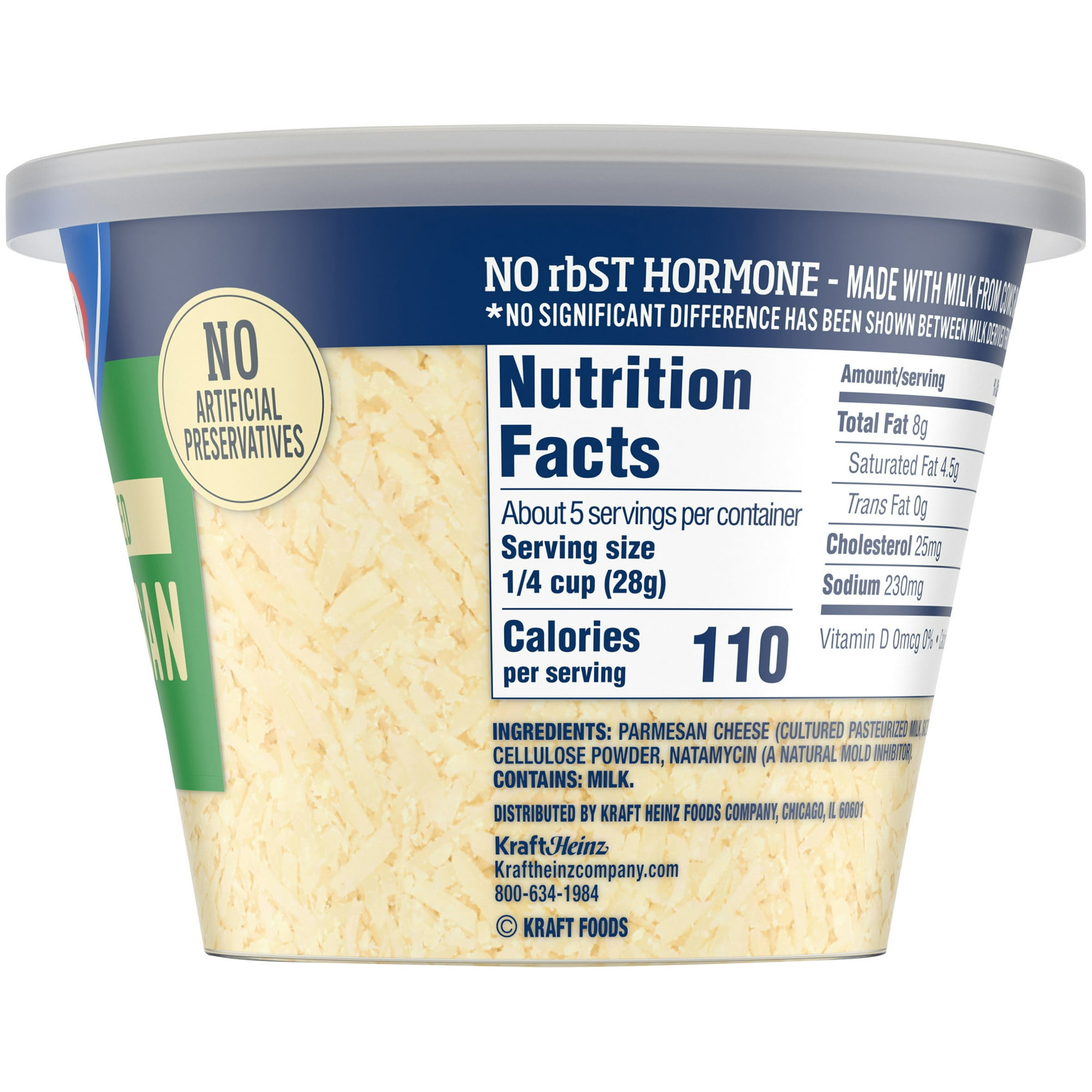
Kraft brand Parmesan has cellulose in it too I don't think many people read the ingredients. It's funny more than anything.
I started buying real block of Parmesan cheese and it's certainly different more sour. The crystals closes to the rind are where the flavour is. Kraft may not even be Parmesan US laws allow other types of cheaper cheese and lots of cellulose sometimes 40%. edit: I should note the crystals theory is from a Parmesan factory documentary. Is it true? They seem to believe it is.
I think it's to the point now where Kraft and real Parmesan are close to the same price especially if you factor in less cellulose in the real stuff.
The cellulose isn't there as filler, it's to prevent clumping. You need it.
And the finer the cheese is grated, the more surface area, so the more cellulose you need.
It's not optional.
(Also no idea what crystals you're talking about, but you don't eat the rind. You can save it to add flavor to soups though, taking it back out at the end. That's just more about not wasting it since it's inedible though.)
Sure, but that's more to do with the quality of the Parmesan to begin with. Not the shredding.
If you want a proper comparison, use a consistent cheddar or mozzarella from the same brand. When preshredded it tends to be drier, but melted there's little difference.
I find the pre-packaged parmesan and a block of imported cheese are fundamentally different products and not really interchangeable. They both work well in their own way and I will enjoy them depending on what I feel like eating.
Is that Kraft parmesan even cheese? It seems like mostly filler, it barely tastes like anything.
Not sure that's necessarily a fair test if people are otherwise talking about shredded cheese that at least you can see what the bulk material is and that it vaguely resembles cheese.
taste is subjective, so I won't argue that point (although I do disagree with it), however if you're going to melt the cheese, it's very easy to tell the difference side by side.


:max_bytes(150000):strip_icc():format(webp)/Health-GettyImages-539802384-072b1d2d29c74caa850d2eb1500b094c.jpg)